It’s Follow-Up Friday: Crosswordnado edition!

Welcome to Follow-Up Friday!

By this time, you know the drill. Follow-Up Friday is a chance for us to revisit the subjects of previous posts and bring the PuzzleNation audience up to speed on all things puzzly.

And today, I’m posting solutions to our Sharknado and Crosswordese puzzles from the last two weeks!

Two Follow-Up Fridays ago, I posted a deduction puzzle in honor of Sharknado 3 rampaging its way across TV screens all over the world, and I challenged you to complete the schedule of mayhem wrought by our five heroes with five different weapons across five different cities on five different days! (Whew!)

How did you do?

And that brings us to our second solution. Last week, we discussed crosswordese — those words that only seem to appear in crosswords, to the dismay and bafflement of casual solvers — and I created a 9×9 grid loaded with crosswordese.

Did you conquer the challenge?

ACROSS

1. Toward shelter, to salty types — ALEE
3. Arrow poison OR how a child might describe their belly button in writing — INEE
5. Flightless bird OR Zeus’s mother — RHEA
6. Hireling or slave — ESNE
8. “Kentucky Jones” actor OR response akin to “Duh” — DER
9. Compass dir. OR inhabitant’s suffix — ESE
12. Wide-shoe width OR sound of an excited squeal — EEE
15. No longer working, for short OR soak flax or hemp — RET
16. Like a feeble old woman OR anagram of a UFO pilot — ANILE
17. Actress Balin OR Pig ____ poke — INA

DOWN

1. Mean alternate spelling for an eagle’s nest — AYRIE
2. Old-timey exclamation — EGAD
3. Unnecessarily obscure French river or part of the Rhone-Alpes region — ISERE
4. Supplement OR misspelling of a popular cat from a FOX Saturday morning cartoon — EKE
7. Maui goose — NENE
10. An abbreviated adjective covering school K through 12 OR how you might greet a Chicago railway — ELHI
11. My least favorite example of crosswordese OR good and mad — IRED
12. Ornamental needlecase — ETUI
13. Movie feline OR “Frozen” character — ELSA
14. Shooting marble OR abbreviation for this missing phrase: “truth, justice, and ____” — TAW

I hope you enjoyed both of these challenging puzzles! If you haven’t had your fill of crafty puzzlers, worry not! We’ll be tackling another tough brain teaser in two weeks!

Thanks for visiting PuzzleNation Blog today! You can share your pictures with us on Instagram, friend us on Facebook, check us out on TwitterPinterest, and Tumblr, and be sure to check out the growing library of PuzzleNation apps and games!

It takes two to puzzle…

I’m always on the lookout for new and different puzzle styles to discuss here, because there’s a seemingly endless supply of puzzly inventiveness in the world, and I endeavor to share as much of it as possible with my fellow PuzzleNationers.

A few days ago, I was reminded of a brain teaser variation that’s a little different from our usual fare, and I thought I’d put it in the spotlight.

Today, we’re talking about guided lateral thinking puzzles!

Let me start you off with a standard lateral thinking puzzle (which is a fancy way of saying “brain teaser”). This one is an all-time favorite of mine:

A man is found murdered on the floor with 53 bicycles scattered around the room. How did he die?

Now, this may sound like a particularly violent end at a local bike shop, but the lateral thinkers and brain teaser proficient types out there have probably already sussed out the true answer.

The man cheated at cards and was killed for it. Bicycle is a famous brand of playing cards, and with 52 cards in your standard deck, 53 implies cheating.

That’s a pretty simple one.

The difference between regular brain teasers like that one and guided lateral thinking puzzles is that a guided lateral thinking puzzle requires two people: one to ask questions in the hopes of solving it, and the other to know the solution and answer the other player’s questions with only yes or no responses.

The scenarios are often more involved than your usual brain teaser, but you’re only given a brief story to start with. These are not rigid brain teasers like the seesaw one we tackled earlier this year. These puzzles depend on your ability to narrow down the possibilities with strategically worded questions.

Here’s an example of a guided lateral thinking puzzle:

Ann, Ben, and Chris are siblings who were conceived on the same day. This year, Ann will be attending third grade while Ben and Chris attend kindergarten. Why?

While you could try to come up with a solution with just this information, guided lateral thinking puzzles encourage you to talk through your suspicions as you ask questions and uncover the truth.

So, what would you ask? What’s your starting theory? (My first instinct was to go straight to imagining how Leap Day was involved, before quickly realizing that was a ridiculous supposition.)

But maybe you have a better theory. Were they conceived by different people? Was it the same day, but different years?

Posing these questions to your partner in puzzly crime could help you find the answer.

The folks at I09 posted a link to six guided lateral thinking puzzles (including the Ann/Ben/Chris one I mentioned above). Give it a listen and try cracking these puzzles alongside the podcasters!

And let me know how you did! Did you solve any of them right away? Did any of them thoroughly stump you? And would you like to see more puzzles like this on PuzzleNation Blog in the future?

Thanks for visiting PuzzleNation Blog today! You can share your pictures with us on Instagram, friend us on Facebook, check us out on TwitterPinterest, and Tumblr, and be sure to check out the growing library of PuzzleNation apps and games!

The art (and science) of optical illusions

Visual trickery plays an important role in puzzles. It can be the clever rebus that challenges you to find the words each image represents, or a visual brain teaser that forces you to think outside the box.

But nowhere in the realm of puzzles is visual trickery more obvious or more disconcerting than in optical illusions. Some are simple, like the famous old woman/young woman image above (or this hilarious video version). But others are not only more complex, they’re absolutely mind-bending.

And if we’re talking mind-bending optical illusions, at some point, you have to mention the work of Akiyoshi Kitaoka.

[Akiyoshi Kitaoka’s “A Bulge,” featuring nothing but squares.]

Dr. Kitaoka is a professor of psychology at Ritsumeikan University in Kyoto, Japan, and he has extensively studied biology and psychology. He has quickly emerged as a modern master of optical illusions, utilizing not only shapes and color gradients to trick the eye, but also to simulate motion in a static image!

Two of the techniques frequently cited in his work with illusions are perceptual transparency and visual completion. Both rely heavily on how our brain and eye process the incredible amount of information we perceive every second of every day.

This is probably the most famous example of a visual completion illusion:

Basically, our brain employs mental shortcuts in order to simplify the information. For instance, visual completion (also known as filling-in) occurs when information unavailable to the eye is assumed to be there and mentally added by the brain.

Perceptual transparency, on the other hand, involves how we can perceive one surface behind another.

Check out this amazing photo from a published paper on perceptual transparency, entitled Zen Mountains:

[The mountains in the background look transparent,
even appearing to overlap each other in impossible ways.]

Dr. Kitaoka’s illusions utilize visual shortcuts and processes such like these, but his most famous creations involve a perceptual technique known as the Fraser-Wilcox Illusion, which involves using lighter and darker gradients of black and white in order to trick the eye into perceiving motion. Essentially, moving from dark to light gradually creates the illusion of motion.

Kitaoka’s work, however, maximizes this effect by employing contrasting color schemes in order to challenge the eye further.

Feast your eyes upon “Rotating Snakes,” Kitaoka’s most diabolical optical illusion:

[For the full effect, click the image and
scroll down for a full-screen version!]

By employing color as well, the rotation illusion is even more striking. In all honesty, I can’t look at it too long or my stomach starts to feel a little off-kilter!

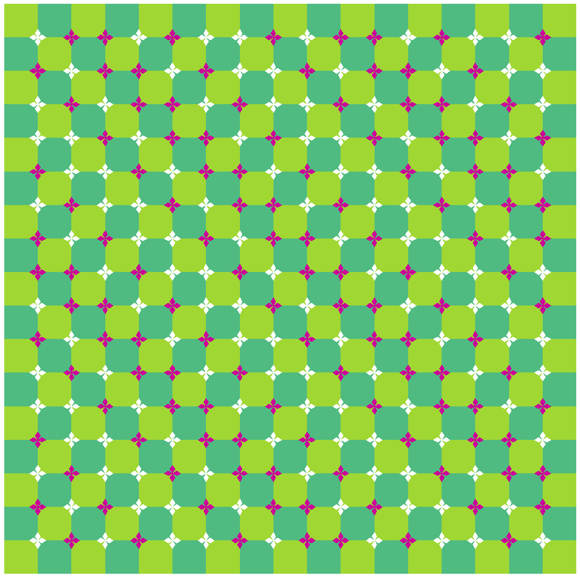
Similarly, Kitaoka tricks the eye into perceiving waves rolling diagonally over this quilt-like sheet in “Primrose’s Field:”

As we understand more about the eye and how it perceives the visual stimuli it receives, as well as more about the brain and how it processes information, I suspect we’ll be able to craft even more convincing, mind-blowing, and unnerving examples of visual sleight of hand.

And undoubtedly, Akiyoshi Kitaoka will be leading the way.


Many thanks to Dr. Kitaoka for granting permission for me to feature three of his illusions in this post. You can check out more of his amazing work on his website, as well as some of his books on Amazon here!

Thanks for visiting PuzzleNation Blog today! You can share your pictures with us on Instagram, friend us on Facebook, check us out on TwitterPinterest, and Tumblr, and be sure to check out the growing library of PuzzleNation apps and games!

The Perils of Puzzling: Alternate solutions!

[Thinking hard. Image courtesy of popsci.com]

The science, fantasy, and science fiction website io9 has a marvelous weekly feature run by Robbie Gonzalez, wherein they tackle brain teasers and riddles both new and old. I’ve explored several of them here on PuzzleNation Blog, most notably the 100 Men in Hats puzzle, which expanded on the Men in Hats puzzle concept from one of our earliest posts.

But one of their latest riddles provided a valuable example of how crucial test-solving and crowd-sourcing can be to a puzzle’s success.

The idea was simple enough: look at the numbers below, and determine what number should take the place of the question mark. The only guideline? The answer was NOT six.

I posted this riddle on our Facebook page on Monday and shared it with fellow editors at the PuzzleNation office, and got all sorts of answers in return.

One solver came up with 5 as the answer, positing that the vertical numbers formed fractions. So, with 1/2 and then 3/4 as the next number, the pattern would be adding 1/4. Adding 1/4 to 3/4 equals 1, and 5/5 equals 1.

There were other solutions that also yielded 5 as an answer, like doing what my friend called a zigzag equation, adding 1 from the top to 4 from the bottom to get 5 on the top as the answer, and then reversing it by adding 2 from the bottom to 3 from the top, getting 5 on the bottom as the missing answer.

A second solver came up with 3 as the answer, adding the top row to equal 9, and then trying to do the same with the bottom row.

Another solver saw them as two separate patterns, where going from 1 to 3 involved adding 2 and going from 2 to 4 involved multiplying by two. Therefore, by this method, the answer is 8. (Yet another solver did the same, except they squared the numbers along the bottom row, leading to 16 as the answer.)

As you can see, there were all sorts of mathematical solutions. When you’re told to ignore the most obvious solution, your mind can create some truly innovative ways of reimagining the information available.

[A head full of numbers. Image courtesy of equip.org]

Several solvers thought outside the box and came up with R, relating the numbers by their positions on a gearshift knob instead of mathematically.

As it turns out, this was the solution the puzzle’s creator initially intended, only realizing later that the puzzle had many possible solutions.

In his own words: The riddle was too open-ended. Whether you interpreted it as a mathematical puzzle, or an automotive design puzzle, it was poorly posed, and that’s on me. Puzzle-posing is an art in and of itself, and it’s easy to mess up. For a solution to be satisfying, the person posing the puzzle needs to provide enough information that the puzzle is unambiguously solvable, but not so much that it gives too much away.

[A proposed layout that points more directly toward the creator’s intended solution.]

Now, as a puzzler myself, I can absolutely empathize with Mr. Gonzalez here. There are plenty of times I’ve created a puzzle or a brain teaser and assumed that everyone would follow the same path I envisioned, considering the solution if not obvious, then at least reproduceable.

But solvers can always surprise you by finding alternate routes to the answer or utilizing a different way of thinking that ends with a second, but still valid solution.

So after a few stumbles and missteps of my own in the past that were similar to the one in today’s puzzle, I now make sure to have another set of eyes on my brain teasers, either during the creation process or as a test-solver afterward.

A second set of eyes can be absolutely invaluable in helping you spot possible alternate solutions.

Thanks for visiting PuzzleNation Blog today! You can share your pictures with us on Instagram, friend us on Facebook, check us out on TwitterPinterest, and Tumblr, and be sure to check out the growing library of PuzzleNation apps and games!

Music strikes a chord with puzzlers?

Are you baffled by a brain teaser, confused by a crossword clue, or positively puzzled by a ridiculous riddle? Maybe take a break and listen to some music!

For years now, parents have heard about — and been touting — the benefits playing classical music has on children from a very early age, even the womb. Heck, there’s an entire industry built around creating “little Einsteins” with music and other supposedly cognitive toys and products.

Now, the idea that making your babies listen to classical music in the womb will turn them into tiny prodigies has been pretty thoroughly debunked. There is no magic one-way ticket to Genius Town.

But there is verifiable data on the favorable effects music can elicit from an early age. Only it usually has more to do with playing music than listening to it. Children who are given music lessons often achieve greater heights in other subjects, including math and sports.

[Picture courtesy of Boston.com and Thinkspace.]

But, as it turns out, both adults and children have performed better on tests, puzzles, and problem-solving exercises when music is involved.

A study was conducted in 1993, wherein people were given one of three possible options to listen to: ten minutes of Mozart, a relaxation tape, or silence. Then each group was asked to complete a visualization exercise known as the Paper-Folding and Cutting task.

They had to imagine a piece of paper was folded several times and then cut along certain corners. Then they had to correct identify the jagged shape the paper would make once unfolded. (As Zoe Cormier of Guerilla Science puts it, “a bit like making paper snowflakes.”)

As you might expect, the people who listened to Mozart did better than the other two groups. This positive influence was dubbed “the Mozart effect.”

But guess what? More recent studies have determined that those benefits aren’t exclusive to Mozart, or even classical music. You can get the same positive uptick in results with any kind of music, as long as it’s music your test subjects enjoy.

Now this is a far cry from the idea that listening to music as a child will guarantee you become a master puzzle solver in the future. But there’s clearly something here, perhaps simply a curious crossroads of music and puzzling where one benefits the other, no matter how old you are.

So, next time you’re stumped by a puzzle, listen to some music and take another crack at it. You may be surprised by the results.

Thanks for visiting PuzzleNation Blog today! You can share your pictures with us on Instagram, friend us on Facebook, check us out on TwitterPinterest, and Tumblr, and be sure to check out the growing library of PuzzleNation apps and games!

Puzzles in Pop Culture: The Big Bang Theory

Puzzles in Pop Culture is all about chronicling those moments in TV, film, literature, art, and elsewhere in which puzzles play a key role. In previous installments, we’ve tackled everything from The West Wing, The Simpsons, and M*A*S*H, to MacGyver, Gilmore Girls, and various incarnations of Sherlock Holmes.

And in today’s edition, we’re delving into the world of The Big Bang Theory, CBS’s runaway hit about four nerdy scientists — Leonard, Sheldon, Howard, and Raj — bumbling their way through social interactions of all sorts.

Although the show covers all sorts of activities often deemed “nerdy” — roleplaying games like Dungeons & Dragons, The Lord of the Rings, comic books, cosplay, conventions, obsessive fandom, etc. — they rarely play puzzles. Usually, the closest they get are board games and card games, whether real ones like 3-D chess or fictional ones like Mystic Warlords of Ka’a.

But in episode 3 of season 7, The Scavenger Vortex, the boys and their girlfriends embarked on one of my favorite puzzly pursuits: the scavenger hunt.

Here, hunt organizer Raj lays down the rules with plenty of style:

The teams end up being the odd couples of Leonard and Bernadette (Howard’s girlfriend), Sheldon and Penny (Leonard’s girlfriend), and Howard and Amy (Sheldon’s girlfriend), allowing some new pairings for the writers to have fun with.

For instance, we’re treated to this exchange between Howard and Amy, where Amy references her unpopularity growing up:

Howard Wolowitz: Wow, you’re really good at puzzles.
Amy Farrah Fowler: I did them all the time as a kid. As my mom used to say: when you’re doing a puzzle, it’s like having a thousand friends. She was full of fun lies like that.

The game starts with a jigsaw puzzle, which quickly reveals the location of the next clue: the comic book store. (Although Sheldon forces Penny to wait while he completes the entire puzzle.)

When the competitors arrive at the comic book store, a cardboard cutout of the Riddler holds their next clue.

Riddle me this:
Arrah, Arrah, and gather ’round,
this hero is legion-bound,
He multiplies N by the number of He,
and in this room the thing you’ll see.

Sheldon instantly solves the riddle, followed by Howard and Amy, then finally by Bernadette and Leonard, highlighting how well the three teams are working together. (Either Sheldon or Penny takes the lead, depending on the task, while Howard and Amy collaborate well, and overcompetitive Bernadette basically yells at Leonard the entire time.)

Arriving at the geology lab at the university, Penny and Sheldon reveal the next puzzle: To continue on your quest, leave no stone unturned.

While they turn over various rock samples in the lab, Sheldon explains how he solved the riddle.

Arrah pointed to Jan Arrah, a member of the DC Comics superhero team The Legion of Super-Heroes, who goes by the name Element Lad. This pointed Sheldon to the Periodic Table of Elements, where he multiplied the atomic number of N, Nitrogen (7) by the atomic number of He, Helium (2), getting 14, the atomic number of Silica, which pointed him to either the geology lab or the chemistry lab.

And the final line of the riddle — “and in this room, the thing you’ll see” — pointed toward the Marvel superhero The Thing, who is made entirely of rock.

As Sheldon is showing off his impressive riddle-cracking skills, underdog Penny actually solves the current puzzle, realizing that “no stone unturned” didn’t mean the samples in the lab. It meant the Rolling Stones poster hung on the door, which she lifts to reveal map coordinates.

This sends them to a bowling alley, and then to the disused elevator shaft in Leonard, Sheldon, and Penny’s apartment building. A montage mentions further puzzles at the planetarium and the tar pits (and plans to attend a Neil Diamond concert for new chums Howard and Amy), before ending up in the laundry room at Leonard, Sheldon, and Penny’s apartment building.

Three bags of laundry await the players, and they quickly realize each bag contains only pants, except for a single shirt of Sheldon’s. A shirt with a spot on it.

Fans of the show, of course, know where their final destination — and the coin — awaits them. But when they tear apart the couch, there’s no coin.

In the end, we discover the final clue was a red herring, and Raj had slipped gold coins into everyone’s pockets earlier in the day. (Which is some pretty impressive sleight-of-hand, I must say.)

And although Raj’s big lesson — it’s getting together and playing that’s important, not the prize at the end — is lost on his fellow castmates, it really does encapsulate the best in group puzzling and gaming… the experience.

Maybe The Big Bang Theory gets puzzles after all.


Thanks for visiting PuzzleNation Blog today! You can share your pictures with us on Instagram, friend us on Facebook, check us out on TwitterPinterest, and Tumblr, and be sure to check out the growing library of PuzzleNation apps and games!