The Conundrum of Computers, Crosswords, and AI

Image courtesy of ESLTower.

AI continues to encroach on nearly every aspect of our lives, online or otherwise, and crosswords are not immune to this effect.

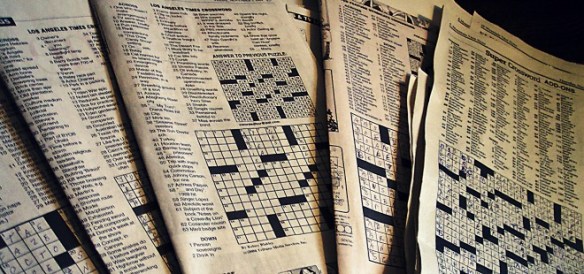
Actually, crosswords and computers have walked hand-in-hand for a long time.

Some companies use computer programs to generate their unthemed crosswords, no human intervention necessary. Computer programs like Crossword Compiler aid constructors in puzzle design and grid fill, allowing them to build and cultivate databases of words with which to complete their grids.
And computers are getting better at solving puzzles as well. Years ago, I wrote about a program that taught itself to solve Rubik’s Cubes.

Matt Ginsberg’s ever-evolving crossword-solving program Dr. Fill won the American Crossword Puzzle Tournament in 2021 — although the top prize still went to a flesh-and-blood solver — a first-time occurrence which garnered a lot of media attention:

The first computer to win the event, Dr. Fill completed most puzzles in well under a minute and only made three mistakes, edging out its top human competitor by 15 points.

To be fair, several constructors responded by vowing to make a crossword for the following year’s tournament that would thwart any computer. And I respect such inspired declarations immensely.

(I’ll have to do more research and find out if any of them succeeded!)

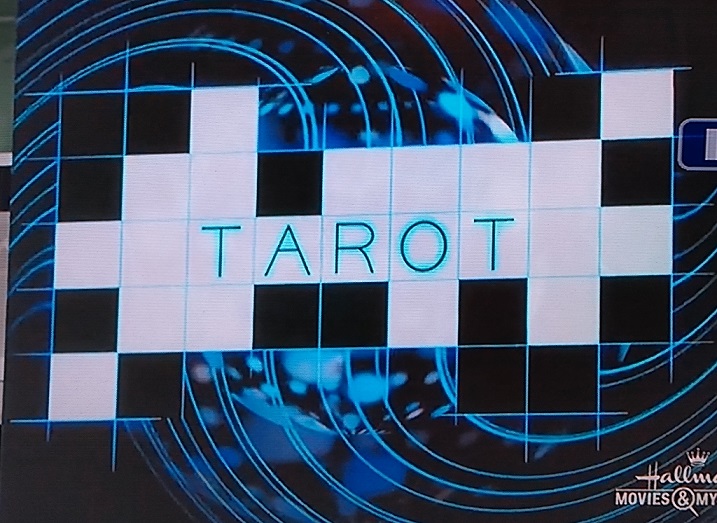
Really, we shouldn’t be surprised. They wrote an entire Crossword Mysteries movie on the Hallmark Channel about a crossword-clue-solving AI (and the people who would kill for the technology).
But I digress.

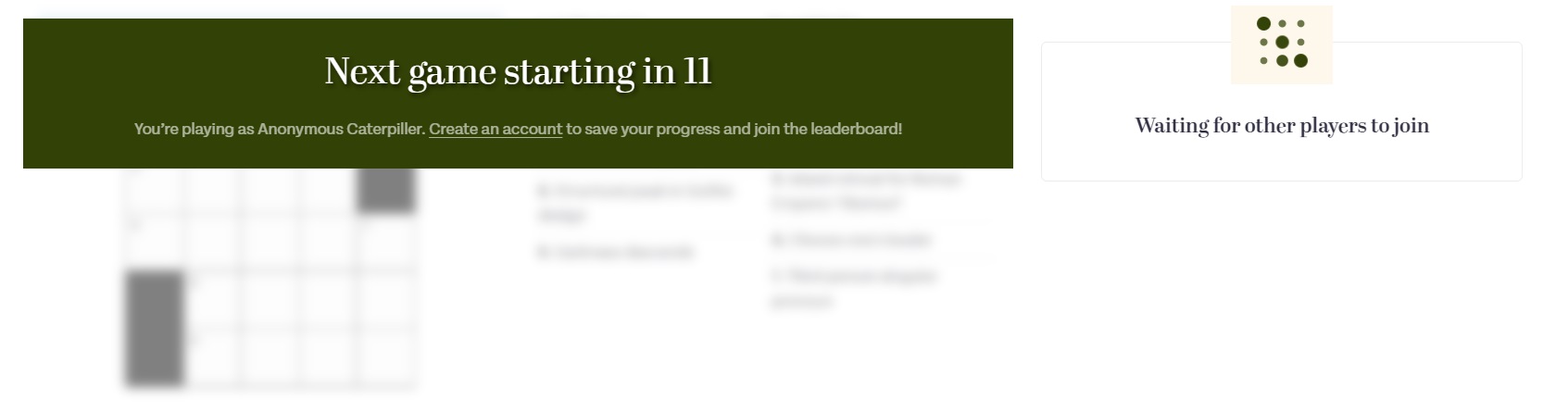
I have AI on the brain today because I just checked out an AI-fueled competitive mini-crossword arena, and I have mixed feelings about it.

It’s called Crossword Race, and it uses AI to generate 5×5 mini-crosswords, clue them, and load them up for solvers to complete in as fast a time as possible.

Yes, the cluing is very bland and overly technical (feeling more like oddly-worded dictionary definitions), but there seems to be a genuine desire to build and serve a puzzle-solving community.
And I can see the value.

If you’re a puzzler trying to get better at solving — especially if you have friends posting their mini-crossword results on the daily — this is a safe space to practice your solving, your grid navigation, and shake off the nerves that come with any timed competitive endeavor. (You can create a profile to track your stats or play anonymously.)

But I’m also a writer, a puzzler, a content creator, and such push-button “creativity” gives me the ick. Beyond the soullessness that comes with so many AI creations that lack the heart and inspiration of human touch, there are already too many computer-generated crosswords these days with crap clues, poor fill, and frustrating Naticks/crossings that would stump the average solver.

I looked at a puzzle book from one of these companies a few years ago. I mean, it was almost impressive that one computer-generated puzzle managed to cram FIFTEEN abbreviations into a 13×13 grid, often crossing or piled together in corners. It was an abysmal solving experience.

Now, abysmal is not a fair word to use when discussing Crossword Race’s grids. Let me be fair here. I don’t like the cluing, but the grids are reliably filled with beginner-appropriate vocabulary.

And I want PuzzCulture to be a place where we discuss what’s going on in the world of puzzles. That includes AI.

So it’s up to you, fellow puzzlers, if you decide to use Crossword Race or not, or if Crossword Race is a net good for puzzlers worldwide. Time will tell, I suppose.

In the meantime, I wish you happy puzzling, folks! And remember to support your friendly neighborhood cruciverbalist! Sign up for a Patreon, buy a puzzle book, attend a crossword tournament, every little bit helps!

Computer Program Teaches Itself to Solve Rubik’s Cubes!

I tried to warn you, fellow puzzlers.

I wrote posts about computer programs that play chess, Scrabble, Go, Atari games, and Jeopardy! I wrote posts about programs that solve crosswords. I even wrote posts about robots that solve Rubik’s Cubes in a fraction of a second.

And they’re getting smarter.

Say hello to DeepCube, an AI program that is now the equal of any master Rubik’s Cube solver in the world at solving 3x3x3 cubes.

And unlike other AI programs that have learned to play games like chess and Go through reinforcement learning — determining if particular moves are bad or good — DeepCube taught itself to play by analyzing each move, comparing it to a completed cube, and reverse-engineering how to get to that move.

It’s labor-intensive, yes, but it also requires no human intervention and no previous information. Chess-playing programs like Deep Blue work by analyzing thousands of previously played games. But DeepCube had no previous history to build on.

It started from scratch. By itself.

And became a Rubik’s Cube master.

In only 44 hours.

Compare that to the 10,000 hours it supposedly takes for a human to become an expert in anything, and that’s a mind-blowing accomplishment.

[Image courtesy of YouTube.]

From the Gizmodo article on DeepCube:

The system discovered “a notable amount of Rubik’s Cube knowledge during its training process,” write the researchers, including a strategy used by advanced speedcubers, namely a technique in which the corner and edge cubelets are matched together before they’re placed into their correct location.

Yes, the program even independently recreated techniques designed by human speed-solvers to crack the cubes faster.

The next goal for the DeepCube program is to pit it against 4x4x4 cubes, which are obviously more complex. But supposedly, deposing human puzzle solvers as the top dogs on the planet isn’t the finish line.

No, this sort of three-dimensional puzzle-solving is only an intermediate goal, with the ultimate endgame of predicting protein shapes, analyzing DNA, building better robots, and other advanced projects.

But first, they’re coming for our puzzles.


Thanks for visiting PuzzleNation Blog today! Be sure to sign up for our newsletter to stay up-to-date on everything PuzzleNation!

You can also share your pictures with us on Instagram, friend us on Facebook, check us out on TwitterPinterest, and Tumblr, and explore the always-expanding library of PuzzleNation apps and games on our website!

The Voynich Manuscript: Finally Cracked?

[Image courtesy of BBC.com.]

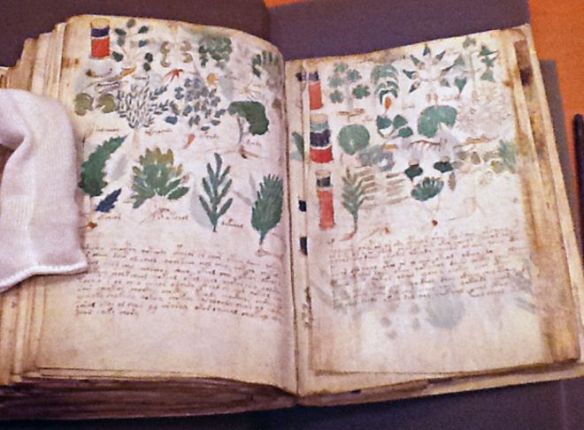
A year and a half ago, I introduced my fellow puzzlers and PuzzleNationers to the Voynich Manuscript, a cryptologic curiosity unlike anything else we’ve seen before. Discovered over a hundred years ago but believed to date back to the fifteenth century, the Voynich Manuscript is a hand-written book that has baffled linguists and puzzlers for decades.

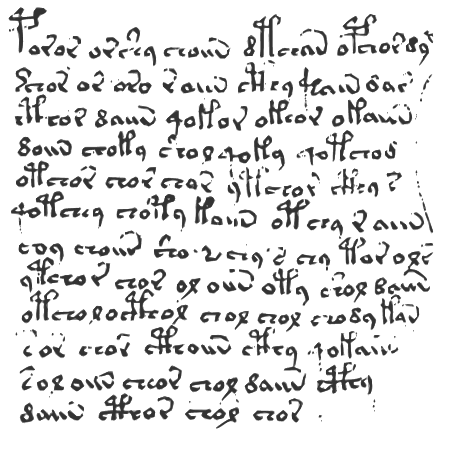
The writing, which reads from right to left, has yet to be identified. It’s unclear if this is some sort of sophisticated code, an unknown or lost language which was then encoded, an invented language, an example of glossolalia (a written equivalent of speaking in tongues), or simply an elaborate hoax.

The only known copy of the text resides in Yale University’s Beinecke Rare Book and Manuscript Library, although Yale has printed replica texts.

From the Yale University website:

Many call the fifteenth-century codex, commonly known as the “Voynich Manuscript,” the world’s most mysterious book. Written in an unknown script by an unknown author, the manuscript has no clearer purpose now than when it was rediscovered in 1912 by rare books dealer Wilfrid Voynich. The manuscript appears and disappears throughout history, from the library of the Holy Roman Emperor Rudolf II to a secret sale of books in 1903 by the Society of Jesus in Rome. The book’s language has eluded decipherment, and its elaborate illustrations remain as baffling as they are beautiful.

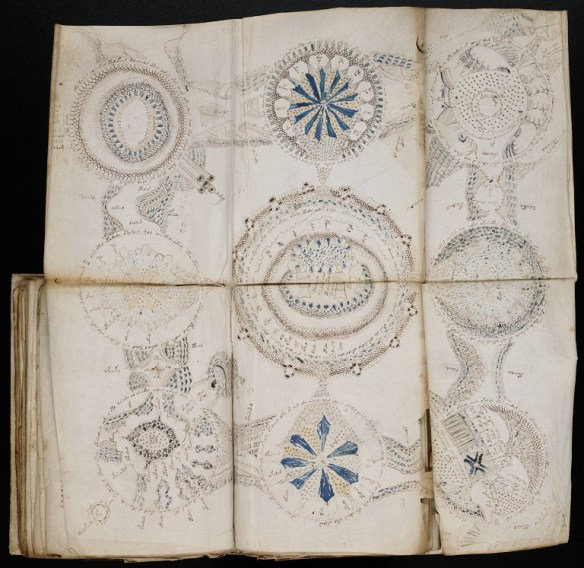
[One of several fold-out pages in the manuscript.
Image courtesy of Wikipedia.org.]

But computer scientists at the University of Alberta believe they’ve finally unraveled some of the mysteries behind the Voynich Manuscript.

They designed an artificial intelligence program with the intent of figuring out the language in the manuscript. The AI analyzed versions of the UN’s Universal Declaration of Human Rights in 400 different languages in order to establish different linguistic patterns to compare against the text of the Voynich Manuscript.

And according to the AI, the text was most likely written in Hebrew.

Now that they had a language to work with, they needed to begin deciphering precisely how that language was encrypted.

[Image courtesy of Wikipedia.org.]

There have been many theories regarding what form of encryption was employed in the Voynich Manuscript. Some investigators theorized that vowels had been removed from the words in the text in order to obscure their meaning further, while others have suggested writing that has been mirrored or otherwise written backwards. Anagrams and other forms of word manipulation are a common theory, and the University of Alberta team went with a variation on the anagram idea.

They theorized that the encoded words were alphagrams, anagrams where the letters in a word are placed in alphabetical order. (For instance, if VOYNICH was encoded this way, it would read CHINOVY.)

Turning loose the AI once again under these parameters, they found that 80% of the words in the Voynich text could be anagrammed into Hebrew words. They managed to cobble together a possible opening sentence for the text:

“She made recommendations to the priest, man of the house and me and people.”

Is it clunky? Sure. But it’s also a partial translation that has held up to some scrutiny, which is better than most amateur AND professional attempts to crack the Voynich Manuscript have done.

The team is currently hoping to team up with experts in ancient Hebrew and continue the process, but until then, they’re excited to apply their AI to other ancient manuscripts to see what it uncovers.

Although we are a long way from calling the Voynich mystery solved, this is a very intriguing step forward for cryptographers and codebreaking enthusiasts everywhere.


Thanks for visiting PuzzleNation Blog today! Be sure to sign up for our newsletter to stay up-to-date on everything PuzzleNation!

You can also share your pictures with us on Instagram, friend us on Facebook, check us out on TwitterPinterest, and Tumblr, and explore the always-expanding library of PuzzleNation apps and games on our website!