
[Note: I received a free copy of this puzzle in exchange for a fair, unbiased review.]
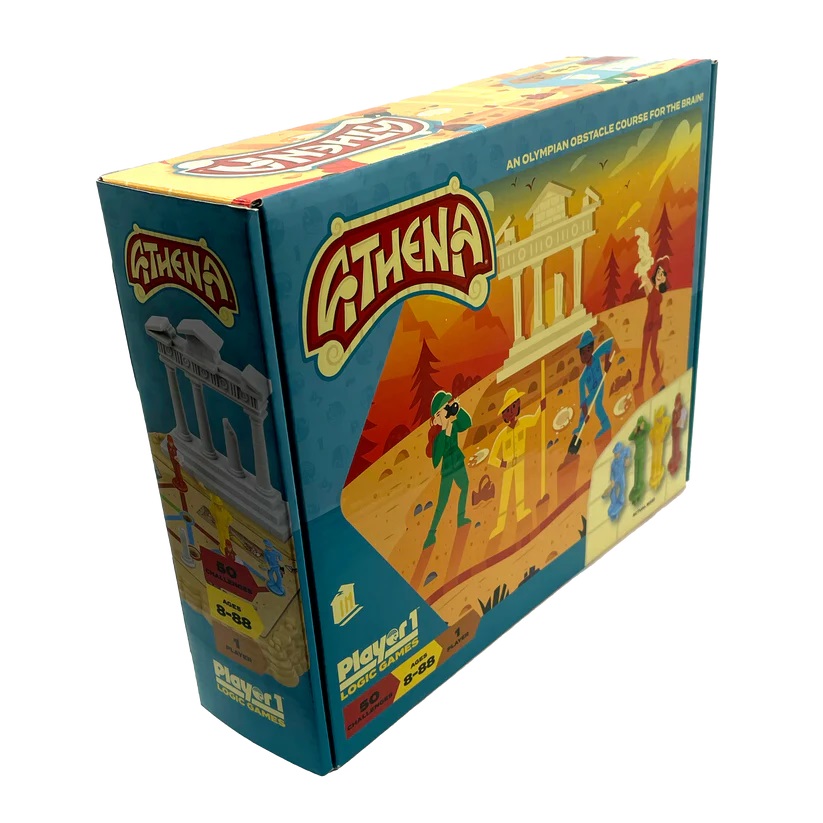
An archaeological dig site can be a very busy place. You’ve got your crew digging, folks photographing the scene and documenting artifacts, staffers keeping meticulous notes… and then there’s you, the lead archaeologist, holding part of a priceless relic: the bust of Athena.
Can you navigate a chaotic dig site and reunite the statue with its pedestal? That’s the puzzly challenge set before you in Athena.
A chain-solving brain teaser in the vein of sliding-tile puzzles or the famous Tower of Hanoi ring puzzle, Athena requires you to think like a tactician or a chess player. You must analyze the scene, move the pieces according to specific rules, and try to plot out the correct path for your lead archaeologist.
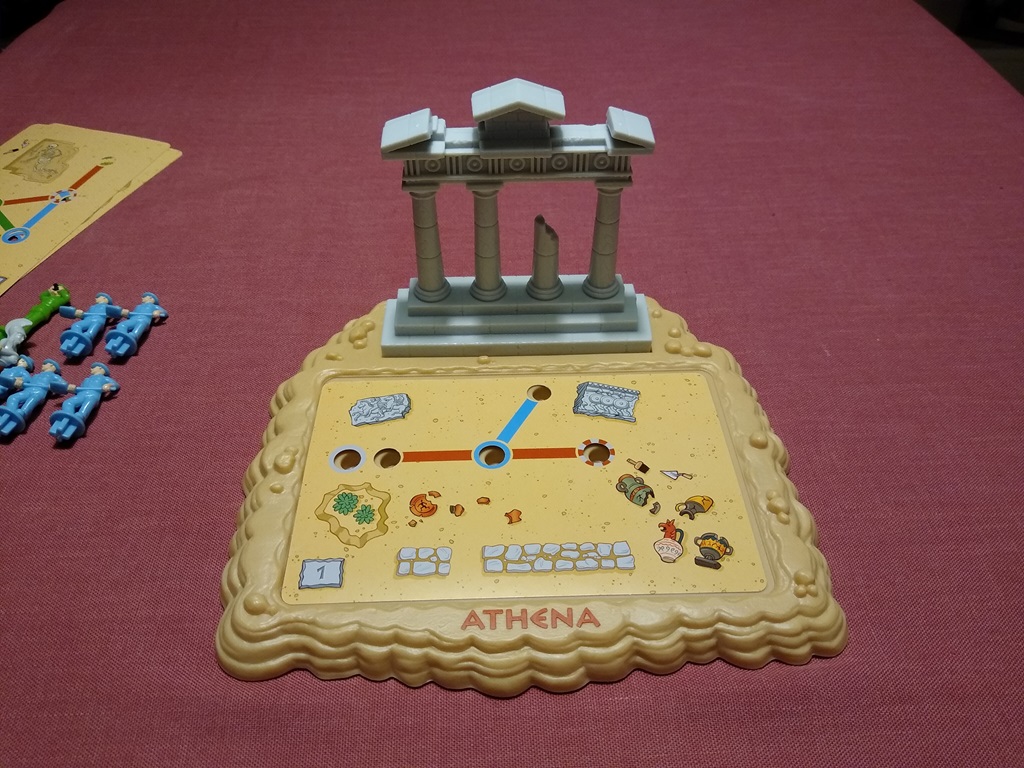
There are 50 challenge cards included, each with a particular arrangement of workers on the board and color-coded paths for the pieces to follow.
On card #1, you can see the paths available for the blue worker (who begins in the blue circle) and the lead archaeologist (who begins in the brown and gray circle). The pedestal sits in the gray circle.
The blue worker can only move between one of two spots along the blue path, and the lead archaeologist can move along the brown paths.
So you move the blue worker out of the lead archaeologist’s path, and bam, the statue is reunited with the pedestal.
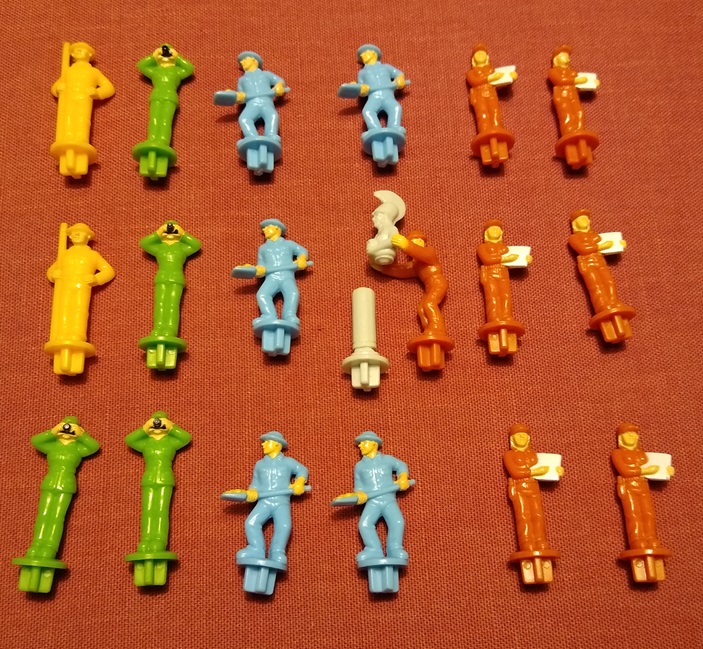
This is a fairly simple setup. What could you need all these other worker pieces for?
I mean, there’s seventeen of them, plus your lead archaeologist and the pedestal for the statue. Where could they all fit?
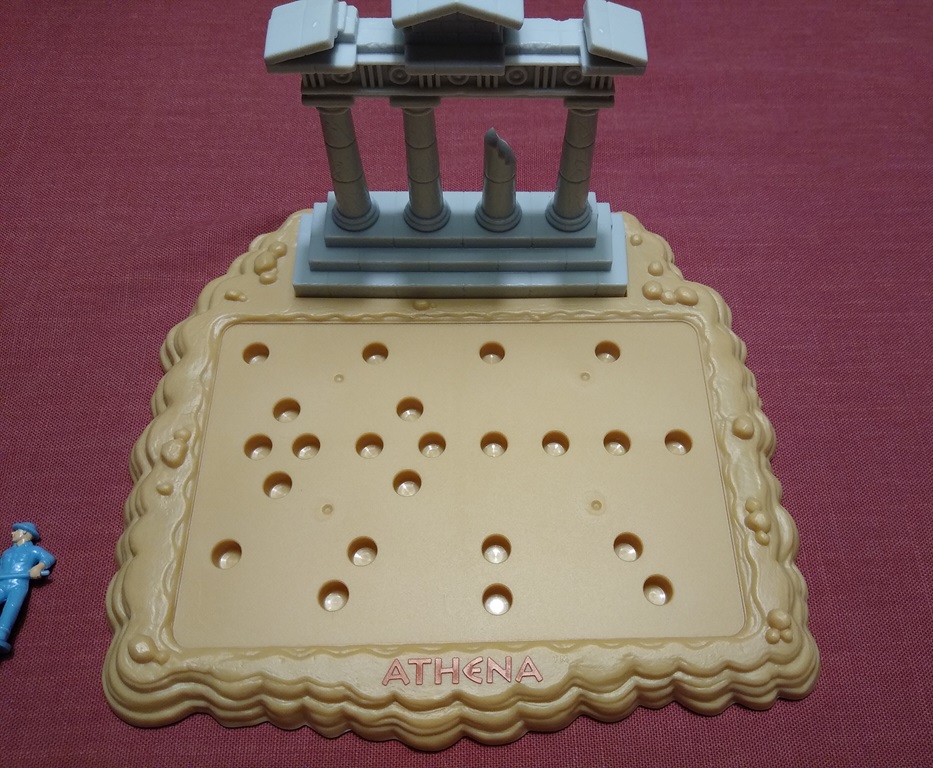
Oh!
As you can see, the base allows for numerous places for the workers to be positioned, and trust me, those later challenge cards can get crowded very quickly.
Let’s take a look at another card as an example.
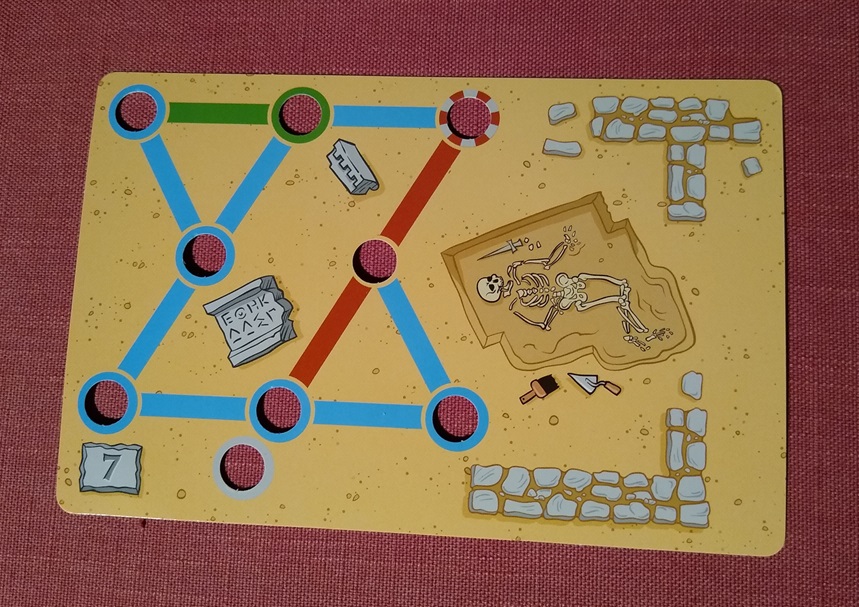
Here’s the challenge card. As you can see, the five blue workers (indicated by the five blue rings) have lots of options for movement, while the green worker and the lead archaeologist have very few.
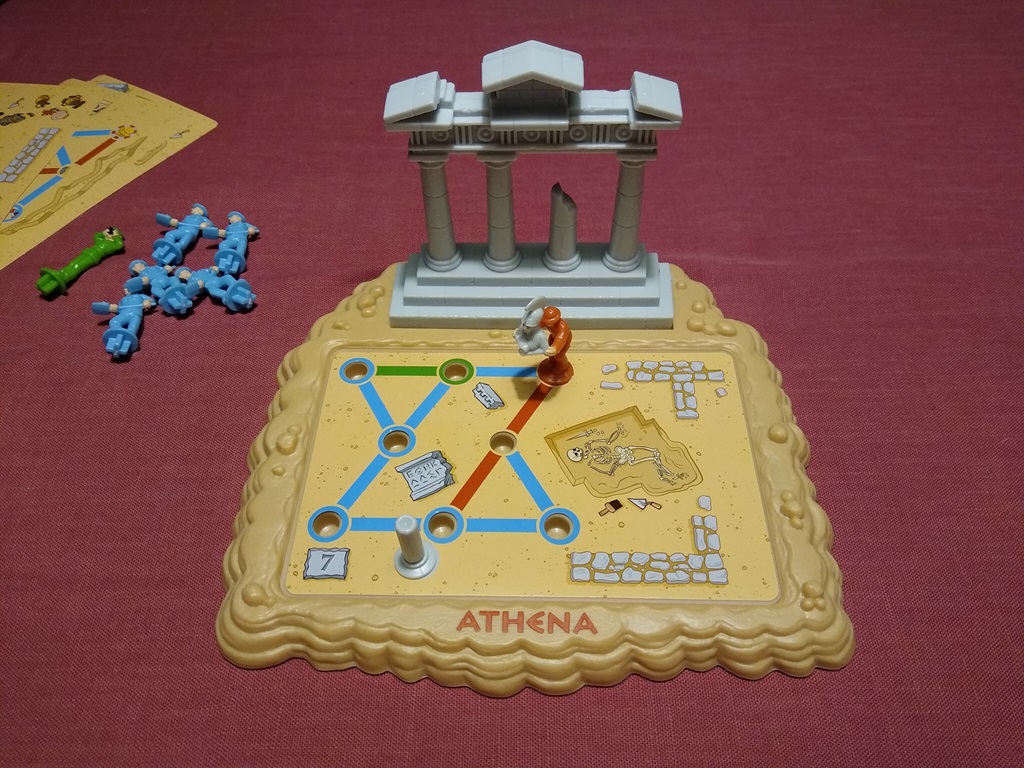
But it seems simple enough. You only need to move the lead archaeologist two spots. How tough could that be?
Let’s finish setting the pieces and take a look.
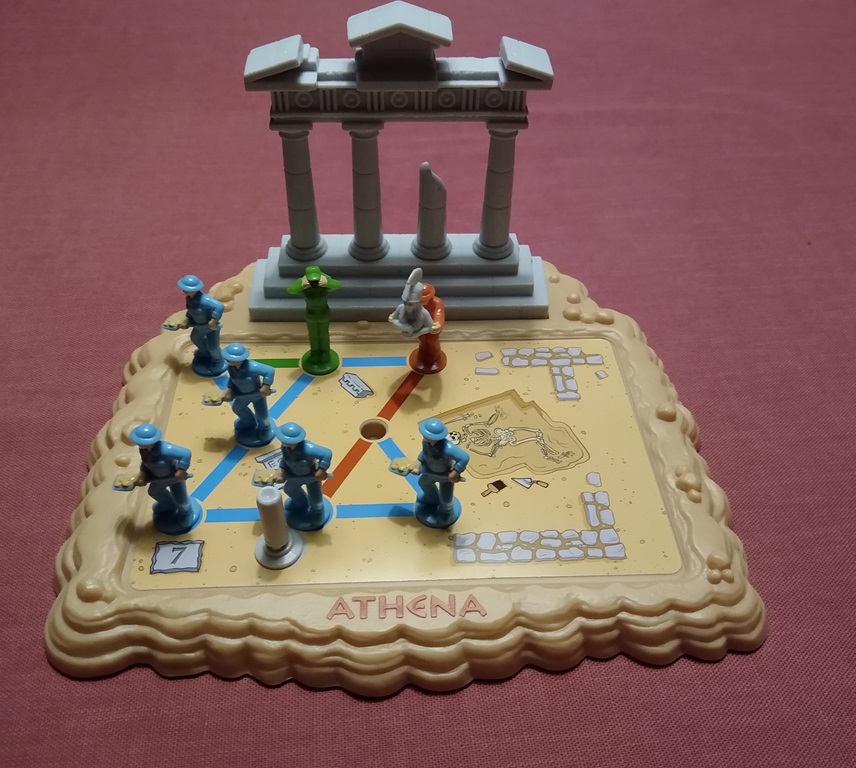
Oh. That’s slightly more daunting.
With only one space available, you’re going to need to move all of the pieces around so that your lead archaeologist can proceed forward.
And suddenly, you’re thinking five moves ahead, looking at how one piece moving creates an opening for another piece, and then another. But wait, this piece can only move to one spot, so these pieces must go over here in this order…
Your mind adapts quickly. You begin to see ALL the possibilities unfurl in front of you. You develop patterns and ideas for how to move things as you’re placing new challenge cards down and setting the pieces in place.
Of course, the challenge cards increase in complexity and difficulty, so as soon as you start hitting your stride, you have new obstacles to overcome. And with some solutions requiring dozens of moves to complete, I can guarantee that you’ll have plenty of challenges awaiting you.
Athena is an engaging reinterpretation of classic chain-solving puzzles, adding a delightfully colorful touch to strategic puzzly thinking. Not only that, but it’s a terrific introduction to the kind of mental gameplay that chess and other puzzly pursuits require.
[Athena is for ages 8 and up, and it’s available from Project Genius and participating websites, starting at $24.99.]
 PuzzCulture