Puzzles in Pop Culture: Forged in Fire

As you might expect, I am always on the lookout for puzzles on television.

Sometimes, a complete solvable puzzle appears, like in the seesaw brain teaser from Brooklyn Nine-Nine. Sometimes, they’re only referenced, like in a murder mystery involving a crossword editor on Bones.

Other times, a major portion of an episode revolves around them. We’ve seen this countless times from shows as diverse as The Simpsons and NCIS: New Orleans.

But I didn’t expect to stumble across a puzzle in an episode of Forged in Fire.
forged in fire

For the uninitiated, Forged in Fire is a reality competition show on the History Channel where blademakers show off their smithing prowess by forging knives, swords, and other bladed weapons for a panel of judges.

A typical episode consists of four competitors given a material to work with, and challenged to create a weapon of their choosing. They work on the set — known as The Forge — and at the end of the first round, they present their preliminary design, and one competitor is eliminated.

forged 8

The remaining three continue working to refine their blades in round two, and at the end of that round, after the blades are subjected to testing by the judges, another competitor is sent home.

In the third round, the two remaining competitors return to their home workshops/forges to create a different weapon entirely from scratch.

forged 5

But that was not how things went in episode 33 of season 7, entitled “Japanese Ono.”

Instead of building a blade of their choosing from a given material, the four bladesmiths were challenged to craft a blade that would fit a particular shape.

forged 1

They were each given the same amount of raw material, and they would have to shape it to fit a very specific design.

forged 2

Yes, their finished blade had to be the final piece in a jigsaw puzzle.

So their challenge was twofold. Not only did they have to exercise extreme resource management — they had only enough raw material to fill the space — but they had to exhibit the skill and finesse to make the steel bend and shape to fit the necessary design.

forged 13

These are two skills that many puzzle solvers are familiar with. Whether you’re dealing with a mechanical brain teaser by filling a particular space with various unwieldy or oddly-shaped pieces OR you’re trying to accomplish a task in a riddle with only simple ingredients, you’ve probably been in a similar situation.

Just not at 2000 degrees Fahrenheit.
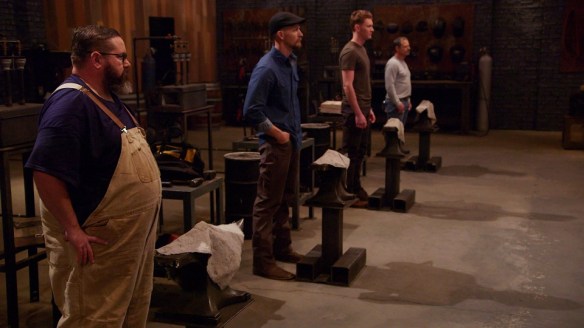
four contestants

The four competitors were Nic, Logan, Keaton, and Dale, each with five to six years’ experience bladesmithing.

They had three hours for the first round of the competition, which would focus on shaping the knife to fit the puzzle.

forged 4

Dale and Keaton immediately welded their metal in preparation for putting it into the forges, while Logan grabbed a sheet of paper to trace the shape of the knife in the jigsaw puzzle.

forged 3

Keaton soon joined him, and they helped each other trace, which highlighted one of my favorite things about this show. Unlike so many reality shows where backstabbing and mean-spiritedness win the day, this one is all about competing against yourself. The blacksmiths aren’t sabotaging each other, they’re simply trying to do their best. We need more of that on TV.

Soon, all four blacksmiths had their pattern, following Logan’s lead.

Then, it was a blur of pressing and hammering their heated metal into shape, followed by quenching, grinding, and other steps in the preparation process.

forged 10

Nic and Logan were making good progress, but Dale was unhappy with how his metal was turning out, so he abandoned his current billet and started over from scratch.

forged 6

The judges noted that Keaton was the only bladesmith who kept returning to the jigsaw to trace and retrace his shape as he worked.

forged 7

But viewers would have to wait to see if that technique paid off.

When Logan went to check his blade against the puzzle template, he discovered his blade was too long, so he cut off about four inches of extra metal.

forged 9

You may recall that the judges said there was just enough metal to fill the space.

Yeah. This plot point would come up later.

But he wasn’t the only smith who had issues. Nic’s blade didn’t come out to the shape he wanted, and the judges joked it looked like an oar. Keaton quenched his blade three times (rather than one) to deal with various problems, but risked stress fractures in the blade by doing so.

forged 11

And just as the judges complimented Dale for his come-from-behind effort, he actually dropped his blade into the quenching liquid. By dipping his arm in to retrieve it, he coated his arm in a potentially flammable oil mixture. He basically turned his arm and sleeve into a potential wick.

forged 12

Good thing he brought a spare shirt.

Soon, the three hours were up, and the bladesmiths presented their blades to the judges to see how they’d fit into the puzzle.

forged 14

Dale’s blade was a decent fit, particularly considering he had to start over partway through, ending up 30-40 minutes behind his fellow competitors. But the judges warned him about several cracks in his blade that would need to be addressed in the second round.

forged 15

Keaton’s blade fit nicely, showing that the multiple tracings served him well. In the end, his blade would end up as the best fit of the four.

forged 16

Logan’s blade was well-shaped, and actually followed the pattern nicely. It was simply too small, because he wasted metal early by making the blade too long and then cutting off the “excess.” Judge Doug Marcaida couldn’t even let the blade sit in the puzzle like the others, because it would fall out.

forged 17

Finally, Nic’s blade was solid and well-made, but just doesn’t fit the pattern, either toward the hilt or along the edge. Beyond that, there was a big crack near the tip of the blade.

The shape alone was reason enough for Nic to be eliminated.
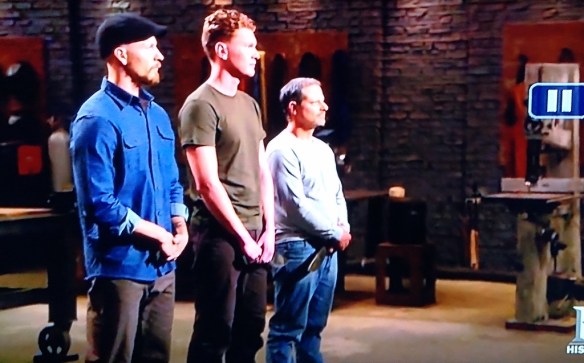
forged 18

And then there were three.

In round two, the remaining bladesmiths had two hours to address the problems raised by the judges, refine their blades, AND use two different kinds of handle material on each side of the tang (the metal on the back end of the knife) to make the handle.

forged 19

Plus a harsher test awaited each blade in round two, as the blades would be subjected to chopping a bone (to test its strength) and slicing a series of apples (to see how the blade retains its sharpness).

Logan and Keaton focused on grinding out the issues with their blades, while Dale had to try to weld shut the cracks in his blade to ensure it would endure the strength test. But in doing so, he noticed more cracks. “It’s make-it-or-break-it time,” he told us, prophetically.

While Dale was still grinding, Logan had moved on to choosing materials for the handle, focusing on building a resilient knife and worrying less about appearances.

forged 21

As Keaton worked on his handle, it turned out that he viewed this — getting the different materials to line up correctly and fit the design — as the puzzliest part of the whole endeavor.

forged 20

He also confessed that he didn’t pay much attention to which materials he chose — he just wanted it to look like a puzzle.

Soon enough, the two hours had expired, and the three bladesmiths presented their refined blades to the judges for the dreaded bone chop test.

forged 22

The judge, J. Neilson, happily slammed each of the knives against these unforgiving bones, interested in seeing what damage the bones inflicted on the blades and how the blades weathered his treatment of them. This would test not only the overall strength of the blade, but how well they retained their edge.

forged 23

Logan’s blade was first for testing, and it went through the first bone like butter. The next five swings of the knife barely made an impression on the second bone. But Neilson complemented the handle design (which allowed for a secure grip), even though the knife had some pitting and metal tearing from the test.

forged 24

Much like Logan’s blade, Keaton’s blade went through the first bone and was chewed up by the second. He lost some of his handle in the testing, and his blade showed similar damage to Logan’s, but again, the blade mostly held up against the strenuous field test.

forged 25

I actually liked Dale’s handle design the most. It looked and felt like pieces of a jigsaw put together, and really fit the aesthetic of the episode’s theme.

forged 26

Unfortunately, one chop into the testing, despite slicing through the first bone, Dale’s blade catastrophically failed.

forged 27

So Logan and Keaton moved on to the final round, where the puzzly theme fell away and the episode’s actual title came into play.

forged 29

The two bladesmiths were given four days in their home workshops/forges to build a Japanese ono, a double-headed battle-axe used by samurai in Japan during the 17th century.

forged 28

Logan, based in Bryan, Texas, and Keaton, based in Nantucket, Mass, set out to recreate this unfamiliar weapon.

Similar to his approach with the puzzle knife, Logan’s technique again involved cutting off the excess metal, but this time, he then stacked the extra metal to reforge and weld to make the large, unusually-shaped blade.

Keaton, meanwhile, focused on using a single piece of metal and shaping each end into one of the blades.

On Day 2, Logan’s blade shattered, and he had to start over from scratch. As it turned out, his welds failed to hold the blade together.
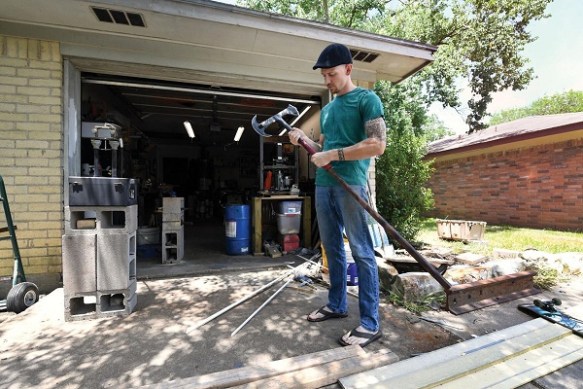
logan ono

[Logan’s finished second effort.]

Meanwhile, Keaton quenched his axe head and was overjoyed with how it turned out. He had ample time to cast heart-shaped ornamentation out of bronze for the axe while working on the handle.

forged 30

After the four days had elapsed, they returned to The Forge and presented their blades for testing. Each Japanese ono was tested against a ballistic gel dummy (to test lethality), a bamboo wall (to test strength and resilience) and a series of water-filled plastic tubes (to see how well it retained its edge).

Both blades performed well, but in terms of balance, design, and execution, Keaton’s was considered the superior blade, and he won the day, becoming a Forged in Fire champion and winning $10,000.

forged 31


While this wasn’t the traditional sort of puzzling we usually cover in a Puzzles in Pop Culture post, I do feel like the ingenuity, problem-solving, and resource management shown by each of the bladesmiths easily fall under the puzzle-solving umbrella.

Like a key into a lock, they had to forge the final piece of a very unique puzzle, and for the most part, they succeeded. That sounds like solid puzzling to me.


Thanks for visiting PuzzleNation Blog today! Be sure to sign up for our newsletter to stay up-to-date on everything PuzzleNation!

You can also share your pictures with us on Instagram, friend us on Facebook, check us out on TwitterPinterest, and Tumblr, and explore the always-expanding library of PuzzleNation apps and games on our website!

Making Wordplay Magic with Word Squares!

[The Smyrna word square, uncovered as a bit of puzzly graffiti in 2016.]

Have you ever tried to make a word square, fellow puzzlers? It’s an intriguing twist on crossword-style construction, except the words you place read both across and down in the grid.

For instance, a five-letter word square could read:

WATER
AWARE
TALON
ERODE
RENEW

As you can see, 1-Across is also 1-Down, 2-Across is also 2-Down, and so on. (Appropriately enough, our friends at Penny Dell Puzzles have a puzzle involving this puzzly trope, and they call it “Across and Down”)

Word Squares have been around for centuries. One of the most famous is dated all the way back to 79 AD in Pompeii (though it has been found in other places throughout history), and is known as the Sator Square:

Not only is it a word square, but it’s a palindrome as well!

It’s a neat little linguistic challenge, and as you might expect, they become more difficult to construct the larger they get.

But physicist, computer programmer, and all-around word enthusiast Eric Tentarelli might’ve cracked the code to making word squares in heretofore impossible sizes…

Doing so in Latin.

In the introduction to his WordWays article “Large Word Squares in Latin,” Tentarelli explains:

Large word squares have been pursued in many languages, but large word squares in Latin appear to have remained unexplored, despite the form’s origins in ancient Rome and despite the benefits offered by Latin inflectional endings.

New word squares constructed in Latin are shown to surpass in size those created in other languages to date, most notably by attaining the holy grail of logology: the first known non-tautonymic ten-squares consisting entirely of solid, uncapitalized words in a single language.

So, what does he mean? Well, essentially, people have been able to pull off word squares of impressive size — 8×8, 9×9, and 10×10 — but not without using certain undesirable words and word variants.

Those variants would include hyphenated words, tautonyms (scientific names where the same words is used twice, like vulpes vulpes for “red fox”), and capitalized words, aka proper nouns. Also, some puzzlers have mixed languages in order to create these word squares, similar to crossword constructors getting themselves out of a tough corner by using a European river.

Ideally, you want a word square consisting of, as he says, solid uncapitalized words in a single language.

Like this:

tentarelli

Say hello to the first verified 11×11 word square in a single language.

“I produced these squares by selecting final rows that combined to produce common endings and therefore maximize the chance of completing the rest of the grid.”

By compiling lists from reliable, verifiable dictionary sources and building a database of potential words, Tentarelli gave himself a strong base to start with.

But by choosing Latin as the language of choice, he significantly increased his chances of success. Thanks to “its extensive and overwhelmingly regular system of inflectional endings,” Latin was an excellent choice for word squares, which are commonly constructed by placing the bottom words first and building upward from there.

From David Brooks’ article in The Concord Monitor about Tentarelli’s work:

English has some endings that finish up on many words, “-ING” being the most obvious example. but Latin has plenty more including some that extend to four and even five letters, which makes it easier to find word squares. “In Latin, if the words in the bottom rows combine to produce nothing but common inflectional endings, such as -NTUR or -ATIS, there is good reason to hope the remainder of the square may be filled,” he wrote.

tintorelli 2

[Four 10×10 word squares built from the same three final words.]

It’s honestly mind-blowing and so inspiring to see what puzzlers can achieve by combining their own linguistic insights with the processing power of computers.

Tentarelli has helped push an ancient style of puzzling to places it has never gone before, and he managed to do so in the original language. How cool is that?

And he’s not done. Apparently, he’s working on a 12×12 square now.

There’s no telling how much farther he could go in the future.


Thanks for visiting PuzzleNation Blog today! Be sure to sign up for our newsletter to stay up-to-date on everything PuzzleNation!

You can also share your pictures with us on Instagram, friend us on Facebook, check us out on TwitterPinterest, and Tumblr, and explore the always-expanding library of PuzzleNation apps and games on our website!

It Was His Sister, In the Living Room, With the…

We’re one week into 2021, but if you’ll indulge me for a moment, I’d like to share one last bit of puzzle fun from 2020.

Every household has their holiday traditions. Maybe it’s who you see on Christmas Eve or who puts the star on the tree, who lights the first candle on the menorah or who says grace at the dinner table.

It’s no different when it comes to puzzly holiday traditions. One friend challenges his kids to a puzzle hunt Christmas morning before they open their gifts. Another couple I know gives each other games for Christmas, and then invites certain friends over that evening for a holiday game night. (Naturally, this year, they did so over Zoom.)

I recently stumbled across another puzzle/game-fueled holiday tradition and I wanted to share the story with my fellow PuzzleNationers.

One Christmas, six years ago, a young man received a candlestick from his sister as one of his gifts. It was in a black box with a purple ribbon. He was very confused. He didn’t understand this gift at all.

The next year, he received another strange gift: a spool of rope.

And so it went each year. Another Christmas, another strange gift.

He soon cottoned on to the pattern, though, and began to look forward to each year’s new offering.

This year, she completed the set for him:

Yes, every Christmas, his sister got him one of the weapons from Clue, a favorite movie from their childhood, inspired by the classic board game Clue/Cluedo. Pictured above are the gifts in order, from the candlestick first to the revolver last.

One can’t help but wonder what their parents thought when the pipe, the knife, or the revolver arrived. But hey, maybe they’re Clue enthusiasts as well.

A lot of people plan ahead for Christmas. But planning ahead for six years? Now that’s puzzly commitment.


Thanks for visiting PuzzleNation Blog today! Be sure to sign up for our newsletter to stay up-to-date on everything PuzzleNation!

You can also share your pictures with us on Instagram, friend us on Facebook, check us out on TwitterPinterest, and Tumblr, and explore the always-expanding library of PuzzleNation apps and games on our website!

New to Crosswords? Solve Along With the Try Guys!

exercise-brain-crossword-670x335

As someone who has attended the American Crossword Puzzle Tournament in the past, I can attest to how blisteringly fast some of the top solvers are.

And there’s a lot that goes into a top-ranked solving technique. There’s the regular experience of actually solving on paper in pencil (which is very different from solving on a screen), and years of familiarity with crossword tropes, building a well-established lexicon of common crossword words, letter patterns, and cluing styles to draw on.

There may be a natural gift or affinity for puzzle solving as well, or simply a knack for reading past clever wordplay and cracking tricky clues and elusive themes faster than most.

In any case, it’s a curious alchemy that makes a top-notch solver. But you don’t have to be top 3 in a tournament to be fast. I am routinely impressed by the average times posted by constructors and fellow puzzlers alike.

During the Boswords 2020 Fall Themeless League, for instance, plenty of fellow solvers completed puzzles in less than half the time it took me.

So when I heard that YouTube’s famous experimental quartet The Try Guys were testing their puzzly mettle against a respected constructor, I happily watched along.

In the video, the team tried to group-solve a Monday New York Times crossword in the time it would take magician and crossword constructor David Kwong to solve FOUR New York Times puzzles.

I won’t spoil how things turned out — watch the video for that! — but I do want to discuss the role David played as puzzle ambassador in the video.

If you know someone who is intimidated by crosswords, or maybe wants to try solving them but hasn’t yet, I would highly recommend sending them a link to this video.

David does a terrific job introducing the Try Guys to the rules of crosswords, discussing everything from themed entries and rotational symmetry to some of the common crossword tropes we all know and love. (He even explains the famous November 5, 1996 quantum puzzle where either BOB DOLE ELECTED or CLINTON ELECTED could fit in the grid.)

He helps demystify the puzzle, but manages to do so in a way that still makes the challenge seem fun. The Try Guys go from being apprehensive about the race to being excited to bring their own unique trivia knowledge and skills to the table.

Not only does it encapsulate a lot of what’s fun and enjoyable about crosswords, but it serves as a small sampling of competitive solving, which might make fellow puzzlers more interested in participating in a tournament someday.

In short, it’s great fun AND great PR for crosswords. I don’t think it’ll make me any faster as a solver, but I enjoyed watching nonetheless. Nicely done, David. Nicely done, Try Guys.


Thanks for visiting PuzzleNation Blog today! Be sure to sign up for our newsletter to stay up-to-date on everything PuzzleNation!

You can also share your pictures with us on Instagram, friend us on Facebook, check us out on TwitterPinterest, and Tumblr, and explore the always-expanding library of PuzzleNation apps and games on our website!

The Valuable Things (and Names and Places) We Learn From Crosswords

Problem-solving-crossword

I’ve learned a lot by solving crosswords. Honestly, it’s quite rare for me to solve a crossword and NOT learn something new. Sometimes, I am baffled by a reference I don’t know, and I end up finding out the answer only when the crossing entries are complete.

But that bafflement, that frustrating moment of ignorance, is soon mitigated, and I add a new fact to my ever-growing mental crossword library.

How many words have you learned by solving crosswords? How many geographic places do you know because of solving crosswords? How many actors, scientists, authors, musicians, and figures from pop culture do you know from solving crosswords? How many nuggets of trivia have you tucked away in the dusty parts of your brain that you picked up from an unexpectedly informative clue in a crossword?

Sure, we joke about the silent film stars and European rivers and African animals that often fall under the banner of crosswordese, but only because we’ve seen them enough to know them. We crave new entries, new peculiarities of language, and new crossword clue fodder to challenge and engage us in equal measure.

135421944_10219703190032375_4805193262790836533_n

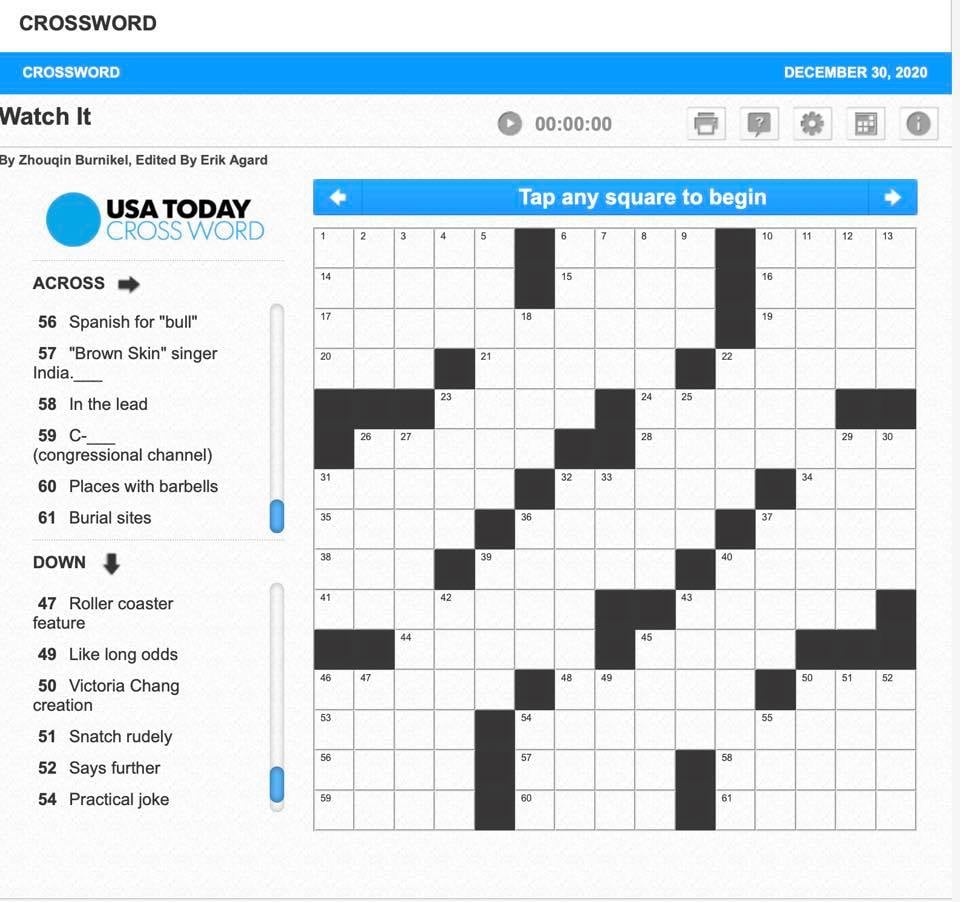
A recent USA Today puzzle clued the word POEM with “Victoria Chang creation,” and a friend of the poet Victoria Chang, Nan Cohen, shouted out constructor Zhouqin Burnikel and editor Erik Agard on Facebook for including Chang in the puzzle.

Nan’s post went on to ask about how Chang ended up in the puzzle (though she thought it was cluing OBIT, Chang’s poetry book, instead of POEM, the actual answer):

I am curious, if you can share, how did you arrive at the cluing and decide it was accessible enough? (I love that it’s a new way of cluing OBIT, and of course that it represents an Asian American poet–cannot think when I have ever seen a contemporary Asian American poet in a puzzle, although Arthur SZE (who won the National Book Award in 2019) might be helpful to someone sometime).

The praise for both Burnikel and Agard is well-earned — Agard was quick to clarify that the clue was 100% Burnikel’s doing — but the discussion itself highlights an important issue in modern crosswords: the concept of who is “crossword-worthy.”

obit

Natan Last discussed this very topic in a brilliant piece in The Atlantic last year, citing the following troubling examples of “crossword-worthy” gatekeeping in major outlets:

Constructors constantly argue with editors that their culture is puzzle-worthy, only to hear feedback greased by bias, and occasionally outright sexism or racism. (Publications are anonymized in the editor feedback that follows.) MARIE KONDO wouldn’t be familiar enough “to most solvers, especially with that unusual last name.” GAY EROTICA is an “envelope-pusher that risks solver reactions.” (According to XWord Info, a blog that tracks crossword statistics, EROTICA has appeared in the New York Times puzzle, as one example, more than 40 times since 1950.) BLACK GIRLS ROCK “might elicit unfavorable responses.” FLAVOR FLAV, in a puzzle I wrote, earned a minus sign.

Appropriately enough, Last’s piece mentions a puzzle by constructor Sally Hoelscher, and Sally herself replied to the Facebook post celebrating Chang’s inclusion in the USA Today crossword:

One thing I enjoy about the USA Today puzzle is that Erik and the constructors are intentional about lifting up and highlighting those who may not be deemed “crossword-worthy” by some publications. I was delighted to learn about Victoria Chang from this puzzle, and to learn about her book, OBIT, when I was researching her to write my blog.

I can’t say for certain how many solvers were already familiar with Victoria Chang or her works, but I suspect the majority of USA Today crossword fans learned something new that day.

That is reason enough to keep pushing the boundaries of what is considered “crossword-worthy.” Inclusion encourages visibility, which encourages greater participation in crosswords, which feeds into greater inclusion. And along the way, solvers are exposed to worthwhile individuals and ideas, learning more about the world we live in.

Sounds like a win-win to me.


Thanks for visiting PuzzleNation Blog today! Be sure to sign up for our newsletter to stay up-to-date on everything PuzzleNation!

You can also share your pictures with us on Instagram, friend us on Facebook, check us out on TwitterPinterest, and Tumblr, and explore the always-expanding library of PuzzleNation apps and games on our website!

Looking Forward to the Year in Puzzles and Games!

We spent this week looking back on the year that was 2020, celebrating the resilience, innovation, creativity, and kindness that makes the puzzle community so unique and remarkable.

But today, on the first day of 2021, it feels appropriate to turn our gazes forward instead of back, looking ahead for what’s to come.

And for our fellow puzzlers and PuzzleNationers, there are already exciting developments awaiting us all in the new year.


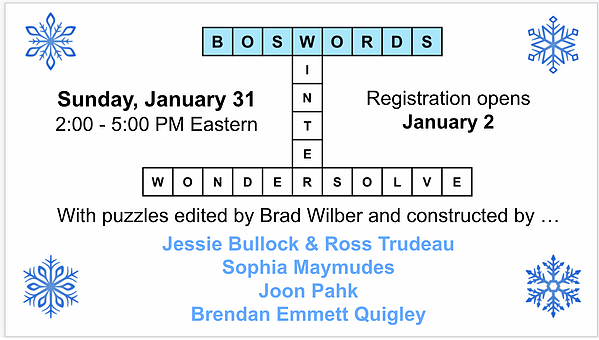
If you didn’t participate in either the Boswords crossword tournament or the Boswords 2020 Fall Themeless League last year, you might not have heard about this yet, but the intrepid puzzlers from Boswords are already launching their next solve-from-home puzzly endeavor…

The Winter Wondersolve.

On Sunday, January 31st, participants will have four puzzles awaiting them — three themed crosswords and a themeless — designed by top-notch constructors.

Registration opens tomorrow, so be sure to visit Boswords.org for all the details!

(And that’s not all! They’ve also announced a Spring Themeless League, a date for their traditional summer tournament, and the return of the Fall Themeless League later in the year! That’s loads of puzzly goodness to look forward to!)


acptlogo

Speaking of crosswords and tournaments…

After being forced to postpone and then cancel the 2020 edition of the American Crossword Puzzle Tournament outright, Will Shortz and the tournament’s organizers announced the following a few days ago:

In most years, registration for the American Crossword Puzzle Tournament opens on January 1. This year, though, we’re going to wait to see how the fight against the pandemic goes before deciding how to proceed.

Our hope is that, with widespread vaccinations, enough people will feel safe in attending an in-person crossword event in April to have it be worthwhile. We won’t know about that for some time.

Whatever happens, in-person or not, we’re planning at least a major online crossword event in April. We hope you’ll take part in some form.

Whether this means an in-person event — which seems optimistic — or a sequel to last year’s Crossword Tournament From Your Couch, we cannot say. But we will certainly keep you posted on any and all updates.


But it’s not just the world of puzzles that will be celebrating and finding new ways to bring fans together in 2021. The folks at Looney Labs will be marking their twenty-fifth year on the calendar in 2021. Yes, twenty-five years of Looney Labs and twenty-five years of Fluxx!

To mark the occasion, Looney Labs has a plethora of events and promotions planned throughout the year. There is a limited run of special anniversary cards and copies of a miniature version of Fluxx available with web store purchases, plus new game releases planned and much more!

The team at Looney Labs is also welcoming fans like never before with a series of one-of-a-kind Zoom experiences for game enthusiasts. You can purchase tickets for these Silver Jubilee events to play games virtually with the game designers and crew from Looney Labs! There are tutorials, full game sessions, previews of new games, and more planned for each one!

Tickets for the first Silver Jubilee event go on sale at their online store at noon Eastern on Tuesday, January 5th, and there will be more throughout the year!


The year is barely a day old and there’s already so much to look forward to!

We have also heard that some of our favorite constructors will be releasing new puzzle books in the coming weeks and months.

When you factor in all of the puzzles we can expect in major and independent outlets throughout the year — not to mention the puzzles we’ll be producing for our own apps like Daily POP Crosswords and Daily POP Word Search — 2021 is certainly looking bright for solvers of all ages!

And we look forward to sharing in all of that puzzle-fueled fun with you, PuzzleNationers. Happy puzzling!


Do you know of any puzzle or game events coming in 2021 that we missed? Let us know in the comments section below. We’d love to hear from you!

Thanks for visiting PuzzleNation Blog today! Be sure to sign up for our newsletter to stay up-to-date on everything PuzzleNation!

You can also share your pictures with us on Instagram, friend us on Facebook, check us out on TwitterPinterest, and Tumblr, and explore the always-expanding library of PuzzleNation apps and games on our website!