If you’ve been reading this blog for any length of time, you’ve no doubt noticed that one of our favorite topics is puzzle-solving animals. In the past, we’ve discussed examples of puzzle solving in cats, dogs, crows, cockatoos, octopuses,bees, pigs, and squirrels.
You probably noticed we’ve got two types of birds on that list already. The more we learn about birds, the more they add to their puzzly resumes.
As for crows, they’re probably the puzzly kings of birddom.
There was a famous study about a crow named Betty, who would bend pieces of wire in order to obtain food.
Originally, Betty was treated as a genius, only for scientists to later discover that many other crows also have a penchant for making tools and figuring out innovative solutions to problems.
The story of Betty no doubt inspired another study, which tested both the puzzle solving wits and social skills of crows.
There were two crows gathered from different locations with no discernable previous connection. On a table, the scientists placed two pieces of wire — a hooked piece of wire and a straight piece of wire. Each crow had a bottle with meat inside. The crows could see each other, but each had to solve the problem separately. Each crow grabbed one of the two wires.
There are differing accounts of this study, and I couldn’t track down the original. Some say the straight wire was the only way to get the food out, others the hooked wire.
In the end, the result was the same. During the first test, only one crow could get the food.
Scientists ran the test a second time, expecting the crows to fight for the one wire that allowed the victor to acquire their food.
And yes, both crows went for the same wire.
But not as competitors.
One held the wire in place, the other bent it. They cooperated, without language, so that both could get food.
That is some solid puzzly thinking.
Factor in other studies about crow cooperation (crooperation?) and stories from Japan about crows building decoy nests to distract patrols intended to remove their real nests from city power grids, and you start to wonder whether crows will join Dr. Fill at the next edition of the American Crossword Puzzle Tournament.
Now, if you’ll excuse me, I’ve heard some stories about puzzle-solving raccoons that I need to follow up on. The menagerie of puzzly animals just grows and grows.
Have you heard any stories about clever creatures that belong on the list of puzzle-solving animals, fellow puzzlers? Let us know in the comments section below! We’d love to hear from you
Your grid entries need to be interesting, yet accessible. You need to navigate long crossings and tight corners without resorting to too many abbreviations, too much crosswordese, or creating the dreaded Natick, a crossing of two obscure entries. Some solvers don’t like partial phrases, others don’t like proper names or brand names.
Your cluing has to be clever but not impenetrable. How much wordplay is too much? How many fill-in-the-blank clues before your clue section resembles your grid? The cluing must be fresh and vibrant yet timeless and not too of-its-era to make the cut for reprint and collection later.
No matter how you clue it, older solvers may decry newer names, slang, terminology, or pop culture references, while younger solvers will bemoan not just older references they consider passe, but long-established crossword-friendly words they quickly tire of seeing.
And that’s all without considering the difficulty in creating engaging, interesting themes or gimmicks for the puzzle.
That question of fresh entries and cluing vs. older/more familiar fare is a curious one. It raises further questions.
For instance, how much can you talk about what’s going on in the world?
By referring to unpleasant topics, however topical, will you alienate solvers who use the crossword as an escape? Or do you risk the puzzle feeling too sanitized and safe by NOT acknowledging the circumstances of the world at the time of the puzzle’s publication?
There are arguments for both sides. I mean, who wants to see ADOLF in a grid? (But then again, it’s not like IDI AMIN has a hard time finding his way into grid fill.)
Margaret Farrar believed that crosswords should avoid “death, disease, war and taxes.” Purposely avoiding unpleasant fill and cluing is informally known as the “Sunday Morning Breakfast Test.” (Our friends at Penny Press know plenty about this, as they shy away from unpleasant entries with diligence.)
But on the flip side, to ignore the unpleasantness of the world potentially ignores the people that unpleasantness affects.
As we continue to push for greater representation in crosswords in both editorial staff and constructors, you cannot deny that including the experiences of women, people of color, and members of the LGBTQIA+ community somewhat necessitates facing those unpleasant aspects of our history and our society.
To exclude them is to exclude potentially thought-provoking and important fill and cluing. (One could easily argue that the vast majority of our own Eyes Open crosswords would not pass the Sunday Morning Breakfast Test.)
Not everyone greets adding new cultural fill with open arms, of course. A few years ago, an LA Times crossword solver complained to us (on our holiday gift guide post, of all places) about “ignorant ghetto language” in the crossword. He referred specifically to innocuous entries like “sup,” “did,” and “street cred.”
Thankfully, he is an outlier.
But on the topic of excluding words from crosswords, when Will Shortz was asked about it, he had an interesting response:
If a word or term is used in the columns of The Times, or in cultured society in general, I think it’s probably O.K. for a crossword, even if it’s touchy or slightly unpleasant. I strive to have crosswords reflect real life as much as possible. … I don’t believe in banning words, except for the very worst. And I’d be happy to abolish the term ‘breakfast test’ completely.
I think this is a topic I’m going to ask crossword solvers about more often. I’d be curious to see where they stand on crossword content and topicality.
I suspect opinions will vary, but I also suspect that most solvers welcome new fill, new entries, and new references in clues. Every crossword is an opportunity to learn and expand one’s knowledge, and add to the mental lexicon of crossword knowledge we each build as we solve.
So where do you stand, fellow puzzlers? Do you prefer your crosswords as an escape or as a puzzly reflection of the world around us? Let us know in the comments section below! We’d love to hear from you.
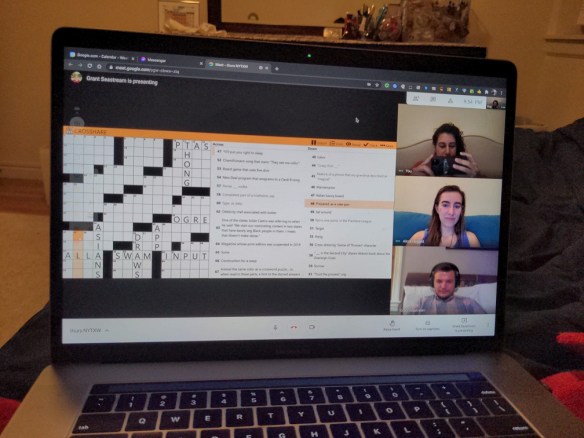
This Sunday, July 25th, from 1 PM to 6 PM Eastern, the Boswords Crossword Tournament returns! The fifth edition of this event will be contested online for the second year in a row, so it’s the perfect opportunity to test your puzzly skills.
If you haven’t signed up yet, registration closes tomorrow at 5 PM Eastern.
With two divisions to choose from — Individual and Pairs — puzzlers of all ages and experience levels are welcome to enjoy some challenging and clever crosswords in a day of puzzly fun and camaraderie.
Tournament organizers Andrew Kingsley and John Lieb (along with talented puzzle editor Brad Wilber) have gathered a diabolical Ocean’s Eleven-style crew of terrific constructors for this year’s puzzles. The five themed puzzles in regular competition (as well as the championship themeless final) will be constructed by Malaika Handa, Andrew Kingsley, Chandi Deitmer, Wyna Liu, Hoang-Kim Vu, Rob Gonsalves, and Jennifer Lim!
Boswords is asking for $25 for adults, $35 for pairs, and $5 for students to (virtually) attend and compete, which is a real bargain! (Also, for anyone with financial difficulties, there is a discounted rate available.)
If you want to solve the puzzles at your leisure and outside of the competitive setting, it’ll only cost you $10 for the puzzle packet, which you’ll receive Monday by email.
To check out the full details of this year’s event, click here! (And for our rundown of last year’s tournament puzzles, click here!)
Will you be attending the Boswords tournament, fellow puzzlers and PuzzleNationers? Let us know! We’d love to hear from you.
It’s always interesting when TV shows incorporate puzzles into their stories. Not only do we get to see what Hollywood (and by extrapolation, the general public) thinks about a given puzzly experience, but we learn more about the characters when they face a particular puzzle or challenge.
This is especially true for sitcoms and comedies, since they usually have less time to focus on the puzzling and therefore put the spotlight on character relationships.
And it occurred to me that there are a number of different shows over the last few years that have featured the characters in escape room-style puzzle settings.
Why don’t we take a look at how accurately these puzzly experiences were portrayed, how difficult the room appeared to be, and what the characters’ solving skills were like?
Please enjoy as we explore fictional escape rooms from TV in our latest edition of Puzzles in Pop Culture!
For our first offering, we turn to the CBS juggernaut The Big Bang Theory. Over the years, TBBT has featured puzzly activities like giant Jenga, a holiday-fueled session of Dungeons & Dragons, and a scavenger hunt with puzzly clues.
So I wasn’t surprised that their take on escape rooms was the same: fairly accurate, but simplified and streamlined for a mainstream audience.
The room in TBBT is pretty spacious, moreso than pretty much any escape room I’ve seen. But the level of detail is easily something achievable for high-end rooms. Also, I’ve heard about escape rooms with actors playing zombies before, so this is legit.
(In fact, one I heard about in Washington D.C. had a zombie on a chain; the chain got longer the more time solvers took to crack puzzles, cutting the room in half at one point!)
We don’t get to see much of their solving, as they allude to puzzles conquered instead of showing us, so it’s hard to gauge difficulty. But given that most of the characters featured in the scene hold doctorates, we can safely assume the puzzles were middle-of-the-road or slightly harder.
However, the episode ignores the fact that you’re trying to escape the room in a certain amount of time. The characters seemed disappointed by their impressive performance, but they probably posted one of the top times in that room’s history. Nothing to sneeze at.
Another show that hasn’t shied away from puzzly content is the former FOX and current NBC hit Brooklyn Nine-Nine. This comedy/drama set at a New York City police precinct has featured a seesaw brain teaser, a crossword-fueled arson mystery, and several multilayered heist storylines set around Halloween.
Puzzle enthusiast Captain Holt invites his fellow officers out to an escape room, and is dismayed when the disinterested Gina and the bumbling Hitchcock and Scully end up being his only fellow players. The group is immediately hampered by Hitchcock wasting two of their three hints, and Holt accidentally wasting the third.
The hint system is usually not as rigid in escape rooms. Three hints is common, though many places allow you to ask for more; sometimes there’s a time penalty, sometimes not. Also, the room in B99 is a three-hour challenge, which was a surprise. The standard time is an hour, though I’ve seen rooms push it to ninety minutes.
The group has also clearly not tried the classic escape room method of “touch everything,” because an hour and a half into the game, having found only one of the four keys needed to escape the room, Holt has not yet investigated the bright red phone sitting out in the open.
This is another escape room where difficulty is tough to judge. Unfortunately, we’re not given enough details on the first key (which involves some sort of chess puzzle) and the fourth key to really gauge the room. But despite the rocky start, the lovable team of misfits manages to escape.
Accuracy rating: 3/5
Room difficulty: 2/5
Character solving skills: Holt gets a 3.5/5, everyone else gets a 2/5.
Next, let’s turn our eyes to It’s Always Sunny in Philadelphia.
The characters in this darkly comedic show all consider themselves devious masterminds, but for the most part, they tend to get in each others’ way and foil their own schemes through silly self-sabotage. Although a few impressive schemes do come to fruition over the years, it’s hard to consider this group a crackerjack team of puzzle solvers.
This escape room breaks the mold quite a bit, since the company brings the escape room trappings to the apartment of two of the characters. This is much more elaborate than any escape room set you can buy for the home, and I don’t know of any companies that deliver an escape room to the house.
You might think this home field advantage would be a boon, but instead, all chance of cooperation immediately goes out the window. One pair takes the key to a lock, the other pair takes the lock, and they spend the entire time negotiating instead of solving.
[Image courtesy of IMDb. Because of the language involved, I couldn’t use an actual video clip and keep the blog post family friendly.]
Once they actually agree to collaborate and open the lock, they discover a list of tasks for them to complete, and they have virtually no time left to do so. (Our only hint to the room’s difficulty comes from the fact that Dee has completed the room beforehand, so it can’t have been too difficult.)
They claim victory when Sweet Dee falls out a window after getting trapped in her brother Dennis’s bedroom. In order to check on Dee’s status, the game runner opens the door and the remaining players consider it a win.
The final entry in our comedic quartet of escape room episodes comes from the musical CW show Crazy Ex-Girlfriend. This romantic drama, comedy, and coming-of-age story often features characters breaking out into elaborate song and dance routines, and many of the songs have become modern classics.
The show didn’t tackle puzzly content often, and indeed, the escape room in question is a b-plot in this particular episode, as main character Rebecca offers her escape room experience to friend Paula and her two disinterested sons.
The escape room is medieval-themed and huge, with lots of great set pieces and detail. The mix of exploring, touching things, solving puzzles, cooperating, and placing objects in particular places are all very traditional escape room moments.
Though I was a little disappointed that the elements of the final puzzle are sitting out in plain sight the whole time. You could easily ACCIDENTALLY solve the last puzzle first and be out in minutes.
But Paula’s sons prove to be able puzzlers, attentive and clever, revealing things about themselves that Paula didn’t know. (In fact, the entire escape room subplot is all about Paula learning about who her sons have become, which is Puzzly Storytelling in Sitcoms 101.)
They all escape, having found new common ground, and it’s easily the most delightful ending of the four escape room scenarios we’ve looked at today.
Accuracy rating: 4/5
Room difficulty: 3/5 (the final puzzle is a long anagram, which is pretty tough, but the rest of the room is easy)
Character solving skills: 4/5
What did you think of this look at escape rooms from TV, fellow puzzlers? Should we look at more fictional escape rooms and see how they hold up?
I’ve heard Bob’s Burgers has one, as well as Schitt’s Creek. Let us know in the comments section below! We’d love to hear from you.
What comes to mind when you think of a mechanical brain teaser? Do you think of a puzzle box or linked metal shapes? Do you think of wooden pieces that need to be fitted together to form a particular shape, or the twists and turns of a Rubik’s Cube or sword puzzle?
I would wager that rope isn’t the first puzzle piece that you think of. Which is surprising, because rope is part of plenty of different brain teasers. And they date back further than you’d think.
Check out this tricky tangled knot. This mix of rope and clay guarded the tomb of King Tut for centuries. Experts in rope and knot-tying have identified many of the knots involved, and claim that there’s no way to remove the rope and open the doors without breaking the clay seal depicting Anubis, the jackal-headed god entrusted with the protection of the dead.
Although it’s rare to find rope puzzles like this guarding tombs these days, they still guard other treasures. Like this wine bottle for instance.
This brain teaser serves as a fun (or annoying) way to add a little flavor to a traditional housewarming or holiday gift.
It’s just one example of a wide array of mechanical brain teasers known as disentanglement puzzles.
And whereas other tangle puzzles that are all metal or all wood are great and offering different challenges, the addition of a rope or two can add a TON of variability and new options to a puzzle. Pieces slide along it, and the rope can be twisted, rolled, or threaded between pieces. This one element triples the possibilities.
As you might expect, rope puzzling has also made the leap to mobile apps.
Games like Tangle Master stick to the disentanglement theme, demanding you untie a number of ropes in a certain number of moves. Later complications include locked ropes you can’t move until other ropes are eliminated, and even bombs that countdown to force certain moves.
Cut the Rope offered a different challenge, requiring solvers to deliver a candy to the waiting mouth of a hungry pet by cutting the rope. Along the way, you’d try to collect stars. The game was a mix of strategy and timing, and I can remember more than a few friends obsessed with this app a long while back.
Where could rope puzzles go from here? Anywhere, really, as long as puzzly minds are out there to try out new ideas.
There are videos online of creative geocaches/letterboxes involving string or rope. I’ve seen them employed in escape room puzzles — once to decode a message, another time to trace a connect-the-dots pattern on a board of nails, and elsewhere to connect two distant objects and hold them in place — and I’m sure that’s not the last I’ve seen of ropes there.
Do any of your favorite puzzles or puzzle apps involve ropes, fellow PuzzleNationers? Let us know in the comments section below! We’d love to hear from you.
When you think of comic books and puzzles, one character instantly springs to mind: The Riddler. He’s easily the most iconic puzzly figure in comics, and his many twisty challenges for Batman have ranged from simple word games to death-defying escape rooms.
But did you know that Superman also has some puzzling in his expansive superheroic past?
In fact, Lois Lane’s life once depended on Superman’s ability to complete crossword puzzles!
At that point, the crossword hadn’t even become a daily feature in The New York Times yet. (The first Sunday edition crossword debuted in February of 1942. The daily version wouldn’t appear until 1950.)
So how did crosswords cross paths with The Man of Steel?
Well, it all starts with Lois Lane on an airplane, solving a crossword in order to find out where she’s going. Lois had received a tip from Horatio F. Horn, a local correspondent for The Daily Planet, and now she finds herself on a hunt across (and down) America for her next destination.
The puzzle leads her to Moundville, a mining town where Horatio has gone missing. She meets a sinister gold-toothed man, and then goes missing herself. Cub reporter Jimmy Olsen soon arrives in Moundville, trying to locate both Lois and Horatio, but having no luck.
Eventually, Clark Kent gets involved, solving the same crossword puzzle as Lois and heading to Moundville himself. He arrives just in time to save Jimmy Olsen from being dragged off a cliff by a spooked horse. (You know how it is with spooked horses in old mining towns.)
After a hotel fire (an attempt on Jimmy and Clark’s lives), Clark finds three more crossword puzzles, but they’re partially destroyed. So he returns to Metropolis to track down solvable copies of each crossword, hoping they’ll reveal the whereabouts of Lois and Horatio.
Yes, one of the episodic cliffhangers was Clark solving crosswords while Lois and Horatio were held in a secret cave at gunpoint. It’s gloriously silly.
Solving the crosswords leads Superman to believe that someone in Moundville is planning to steal a shipment of gold, so he returns to the town and teams up with Jimmy and a local sheriff to get more information. He deduces that a particular shipment going out that night is the target, and manages to rescue Lois and Horatio from the gang of ruffians planning the theft.
It turns out that the mastermind of the thefts is the owner of a Metropolis newspaper syndicate — who supplies puzzles to all the papers, including The Daily Planet — and would alert a vast network of gangs in the West to various gold shipments going out by putting the name of the town in the puzzle.
That’s how Horatio ended up investigating in the first place: he’s a crossword fan himself and noticed the pattern.
The serial concludes with Superman capturing the rest of the thieves in Moundville while the Metropolis police arrest the nameless puzzle mastermind. Good job, everyone! Another crime spree thwarted, thanks to solving puzzles!
The plot of this radio serial is quite similar to the plot of the first Crossword Mysteries film — both featuring thieves informed about targets through the local crossword — and honestly, it tickled me to imagine all these gun-toting ne’er-do-wells scattered throughout the western states, solving crossword puzzles every day and waiting to see where they’d need to go robbing.
This plan also implies that the crossword constructor NEVER mentioned towns or cities at other times, because that would send his goons on wild goose chases. Imagine all the abbreviated Canadian provinces they’d be searching, not to mention the European rivers.
Perhaps this fiasco resulted in The Daily Planet hiring their own crossword editor, because later on in the comics, we see someone in the newspaper offices with a crossword pattern on his wall:
[Image courtesy of Adam Talking Superman, who offered this caption: Huge fan of the newest Daily Planet character, crossword puzzle guy listening to Perry White’s vocabulary!]
Still, it’s fascinating to know that a major radio program — one with over two THOUSAND episodes — devoted literal weeks of airtime to a crossword-themed mystery.
It also makes you wonder what else is lurking in the daily crossword grids. What other devious crimes are afoot right under our noses?
I guess we better keep solving, folks! Our puzzly vigilance could be a crime-riddled town’s only hope!