Puzzles in Pop Culture: Hell’s Kitchen

Puzzles in Pop Culture is all about chronicling those moments in TV, film, literature, art, and elsewhere in which puzzles play a key role. In previous installments, we’ve tackled everything from The West Wing, The Simpsons, and M*A*S*H to MacGyver, Gilmore Girls, and various incarnations of Sherlock Holmes.

And in today’s edition, we look at a puzzle that popped up in a most unexpected place: a reality cooking show.

Hell’s Kitchen is in its sixteenth season, so clearly I’m not the only one who enjoys Gordon Ramsay’s drill sergeant-esque haranguing of nervous up-and-coming chefs.

For the uninitiated, Hell’s Kitchen is a competition reality show where chefs cook in Ramsay’s eponymous restaurant, engaging in ridiculous team games and devious cooking challenges, all judged by the highly demanding and critical Michelin star-winning Ramsey.

[Devin, one of the male contestants, trying to spell ONION. It wasn’t pretty.]

The male contestants are placed on the Blue Team and the female contestants on the Red Team, and each week, one chef is cut until the finale, when the top two chefs compete for the top prize, a head chef position at a prestigious restaurant.

In Friday’s episode, the team game that awaited the Blue and Red Teams was the Ingredient Crossword Challenge.

A member of each team had to spell out ingredients with letters on books from “the Hell’s Kitchen library,” placing them into squares on a giant crossword-like grid.

Any ingredients placed in the grid had to share a letter with one of the established words, just like in a crossword or Scrabble game.

[Here, the placement of the word BACON violates the rules of the puzzle and is disallowed.]

The Red Team started at a disadvantage, since the first player on their team placed CHICKEN in the center of the board, leaving some difficult letters to work with. (Placing it along the left-hand edge might have given them better options going forward.)

This caused the team problems later when they tried to get creative, playing SNAP and then PEA in the lower-right corner, so they could add snap peas to their list of ingredients.

Chef Ramsey rejected that gambit, however.

Once their five minutes of ingredient spelling and placement were up, the contestants then had 45 minutes to cook a stunning entree with those ingredients, which would then be judged by Chef Ramsay on a scale of 1 point (for a terrible dish) to 5 points (for an outstanding dish).

The Red Team’s bad luck with the game would continue with the scoring portion of the challenge, as they lost by a single point to the Blue Team.

Sadly, puzzle skills couldn’t save either team from a fairly disastrous dinner service, leaving both teams in the cross-hairs of an irate Chef Ramsay.

It’s always a treat to see puzzles find their way into the team challenges on reality shows. It’s too bad combining the ingredients in a tasty dish isn’t as easy as making them cross in a grid.


Thanks for visiting PuzzleNation Blog today! Be sure to sign up for our newsletter to stay up-to-date on everything PuzzleNation!

You can also share your pictures with us on Instagram, friend us on Facebook, check us out on TwitterPinterest, and Tumblr, and explore the always-expanding library of PuzzleNation apps and games on our website!

It’s Follow-Up Friday: Funding and Fright edition!

Welcome to Follow-Up Friday!

By this time, you know the drill. Follow-Up Friday is a chance for us to revisit the subjects of previous posts and bring the PuzzleNation audience up to speed on all things puzzly.

And today, I’ve got some updates and answers for you!

First off, I want to say congratulations to Patrick Blindauer, whose Piece of Cake Crosswords Kickstarter campaign was funded by solvers hungry for quality puzzles without the obscurities and crosswordese!

It was down to the wire, but the campaign raised the final $10,000 in just seven days to pass the funding goal and ensure that 52 terrific puzzles will be wending their way to solvers all over the world!

In fact, the first one has already arrived in solvers’ inboxes! I can’t wait to see what Patrick has up his sleeve for the next 51 weeks!


And now, on to the answers!

On Monday, I posted a video by musician, comedian, and pun-enthusiast Ali Spagnola where she assembled twenty Halloween themed (or just generally spooky) songs and challenged you to name them all.

How did you do?

1. “Thriller” — Michael Jackson
2. Ghostbusters theme — Ray Parker Jr.
3. “Sweet Dreams (Are Made of This)” — Eurythmics
4. “Time Warp” — The Rocky Horror Picture Show
5. “The Monster” — Eminem ft. Rihanna
6. “Monster Mash” — Bobby “Boris” Pickett and the Crypt-Kickers
7. “The Phantom of the Opera” — Andrew Lloyd Webber
8. The Addams Family theme
9. “This Is Halloween” — The Nightmare Before Christmas
10. The Twilight Zone theme
11. Little Shop of Horrors theme
12. “Crazy Train” — Ozzy Osbourne
13. Scooby Doo, Where Are You? theme
14. “Everybody (Backstreet’s Back)” — Backstreet Boys
15. “Enter Sandman” — Metallica
16. “Somebody’s Watching Me” — Rockwell
17. “Disturbia” — Rihanna
18. “Heads Will Roll” — Yeah Yeah Yeahs
19. “Hungry Like the Wolf” — Duran Duran
20. “The Devil Went Down to Georgia” — The Charlie Daniels Band

Admittedly, I didn’t get all of them — the Ghostbusters theme eluded me, and I don’t think I’d ever heard Rihanna’s “Disturbia” — but I got all of the others! Not too shabby!


Thanks for visiting PuzzleNation Blog today! Be sure to sign up for our newsletter to stay up-to-date on everything PuzzleNation!

You can also share your pictures with us on Instagram, friend us on Facebook, check us out on TwitterPinterest, and Tumblr, and explore the always-expanding library of PuzzleNation apps and games on our website!

PuzzleNation Reviews: ThinkFun’s Circuit Maze and Clue Master

[Note: I received free copies of these games in exchange for a fair, unbiased review. Due diligence, full disclosure, and all that.]

Deduction is one of the most powerful puzzle-solving skills, and honestly, it’s a difficult one to develop.

“If this, then that” thinking involves holding several pieces of information in your head at once, eliminating red herrings and unhelpful possibilities until you’re left with one solution that fits all the requirements. (Every Sudoku puzzle is an exercise in deduction, after all.)

And today, we’ve got two new ThinkFun products to review that are centered around learning the art of deduction in different ways: Clue Master and Circuit Maze.

Clue Master is centered around a 3×3 grid that the solver must fill with nine dog toys: three bones, three balls, and three bowls. Each symbol comes in three colors — green, red, and blue — leaving us with nine unique pieces to place in our grid. (The solving style is very similar to their Brain Fitness puzzle game Chocolate Fix.)

Completing the grid is the only way to open the secret door of Tippy the dog’s doghouse, returning the friendly, blocky puppy to his rightful place in the back yard. (Hence the dog toys.)

The instructions, puzzles, solutions, game board, and pieces are all contained within the single spiral-bound game book, making this one of ThinkFun’s most portable products yet. The magnetic pieces are fairly sturdy, as is the game board, so it will hold up nicely to the rigors of travel (and being stuffed into various carry-on bags).

The gameplay itself is all about interpreting the clues provided with each challenge card. Some clues give you colors only, others shapes only, and the occasional clue is centered around a given piece’s location on the grid.

Once you graduate from the Beginner and Intermediate difficulty levels, you’ll face a new wrinkle: negative clues. Negative clues are layouts that must be avoided, so instead of telling you where to place a piece, they tell you expressly where NOT to place a piece, ratcheting up the difficulty.

Clue Master truly lives up to the “8 to adult” age range of the product. The Beginner puzzles walk you through simple deduction techniques, allowing younger minds and new solvers alike the chance to get accustomed to that sort of if-then chain-solving.

For a bit more of a challenge, let’s check out Circuit Maze.


ThinkFun has a solid track record when it comes to maze games that involve some level of logic or deduction, whether it’s learning optics with Laser Maze Jr. (or the original Laser Maze) or navigating the three-dimensional twists, turns, and drops of Gravity Maze.

Now, they’ve turned their attention to current and electricity with Circuit Maze, challenging solvers to use switches, connective pathways, and light-up relays to complete the partially-built circuits on each of the game’s challenge cards.

One of the more intriguing twists built into Circuit Maze is that your starting and ending points are a pair of connected pieces: the blue positive piece containing the batteries and the blue negative piece that closes the circuit. The current has to flow from positive to negative, so that means your light-up relays (which are also marked with + and – paths) can only be placed in certain configurations.

To add to the difficulty, oftentimes one of the two blue starting and ending pieces is NOT set in the challenge cards, so you won’t necessarily know what your starting or ending point is, placing another obstacle between you and successfully closing the circuit and ensuring your relays light up as needed.

The switch is another delightful wrinkle on the ThinkFun logic maze formula, since each setting can have its own unique requirements.

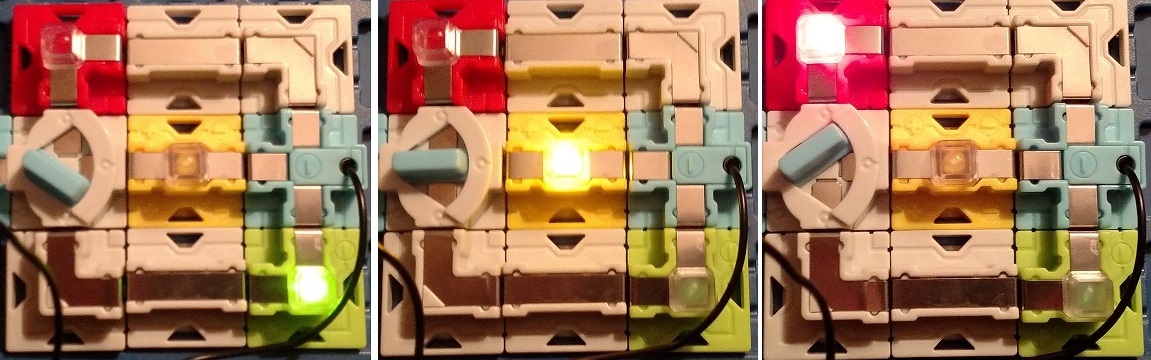
For instance, the above setup requires a different relay to light up for each switch setting (meaning that the switch’s first setting lights up the red, its second setting lights up the yellow, and its third setting lights up the green). These multiple goals make building your pathway more challenging and really forces you to think about how to use each piece to its utmost.

[Here the completed circuit causes each relay to light up with a flip of the switch.]

The challenge cards range from Beginner, which offers introductory tricks and lessons, to Intermediate, Advanced, and Expert puzzles, each with their own obstacles.

Sometimes, you know where a piece is placed, but not which direction it should face. Other times, you have to create pathways that will allow multiple relays to light up at once, and others where nothing lights up at all.

In the Advanced-level challenge card below, the solver has to make sure that the red relay always lights up, no matter what setting the switch is on, but other switch settings also have to light up either the yellow or green relays. It’s quite a mental workout!

Circuit Maze definitely rivals Gravity Maze as the most challenging ThinkFun product to date, but it’s a very worthwhile challenge to tackle. This is next-level deductive thinking, plotting out paths that accomplish different tasks at different times, all while maintaining a complete circuit and matching positive and negative current paths.

This serves as a strong follow-up to the deduction lessons new solvers learned in Clue Master, making for a solid one-two punch of logical puzzling the whole family can enjoy together (or you can play by yourself)!

Clue Master and Circuit Maze are both available this holiday season at Amazon or Target!


Thanks for visiting PuzzleNation Blog today! Be sure to sign up for our newsletter to stay up-to-date on everything PuzzleNation!

You can also share your pictures with us on Instagram, friend us on Facebook, check us out on TwitterPinterest, and Tumblr, and explore the always-expanding library of PuzzleNation apps and games on our website!

An Unexpected Tribute to a Loyal Solver

Crossword solvers are creatures of habit. Whether it’s a Sunday morning thing or an every day thing, you have your certain puzzle, which you solve in your certain spot, with a certain drink in hand.

The Washington Post unintentionally disrupted that routine for many solvers last Wednesday when they accidentally left the crossword out of the paper.

One solver in particular, though, found it to be a most appropriate interruption.

A man named Sidney Schulman was a devotee of the Washington Post crossword, and his great-grandson Justin Green reached out to The Post‘s Design Director, Greg Manifold, to share this story:

There are moments in life when pieces fall into place so perfectly, it seems meant to be. This must’ve been one of those times.

[Thanks to Evan Birnholz for sharing this tweet.]


Thanks for visiting PuzzleNation Blog today! Be sure to sign up for our newsletter to stay up-to-date on everything PuzzleNation!

You can also share your pictures with us on Instagram, friend us on Facebook, check us out on TwitterPinterest, and Tumblr, and explore the always-expanding library of PuzzleNation apps and games on our website!

Halloween Hallowhimsy!

Hello there, fellow puzzlers and PuzzleNationers!

It’s Halloween, that spookiest of holidays, and I’ve got two puzzly videos loaded with today’s traditional tricks and treats!

The first video comes from musician and comedian Ali Spagnola, who has created a masterful mashup of 20 tunes loaded with Halloween spirit! Can you name all 20 songs?

I’m a little disappointed that Warren Zevon’s “Werewolves of London” didn’t make the cut, but otherwise, this is awesome.

The second video comes from domino artist and friend of the Blog Hevesh5, who has created a new domino chain to celebrate All Hallow’s Eve in eerie, energetic fashion!

Whether it’s ghosts or goblins, ditties or dominoes, we hope you have a marvelous Halloween!


Thanks for visiting PuzzleNation Blog today! Be sure to sign up for our newsletter to stay up-to-date on everything PuzzleNation!

You can also share your pictures with us on Instagram, friend us on Facebook, check us out on TwitterPinterest, and Tumblr, and explore the always-expanding library of PuzzleNation apps and games on our website!

It’s Follow-Up Friday: This Illusion’s Got Legs edition!

Welcome to Follow-Up Friday!

By this time, you know the drill. Follow-Up Friday is a chance for us to revisit the subjects of previous posts and bring the PuzzleNation audience up to speed on all things puzzly.

And today, I’d like to return to the subject of viral optical illusions.

Last year, we had The Dress. Then, in March of this year, we had The Jacket. And in May, we asked the question How Many Girls?

Whether we’re spotting iPhones or looking for cats in woodpiles, we can’t seem to get enough of optical illusions.

And there’s a new one making the rounds recently:

[Image courtesy of TheChive.com.]

A woman named Bree tweeted this image of a pair of bare legs that look incredibly shiny. Are they false legs? Are they lotioned or wrapped in Saran wrap? What’s going on here?

I’ll give you a few moments to ponder the image before revealing the secret behind it. Because, as Bree said, “Once you see it, you can’t unsee it.”

Ready? Okay, here we go.

Like most optical illusions, the answer is startlingly simple.

[Image courtesy of TheChive.com.]

The illusion of shininess is actually the result of strategically placed streaks of white paint or toothpaste or something similar.

Pretty impressive once you really look at it, isn’t it?

This image has truly gone viral. As I write this, it’s been retweeted over 16,000 times, and liked over 20,000 times. Bree herself seems baffled by the attention the post has received.

Amazing what you can do with a bit of white paint.


Thanks for visiting PuzzleNation Blog today! Be sure to sign up for our newsletter to stay up-to-date on everything PuzzleNation!

You can also share your pictures with us on Instagram, friend us on Facebook, check us out on TwitterPinterest, and Tumblr, and explore the always-expanding library of PuzzleNation apps and games on our website!