Puzzle History: Codebreaking and the NSA, part 2

[Image courtesy of NSA’s official Twitter account.]

At the end of part 1 of our look at the history of the NSA and American codebreaking, we left off with the pivotal Black Friday event.

On November 1, 1948, all intel coming from monitored Soviet signals went quiet. All traffic on military, naval, and police radio links was replaced with dummy messages. It was such an unprecedented and alarming event that London and Washington briefly considered that it might’ve been the first indication of preparations for war.

According to Code Warriors author Stephen Budiansky:

The full extent of the disaster only became apparent the following spring when real traffic started reappearing on the radio nets, now employing greatly improved — and completely unbreakable — technical and security procedures. The keying errors or other mistakes that had allowed most of the Soviets’ machine-enciphered military traffic to be routinely read by US and British codebreakers for the last several years had been corrected, and the much more disciplined systems that now replaced them slammed the cryptanalytic door shut.

Even the one-time pads that had offered some hope to attentive American codebreakers were updated, eliminating the ability to sort messages by which organization they originated from.

Codemakers had suddenly outpaced codebreakers.

[The Kryptos sculpture outside CIA Headquarters. The NSA cracked
several of its codes before the CIA did. Image courtesy of Slate.com.]

The Office of Naval Intelligence wanted to take over from Signals Intelligence (SIGINT), demanding to see “everything” so they could do the job. They claimed SIGINT should limit their work to message translation, leaving interpretation to “the real experts.” This sort of territorial gamesmanship would continue to hamper government organizations for decades to come.

And that demand to see everything? That probably sounds familiar, in light of the revelations about government data collection and the PRISM program that were revealed in Edward Snowden’s leaks.

Black Friday was the start of all that, a shift from codecracking to the massive data collection and sifting operation that characterized the NSA for decades to come.

More amazingly, there was SO MUCH information collected during World War II that SIGINT was still poring over it all in 1949, decrypting what they could to reveal Soviet agents in the U.S. and England.

The fact that a high-ranking member of British Intelligence at the time, Kim Philby, was actually a Soviet double agent complicated things. After a decade under suspicion, Philby would flee to the Soviet Union in 1963, stunning many friends and colleagues who had believed in his innocence.

[The spy and defector, honored with a Soviet stamp.
Image courtesy of Britannica.com.]

Although the Russians had flummoxed SIGINT, other countries weren’t so lucky. The East German police continued to use ENIGMA codes as late as 1956. Many of the early successes in the Korean War were tied to important decryption and analysis work by SIGINT. Those successes slowed in July of 1951, when North Korea began mimicking Russia’s radio procedures, making it much harder to gain access to North Korean intel.

Finally, the chaotic scramble for control over signal-based data gathering and codebreaking between the government and the military resulted in the birth of the National Security Agency on November 4, 1952, by order of President Truman.

One of the first things the NSA did? Reclassify all sorts of material involving historical codebreaking, including books and papers dating back to the Civil War and even the American Revolution.

[The actual report that recommended the creation of the NSA.
Image courtesy of NSA’s official Twitter account.]

The creation of the NSA had finally, for a time at least, settled the issue of who was running the codebreaking and signals intelligence operation for the United States. And they were doing fine work refining the art of encryption, thanks to the work of minds like mathematician and cryptographer Claude Shannon.

One of Shannon’s insights was the inherent redundancy that is built into written language. Think of the rules of spelling, of syntax, of logical sentence progression. Those rules define the ways that letters are combined to form words (and those words form sentences, and those sentences form paragraphs, and so on).

The result? Well, if you know the end goal of the encoded string of characters is a functioning sentence in a given language, that helps narrow down the amount of possible information contained in that string. For instance, a pair of characters can’t be ANYTHING, because letter combinations like TD, ED, LY, OU, and ING are common, while combos like XR, QA, and BG are rare or impossible.

By programming codecracking computers to recognize some of these rules, analysts were developing the next generation of codebreakers.

Unfortunately, the Russian line was holding. The NSA’s failure to read much, if any, Soviet encrypted traffic since Black Friday was obviously becoming more than just a temporary setback.

Something fundamental had changed in the nature of the Russian cryptographic systems, and in the eyes of some scientific experts called in to assess the situation, the NSA had failed to keep up with the times.


I hope you’re enjoying this look at the early days of America’s 20th-century codebreaking efforts. Part 3 will continue next week, with the sea change from active codebreaking to data mining, plus Vietnam, the space race, and more!


Thanks for visiting PuzzleNation Blog today! Be sure to sign up for our newsletter to stay up-to-date on everything PuzzleNation!

You can also share your pictures with us on Instagram, friend us on Facebook, check us out on TwitterPinterest, and Tumblr, and explore the always-expanding library of PuzzleNation apps and games on our website!

Our Fourth of July Deluxe Puzzle Set is Here!

Hello puzzlers and PuzzleNationers! Happy Independence Day!

And we’re celebrating the Fourth of July the way we know best: by launching a new puzzle set for the Penny Dell Crosswords App!

Our July Deluxe puzzle set just launched for both iOS and Android users, and it’s one of our best yet!

Take a break from the fireworks and barbecue to tackle this patriotic puzzle bundle, designed for any skill level!

Offering 30 easy, medium, and hard puzzles, plus 5 July-themed bonus puzzles to delight solvers of all skill levels, the July Deluxe set is just what the doctor ordered to scratch that puzzly itch!

But that’s not all!

That’s right, double down on puzzle goodness with the July Deluxe Combo! That’s 70 puzzles, including July-themed bonus crosswords for your puzzly pleasure!

But maybe you need more! If you want an explosive deal on PuzzleNation-quality crosswords, we’ve got you covered with the July Deluxe Bundle! That’s 105 puzzles, three times the terrific content and crafty cluing, loaded and ready for you to solve!

You can’t go wrong with these awesome deals! PuzzleNation is dedicated to bringing you the best puzzle-solving experience available, with world-class puzzles right in your pocket, ready to go at a moment’s notice! That’s the PuzzleNation guarantee.

Happy solving, and happy Independence Day everyone!


Thanks for visiting PuzzleNation Blog today! Be sure to sign up for our newsletter to stay up-to-date on everything PuzzleNation!

You can also share your pictures with us on Instagram, friend us on Facebook, check us out on TwitterPinterest, and Tumblr, and explore the always-expanding library of PuzzleNation apps and games on our website!

Site Update in Progress

Forgive the interruption, folks. We’re working on an upgrade to the blog, so you may notice broken photo links and other irregularities while reading posts. Worry not! All is in good hands.

We’ll keep you posted on when you can expect the blog to be back up and running in full. Thank you for your patience.

PuzzleNation Product Review: Less

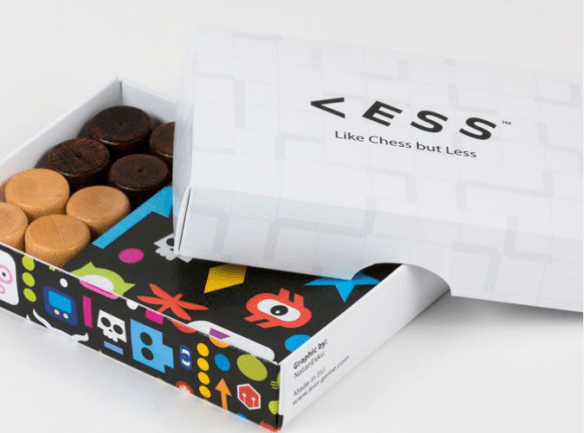
lessgame

There are many games out there that pair nicely with food or drink. Many party games even revolve around this mechanic, like Jason Anarchy’s alcohol-fueled roleplaying game Drinking Quest.

But I think Less is the first game where the playing tiles intentionally double as coasters for your drinks. It feels like a game that could be played in a tavern at a moment’s notice, which lends its minimalist style an old-world gaming charm.

less1

But I’m getting ahead of myself here. Less is a strategy game that combines the tactical planning of chess with the dynamic maneuverability of checkers.

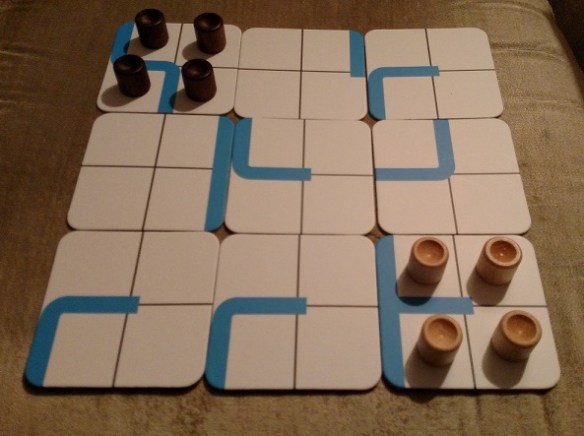
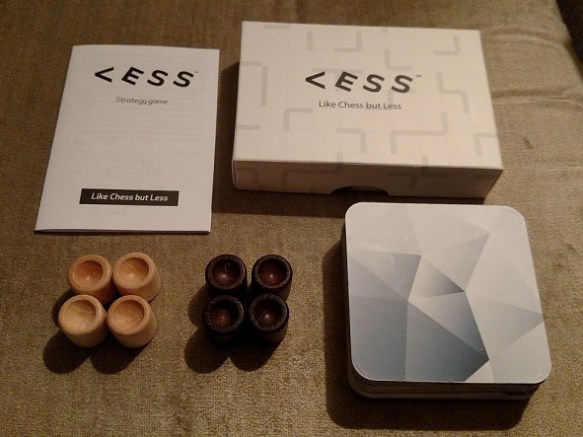
The game consists of 12 tiles and 8 game pieces, 4 white and 4 black. The players randomly select 9 of the 12 tiles and arrange a 3×3 game board. (With 12 tiles and four ways to place each tile, you’re virtually guaranteed a different game board every time you play.)

One player sets up their 4 game pieces in one corner, and the other player sets up their game pieces in the opposite corner. The goal of the game is to move all 4 of your pieces into your opponent’s corner before your opponent can occupy your corner.

less2

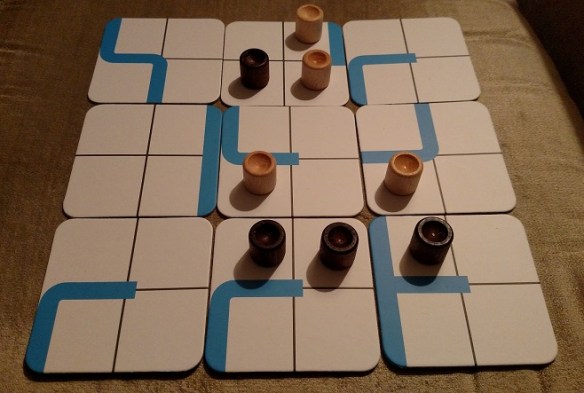
To do so, you are allowed three moves per turn. You can use all three moves for a single game piece, or spread them out over multiple game pieces. Moving a piece from one square to a neighboring square is one move. Jumping over a game piece to the next open square is also one move. (Here’s where checkers-style planning comes in handy.)

By now, you’ve probably noticed those blue walls on some of the tiles. Those walls require an extra move to traverse, so moving a game piece over a wall requires two moves. (And if neighboring squares each have a wall between them, jumping that double wall requires all three moves that turn.)

This three-move system offers players loads of options going forward, but your best bet is to arrange a sequence of leapfrog jumps to move your pieces as efficiently as possible across the board. (Unlike chess or checkers, there is no capturing or removing your opponent’s pieces from the board.)

less3

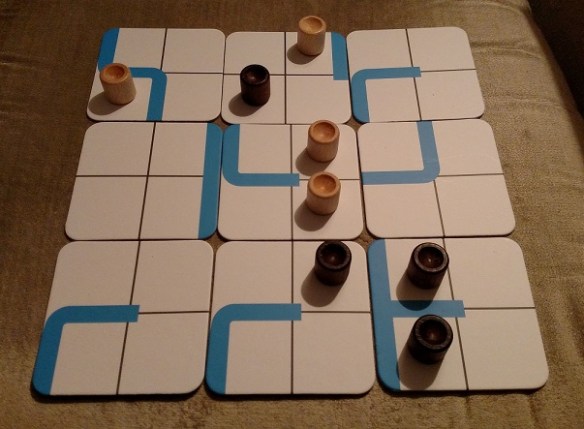
[Here, black has more pieces near the opposing corner, but that blue wall will make it harder to occupy the corner efficiently. Meanwhile, more of white’s pieces are farther away, but there are fewer obstacles to slow those pieces down.]

Mixing a tactical approach with the improvisation that comes with reacting to your opponent’s movements makes Less a very engaging gaming experience, even if a game routinely lasts less than ten minutes. And on the puzzle side of things, figuring out the most efficient way to navigate a path toward your opponent’s corner is great fun, since every game is different, and your opponent has different obstacles to tackle than you do, given the random placement of walls on the board.

Plus, if you’re willing to invest in two copies of the game, you can play with four players, as you and your partner coordinate your efforts across a 4×4 game board in the hopes of occupying your opponents’ corners first.

It’s a game that takes a few minutes to learn and offers near-infinite replayability. It might be called Less, but it feels like a very complete, very satisfying challenge.

less4

Less is published by InventedFor and is available online at less-game.com (with numerous coaster designs for the reverse side of the tiles). Click here for full details.


Thanks for visiting PuzzleNation Blog today! Be sure to sign up for our newsletter to stay up-to-date on everything PuzzleNation!

You can also share your pictures with us on Instagram, friend us on Facebook, check us out on Twitter, Pinterest, and Tumblr, and explore the always-expanding library of PuzzleNation apps and games on our website!

Puzzle History: Codebreaking and the NSA

ohr577n

[Image courtesy of NSA.gov.]

The National Security Agency has been in the news a lot over the last few years.

It arguably all started with Edward Snowden and the revelations about government surveillance, both domestic and foreign, that emerged in his wake. Between President Trump’s intimations of Obama-era wiretapping (which also supposedly involved England’s GCHQ) and recent news stories about NSA contractor Reality Winner leaking information, the NSA continues to draw mainstream attention in the 24-hour news cycle.

When you factor in the declassification of codebreaking intel during and after World War II, we know more about the NSA’s inner workings than ever before.

You might be asking what the NSA has to do with puzzles. Well, everything. Because the NSA was born as a codecracking organization.

enigma

The NSA was founded in November of 1952, but its formative stages began during World War II, as codebreakers were recruited in the U.S. starting in 1943. Not only were they tasked with tackling the German ENIGMA code, but their secondary mission was to solve “the Russian problem.” This group was known as Signals Intelligence, or SIGINT.

William Friedman, one of the early figures in American codebreaking, described cryptanalysis as “a unique profession, demanding a peculiar kind of puzzle-solving mentality combined with patience. So staffing this new organization was a curious endeavor.”

Those who were recruited came from all walks of life:

Career officers and new draftees, young women math majors just out of Smith or Vassar, partners of white-shoe New York law firms, electrical engineers from MIT, the entire ship’s band from the battleship California after it was torpedoed by the Japanese in the attack on Pearl Harbor, winners of puzzle competitions, radio hobbyists, farm boys from Wisconsin, world-traveling ex-missionaries, and one of the World’s foremost experts on the cuneiform tablets of ancient Assyria.

04/11/14 imitation game - bletchley park, milton keynes

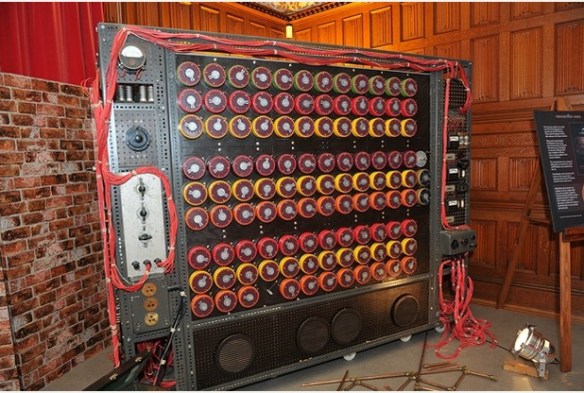
A large campus was built that echoed the style and efforts of Britain’s Bletchley Park, including Alan Turing’s calculating machines, the bombes. Efforts on both sides of the Atlantic centered on cracking ENIGMA, the German codes used in all sorts of high-level communications. The teams worked alongside the bombes to try to determine which of the 456, 976 possible codes was being used in a given piece of communication.

It was a truly Herculean effort.

But while nearly half the staff focused on the Germans, others focused on cracking Russian codebooks, where words were translated into four-digit codes. Often, decrypting these codes involved “brute force” efforts, poring through numerous messages to pair up messages that used similar numerical groups, meaning they used the same cipher.

This would only work if the Soviets were lazy in their production of so-called “one-time pads,” encryption devices that had a particular code, which would be used once and then thrown away. Brute force codebreaking revealed that some of the one-time pads had been used more than once, a lapse in Soviet security that could work to the advantage of U.S. intelligence.

That deduction led to another stunning discovery: cracking the system used in encrypted messages to tell agents which encryption was used in a given missive. You see, each encoded message contained within it a code that dictated the cipher necessary to decrypt the message.

The Russians would later complicate this work by employing multiplexers: devices that would transmit numerous messages at once, making it harder to separate one message from another in the same dispatch.

hqdefault6

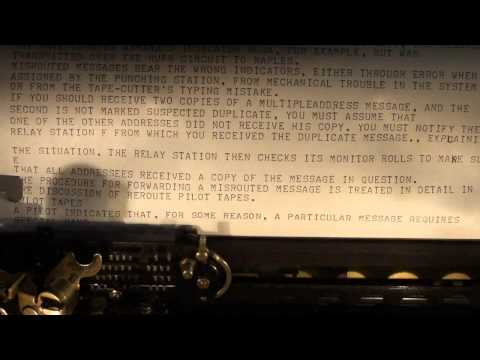
[Image courtesy of Virtantiq.com.]

The Germans would unwittingly aid the US in their Russian codebreaking efforts when a POW camp in Bad Aibling, Germany, was captured by the US army, and they uncovered a German device designed to “de-multiplex” Russian messages. The device was called the HMFS, because Hartmehrfachfernschreiber, while a great deal of fun to type, is hard to say quickly.

After World War II ended, U.S. intelligence consolidated their efforts on “the Russian problem,” continuing their work unraveling the Russian codebooks. Slowly, the codemasters began determining which organizations in the Soviet government used which codes. Even if the codes weren’t broken yet, it helped the intelligence community organize and prioritize their efforts.

The problem? They had a very tight timeframe to work in. Those duplicated codebooks were produced during a very small window of time in 1942, and only issued to Soviet agents in the three years that followed. By 1947, SIGINT analysts knew the Soviets would soon run out of the duplicated pads. Once they did, those recurring patterns of encrypted numbers would stop, and the best chance for cracking the Soviet codes would be lost.

Still, there was reason to be encouraged. Some important code words had been identified. TYRE was New York City, SIDON was London, and CARTHAGE was Washington; ENORMOZ appeared often enough that they determined it referred to atomic bomb research in Los Alamos.

It would also be revealed, through careful analysis of decrypted intel, that Soviet agents were embedded in both the U.S. Justice Department and in England’s Bletchley Park campus. The Justice Department agent was identified and tried, but released after the court found insufficient evidence to place her under surveillance in the first place.

This was one consequence of the secrecy surrounding codebreaking: an unwillingness to reveal their codebreaking success by turning over evidence of it. (As for the Bletchley Park spies, one was identified in 1951 and confessed in 1964. The other was never identified.)

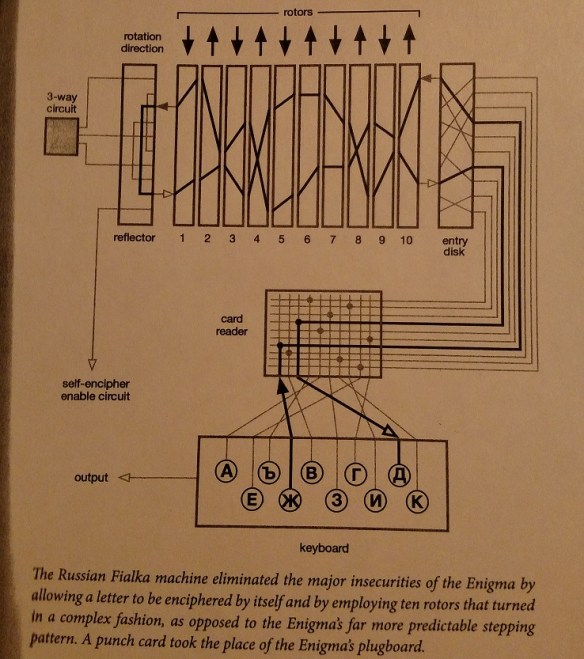
By this time, the Russians had gone over ENIGMA machines captured during the German retreat, and had unraveled not only how the devices worked, but how to improve upon them. This would lead to the next-generation Russian Fialka machine.

fialka

With ever-increasing complexity when it came to encryption, thanks to increased automation, codebreaking evolved into not just intelligence work, but intelligence analysis. After all, if you don’t know something is important, you don’t necessarily give it the attention it deserves. As researcher Stephen Budiansky put it, “The top translators at Bletchley were intelligence officers first, who sifted myriad pieces to assemble an insightful whole.”

It also led to bigger, faster machines, like Goldberg and Demon, two computation machines designed to more efficiently pore over the vast amount of encrypted information being intercepted by the various U.S. intelligence services.

In 1948, though, the game changed. It changed so dramatically that November 1, 1948, is still remembered in NSA circles as Black Friday.


I hope you’re enjoying this look at the early days of America’s codebreaking efforts. Part 2 will continue next week, with a look at the rise of the NSA, Cold War cryptography, and more!

[Quotes and certain photos were sourced from Code Warriors: NSA’s Codebreakers and the Secret Intelligence War Against the Soviet Union by Stephen Budiansky.]


Thanks for visiting PuzzleNation Blog today! Be sure to sign up for our newsletter to stay up-to-date on everything PuzzleNation!

You can also share your pictures with us on Instagram, friend us on Facebook, check us out on TwitterPinterest, and Tumblr, and explore the always-expanding library of PuzzleNation apps and games on our website!

Collection 23: New Puzzle Sets for the Penny Dell Crosswords App!

Hello puzzlers and PuzzleNationers! Happy Friday!

Our latest puzzle set for the Penny Dell Crosswords App just launched for both iOS and Android users, and it’s one of our best yet!

Collection 23 has arrived!

23a

For the prolific puzzlers and savvy solvers among you, we’ve just launched the perfect puzzle bundle, designed for any skill level!

You can grab any of the Collection 23 puzzle sets, which range from easy to medium to hard, each one featuring 30 topnotch puzzles!

23c

Or you can pick up one of the Collection 23 puzzle combos, which offer 60 easy puzzles or 60 medium puzzles for your solving enjoyment!

23d

But that’s not all! You can always opt for the Collection 23 Value Pack, which offers 150 easy, medium, and hard puzzles designed to satisfy and challenge any puzzler!

You can’t go wrong with these awesome deals! PuzzleNation is dedicated to bringing you the best puzzle-solving experience available, with world-class puzzles right in your pocket, ready to go at a moment’s notice! That’s the PuzzleNation guarantee.

Happy solving, everyone!


Thanks for visiting PuzzleNation Blog today! Be sure to sign up for our newsletter to stay up-to-date on everything PuzzleNation!

You can also share your pictures with us on Instagram, friend us on Facebook, check us out on TwitterPinterest, and Tumblr, and explore the always-expanding library of PuzzleNation apps and games on our website!