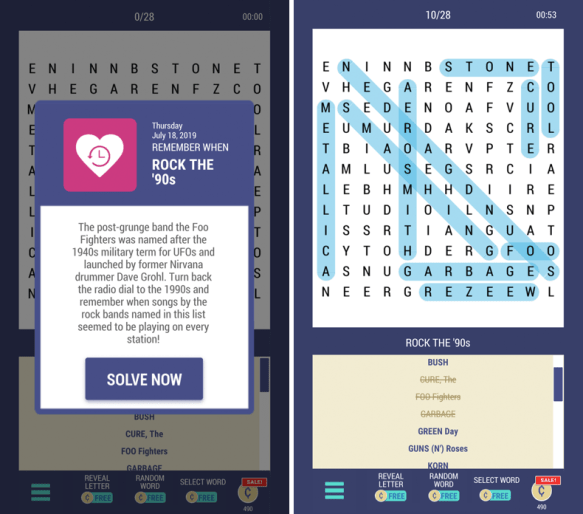
One of my favorite features offered by the Daily POP Word Search app is how it maintains records of your solving.
Not only can you see your fastest times for each theme day, but the app even keeps a running tally of how many days in a row you solve the free daily puzzles.
True, the app has only been out for a month or so, so even the most loyal PuzzleNationer hasn’t had the chance to compile a monster streak.
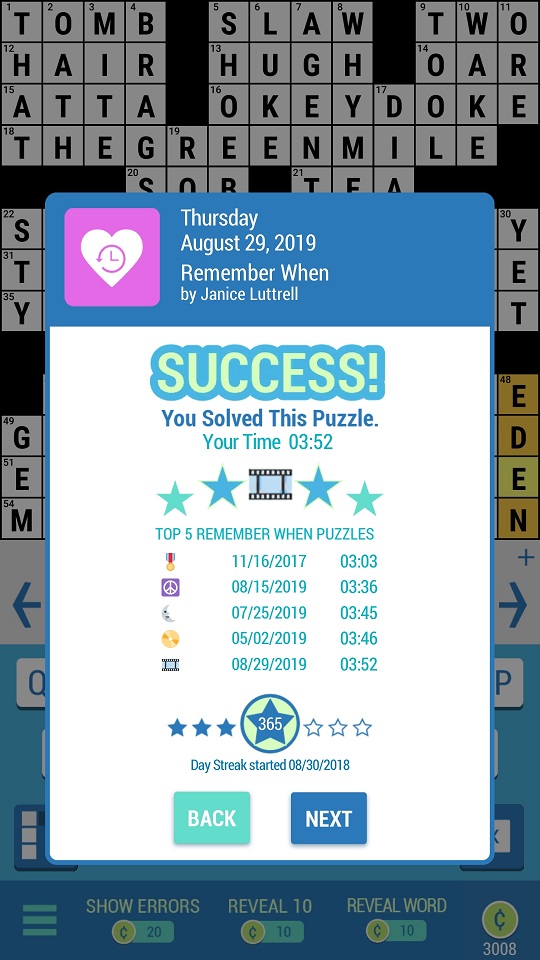
But users of the Daily POP Crosswords app also have a streak counter, and one of our faithful fellow puzzlers, Lori, just hit a milestone.
Check it out!
Not only did she score a top 5 performance for the August 29 “Remember When” puzzle, but she did so while solving her three-hundred-and-sixty-fifth puzzle in a row.
That’s a one year streak of Daily POP Crossword solving! Amazing!
(I must confess that my best attempt topped out around 150 or so before I missed a day.)
However, it’s certainly possible there’s a PuzzleNationer out there with an even more impressive streak going. If you’ve got a Daily POP streak that you’re proud of, whether it rivals Lori’s record or not, let us know in the comments below! We’d love to hear from you!
And hey, maybe we’re only 11 months away from celebrating our first year-long streak in Daily POP Word Search!
Wouldn’t that be something?
Thanks for visiting PuzzleNation Blog today! Be sure to sign up for our newsletter to stay up-to-date on everything PuzzleNation!
[Note: I received a free copy of this game in exchange for a fair, unbiased review. Due diligence, full disclosure, and all that.]
Some of the most important moments in the Star Trek franchise center around altering the past through time travel. Choosing to save Edith Keeler in the original series, the Enterprise-C sacrificing itself to bring peace to the Klingons and the Federation in Star Trek: The Next Generation, or Sisko preventing a Tribble bomb from killing Kirk in Deep Space Nine… iconic scenes both humorous and galaxy-changing involved rending the fabric of time and space. (Heck, the new film franchise was based entirely on changing the timeline from what we knew previously!)
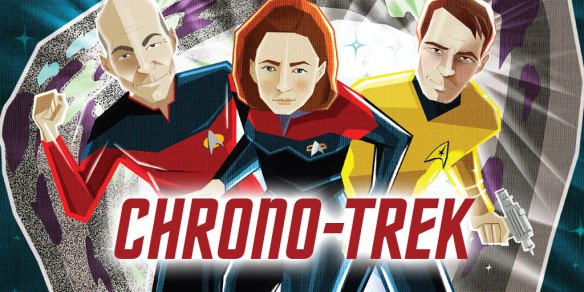
So when I heard that Looney Labs updated their time-jumping strategy card game Chrononauts to include elements from the Star Trek universe, it seemed like a perfect fit. How did they do? Find out today as we review the new Star Trek Chrono-Trek card game.
[A sample of each of the 11 different types of cards in the game.]
Much like its inspiration Chrononauts, Chrono-Trek is all about the cards. You’ve got assignment cards, ID cards, timeline cards that make up the playing space, artifact cards, cards that change history (and others that change it back), as well as cards that can help or hinder your fellow time travelers.
At the beginning of the game, the timeline cards are laid out in a 4×9 grid that represents the historical timeline from the Star Trek shows and films. Each player then draws an ID card representing a Star Trek character. Each character has certain victory conditions — some combination of events that must be preserved or changed in the timeline and artifacts to be acquired during play — that must be met for you to win the game. The ID cards are ranked by difficulty, indicating how complex the victory conditions are.
As for the other cards available to the player, they allow you to manipulate time, find artifacts, or manipulate the cards in your opponents’ hands. (For Fluxx players, some of these Action cards will seem very similar, as will the artifact cards, which are played just like keepers in Fluxx.)
[A small glimpse of the timeline.]
The history-changing aspect is the puzzliest part of the game, as you determine what moments to change (and which to protect from your opponents) in order for your timeline to come to pass. But you must be careful, because you also need to ensure that you don’t accidentally end the game by allowing the anomaly from the series finale of Star Trek: The Next Generation — the Anti-Time Devron Anomaly — from preventing life on Earth. (In nearly every scenario, that’s a game over for all players. Pretty daunting, to say the least!)
And although bending time to your will and winning is certainly fun, watching the effect ripple down through the cards after making a bold history-altering move is arguably the best part of the game.
It will take one or two playthroughs — with easier ID cards only — to get used to the game mechanics, but after that, it’s a quick and easy deep-dive into the more complex victory conditions and a much more immersive and challenging play experience. (The game can go a bit too rapidly if you’re only using two players, so I’d recommend playing with four or more players to get the most out of the game.)
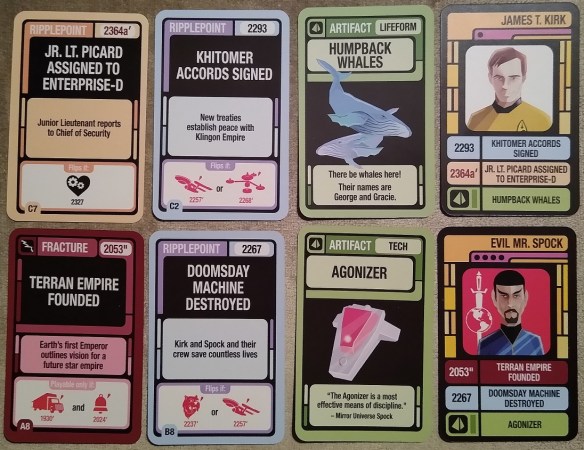
[A comparison of a one-pip (easy) ID card and a four-pip (complex) ID card. Kirk simply requires you to protect one moment, invert another, and collect an artifact. Meanwhile, Evil Spock requires you to find the Fracture card, manipulate two events just to place the Fracture, and still maintain another moment AND acquire an artifact. That’s a much taller order.]
The designers did an impressive job figuring out which moments from the 50 years of Star Trek history to include in the timeline, which characters to offer as ID cards, and so on. For a Star Trek enthusiast, there are great references and little callbacks galore to favorite moments from the series. Not only that, but the game ups the ante from the original Chrononauts formula, keeping all of the best aspects of that game while making this one feel unique.
I posed the question in the intro asking how Looney Labs did marrying Star Trek and Chrononauts. The answer? They boldly went where no Star Trek card game had gone before, and created one heck of a fun adventure.
[Note: I received a free copy of this game in exchange for a fair, unbiased review. Due diligence, full disclosure, and all that.]
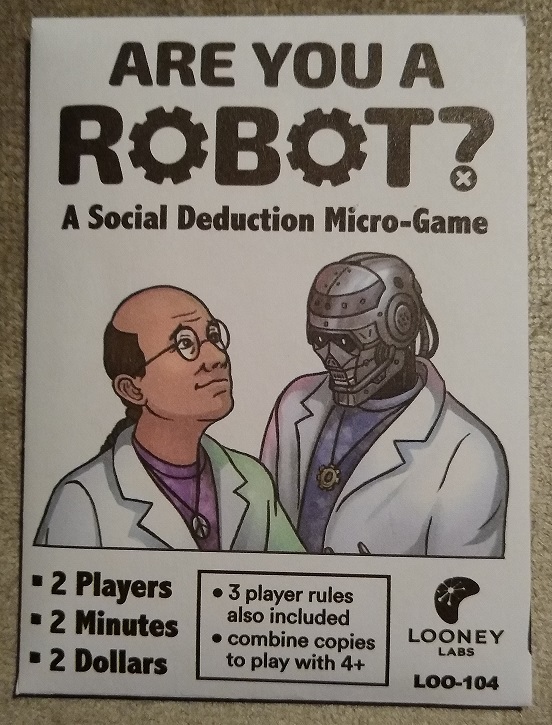
Whether you’re playing a board game like Clue or a card game like Werewolf or Mafia, you and your fellow players have accepted the challenge of a very different form of puzzle gaming: the social deduction game.
Social deduction games operate under a simple premise — the cards determine the role you play — and from that point forward, you’re trying to determine who is secretly a danger to you and others in the game.
In this particular case, there might a robot lurking among the humans aboard your space station.
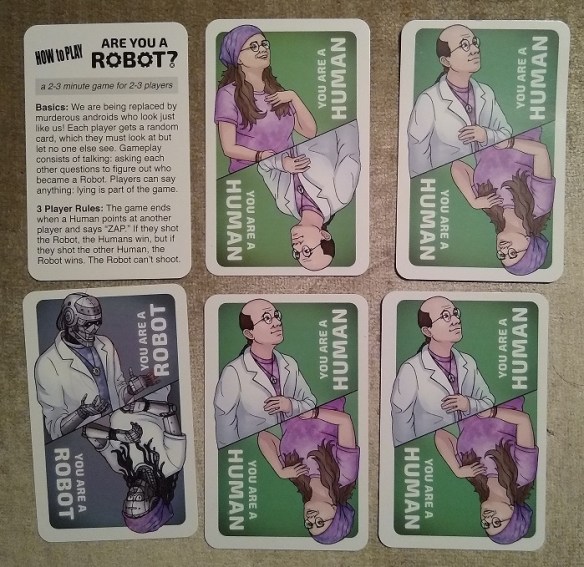
You see, in Are You a Robot?, all of the players randomly select a card. There’s always a human card for every person playing the game, plus one robot card. (So, for instance, if five people are playing, you have five human cards and one robot card in the deck.) You shuffle the cards, deal out one to each player, and put the last one aside. Everyone looks at their card (but doesn’t show anyone else) and discovers their role for the game.
Now, at this point, there’s between zero and one robots in the game, and the rest of the players are human. The humans want to suss out if there are any robots disguised as humans, and the robot wants to get the humans to accuse each other and whittle down their numbers so the robots can take over.
[A whole lot packed into a little envelope.]
This is the social aspect of the game. There are three things players can do in order to figure out who is who: shake hands, shoot a laser gun at another player, or talk. If the players all agree that there are no robots in play, two players can agree to shake hands. If there are no robots in the game after all, the humans win. If a robot is present after all, the humans lose.
Humans can shoot other players, but robots cannot. If a robot is shot, it’s gone from the game and the humans rejoice. If a human is shot, three things happen: the shooter is immediately removed from the game, the human who was shot comes back to life and returns to the game, and there’s a chance another robot slips into the game.
This element of chance involves all of the players closing their eyes, any robots secretly revealing themselves, and all of the remaining players turning in their cards. Those cards are shuffled randomly, a robot card is introduced, and the cards are redistributed to the surviving human players.
It’s possible everyone remains human, and it’s possible one of the humans is now a robot in disguise.
The game now resumes, and the players must once again figure out if there are any robots in their midst. (And your mind immediately begins spiraling out with possibilities. “Did so-and-so not shoot me because he believes that I’m human? Or because he’s a robot and can’t shoot me?”)
[The set up for a four-person game: instructions, four human cards, and one robot card.]
Play continues until either the humans have eliminated any possible robots (and have shaken hands to confirm this) or the robots have overwhelmed the game and the humans have been whittled down to a single player.
In my estimation, Extended Mode, designed for 5 or more players, is the most interesting version of the game. The core game is for two or three players, consisting of two human cards and one robot card. Adding a second game allows for up to four players, a third game allows for up to six, and so on.
Our Extended Mode testing involved eight players (and four copies of the game), which allowed for multiple rounds of play, the introduction of several possible additional robots, and so on, making for a deeper, more engrossing (and nerve-wracking!) play experience.
And that’s the beauty of Are You a Robot? when compared to similar social detection card games like Mafia and Werewolf. Not only can you have satisfying play experiences with fewer people but the element of randomness that comes into play with more players adds tension to the game. (In Mafia and Werewolf, the number of antagonists is set at the start of the game. In Are You a Robot?, the number might increase, or it might not. It’s a simple change that adds so much.)
An elegant balance of silliness and suspenseful, consequence-loaded gameplay, Are You a Robot? is a winner with any number of players. Bring your laser gun, bring your skepticism, and bring along a couple of sets so everyone can play.
Back in March, we did a round-up of all sorts of puzzle books for solvers looking to return to the simplicity of solving with pencil and paper. We focused on books loaded with puzzles for your enjoyment.
But that’s only a small sampling of the books available to puzzle fans. In addition to straight-forward puzzle books, you can find guides on how to make puzzles and games, books offering historical or social insight on the puzzle-game genre, and even fiction books that incorporate puzzles into the storytelling.
So today, we’re doing another puzzle-book round-up, but we’re expanding the scope a bit to cover some delightful puzzle-themed books you might’ve missed recently.
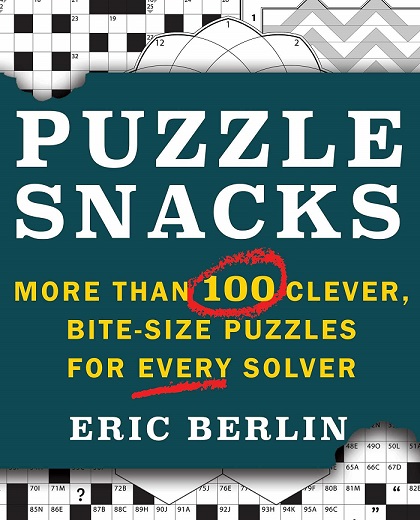
If you’re relatively new to solving — or you’d like to introduce someone to the world of puzzles — then Puzzle Snacks by Eric Berlin is a terrific place to start.
Loaded with over 100 puzzles that run the gamut from fill-ins and clued puzzles to brain teasers and wordplay games, Puzzle Snacks fits solvers of any experience level, helping build up your puzzle skills while introducing you to dozens of variations on the puzzles you know.
For the word seek/word search fans, we’ve previously recommended the word search puzzles of Shawn Marie Simmons, which are geared toward bookworms with themed lists based on literature.
Her latest offering is 25 Word Search Puzzles for MODERN Literature Lovers. With word lists tailored to different iconic authors and works of literature — ranging from the Lord of the Rings and Virginia Woolf to Roald Dahl and Margaret Atwood — you can revisit your favorite reads as you go searching each grid for a bevy of fun and familiar words.
But maybe you’d like to mix some light puzzling with a touch of adventure-filled storytelling for either you or younger solvers. In that case, the recent Netflix revival of Where in the World is Carmen Sandiego? might have what you’re looking for.
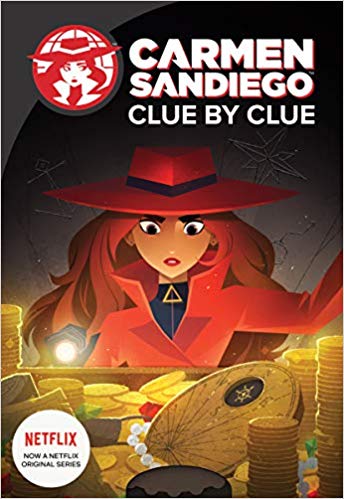
A series of tie-in books for the show are now on the market, and the best of them is Clue by Clue by Catherine Hapka. Centered around the former thief’s efforts to do good and thwart her former allies, Clue by Clue sets Carmen and the ACME team on a treasure hunt for a prize that’s been missing for centuries.
What makes this book so noteworthy is the decoder wheel built into the cover itself! By rotating the wheel, you can decipher different coded messages throughout the book, cracking the case alongside Carmen and her allies.
Our last offering turns to the world of board games, as the author shares both his own personal experiences with games and how different types of games create different play experiences.
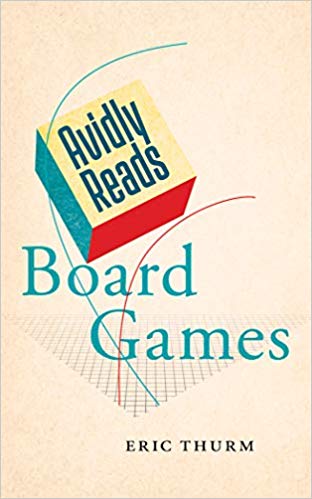
Avidly Reads Board Games by Eric Thurm covers topics like the pluses and minuses of cooperative games, the emergence of legacy games, the infamy of Monopoly, and the curious subgenre of political games (both the intentionally nasty and those that history has judged poorly). Along the way, Thurm offers glimpses into various aspects of modern gaming.
More a series of short essays than one cohesive narrative, Avidly Reads Board Games is one man’s look at a world of games that is constantly evolving, yet remains tied to its earliest successes.
Can you think of any terrific puzzle books we missed? Let us know in the comments section below! We’d love to hear from you.
Thanks for visiting PuzzleNation Blog today! Be sure to sign up for our newsletter to stay up-to-date on everything PuzzleNation!
I’ve had 3-D puzzling on the brain for a few days now, after a conversation about video games with a well-informed friend of mine.
What do I mean when I say 3-D puzzling? Well, I don’t just mean a puzzle that exists in three dimensions. I mean a puzzle where the solving experience requires all three dimensions.
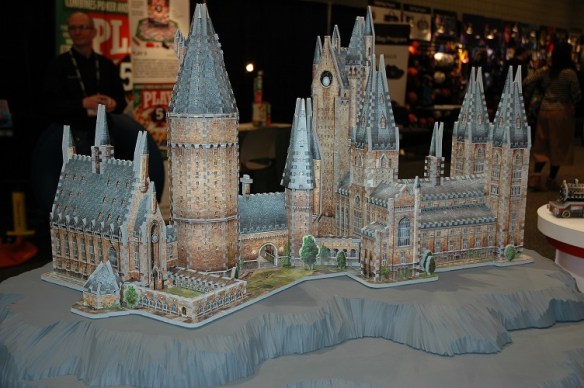
Think about your average maze or a jigsaw puzzle. Although they’re three-dimensional objects, the solving is two-dimensional. Yes, there are certainly variations on these themes, like maze cubes where you navigate a marble from one place to another, or 3-D jigsaw puzzles that allow you to reconstruct famous landmarks. But these still rely heavily on two-dimensional solving.
Compare that with the iconic puzzle video game Portal, for instance. Portal requires you to accomplish different tasks, and you can only do so with your portal gun, a device that allows you to connect two different locations on the map.
That requires a complete realignment of your perspective, because you can walk in a straight line through one portal and emerge above, below, or at a 90-degree angle from where you started. This isn’t two-dimensional thinking anymore.
Between 3-D printing techniques and the constantly evolving engines behind video game systems, we’re seeing more and more examples of three-dimensional thinking in puzzles, and I’m perpetually amazed by what creators and designers come up with.
Your character navigates elaborate three-dimensional landscapes, and gravity is wholly dependent on how your character is oriented at the moment. So you need to be clever enough to use the landscape in order to move your character in very unorthodox ways.
It’s fascinating, a step beyond some of the puzzles seen in previous games like Portal and Fez. (In those games, gravity still only worked in one direction, whereas Etherborn breaks even that fundamental baseline.)
I think this sort of puzzling appeals to me so much because the change in perspective that comes from solving in an additional dimension completely rewrites the rules we thought we knew.
Imagine for a second that you’re inside a corn maze. Now think about the paper mazes you’ve solved. See the difference? In the first scenario, you’re beholden to the meager information you get from following each path, whereas in the second, you can plan a route from above because you have much more information. You can see dead ends and avoid them.
The three-dimensional scenario is far more challenging than the 2-D solving you’re doing with the paper maze.
ThinkFun managed a similar feat with Gravity Maze, a puzzle game that required you to move a marble from the starting cube to the ending cube. The main challenge was that you had to build the path with only the given materials, and then just drop the marble in. All the puzzling happened at the beginning, and then you became a bystander as the marble traversed the solution you built.
This isn’t just plotting a path like in a normal maze, it was understanding a chain of events you were setting in motion, like cause and effect. It’s like building a simple Rube Goldberg machine and watching it go.
But whether you’re manipulating portals, shifting perspectives, dropping marbles, or solving corn mazes, you’re pushing your puzzly skills into new dimensions. And that’s just the puzzles we have now. Imagine what comes next.
Thanks for visiting PuzzleNation Blog today! Be sure to sign up for our newsletter to stay up-to-date on everything PuzzleNation!









 PuzzCulture