“I have the solution,” Tom answered.

As promised, here are the answers to Friday’s PuzzleNation live game, a.k.a. the Tom Swifties challenge! Thank you to everyone who gave it a shot. I look forward to doing another live puzzle game soon!

TWITTER

1.) “This is all from memory,” Tom… wrote.

2.) “That just doesn’t add up,” said Tom… nonplussed.

3.) “There’s no need for silence,” Tom… allowed.

4.) “Little devils don’t always tell the truth,” Tom… implied.

5.) “You don’t see the point, do you?” asked Tom… stabbing in the dark.

6.) “No test throw,” thought Tom… triflingly.

7.) “The exit is right there,” Tom… pointed out.

FACEBOOK

1.) “I can take photographs if I want to!” Tom… snapped.

2.) “That’s already been taken care of,” Tom… pretended.

3.) “She’s repeating an SOS message,” said Tom… remorsefully.

4.) “I only have diamonds, clubs and spades,” said Tom… heartlessly.

5.) “I’m covering the neighborhood with heavy cotton cloth,” said Tom… canvassing the area.

6.) “I’ve deduced that this is the right way,” said Tom… pathologically.

7.) “I have a split personality,” said Tom… being frank.

And if there’s some kind of live game puzzle challenge you’d like to see, be sure to let us know! You can like us on Facebook, follow us on Twitter, or contact us here!

PuzzleNation Reviews: Laser Maze

Here at the PuzzleNation blog, we love spreading the word about great new puzzle-solving experiences of all sorts, so when the creative folks at ThinkFun passed along a free copy of their latest puzzle game, Laser Maze, we were all for testing it out.

And I’m pleased to say that Laser Maze is a terrific puzzle game.

The concept is deceptively simple. All you have to do is set up the mirrors, gateways, and other game pieces and light up your targets with the laser. Some pieces allow you to bounce the beam at a right angle, others allow you to split the beam in two, and still others can double as both reflecting mirrors and light up targets. An impressive amount of adaptability is packed into 11 game pieces.

There are 60 challenge cards that range in difficulty from beginner to expert. In the earliest challenges, there are only a few pieces on the game board, and you’re given both their location and the direction each piece faces, and it’s up to you to complete the laser’s path by adding only the pieces listed on the card.

In later challenges, you get less information. You might know a piece’s location on the board, but you don’t know which direction it should face. The number of targets to light up with the laser increases, and the solutions become more complex.
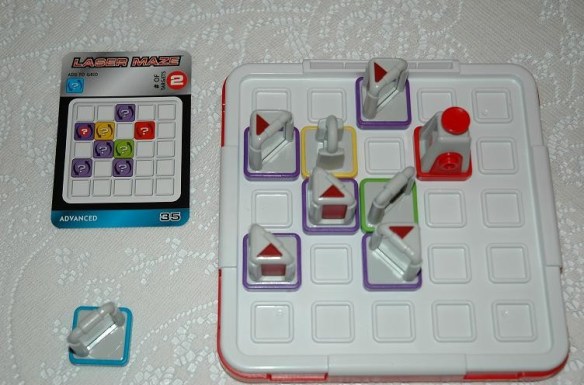
laser maze 2

But the genius of Laser Maze is that the beginner and intermediate puzzles teach you the fundamentals necessary to tackle the harder puzzles to come. Like the best puzzle games, Laser Maze allows you to learn by doing, building your skills, your deductive reasoning, and your bag of game-piece-centric tricks as you become more proficient at using the mirrors and beam-splitters to direct the laser precisely where you need it.

Plus, the gameplay itself is intuitive. With just a brief skim of the instructions and a minute to familiarize myself with the symbols key for the puzzles, I was in.

I played through a number of beginner, intermediate, advanced, and expert puzzles. As a pretty puzzle-savvy guy, I expected to breeze through the early challenges, but a few of the intermediate puzzles made me pause and restrategize. By the time my confidence grew and I was sure none of the intermediate puzzles would stymie me, I still didn’t WANT to move on to the next level. I was having too much fun.

I progressed through the advanced challenges and into the expert puzzles, and then went back to the intermediate puzzles to test the game’s replay value. And that’s when I discovered another facet of Laser Maze.

Once you’ve solved a given puzzle, you clear the board and prepare for the next one. By design, you start with a clean slate. But you’re also forced to completely ignore any preconceived notions you have about the puzzle to come, because each one has its own challenges.

As I played through puzzles I knew I’d played before, they still FELT like fresh challenges, because of the sheer adaptability of the game pieces. This wasn’t going to end up a one-time playing experience.

You’ll no doubt note similarities between Laser Maze and the popular game Khet, which also features a laser. That’s to be expected, since they were both invented by devious puzzlesmith Luke Hooper. But while Khet is a strategy game to played against an opponent, Laser Maze pits a single player against the game itself. It’s a learning experience disguised as an incredibly fun game.

Plus, every time I’ve played, I’ve attracted family and friends as onlookers and collaborators. It might be designed for one player, but it’s hardly a solitary endeavor.

Of course, I’m covering the gameplay as an adult solver, and Laser Maze is designed for ages 8 and up. (Plus, there’s an actual REAL laser, so safety first, fellow solvers.)

Fellow PuzzleNationer Fred took the game home and unleashed his kids on the game, and as you can see, he had ample time to snap a pic of his very focused son Max, ready to activate the laser and solve his latest challenge.

All in all, Laser Maze is both great fun and an engaging puzzle-solving experience. ThinkFun really knocked it out of the park with this one.

(Check out Laser Maze on ThinkFun or on Amazon!)

Three posts, five rings, endless possibilities…

I’ve always been a big fan of DIY puzzling. With seven nieces and nephews to keep engaged and entertained at family gatherings, I often find myself cobbling together new games and puzzles for them from whatever I can find around me.

(For instance, you’d be surprised how many board games are spiced up a bit by the addition of dinosaur figurines.)

So last weekend, I discovered my youngest nieces have three of those ring-stacking toys with the colored rings, the ones I think every kid has played with at some point or another.

And I realized I had all the tools necessary to whip up a challenge for the kids and adults alike… a Tower of Hanoi puzzle.

The Tower of Hanoi puzzle and its many variants look simple, but can be fiendishly puzzling. The rules are simple: move the stack of rings from the first post to the third. You move one ring at a time, and at no point can you place a larger ring atop a smaller ring.

(The standard puzzle is five rings, but variants can go as high as 10.)

I gave the adults first crack at it, and after laughing it off as childishly simple, it took them far longer than expected to solve the puzzle, especially in the later stages as you try to place the largest ring. There was plenty of pointing and strategy and “No, no, not there! THERE!”

The kids, on the other hand, worked together, and managed to solve the puzzle in about fifteen minutes, each taking turns moving colored rings here and there (and for my youngest niece, occasionally biting them, as you do). Their sense of accomplishment was a joy to watch, and each crowed to their parents about their victory.

As a placement puzzle, the Tower of Hanoi is much like a sudoku puzzle, a combination of strategy — where to place a number or a ring — and deduction — determining which moves you can’t make based on the information provided. It’s one of those universal puzzle-solving skills that will serve a puzzle fiend well for decades to come.

(To try the Tower of Hanoi puzzle, check out this online version I found.)

A hallmark of puzzles to come…

Cleverness abounds in the puzzle community, both in those who create puzzles and those who solve them. But the advent of the Internet has truly raised the bar in what you can accomplish with a puzzly mindset and some serious ingenuity.

From Easter Eggs concealed in DVD menus (like the blooper reel hidden in the silver box DVD release of the original Star Wars trilogy) to viral marketing campaigns that conceal plot details and exclusive scenes for industrious fans (as Christopher Nolan’s Batman films frequently employed), there are delightful little entertainment nuggets secreted away in all sorts of media these days.

But only a select few of these hidden puzzles reach the level of complexity and elegance embodied by a series of puzzles lurking within the game Portal (which eventually unlocked details regarding the upcoming sequel).

Portal, itself widely regarded as a masterpiece of outside-the-box puzzle-solving wizardry and gameplay, demands a great deal from its players, so any hidden game designed for these players would have to be something special.

Adam Foster did a thorough and fascinating write-up on both the hidden puzzle game itself (known as the Portal ARG) and the process behind creating this dastardly electronic scavenger hunt, and you can read the full details here.

What’s particularly brilliant about this particular multitiered puzzle is that it incorporated rewards for both mid-level gamers — collecting all the radios in the game and locating where they received broadcasts — as well as the stunningly devoted fans who were willing to chase the puzzle farther down the rabbit hole, delving into top-tier decryption and deduction puzzle-solving.

This sort of chain-reaction puzzle-solving is becoming more and more commonplace. For a simpler example, you need go no further than PuzzleNation’s own Guessworks game. You start with a Hangman-style guessing and deduction game, which leads to clues to be solved, which then lead to a quotation to be unraveled.

As you build upon these earlier steps, you not only challenge yourself in new ways, but you develop multiple puzzle-conquering skills at once. Tackling a puzzle as wily as the Portal ARG is some serious mental exercise.

By pushing the boundaries of what form puzzles and games can take, people like Adam Foster are redefining and rejuvenating the puzzle-solving experience for a new generation of savvier solvers.

Where brilliance meets joyous frivolity…

Two weeks ago, we celebrated the 29th birthday of Tetris in a blog post, and I referenced the famous MIT prank where a giant game of Tetris was played on the side of a building.

This prank is one of the most recent in a long line of “hacks”, and MIT students have performed some impressive feats of creative whimsy along the way.

From a fire hose drinking fountain in 1991 to the installation of a shower stall in a common area in 1996, from turning the dome into R2-D2 (as pictured in our opening picture) to the “discovery” of an elevator in the remains of the demolished Building 20 (purportedly leading to a secret subbasement), these are top-tier pranks executed by some of the cleverest students in the world.

The Great Dome is often the palette of choice for MIT hacks, having featured a Triforce from the Legend of Zelda video games, the TARDIS from Doctor Who (which appeared all around campus), a fire truck, the Batman symbol, and numerous other Hack endeavors.

Here, the Apollo lunar lander looks down on a statue of Athena also added by industrious students. (Apollo watching over Athena, how apropos.)

One year, board games invaded campus. Giant versions of Cranium, Mousetrap, and Settlers of Catan appeared around campus, and all of the helpful maps around campus were altered to feature Risk gameplay.

Another time, an enormous game of Scrabble appeared on the wall, complete with MIT-inspired words fluttering in the breeze.

To honor the posting of XKCD’s 1000th comic — a comic that has also made appearances on this blog — XKCD comics appeared all over campus, often spelling out “1000”.

A Newton’s Cradle with imagery inspired by the Portal video game series appeared in 2012

But the best part of MIT hacks? Wondering just how the heck they managed to pull it off without anyone seeing. Like the urban legends behind stories of cars disassembled and reassembled in a professor’s office, the technological wizardry and sneaky cunning required for these marvelous pranks makes MIT Hack enthusiasts fellow puzzlers in spirit AND practice.

A milestone worth celebrating.

It was #5 on G4’s Top 100 Video Games of All-Time countdown, and has been consistently ranked as one of the top games of all-time by IGN, EGM, and gamers of all ages.

It’s Tetris, and it’s turning 29 this week. Yes, Alexey Pajitnov’s incredibly addictive puzzle game baby is ready to start freaking out about the future because it’s almost 30.

Tetris combines the quick reaction time and coolness under pressure of video games with several aspects of puzzlesolving to create a marvelous puzzle game experience.

Firstly, you have the improvisation and adaptability necessary for other tile-placement puzzle games like Scrabble (or Words with Friends for the app-savvy in the audience). But utilizing pieces very similar to those in a pentominoes puzzle — as I discussed a few weeks ago — you also have a spatial puzzle aspect reminiscent of a Brick by Brick.

(FYI, here’s a sample puzzle, provided by our pals at pennydellpuzzles.com.)

From scientific studies linking gameplay with lessened post-traumatic stress to utterly inspired pranks turning buildings into playable surfaces, Tetris has left an indelible mark on both puzzle culture and pop culture. (Plus, I suspect it’s made us all a little better at packing up the car for long trips.)

Happy Birthday, Tetris.