An Immersion Course in the Language of Images

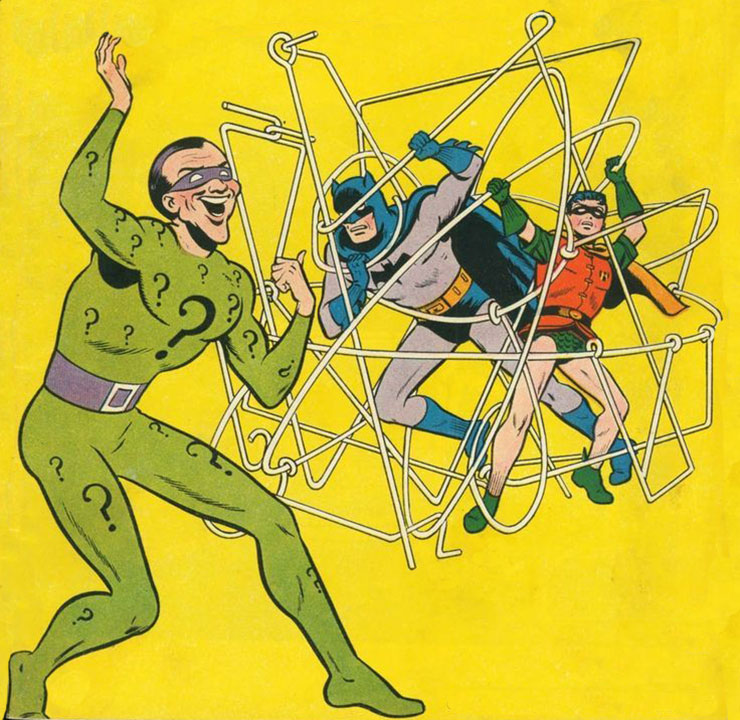
A lot can happen inside a series of squares. An Oscar-winning actor might meet a basketball star, or your favorite song might intersect with the punny punchline of a joke. Gimmicky grid construction might reveal hidden gems! Gotham might be saved from the Riddler’s clutches! Calvin and Hobbes might sculpt an army of gruesome snowmen! Krazy Kat might introduce newspaper readers to gender fluidity! You might discover new facets of your own artistic voice!

There’s a good chance you already fill in creative arrangements of squares on a regular basis, enriching your brain’s language centers by solving crosswords. Why not take this ritual a step further? Lynda Barry’s Making Comics begins with the reminder, “There was a time when drawing and writing were not separated for you,” and she shows us that it is possible to return to such a time. By partaking in the book’s exercises, you can learn to reunite images and language in your mind, to “practice the language of the image world.”

If you feel like your language centers need a good jolt, comic-making might be a perfect new hobby, and Making Comics is the perfect introductory text for puzzle fans. As Barry explains, the book’s exercises “take advantage of a basic human inclination to find patterns and meaning in random information,” and who loves patterns more than puzzlers? For instance, one simple exercise she says that anyone can do is drawing a scribble and then figuring out how to turn it into a monster. It’s that simple.
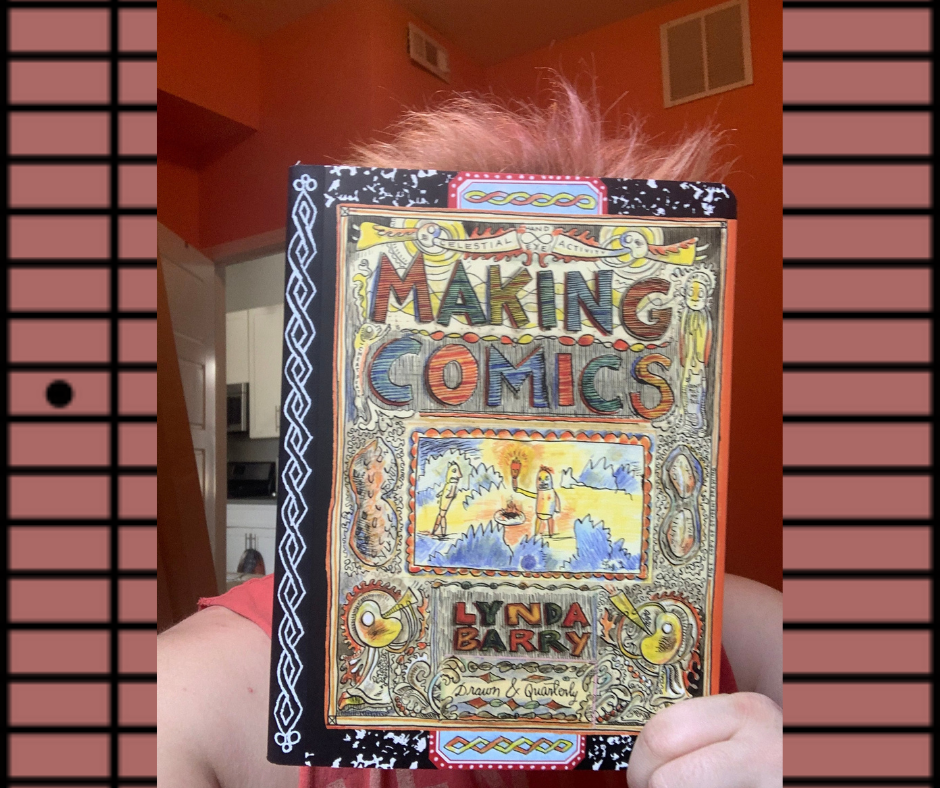
Your blogger with the book in question.

Many of the pattern-finding exercises in Making Comics’ treasure trove are collaborative, depending on a classroom setting or simply a creative partnership among friends. Others, however, can be done in solitude, including the exercises I’m going to take you through below. To prepare: Barry recommends, when just starting out, working with black Flair pens, a composition notebook (preferably not made from recycled materials), index cards (blank on one side), and basic 8.5×11 printer paper. She describes the composition notebook as “a place rather than a thing,” and says that you should try to keep it by your side like a faithful dog. “Making comics involves the same daily practice that learning any language does,” so keeping your materials handy is crucial.

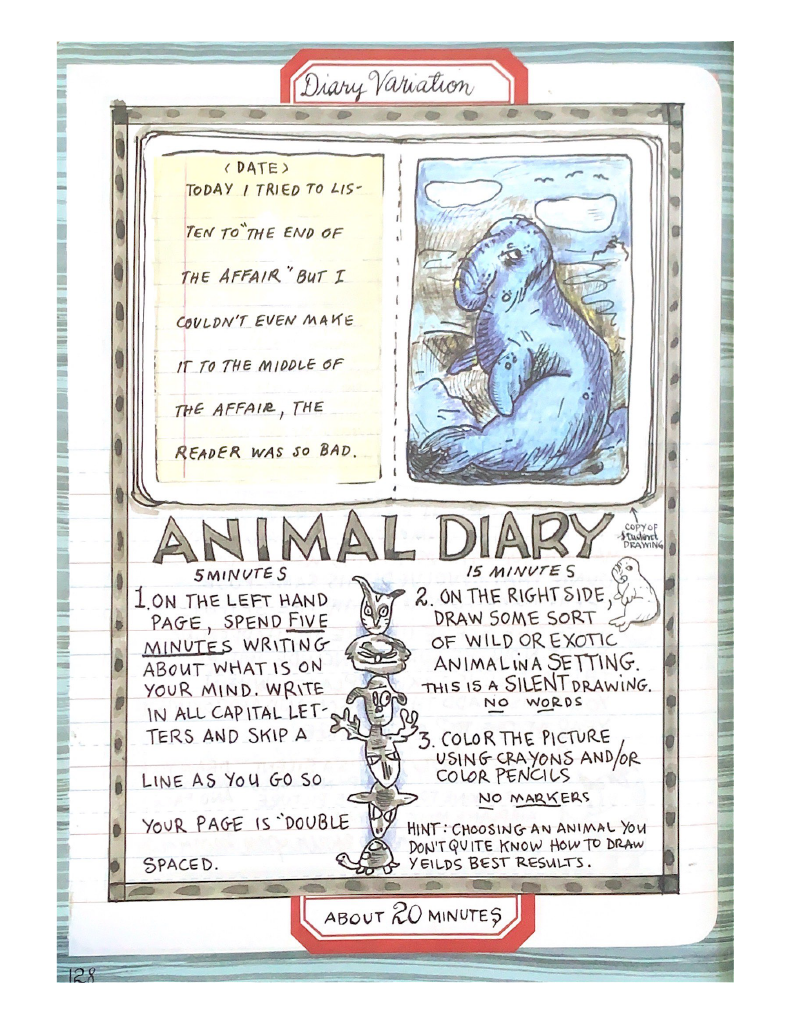
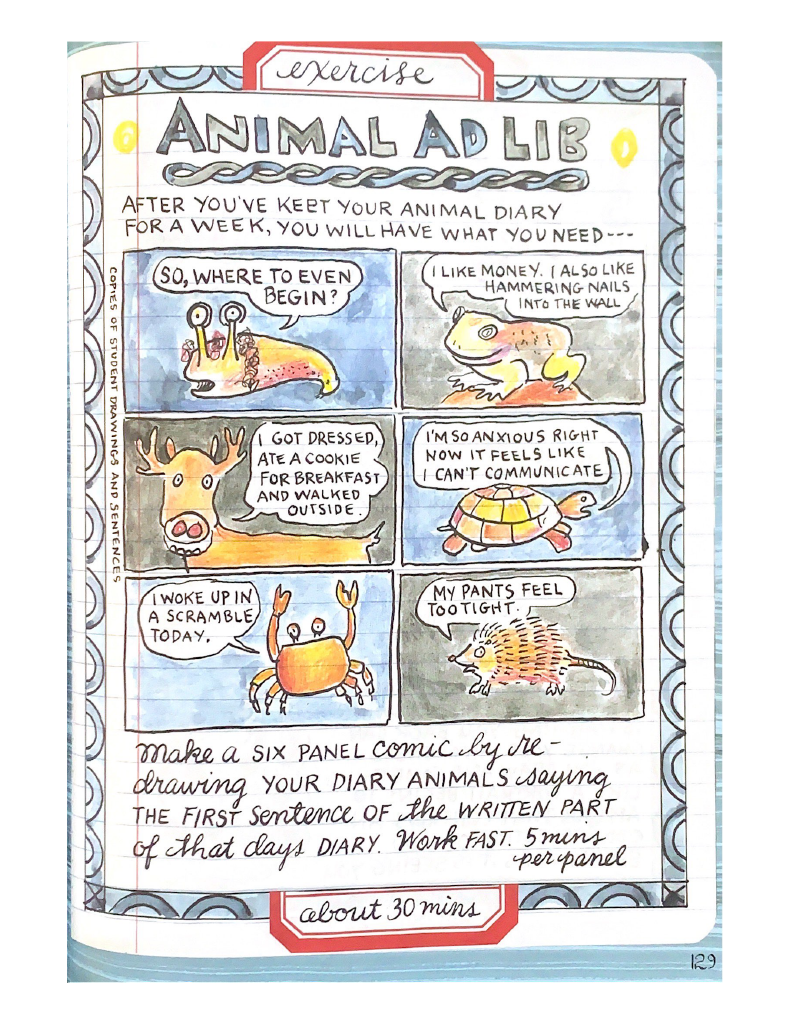
Do you have your materials? Great! Let’s dive into the Animal Diary and consequent Animal Ad Lib, instructions pictured below!
More of Barry’s comics wisdom can be found on her Tumblr and Instagram, or of course, if you’re hooked, you can always pick up a copy of the book. It’s a full immersion course in a new language, in a new way of seeing.


For more fun, daily forays into the world of language, there’s Daily POP!
You can find delightful deals on puzzles on the Home Screen for Daily POP Crosswords and Daily POP Word Search. Check them out!

Thanks for visiting PuzzleNation Blog today! Be sure to sign up for our newsletter to stay up-to-date on everything PuzzleNation!

The Monster at the End of This Blog

This past Sunday, Instagram user @muppethistory posted that PBS had newly released a Grover-centric game called “The Monster at the End of This Game.” Based on the classic children’s book of a similar name, the game joins assorted other Sesame Street fare such as “Show Me the Cookies,” “Ernie’s Dinosaur Daycare,” and “Oscar’s Rotten Ride” on the PBS Kids website and in the PBS Kids Game app.

Gameplay is unsurprisingly straightforward, designed as it is for small children. On most screens, challenges are as simple as clicking a glowing item; the imperative to draw a triangle notches the difficulty up barely a smidge. The most complex obstacle to reaching the game’s end (and the monster therein) is a shattered arrow that must, like a tangram, be restored to wholeness. As the player rebuilds the arrow, Grover despairs, “I did not know you were such a skilled puzzler!”

While I have no doubt that many of our readers’ puzzle skills outstrip my own, I do, at twenty-seven, have a significant edge on the game’s intended audience of preschool puzzlers. Why, then, did I find “The Monster at the End of the Game” so captivating? It wasn’t nostalgia for the fuzzy blue Grover’s picture-book antics fueling my determined clicking and dragging—I did not read “The Monster at the End of the Book” as a child. I had only the dimmest suspicion, via cultural osmosis, that a mirror would feature prominently in the conclusion, and could not say for certain if Grover would be the monster in the mirror, or if I would be.

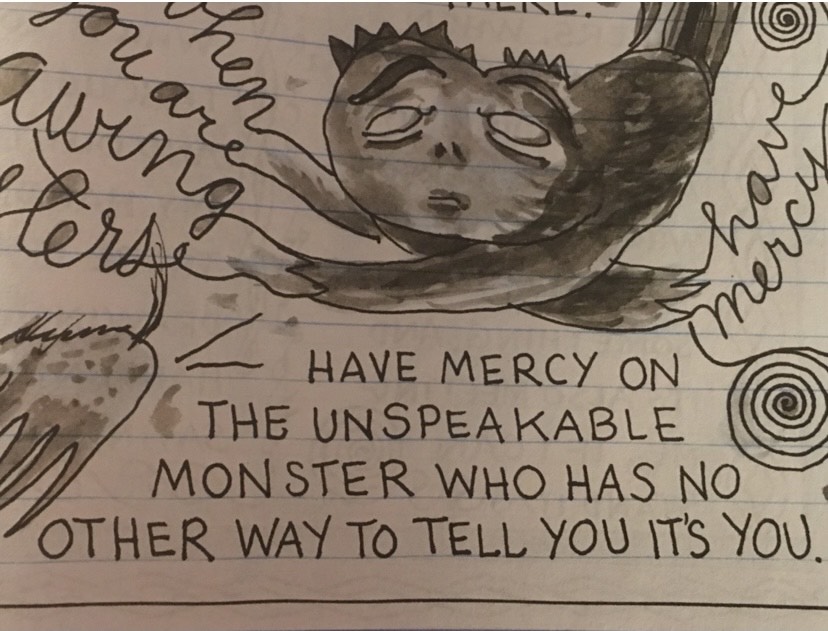
From Lynda Barry’s Making Comics

Without this particular childhood memory on my side, Grover’s pleading that I not finish the game, his insistence that only woe and horror waited for me as I progressed past the stumbling blocks he placed in my path, reminded me of nothing so much as Lemony Snicket’s narration in the A Series of Unfortunate Events books. Maybe the driving factor in convincing me to keep playing wasmy uncertainty as to how exactly it would end. But maybe it was a different branch of childhood nostalgia, fondness for the perilous problems plaguing the Baudelaire children in Snicket’s series.

In 2004, HarperCollins released a collection of puzzles called The Puzzling Puzzles: Bothersome Games Which Will Bother Some People, based on the Baudelaires’ trials and tribulations and framed as a training manual for a secret organization from the series. According to the Snicket Fandom wiki, many of the puzzles are designed to be unsolvable, and the letter to the reader from Snicket himself describes the book as “distressing,” and “frustrating,” the polar opposite of “The Monster at the End of This Game” (at least, if you’re outside Sesame Street’s target demographic).

Before signing off, Snicket writes, “I have dedicated my life to unraveling the puzzles that surround the doomed Baudelaire orphans. Why should you?”

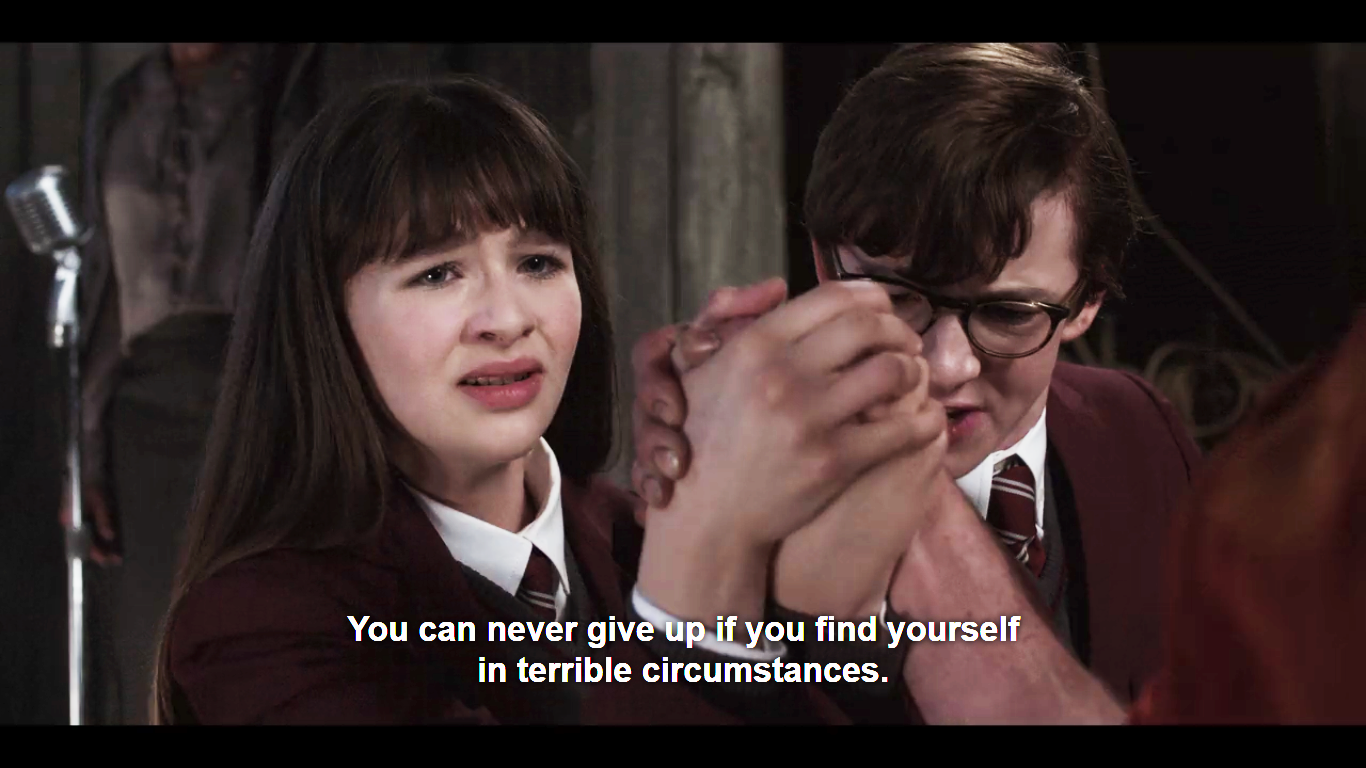
Violet and Klaus Baudelaire in the Netflix adaptation of ASoUE

Why indeed? Why try to solve the unsolvable? Why try to solve the extremely easily solvable? When the story is so good, why not try? Who can resist a compelling narrative, especially one brimming with pathos and puzzles, mystery and monsters? Whether the primary focus is on Muppets or murders, whether the monster is Grover, Count Olaf, or myself, I always want to reach the end. I’ll untie any rope, click any brick, trace any triangle—if it means gazing into the mirror at any good story’s conclusion.


If you also love the intersection of stories and puzzles, our Book Smarts, Movie Madness, and TV Time Daily POP puzzles are probably right up your alley! 

You can find delightful deals on puzzles on the Home Screen for Daily POP Crosswords and Daily POP Word Search. Check them out!

Thanks for visiting PuzzleNation Blog today! Be sure to sign up for our newsletter to stay up-to-date on everything PuzzleNation!
The Sestina and You

Last week, we began to explore a rich riddle together: “How is a poem like a puzzle?” We discussed a couple of important answers, but overlooked the immediately obvious answer that both begin with “P” and have—at least, for a significant portion of English-speakers—two syllables. This may seem overly superficial, but those similarities are nothing to sneeze at! When we’re talking about puzzles and poems, letters and length are deeply important.

With regard to syllables, our post discussed the puzzly limitations of forms like haiku, which become increasingly challenging as you write. Even more challenging than the haiku is the sestina, a French form that requires expert-level problem-solving skills.

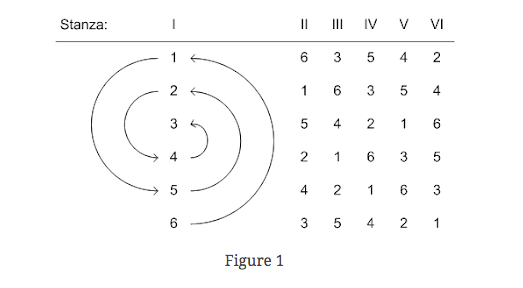
Typically unrhymed (though rhyming would only add an extra fun brain-bending element), a sestina is a thirty-nine-line poem made up of six six-line stanzas plus a final three-line stanza known as an “envoi.” The same six line-ending words appear in each stanza, though mixed up like a Boggle cube into a different, strict order in each stanza. If we label the last word of each of the first six lines 1, 2, 3, 4, 5, 6, then the last word of each of the stanzas afterward follows this pattern:

Stanza two: 6, 1, 5, 2, 4, 3

Stanza three: 3, 6, 4, 1, 2, 5
Stanza four: 5, 3, 2, 6, 1, 4
Stanza five: 4, 5, 1, 3, 6, 2
Stanza six: 2, 4, 6, 5, 3, 1

The final envoi of three lines must contain all six of the ending words. Three of the words will come at the end of the lines, and the other three words will be contained within.

Thus, once the six ending words are established in the first stanza, the ending words of the following stanzas are set in stone, turning the exercise of writing poetry into an elaborate game of fill-in-the-blank. The more wedded you are to having your poem make a lick of sense, the more crucial it becomes to tap into your puzzle brain to determine what jigsaw pieces of language could possibly go inside the parameters established by the “corner pieces” that are these ending words.

Sestina diagram via http://aka-arcadia.blogspot.com/2009/03/sestina-and-double-sestina.html. What other brainteasery poetic limits might we invent if we start placing numbers on different labyrinthine shapes?

Sestina examples that follow the rules of the puzzle:

Farm Implements and Rutabagas in a Landscape by John Ashbery

A Miracle for Breakfast by Elizabeth Bishop

Forage Sestina by Marilyn Hacker

And one sestina example that breaks them:

Deleting Names (A Decaying Sestina) by Lawrence Schimel

Even if you don’t consider yourself a poet, if word puzzles are your jam, we invite you to try your hand at a sestina, and watch as it unlocks the puzzler inside!


First—consider warming up your verbal, puzzling centers by taking our crosswords or word searches for a spin!

You can find delightful deals on puzzles on the Home Screen for Daily POP Crosswords and Daily POP Word Search. Check them out!

Thanks for visiting PuzzleNation Blog today! Be sure to sign up for our newsletter to stay up-to-date on everything PuzzleNation!
Puzzles, Poems, Problem-Solving, & Productivity

How is a poem like a puzzle? That question’s easier to answer than the Mad Hatter’s classic “How is a raven like a writing desk?” From crosswords to cryptograms, many beloved puzzles do, if nothing else, resemble poems in their mutual wordiness. However, some forms of poetry are more puzzly than others—compare a sprawling collection of free and blank verse like T.S. Eliot’s “The Waste Land” to the concise machinery of a syllabically limited haiku, the boundaries of which are as strict as the edges of a crossword puzzle.

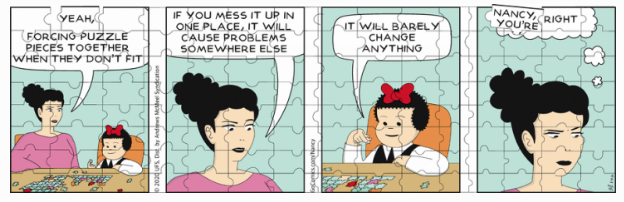
Like Nancy, though, you can always break the boundaries of form to create new meaning.

When you start to write a haiku, your possibilities are wide-open; with each word you set down, though, the potential choices for what might follow narrow. In effect, your “word bank” shrinks, and if three syllables already occupy the first line, then any words longer than two syllables are ineligible for that line’s continuation. The poet’s puzzling brain must kick into action, considering words for their dimensions and how they might lock into place with the words directly alongside them.

Haikus aren’t the only poetic forms that require this type of geometric thinking. Similarly brainteasery in their construction are sonnets, villanelles, and sestinas. Concrete poems take the shape of objects relevant to their contents, and erasure poetry—much like a word seek—highlights hidden messages by winnowing the chaos of a pre-existing text.

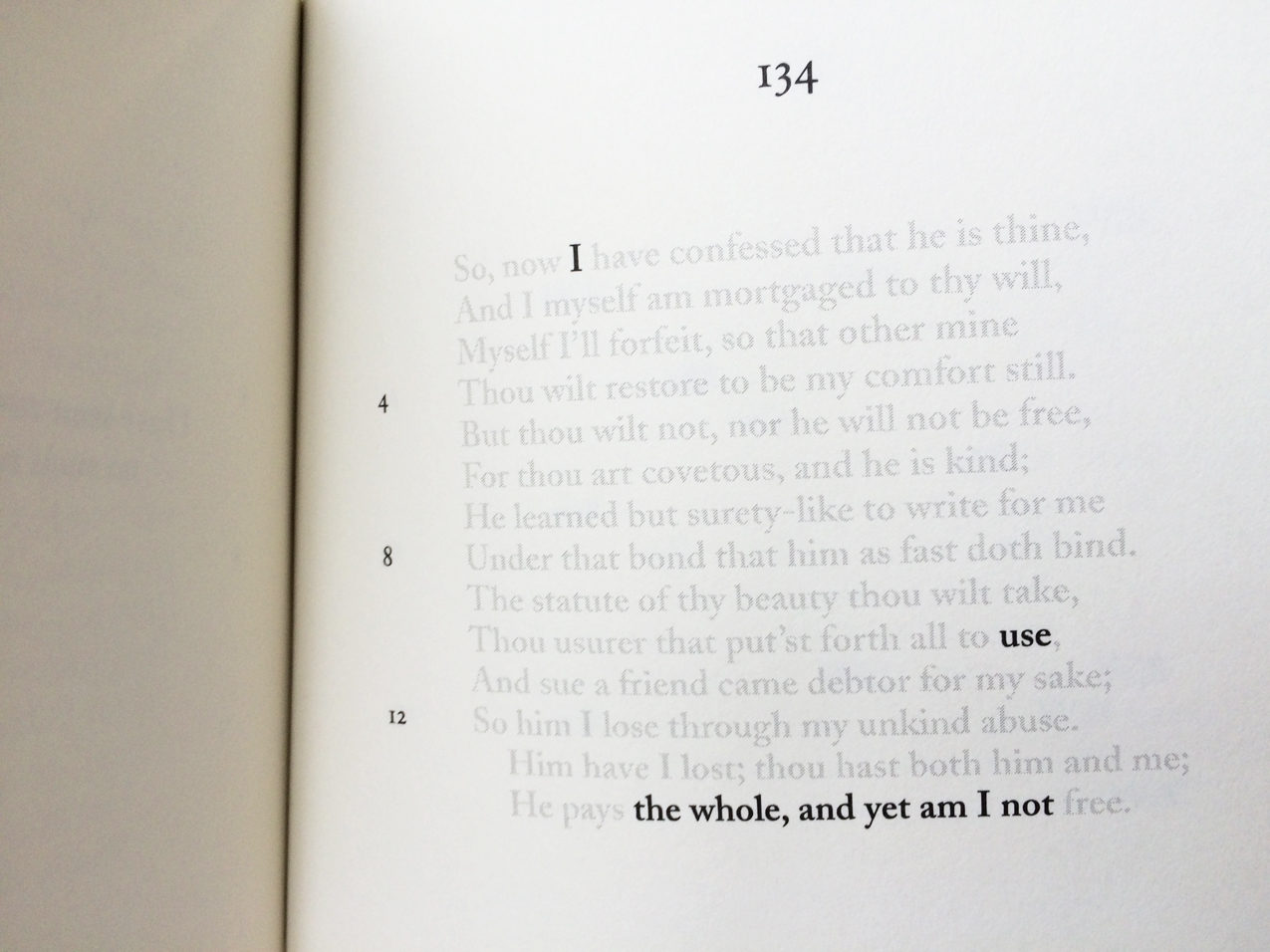
An erasure poem by Jen Bervin, made from one of Shakespeare’s sonnets.

What about a more sprawling, less tightly organized work like “The Waste Land,” then? Beyond the wordiness it has in common with cryptograms et al, is it left out of our riddle’s answer? Roddy Howland Jackson, in the recent essay, “Beastly Clues: T. S. Eliot, Torquemada, and the Modernist Crossword,” appears to argue that no, such works are very much like puzzles.

Jackson takes us back to the 1920s, when “The Waste Land” first appeared in print, and modernist poetry and puzzles alike were derided by critics. He locates “a question asked about labour and idleness in this period: are crosswords and difficult poems worth the efforts required to elicit literary pleasure and linguistic revitalisation? Or merely a waste of time?”

As a poet and puzzler, this question resonates with me a century later. Swimming in the high-pressure waters of hustle culture makes us highly sensitive to the terror of “wasting time,” as in doing anything that doesn’t build our personal brands. Writing and reading poetry that isn’t tidily instagrammable? Solving puzzles that aren’t social media fads? By hustle culture’s standards, both of these things are wastes of time.

So how is a poem like a puzzle? Both present us with opportunities to take back our time, to carve out pockets of our days where we exert mental energy purely for the joy of thinking. Instead of being just a bullet point on your resume, your problem-solving skills can be part of how you resist the pressure to always have your nose to the grindstone.

Next week, we’ll encourage you to find joy in poetry by more closely examining one particular puzzly form. In the meantime . . .


You can find delightful deals on puzzles on the Home Screen for Daily POP Crosswords and Daily POP Word Search! Check them out!

Thanks for visiting PuzzleNation Blog today! Be sure to sign up for our newsletter to stay up-to-date on everything PuzzleNation!
Horse of a Different Color, Posts of a Different Blogger

Please briefly pay attention to the man behind the curtain.

You may remember that when long-time blogger Glenn stepped down from posting at the beginning of this year, he assured you all that it was time “for a new voice to take over.” Obviously, his prediction came true, and it’s been fun these past few weeks, regaling you with discussions of Wordle, a biblical adventure, and tarot cards. Maybe you’ve wondered, however, exactly whose voice you’re hearing. I think it’s time we get to know each other. This week, I pull back the curtain and reveal your new Wizard of Blog.  

The Wizard of Oz revealed his full name to be Oscar Zoroaster Phadrig Isaac Norman Henkle Emmanuel Ambroise Diggs, but I’m going to go easy on you; you can just call me Rae. Puzzle fans are often excited to learn my name, pointing out that RAE is a common crossword entry. When you come across clues such as [“Call Me Maybe” singer Carly ___ Jepsen], [“Wayne’s World” actress ___ Dawn Chong], [Rap duo ____ Sremmurd], or countless others, you’ll already know the answer.

In addition to handling social media here at PuzzleNation, I act as our Editorial Assistant and as an occasional writer of Daily POP clues. Previously, I worked for Dell Magazines, writing clues for a range of crossword titles in addition to assisting the editors of Dell’s mystery and science fiction publications. Although my own writing is strictly nonfiction and poetry—I’m currently an MFA candidate in both disciplines—I am emotionally committed to genre fiction, mystery and sci-fi especially. You can expect to see those two genres making appearances on the blog in the future!

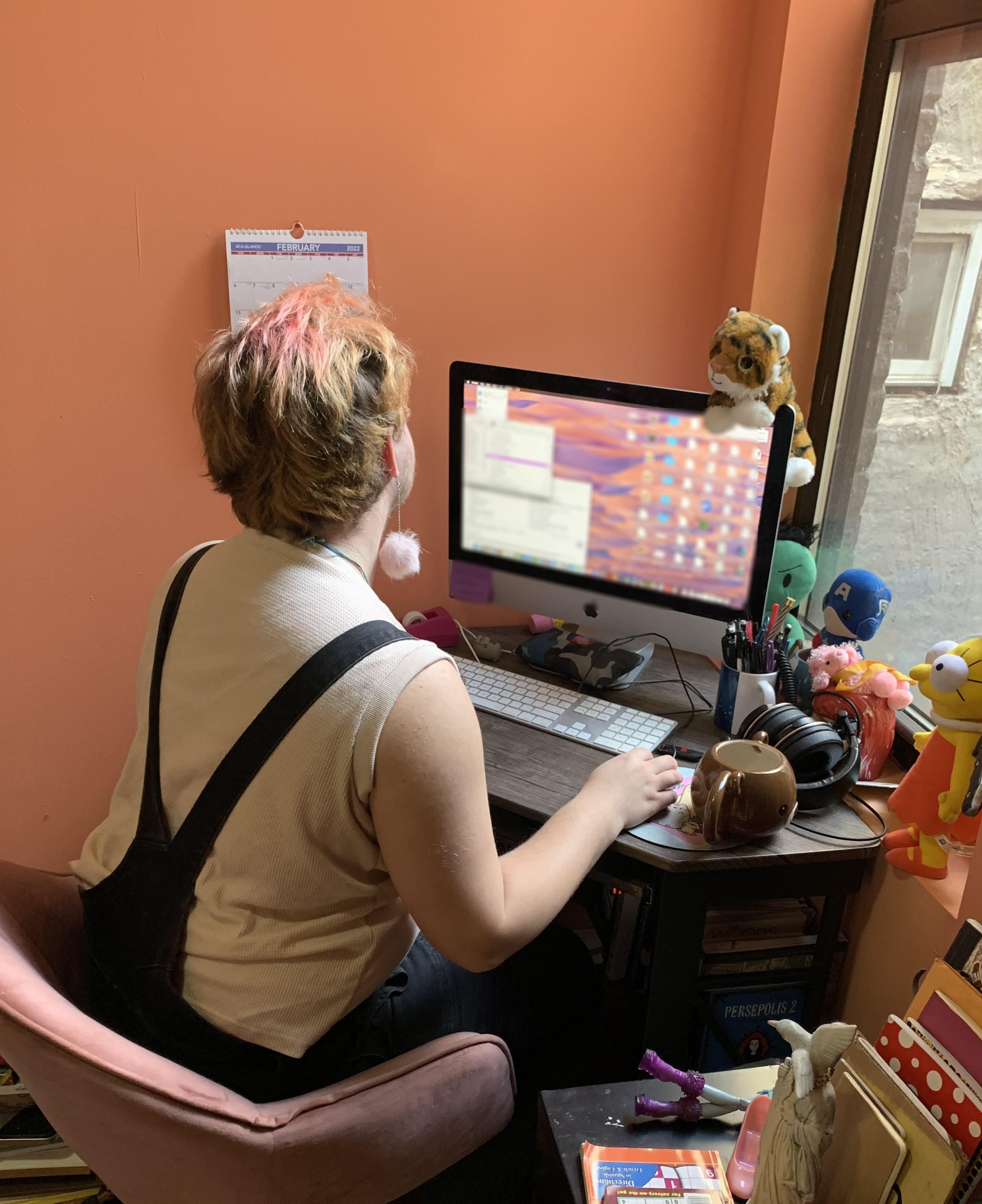
Your blogger in his natural habitat.

Outside of work, I’m a Simpsons buff and general television nerd, a voraciously omnivorous reader, a fan of superhero and heist media, and a painter. Wordplay, problem-solving, and board games are a few of my favorite things (the classic Clue is my favorite of the latter). As you may have inferred from blog posts thus far, I do read tarot, and yes, I try to solve Wordle right on the dot of midnight, turning to Queerdle immediately after (the artificial stress of Absurdle is a sometimes snack).

So what else, exactly, do I plan to bring to this digital table? The future holds a broad spectrum of posts, examining poetry and literature, art and music, TV shows and movies, video games, board games, and the scientific and historical sides of puzzles and games. Human interest pieces are close to my heart too—the puzzle and gaming worlds are full of fascinating people doing creative, groundbreaking things, and I can’t wait to spend time connecting with some of those individuals and bringing their stories to your screens.

On that note: it’s your turn! I would love to hear more about who’s reading. And if there’s anything in particular you’re interested in seeing on the blog, don’t be afraid to ask the Wizard for what you want.


One thing the Wizard can offer you now is delightful deals on puzzles!

They can be found on the Home Screen for Daily POP Crosswords and Daily POP Word Search! Check them out!

Thanks for visiting PuzzleNation Blog today! Be sure to sign up for our newsletter to stay up-to-date on everything PuzzleNation!

Returning to Wordle: The Evolution of a Phenomenon

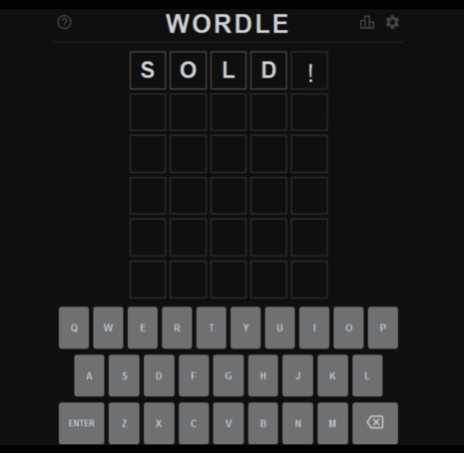
Suddenly, for Josh Wardle, every square is green.

Each day brings a new five-letter word for Wordle’s devotees to deduce. If I had to pick one five-letter word to describe Wordle’s current moment, it would be SHIFT, as in seismic movement and mutation. This is for a couple of reasons. The first is a piece of news that rippled through the puzzle-loving internet at the end of January: Wordle has been purchased by the New York Times, and will be packaged with games like Spelling Bee and Letter Boxed going forward. Creator Josh Wardle’s Twitter announcement pointed out, “If you’ve followed along with the story of Wordle, you’ll know that NYT games play a big part in its origins and so this step feels very natural to me.” For anyone who hasn’t done a deep dive into Wordle’s genesis: Wardle is referring, here, to the fact that he created the game as a gift for his partner after she got hooked on Spelling Bee and the Times crossword.

Despite how it started, Wordle is no longer just “a love story” (as a January 3rd Times headline said). It’s also a story of hitting the jackpot—reportedly, Wardle sold the game for a number in the low seven figures—and it could become, as well, a story of the internet’s ongoing privatization. Wardle’s tweet stated that the game will be “free to play for everyone” even after its migration to the Times website, but fears to the contrary abound. A Mashable article about the news features the sub-headline, “’Paywall’ has too many letters,” and ends by gloomily describing Wordle as “beautiful while it lasted.” Twitter user @mcmansionhell summed up the ordeal: “the NYT took one nice and simple thing that a lot of people really liked, a dumb bit of fun in our exhaustingly dark times, and implied that they’ll stick it behind a paywall. exhausting.” Overall, ominous social media speculation has little to do with resenting Josh Wardle’s laudable success, and everything to do with anxiety about the once-free commons of the internet becoming less and less free by the day.

In response to this anxiety, solvers are already finding workarounds for the possible future paywall. One solution is downloading the Wordle site to your device, a process with instructions located here. Another alternative is playing on the Wordle Archive, which recycles previous days’ words.

Even if the Times does decide to throw Wordle behind a paywall, its story will remain a love story. I’m not just talking about Wardle’s love for his partner; I’m referring to the public’s intense love for the game. Regardless of who officially owns Wordle, it has taken on a life of its own, and that’s the second reason why SHIFT is the word of the moment. Minimalist though it may appear, Wordle has sparked widespread creativity, inspiring memes and jokes, craft projects, and spin-off puzzles that take the game’s basic premise and alter the specifics just enough to be novel. In a short span of time, Wordle has mutated, in many incarnations, away from where it began in Wardle’s Brooklyn home.

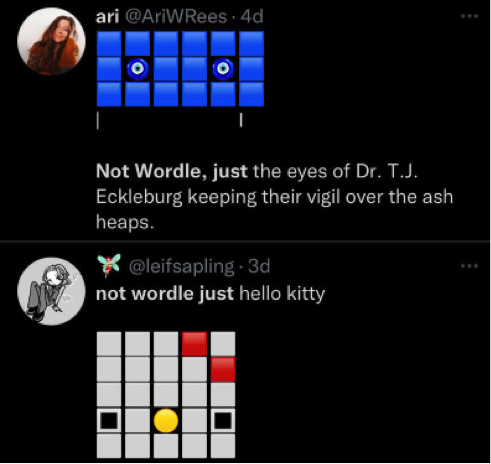
“Not Wordle, just XYZ” memes are everywhere these days, much like Wordle results themselves

Absurdle, for instance, is a version of Wordle that does not start out with one secret word in mind. Instead, behind the scenes, the site responds to the player’s guesses by—as slowly as possible—whittling down a mammoth list of possible words until the player essentially traps the computer into only having one word left. If you identified with my earlier post speculating that Wordle’s appeal lies in its un-bingeable nature and the way it provides all players with a short, sweet shared experience, then maybe the infinitely replayable Absurdle is not for you. On the other hand, if you prefer your puzzles to have concepts that can be difficult to wrap your brain around, then dive on in. You might also love to read a further explanation from the creator of the exact mechanics of the computer’s adversarial actions.

Then there’s Queerdle, a Wordle lookalike in which the word is a different length each day, but all are themed around LGBTQ culture and history. Answers have included COMPTON—in reference to the 1966 Compton Cafeteria Riot, a San Francisco-based Stonewall Riot predecessor—and DIVINE, as in the name of the drag queen best known for appearances in Hairspray and other John Waters films. When players guess correctly, a pop-up appears with a GIF or different snappy indicator of the word’s queer significance, and a grid of snake, coconut, and banana emojis meant to emulate Wordle’s shareable squares.

Byrdle is a version of Wordle where all answers are related to choral music. Gordle is Wordle for hockey fanatics. Squirdle invites players to guess names of Pokemon, Weredle howls words at the full moon, and you can probably guess the theme organizing Lordle of the Rings. Call them knock-offs, parodies, or homages, these variations most importantly are multiplying explosively. The New York Times may own the original game, but they cannot commandeer the inventive passion that Wordle has stoked in puzzlers everywhere.

____

Not Wordle, just a different exciting opportunity to solve new word puzzles each day:

You can find delightful deals on puzzles on the Home Screen for Daily POP Crosswords and Daily POP Word Search! Check them out!

Thanks for visiting PuzzleNation Blog today! Be sure to sign up for our newsletter to stay up-to-date on everything PuzzleNation!