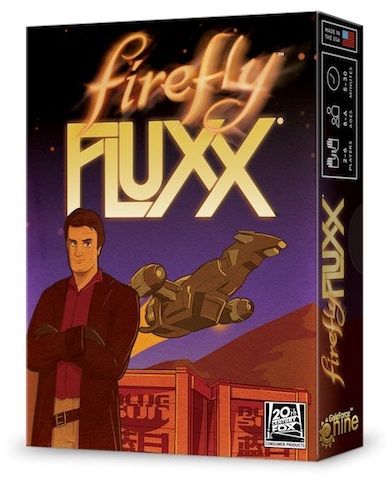
PuzzleNation Product Review: Firefly Fluxx

firefly-fluxx-card-game

[Note: I received a free copy of this game in exchange for a fair, unbiased review. Due diligence, full disclosure, and all that.]

Looney Labs is celebrating 20 years of puzzle-game goodness this year. From Pink Hijinks and Just Desserts to Retro Loonacy and Chrononauts, they have built a reputation for games that endlessly reinvent themselves every time you play, maximizing both fun and replayability.

And their newest edition to their flagship Fluxx series typifies the spirit of Looney Labs: it’s bright, chaotic, stylish, and entertaining as all get out.

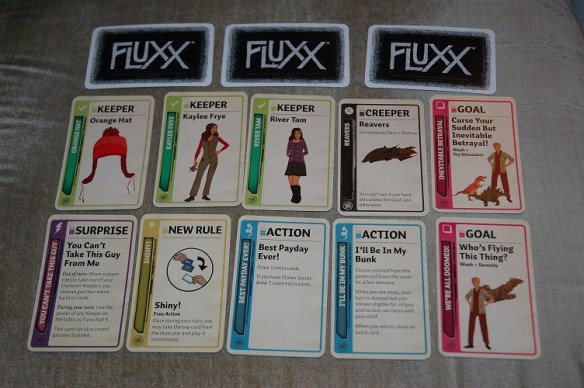
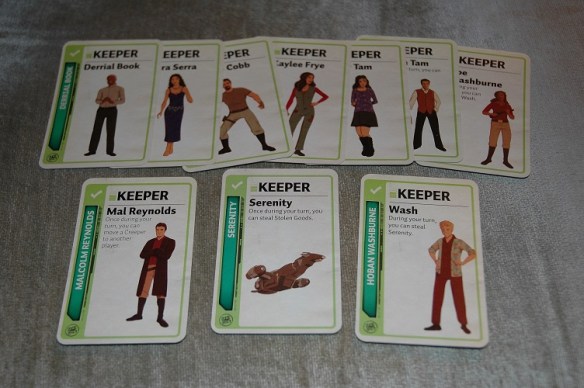
Firefly Fluxx makes the most of the much-beloved fan favorite one-season wonder, utilizing the characters, tropes, and best lines from the show to place their particular spin on the shifting rules, goals, and actions of earlier editions of Fluxx. (And you won’t even need to brush up on your Chinese expletives!)

firefly2

Now, anyone who has played Fluxx in the past is familiar with action cards, goal cards, keeper cards, new rule cards, and surprise cards. For those unfamiliar with the game, the basic idea is to collect keeper cards in the hopes of completing a goal and winning the game. But since every player can change rules (like how many cards you draw during your turn, how many you drop, etc.) as well as what the current goal is that will allow you to win the game, you have to be on your toes.

Firefly Fluxx capitalizes on the outlaw spirit of the show to encourage players to swap out goals, play diabolical creeper cards, and spring devastating surprises on their opponents, all while sharing in the collective fandom with references like “Shiny!,” “I’ll be in my bunk,” and my personal favorite, “Curse Your Sudden But Inevitable Betrayal!”

firefly3

[The crew of the Serenity reunites to elude the Reavers,
gather some loot, and escape unscathed, Fluxx-style.]

The art is delightful in a cartoony way, visually bringing home their larger-than-life adventures. Even the backgrounds of each card get a washed-out, Old West-style color palette to compliment the game and its fictional universe.

Although they’re not reinventing the wheel here with this newest edition of Fluxx, they are providing another terrific example of what they do best: marrying fun pop culture properties with great puzzly gameplay. It’s a winning combination.

You can pick up Firefly Fluxx here, and to check out all of our reviews of Looney Labs games and products, click here!


Thanks for visiting PuzzleNation Blog today! Be sure to sign up for our newsletter to stay up-to-date on everything PuzzleNation!

You can also share your pictures with us on Instagram, friend us on Facebook, check us out on TwitterPinterest, and Tumblr, and explore the always-expanding library of PuzzleNation apps and games on our website!

A puzzle in your pocket

Brain teasers come in all shapes and sizes, but there’s one particular brand of brain teaser that fits in your pocket. Today we’re talking about matchstick puzzles (or toothpick puzzles).

Matches as we know them (relying on friction to ignite, rather than dipping or crushing) were invented in 1826 by English chemist John Walker, and in the decades that followed, numerous improvements were made, especially in terms of safety and ease of use. Matchsticks soon grew ubiquitous and match companies started putting little puzzles on their boxes.

And the matchstick puzzle was born.

(I have no historical documentation to back me up on this, but I suspect that bar bets also played a role in the rise of matchstick puzzles, because the sort of cleverness and trickery that goes into solving some of these puzzles would be perfectly at home in the repertoire of someone looking to con a few free drinks out of fellow tipplers.)

So, for the uninitiated, what are matchstick puzzles?

These are rearrangement or transformation puzzles, where you’re given a certain shape (laid out in matchsticks, toothpicks, straws, pencils, or anything else of equal length), and you have to move the items into another shape or configuration. Sometimes, it’s simply about placing the matchsticks economically, but other times, you have to get crafty and think outside the box to complete your task.

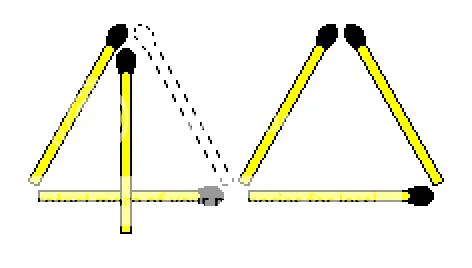
For instance, here’s the first matchstick puzzle I ever remember seeing:

[This image, and the one below, courtesy of Matchstick Puzzles on Blogspot.]

You have two triangles formed from six matchsticks. Move one matchstick to make four triangles.

Now, you could easily use all of these matchsticks to make four triangles, but that would involve moving more than one of them. So clearly there’s something else at work here if you only need to move one to solve the puzzle.

That something, in this case, is a little visual trickery.

As you can see, you turn one triangle into a numeral four, making the matchsticks literally read out “4 triangle.” Sneaky sneaky.

There are literally hundreds of these puzzles if you go hunting for them. (I found a treasure trove of them here.)

A curious variation, though, applies the same rules to mathematical formulas laid out in matchstick form.

Here’s one that’s been making the rounds on Facebook recently:

Now, the big difference between these mathematical ones and the shape ones mentioned above, as far as I’ve found, is that the math ones are far more alternate prone.

For instance, this equation puzzle has at least four solutions that I’ve found:

  • You can move one match to make the 6 a 0, so that 0+4=4.
  • You can move one match from the 6 to the second 4 to make the 6 a 5 and the 4 a 9, so that 5+4=9.
  • You can move one match from the plus sign to the 6 to make the plus sign a minus sign and the 6 an 8, so that 8-4=4.
  • You can move one match from the plus sign to the equal sign to make the plus sign a minus sign and the equal sign a doesn’t-equal sign, so that 6-4 does not equal 4.

As you can see, with matchstick puzzles,  the possibilities are endless and the building blocks — whether matches, toothpicks, Q-Tips, or straws — are easily accessible.

I’ll leave you one more to ponder, this time provided by the folks at IO9:

Using six matchsticks of equal length, create four identical, equilateral triangles. There’s no need for snapping, burning, or otherwise altering the matchsticks.

Good luck!


Thanks for visiting PuzzleNation Blog today! Be sure to sign up for our newsletter to stay up-to-date on everything PuzzleNation!

You can also share your pictures with us on Instagram, friend us on Facebook, check us out on TwitterPinterest, and Tumblr, and explore the always-expanding library of PuzzleNation apps and games on our website!

Follow-Up Friday: Other puzzles you might not know! (Volume 2)

Welcome to Follow-Up Friday!

Follow-Up Friday is an opportunity to look back on past posts and puzzly topics. Whether we’re updating you with new developments, providing answers to a previously-posted brain teaser or puzzle, or simply revisiting a subject with a fresh perspective, Follow-Up Friday lets us look back and look forward.

In today’s edition, now that we’ve presented some new puzzles for crossword devotees to try out, let’s turn our attention to Fill-In puzzle fans.

Fill-Ins feature the same grid-filling solving as crosswords, but instead of coming up with the answers to clues, you’re given all of the words in advance, organized by length, and it’s up to you to deduce which words fit the across boxes and which fit the down boxes.

Fill-Ins don’t demand the same level of recall and vocabulary as crosswords, but the deduction aspect more than makes up for it. And if you’re a Fill-In fan, but looking for something different, there are plenty of options out there for you.

Like Frameworks, for instance.

[Click here or on the grid for a larger version.]

A Framework puzzle is like a Fill-In, but without the rigid crossword-style grid. Instead, the grid is looser, allowing for longer words and interesting themes to be incorporated into the puzzle. The trade-off here is that, with fewer letters crossing, you have fewer hints for placing words in the grid. You’ll have to rely on knowing word lengths and counting boxes to complete these grids.

But for something a little less familiar, how about Places, Please?

[Click here or on the grid for a larger version.]

Places, Please gives you all of the words to place in the grid, just as Fill-Ins do, but there are no black squares to help guide you. Instead, you’re told where the first letter of each word will be placed, and you have to figure out in which direction each word will read.

You’ll want to start with the longest words first, seeing which directions will allow them to be placed. As you place each word, those letters offer clues for placing other words. Eventually, you’ll fill the entire grid! (It’s like a word seek in reverse!)

And if that’s a bit too open-ended for you, let’s talk Stretch Letters.

[You get the idea.]

Stretch Letters puzzles offer the same word-list format as Fill-Ins (organized by word length), but you’ll only enter them reading across. The wrinkle here is that some of the words above and below each row will share those letters, stretching the boxes (and the letters themselves).

It’s a visually striking take on word-placement puzzles, and the stretched letters make for a fun and interactive grid. One S could provide S’s for a half-dozen words or more!

Of course, if you enjoy the deductive side of Fill-Ins — figuring out word placement in the grid — you should also consider trying traditional Logic Puzzles.

[Yup.]

Now, I know these grids can seem a little daunting to new solvers, but they’re simply a way of organizing information. As you work your way through the different clues in the Logic Puzzle, you exclude possibilities in the grid by putting an X in the box where those two options cross.

For instance, in the above Logic Problem, based on clue 7, you’d place an X in the box where Esther (listed under First Name) crosses Tyson (listed under Last Name), eliminating it as a possibility.

The more boxes you fill with X’s, the greater the amount of information you garner from the grid, and eventually, you’ll know their full names, ages, and instrument of choice based on those seven clues. Pretty impressive deduction there.


Next week, we’ll take a break from these puzzle recommendations posts, but if you’ve got puzzle recs for your fellow puzzlers in the meantime, please let us know in the comments!

Thanks for visiting PuzzleNation Blog today! Be sure to sign up for our newsletter to stay up-to-date on everything PuzzleNation!

You can also share your pictures with us on Instagram, friend us on Facebook, check us out on TwitterPinterest, and Tumblr, and explore the always-expanding library of PuzzleNation apps and games on our website!

5 Questions with Author Elizabeth Singer Hunt!

Welcome to 5 Questions, our recurring interview series where we reach out to puzzle constructors, game designers, writers, filmmakers, musicians, artists, and puzzle enthusiasts from all walks of life!

It’s all about exploring the vast and intriguing puzzle community by talking to those who make puzzles and those who enjoy them! (Click here to check out previous editions of 5 Questions!)

And I’m excited to welcome Elizabeth Singer Hunt as our latest 5 Questions interviewee!

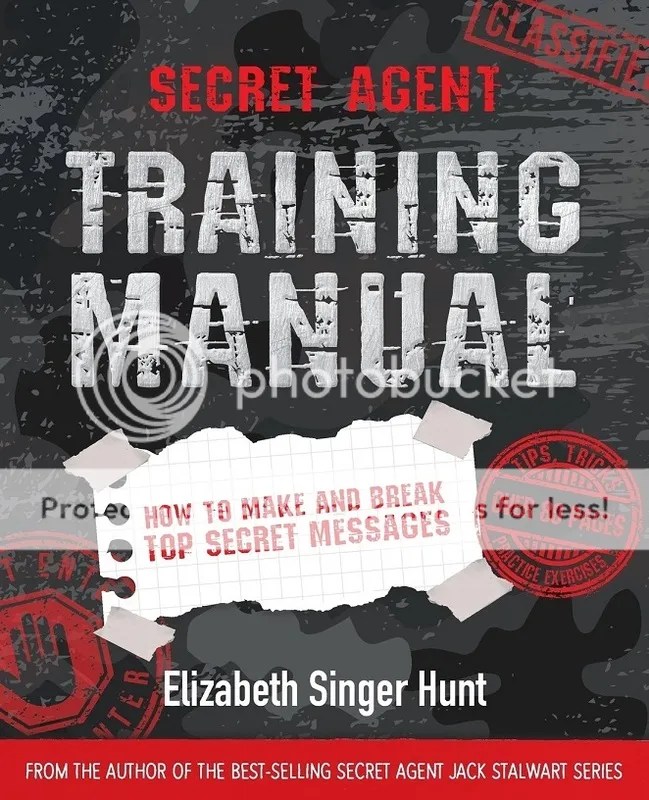
Elizabeth Singer Hunt is the author behind the globe-spanning Jack Stalwart books, a young adult series featuring a nine-year-old secret agent, with over two million books sold to her credit! She’s recently expanded into the world of puzzles with the publication of the Secret Agent Training Manual, a terrific introductory guide to codecracking and concealment.

Anagrams, ciphers, scytales, and encoding with other letters, numbers, or symbols are all explained with easy-to-understand instructions and plenty of examples. She even provides sample encryptions to crack, letting readers practice their newfound skills and techniques, giving young readers the chance to become their own Jack Stalwart-style secret agents!

Elizabeth was gracious enough to take some time out to talk to us, so without further ado, let’s get to the interview!


5 Questions for Elizabeth Singer Hunt

1. What inspired the adventures of Jack Stalwart?

As a young girl, I struggled to read. It wasn’t so much that reading was a problem for me. I couldn’t find any books that I identified with. I grew up in a small town in Louisiana, and spent most of my weekends fishing, crabbing, playing with frogs and tossing around footballs. Basically, I was a tomboy. It was difficult to find books that I could relate to since most of the ‘girl’ books were about friendship issues, horses and fairies.

At around that same time, Raiders of the Lost Ark opened in theatres. That movie introduced me to archaeology and adventure, and showed me that there was a world outside of Louisiana. As a southern girl, I had no idea that places like ‘Nepal’ and ‘Peru’ even existed!

When I was in my late twenties, I decided to take a crack at writing a children’s book series. I drew upon my childhood experiences and inspirations to create the series’ main character, nine-year-old Jack Stalwart. Jack moonlights as a junior secret agent for the Global Protection Force, or GPF. In every book, he’s sent on a mission to an exotic locale in order to protect one of the world’s most precious treasures.

Millions of children around the world have fallen in love with Jack, largely because they identify with him and want to be like him. He’s like a pint-size Indiana Jones, sprinkled with a bit of James Bond and written for the nine-year-old ‘reluctant reader’ me.

Did they, in turn, inspire the Secret Agent Training Manual, or was that meant to be a standalone creation?

Over the years, I have received thousands of emails from children asking how they can become a secret agent like Jack. So I thought it would be fun to create a series that introduced them to basic secret agent/spy skills. Code-breaking seemed a natural place to start! The first book in the series is called How to Make and Break Top Secret Messages. Subsequent books will discuss basic spy craft and the history of intelligence gathering.

2. Are you a puzzle fan yourself, or did your aptitude with encryption and codebreaking puzzles come out of your research and work as a writer?

A little bit of both! I have always had an affinity and aptitude for word puzzles. My favorite game growing up was Boggle and to this day, I am the family Boggle Champion! Recently, my children and I discovered Bananagrams.

It’s right up my alley, since it relies on the ability to quickly arrange and re-arrange letter tiles into words. That being said, I didn’t know too much about the world of cryptography (except for some of the basics) until I began researching for this book.

Do you have a favorite method of encryption or one that didn’t make it into the SATM?

I am fascinated by all of the methods of encryption featured in the book because each has its use depending upon the situation. I suppose my favorite is the ‘cipher’ because it’s ever-changing and difficult for the average person to solve without a key.
3. Let’s talk a little bit about your writing process, since composing a novel is a puzzle in itself. Do you start with characters, plot, certain scenes in your head already? How do you approach the process of writing a book?

Good question! It depends upon the type of book that I am writing.

For my (fiction) Jack Stalwart chapter book series, I have a fairly unorthodox way of writing. I establish the setting, mission and villain and then I start writing! Everything is free-flowing, and little is planned. I love movies and am extremely influenced by film, so in a way I am writing as though I am watching a film play out before my eyes.

For the (non-fiction) Secret Agent Training Manual book, things needed to be a lot more structured. Research was done, notes were taken and the book was organized from the most basic cryptographic methods to those that took a bit more time and thought to decode. Most of this book was handwritten, while many of my fiction books are typed onto a computer screen from the get-go.

4. What’s next for Elizabeth Singer Hunt?

I’m excited to say that Costco is planning an exclusive nationwide launch of the Jack Stalwart series in volume form next month, i.e. in April of 2016. That means that children across the country will be able to enjoy the Jack Stalwart series four books at a time in a specially produced keepsake volume.

Besides this news and the launch of the Secret Agent Training Manual book, I’ve also recently published the first book in a new middle grade series called Swamp Mysteries: The Treasure of Jean Lafitte. The series chronicles the adventures of four twelve-year-old friends as they solve paranormal mysteries in the swamps and bayous of Louisiana. It’s a bit like Scooby-Doo with a southern twist.

5. If you could give the readers, writers, and puzzle fans in the audience one piece of advice, what would it be?

As my mother always says, “There’s always a solution to everything. Persevere!”

When I first had the idea for the Jack Stalwart series, I shopped it around to various agents and publishers and they promptly rejected it. I could have felt sorry for myself and given up. But I believed in the idea and in myself. So, I found a solution to the problem. I published it myself, i.e. hired an editor, illustrator, designer and found a local printer to produce the books. I printed thousands of Jack Stalwart books, and sold them personally to as many booksellers as I could find.

After five months of hard work, the series caught the attention of an agent and the head of children’s fiction at Random House UK. (I was living in England at the time). Random House acquired the Jack Stalwart series, and commissioned me to write a total of fourteen books.

The rest as they say is history. Had I listened to the naysayers, Jack Stalwart never would have existed and I never would have had a career as an author. Thankfully, I took my mother’s advice. It’s the same advice that I would give to anyone with a dream. Never give up. Be resourceful, and persevere.


A huge thank you to Elizabeth for her time. Be sure to visit her website for updates on her latest projects. I cannot wait to see what she has in store for us next!

Thanks for visiting PuzzleNation Blog today! Be sure to sign up for our newsletter to stay up-to-date on everything PuzzleNation!

You can also share your pictures with us on Instagram, friend us on Facebook, check us out on TwitterPinterest, and Tumblr, and explore the always-expanding library of PuzzleNation apps and games on our website!

The American Crossword Puzzle Tournament looms!

It’s less than two weeks until the American Crossword Puzzle Tournament returns to Stamford, Connecticut, once more!

The 39th annual ACPT will run from April 1 to 3, and I’ll be attending for the second time. (Click here for my coverage of last year’s event!)

The tournament takes place over two days, with six puzzles to solve on Saturday, followed by one on Sunday. Then the top three finishers solve the championship puzzle on white boards in front of the audience.

On Friday and Saturday night, there are often puzzle events, demonstrations, and panels by top puzzlers and figures in the puzzle world as well. Author and friend of the blog Eric Berlin will be hosting an Escape the Room-inspired puzzle hunt!

I’ll be around for the festivities on Saturday, and once again I’ll be sitting in with my pals at the Penny Press/Dell Magazines booth, offering some great puzzles and meeting topnotch competitors and constructors alike.

How many PuzzleNationers and fellow puzzle fiends are attending? Come by, I’d love to meet you!

You can click here to register for the event, and there are also options to solve by mail or online from the comfort of your home! Oh, and if you’re looking for advice for solving under tournament conditions, look no further than right here!

I hope to see you there! And if you’ve got any questions, please don’t hesitate to ask!


Thanks for visiting PuzzleNation Blog today! Be sure to sign up for our newsletter to stay up-to-date on everything PuzzleNation!

You can also share your pictures with us on Instagram, friend us on Facebook, check us out on TwitterPinterest, and Tumblr, and explore the always-expanding library of PuzzleNation apps and games on our website!
It’s Follow-Up Friday: The Wonderful World of Wordplay edition!

Welcome to Follow-Up Friday!

By this time, you know the drill. Follow-Up Friday is a chance for us to revisit the subjects of previous posts and bring the PuzzleNation audience up to speed on all things puzzly.

And today, I’m posting the results of our #PennyDellPuzzleDisney hashtag game!

You may be familiar with the board game Schmovie, hashtag games on Twitter, or @midnight’s Hashtag Wars segment on Comedy Central.

For the last few months, we’ve been collaborating on puzzle-themed hashtag games with our pals at Penny Dell Puzzles, and this month’s hook was #PennyDellPuzzleDisney, mashing up Penny Dell puzzles and anything and everything having to do with characters, songs, theme parks, and all things Disney!

Examples include: The Jungle Bookworms, A Whole New Word Seek, or Lilo & Stretch Letters!

So, without further ado, check out what the puzzlers at PuzzleNation and Penny Dell Puzzles came up with!


Disney Puzzle Films, Shows, and Characters!

Crypto-Family Robinson / Swiss Family Ties Robinson

Beauty and the Beat the Clock / Beauty and the Word Seek

Zoo-Doku-topia

Abacus in Wonderland

The Throwbacks of Notre Dame

The Little Puzzler Mermaid / The Little MerMaze

Buried Treasure Island

101 Associations / A 101 Quotations

The Sword in the Stepping Stones

Mary Stoplines

Escape to Which Way Words Mountain

The Windowbox and the Hound

White Fan’ Words

These Three Musketeers / The Three of a Kind Musketeers

Oliver and Three’s Company

The Lotto King

Crackerella

Al-add-one / AladdIn the Middle

Crisscross-topher Robin

Crackerjacks Sparrow

Pollyanagrams

Peter Panagrams

National Treasure Hunt

Monsters, Incognito

Cruella De-V-Words

Monkeys Go Home Runs

The Lucky Star to the Right

Winnie-the-Pooh and the Honey-comb Tree

The Three Little Piggybacks

Off with her Heads & Tails

Cross Aristocats

The Jumble Book

Disney’s Into the Tanglewoods

Sheriff Callie’s Wild Window Boxes

Mickey Mouse Cryptohouse

Minnie’s Mixed Bag of Tricks!

Pluto in the Round

Snow Whitelines and The Shadow Dwarfs


Disney Theme Park Puzzles!

The Wonderful Codeword of Disney

Anagram Magic Kingdom / Animal Crackers Kingdom

Epcot In the Middle (or is it center???…)

The Carousel of Progress-ions

Buzz Lightyear’s Space Ranger Spinwheel


Disney Song Puzzles!

“When You Wish Upon a Starspell”

“Whistle While You Framework”

“Be Our Guest Star Framework”

“The Pairs Necessities”

“Some Day My Printout Will Come”

“Under the ABC’s”

“It’s a Small Change (After All)”

“Can You Paint with All the Color by Numbers of the Wind?” / “Color of the Wind-ow Boxes”

“Circles in the Square of Life” / “The Full Circle of Life”

“Do You Want to Build-A-Pyramid?”

“Let It Go Fish”

“Heigh Ho HeigHocus Pocus”

“A Whole New Whirlybird”

“Song of the North South”

“You’ll Fill-In My Heart”

“Little Puzzler Showers”

“Step by Step in Time”

“Kakuro Matata”

“Be True To Your Hearts and Flowers”

“Bibbidi Bobbidi Boomerang” / “Bibbidi-Bobbidi-Book” / “Bippity-Boppity-Bookworms”

“Zip-It Dee Doo Dah, Zip-It Dee Ay!
My oh my what a Number-Jumble day!
Plenty of Sunrays Headings my way!
Zip-It Dee Doo Dah, Zip-It Dee Ay!”


Have you come up with any Penny Dell Puzzle Disney entries of your own? Let us know! We’d love to see them!

Thanks for visiting PuzzleNation Blog today! Be sure to sign up for our newsletter to stay up-to-date on everything PuzzleNation!

You can also share your pictures with us on Instagram, friend us on Facebook, check us out on TwitterPinterest, and Tumblr, and explore the always-expanding library of PuzzleNation apps and games on our website!