Eight months + 40,000 pieces = one heck of a gigantic K’Nex machine.
Just Like Clockwork
Reply

Eight months + 40,000 pieces = one heck of a gigantic K’Nex machine.
The Kraay Family Farm in Alberta, Canada, has a gigantic corn maze in the shape of a (fuctional!) QR code.

Hat tip: Smart News.
This Machine Kills Secrets, by Andy Greenberg, is a look at the history of information leaks, and as such spends a fair amount of time on Julian Assange. Forbes has an excerpt with these surprising paragraphs.
…Perhaps chiefly to entertain himself during his time in college, Assange invented a game: The Puzzle Hunt. Following a model invented by MIT for its venerable Mystery Hunt, the Puzzle Hunt was an elaborate campus-wide scavenger hunt punctuated with dozens of math and logic problems that drew in hundreds of students and still takes place annually on the University of Melbourne’s campus.
One of the puzzles Assange generated for that competition—and he created more of them in his first year than any other student—involved a long quote from Shakespeare’s Julius Caesar, with each letter written backward. Seemingly random gaps appeared throughout the chunk of text, and collecting the letters following those anomalies revealed a clue for the next puzzle. Another conundrum involved factoring large numbers into primes—a procedure that would have seemed natural for anyone familiar with RSA’s public key encryption tricks.
A year after Assange left the university—he’s described quitting as a “forced move,” as in chess, “when you have to do something or you’ll lose the game”—he sent an e-mail to many of his former colleagues in the Melbourne University Math and Statistics Society asking for their participation in a new project as exciting and intellectually challenging as the Puzzle Hunt.
It was called WikiLeaks.
 There aren’t many games featuring bombs that make you want to say “That’s adorable!” Blast-A-Way from Illusion Labs definitely manages this feat. In this cheerful kid-friendly game for the iPad, you control a number of adult “Boxies” — basically boxes with legs — and are tasked with rounding up the little ones, who have gotten lost and need some rescuing.
Each level is essentially an abstract maze, and to navigate the maze you will need several kinds of bombs. You’ve got your basic blow-things-to-smithereens bomb — useful for rescuing little Boxies who have become embedded in a wall, or simply to make a path so you can reach the finish line. There are teleporters, which will blip you over to a different part of the maze, as long as the teleport bomb matches the color it lands on. Rebuilders are anti-bombs: They put back together the parts of the maze you previously blew up.
Add to this further complications: Sheets of colored glass will change the color of your bombs. Portals will send your bombs zipping to the other side of the maze. And some levels will require two Boxies to work together to rescue all the little ones.
The puzzles stay at the softball level for at least half of the game’s 80 levels — a smart kid will have no trouble helping to solve them, or pushing you aside and doing it herself. After the halfway mark, you and your child may well need to think things over for a while, and you might even have to leave a Boxie or two unrescued, the poor little things.
Blast-A-Way is loaded with charm. The levels are richly textured — you’ll have just gotten used to the beauty of the wooden-block mazes, when suddenly you’re on to new levels done up in a sleek metal finish, or upholstered in the soft fabric of a kiddie rumpus room. My daughter says at least once during our play sessions, “I love this music!” And then there are the adorable little Boxies themselves, trying to get your attention with a high-pitched “Over here!” and “Miiister!” Blast-A-Way raises the bar on high-polish puzzling on the iPad.
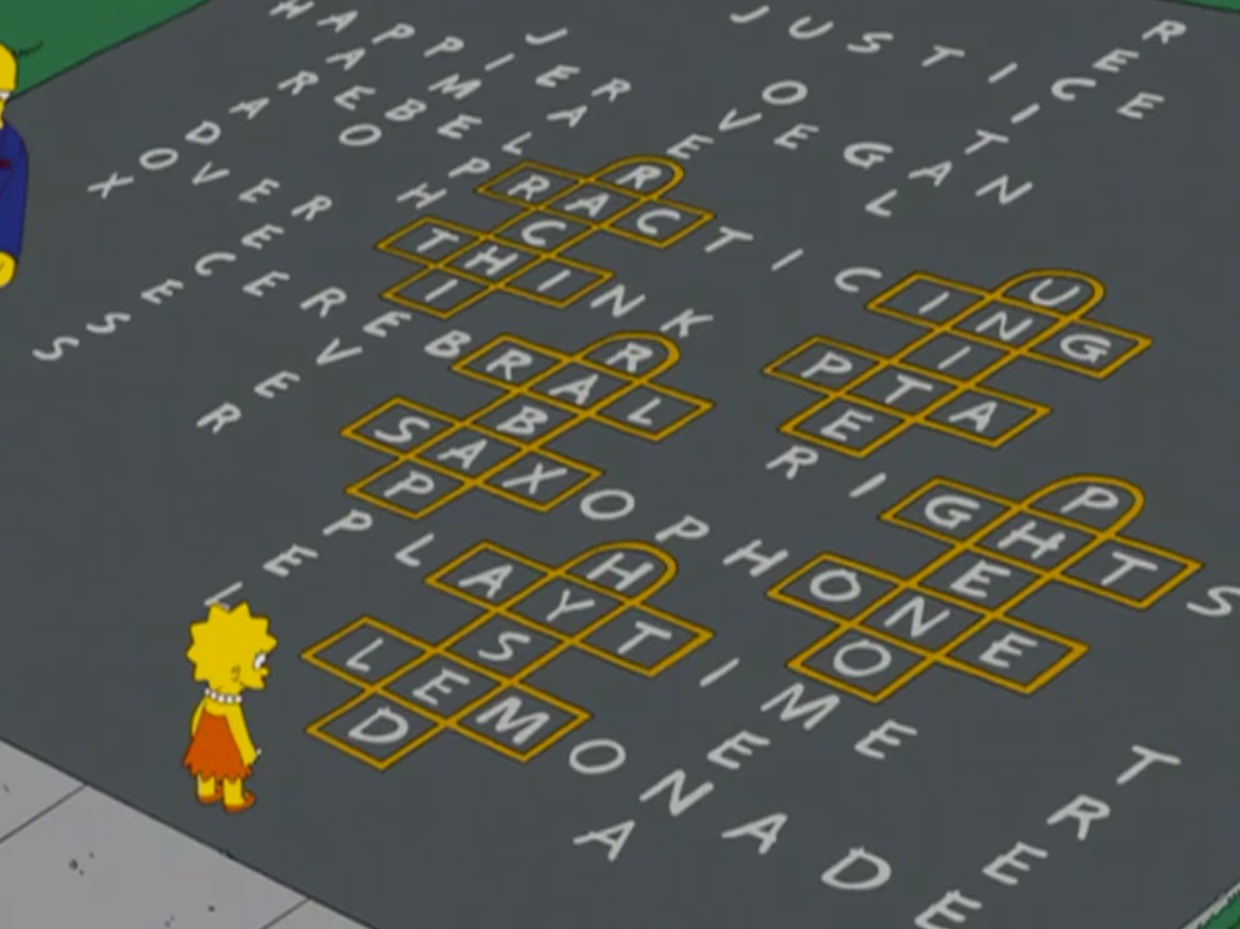
From Stanley’s love of crosswords on The Office to the clever conundrums constantly conjured by the Riddler in various iterations of Batman, puzzles have played roles both big and small in numerous TV shows and films.
But for my money, few shows have made puzzles the centerpiece of storyline development and family interaction quite like The Simpsons.
The first episode that comes to mind — and my personal favorite — is season 9’s Lisa the Simpson.
In the episode, Lisa is stumped by a brain teaser and begins to worry about her intelligence, a concern that is only exacerbated by Grandpa’s revelation of the Simpson Gene, a genetic quirk that caused Homer and Bart’s descent from academic achievement to hilarious idiocy.
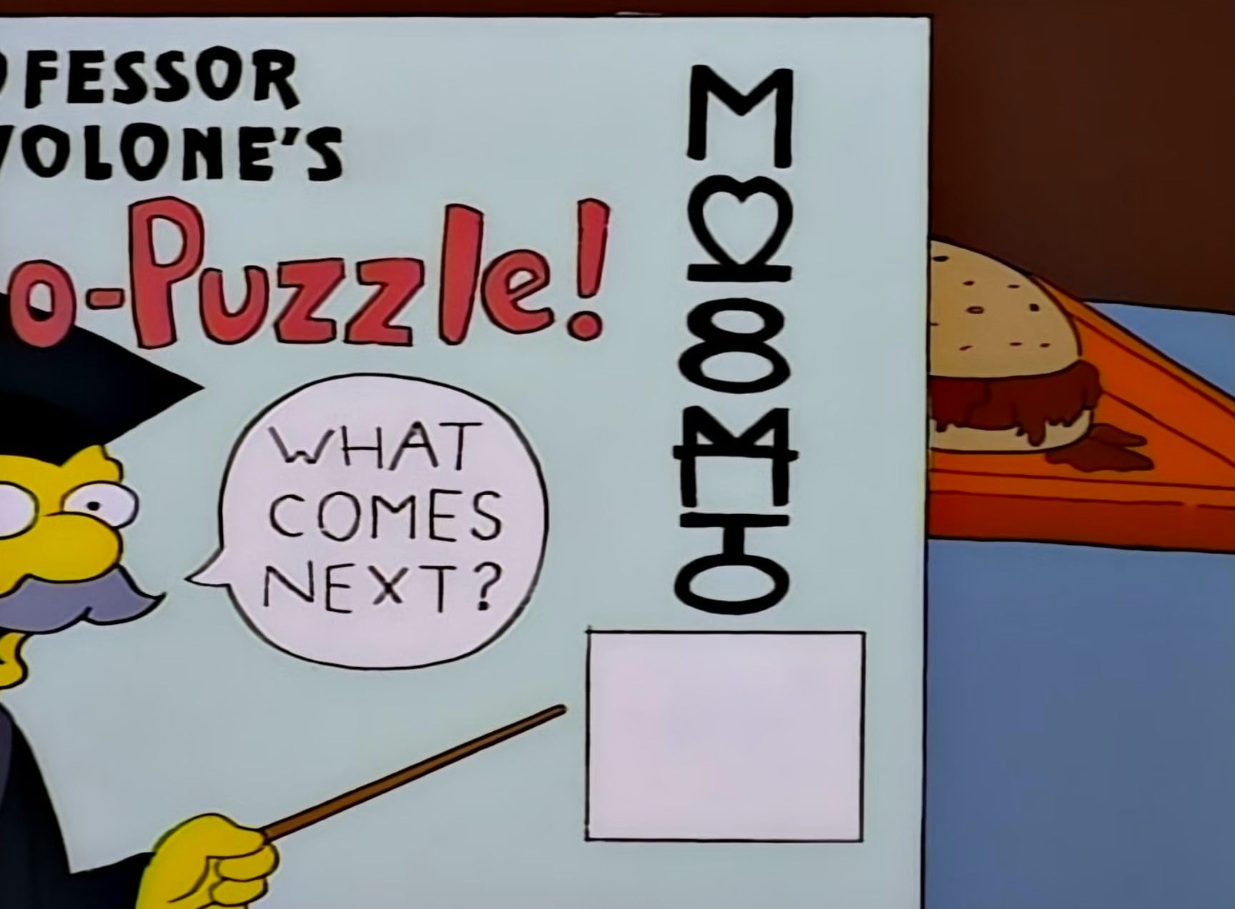
In the end, of course, Lisa discovers she’ll be just fine — the defective gene is on the Y chromosome, so only male Simpsons are afflicted — and she conquers the brain teaser.
Puzzly themes would continue to crop up in the show from time to time.
For instance, Homer discovers a secret acrostic message from his mother in the newspaper in season 15’s My Mother the Carjacker. But most of the puzzle-centric goodness centered around Lisa.
She indulged in palindromic fun with fellow Mensa members in season 10’s They Saved Lisa’s Brain, as well as an anagramming game in the season 6 classic Lisa’s Rival.
(That’s when I first learned that Alec Guinness anagrams into Genuine Class.)
But puzzles wouldn’t again take center stage until season 20’s episode Homer and Lisa Exchange Cross Words.
In the episode, Lisa quickly becomes a crossword fiend, solving all the puzzles she can and eventually entering the Crossword City Tournament.
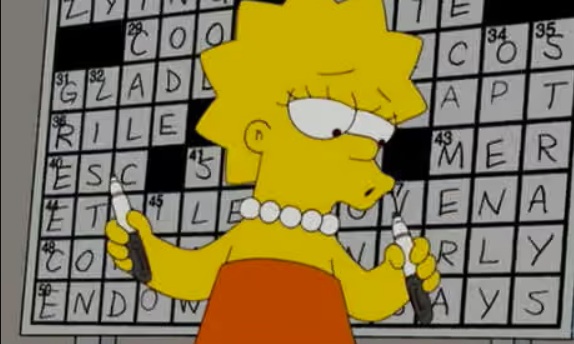
Trouble brews when Homer bets against her in the championship round, and their relationship fractures.
This was a real watershed moment in synergy for the show, since they somehow managed to convince The New York Times to publish the same puzzle in the paper that Homer uses to apologize to Lisa.
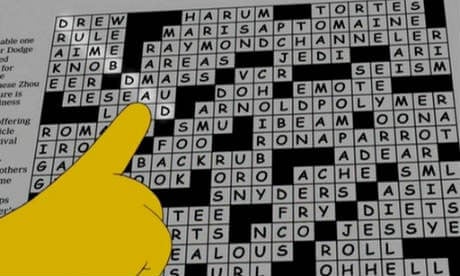
(You can click here to see the full puzzle.)
Homer’s hidden message runs along the diagonal, and it’s a brilliantly unobtrusive trick. I’m sure some solvers never even noticed the tie-in. (The puzzle didn’t reference The Simpsons or the episode in any other way.)
Puzzlemaster Merl Reagle created the puzzle, and Will Shortz oversaw the project. Both also appeared in the episode. (Reagle also created the word crossings for the hopscotch puzzle pictured above.)
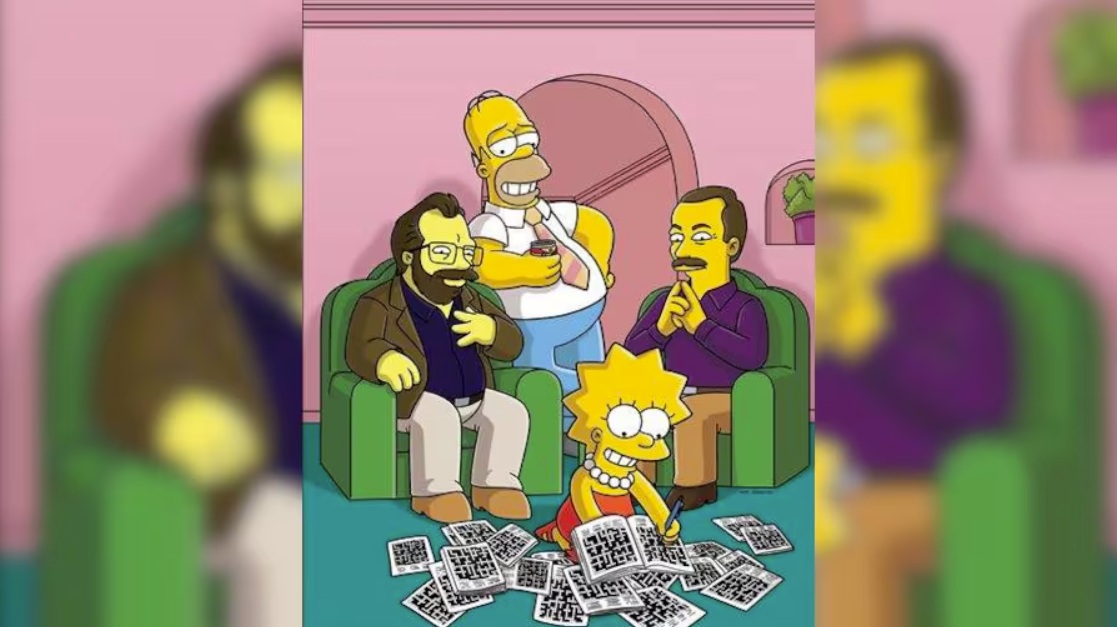
It’s a real treat to see puzzles incorporated into a narrative like this. Instead of a time-killer or a mere passing interest, they become linchpins of each story. The puzzles create conflict, drive epiphanies, and bring people together.
It’s a testament to the power of puzzles in pop culture. Plus, they’re just a buttload of fun.
Hope you enjoyed this little (animated) trip down memory lane. Until next time, keep calm, puzzle on, and I’ll catch you again soon.
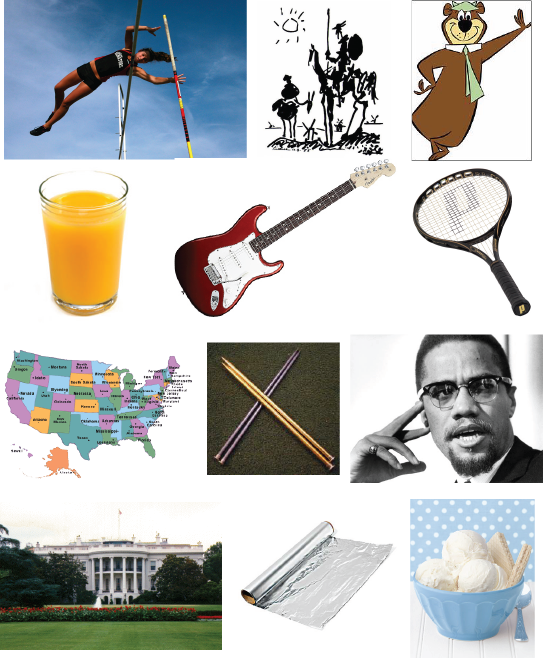
What rock band should join the set of pictures seen here?
 PuzzCulture