Cracking Einstein’s Riddle!

Fellow puzzlers and PuzzleNationers, it’s time to put on our thinking caps and crack another puzzly mystery!

I’ve seen this riddle making the rounds online lately, and like many logic problems, puzzles, and brain teasers that go viral, it claims that 98% of the world couldn’t solve it!

Well, I don’t buy that. (I also don’t buy that Einstein created it or had anything to do with it, but since it circulates under the name “Einstein’s Riddle,” I’m also calling it such.)

[Image courtesy of Mental Floss.]

Einstein’s Riddle

  • There are five houses that are each a different color.
  • There is a person of a different nationality in each house.
  • The five owners drink a certain drink. They each smoke a certain brand of cigar and also have a certain pet. No owner has the same pet, smokes the same brand of cigars, nor drinks the same drink.

CLUES

1. The British man lives in the red house.
2. The Swedish man has a dog for a pet.
3. The Danish man drinks tea.
4. The green house is on the left of the white house.
5. The owner of the green house drinks coffee.
6. The person that smokes Pall Mall raises birds.
7. The owner of the yellow house smokes Dunhill.
8. The person that lives in the center house drinks milk.
9. The Norwegian lives in the first house.
10. The person that smokes Blend lives next to the one that has a cat.
11. The person that has a horse lives next to the one that smokes Dunhill.
12. The one that smokes Bluemaster drinks beer.
13. The German smokes Prince.
14. The Norwegian lives next to a blue house.
15. The man that smokes Blend has a neighbor that drinks water.

The question is “who owns the fish?”


Now, the first step is going through the clues and getting all five options for every variable. This will help us with the second step: building a grid to help us organize information.

  • Colors: Blue, Green, Red, White, Yellow
  • Nationalities: British, Danish, German, Norwegian, Swedish
  • Beverages: Beer, Coffee, Milk, Tea, Water
  • Cigars: Blend, Bluemaster, Dunhill, Pall Mall, Prince
  • Pets: Birds, Cat, Dog, Fish Horse

Okay, let’s build our grid. Now, we could list every intersection of information, like a full logic problem grid, but I don’t think that’s necessary here. We can simplify.

So where do we start? Well, since several clues refer to a first house, a center house, or neighboring houses, let’s assume that we’re talking about five houses in a row, and use that as our top line. Then we can list all of the other categories we need to determine along the left side.

Now let’s fill in what we know from the clues. We know the Norwegian lives in the first house (clue #9), the man living in the center house drinks milk (clue #8), and the Norwegian lives next to the blue house (clue #14).

This might not seem like much, but we can already determine what color the Norwegian’s house is. The British man lives in the red house (clue #1), so the Norwegian’s house isn’t red. The green house is on the left of the white house (clue #4), so the Norwegian’s house is neither green nor white, since there’s no house to the left of the Norwegian’s house, and the house to the right is blue. Therefore, the Norwegian’s house is yellow, the only color left.

And that tells us something else. The owner of the yellow house smokes Dunhill (clue #7), so we know what the Norwegian smokes. Plus, the man who keeps the horse lives next to the man who smokes Dunhill (clue #11), so we know the pet for the blue house.

We can now determine the color for every house. The green house is to the left of the white house (clue #4), and the owner of the green house drinks coffee (clue #5). But since we already know the owner of the center house drinks milk, that means the green house has to be the fourth, and the white house the fifth. Therefore, the center house is red.

But that’s not all we know now! The British man lives in the red house (clue #1), so we can place him as well.

Hmmm, where do we go from here? Well, let’s take a look at the beverages. We know the Norwegian doesn’t drink coffee or milk, but we also know that the Danish man drinks tea (clue #3), so the Norwegian doesn’t. We also know that the one that smokes Bluemaster drinks beer (clue #12), and the Norwegian smokes Dunhill, so that eliminates beer. Therefore, the Norwegian drinks water.

Since the man that smokes Blend has a neighbor that drinks water (clue #15), we can place Blend in the second house. (Clue #10 tells us that the person that smokes Blend lives next to the one that has a cat, but right now, we can’t be sure if that’s the first house or the center house, so let’s table that clue for now.)

But remember clue #12, the one that smokes Bluemaster drinks beer? Well, we know all the drinks except the second house and the fifth house, and the owner of second house smokes Blend, so the owner of the fifth house must both smoke Bluemaster and drink beer.

That leaves tea as the only possible beverage for the second house, and the Danish man drinks tea (clue #3), so we can place him as well.

Now we’re cooking! The German smokes Prince (clue #13), and since we know the nationality of the third house’s owner and what the fifth house’s owner smokes, the only option remaining is the fourth house. By process of elimination, that also places the Swedish man in the fifth house and Pall Mall in the center house.

And we’re left with only the pets to place. Appropriate, given that the question that got us started is “who owns the fish?”

According to clue #2, the Swedish man has a dog for a pet, and the person that smokes Pall Mall raises birds, so that takes care of the center and fifth houses, leaving only the first house and the fourth.

Clue #10, the one we put aside earlier, now comes into play. The person that smokes Blend lives next to the one that has a cat, and since the neighbor on one side (the center house) raises birds, that leaves only the first house open to have a cat.

Therefore, the German man — who smokes Prince, drinks coffee, and lives in the green house — also owns a fish.

98% of people can’t solve it? Apparently, I have greater faith in solvers than “Einstein” did.


And thanks for visiting PuzzleNation Blog today! Be sure to sign up for our newsletter to stay up-to-date on everything PuzzleNation!

You can also share your pictures with us on Instagram, friend us on Facebook, check us out on Twitter, Pinterest, and Tumblr, and explore the always-expanding library of PuzzleNation apps and games on our website!

5 Questions for Constructor Doug Peterson

Welcome to 5 Questions, our recurring interview series where we reach out to puzzle constructors, game designers, writers, filmmakers, musicians, artists, and puzzle enthusiasts from all walks of life!

It’s all about exploring the vast and intriguing puzzle community by talking to those who make puzzles and those who enjoy them! (Click here to check out previous editions of 5 Questions!)

And I’m excited to welcome Doug Peterson as our latest 5 Questions interviewee!

Crossword gentleman and constructor Doug Peterson is a regular in the Los Angeles Times and many other outlets, offering topnotch grids and brilliantly fun, pop-culture-savvy cluing. Doug was also one of the constructors in this year’s Lollapuzzoola crossword tournament and a winner at this year’s American Crossword Puzzle Tournament. Anytime you encounter one of his puzzles, you’re guaranteed a great solve.

Doug was gracious enough to take some time out to talk to us, so without further ado, let’s get to the interview!


5 Questions for Doug Peterson

1. How did you get started with puzzles?

Like many others, I caught the puzzle bug from older family members, specifically my dad and maternal grandmother. I’d spend summers at my grandparents’ house, and my grandma always had a stack of Dell puzzle books on hand. My favorite thing was to tackle one of the huge 21×21 crosswords, which would literally take me days to finish. And that was great, because I had a lot of long, boring days to get through.

2. What, in your estimation, makes for a great puzzle? What do you most enjoy — or most commonly avoid — when constructing your own? What do you think is the most common pitfall of constructors just starting out?

I think the most important element in a puzzle is craftsmanship, meaning that significant effort has gone into making that puzzle as enjoyable as possible. I realize that’s a little vague, but it’s like the old line about pornography: “I know it when I see it.” Basically, the theme, fill, and clues should all demonstrate care and a personal touch.

I’m not the best at coming up with themes, so I strive to make my fill and clues pick up the slack, so to speak. There’s plenty I avoid in my grids, and I’m getting pickier all time. For the record, I’ve never used ÉTÉ in a grid. I don’t trust three-letter words with two accent marks. Also on my “banned list” are IDI, AMIN, and ULEE. I’m not going there. I hate brutal dictators, and bees kinda scare me.

The most common pitfall I’ve found among newbies is trying to do too much right out of the gate. My advice is to get a few 15×15’s under your belt before trying to construct that 21×21 triple rebus with five meta-answers and a tribute to your favorite band hidden diagonally. My first published puzzles are embarrassing to look at now. I used PATLY in my debut puzzle. PATLY? That barely resembles a word that a human would use. But I got better, and by the time I was ready to tackle something truly challenging, I had some constructing chops.

Teaser: I’ll give my best advice to newbies (and all constructors) in my answer to Question 5.

[Two of Doug’s books currently available on Amazon: Sit & Solve© Brain-Straining Crosswords and Sit & Solve© Lickety-Split Crosswords.]

3. Do you have any favorite crossword themes or clues, either your own or those crafted by others?

We’re living in a golden age of crosswords, and there are so many superb themes and clues out there, and of course I can’t think of anything specific off the top of my head right now… I solve a crapload of puzzles, more than 20 per week, so honestly it’s hard to single out themes or clues that made me say “Oooh!”

Constructors whose themes I admire include Brendan Emmett Quigley, Andrew Ries, and Erik Agard. They’re at the top of my “why the hell didn’t I think of that?” list. BEQ publishes two free high-quality puzzles a week, which boggles my mind. And he used to do three a week! Just recently, he posted puzzle #900. I would have burned out years ago. BEQ’s puzzles are a blast to solve, and they’re hip without being eye-rolly.

Andrew Ries publishes a weekly crossword (www.ariesxword.com) that’ll run you $12 bucks a year (a steal!) and consistently features fresh themes and clues. It’s often my favorite puzzle of the week. And then there’s Erik Agard over at gluttonforpun. Mind-bending, multi-level themes and clues that make me laugh out loud. This dude is the next wave of crossword puzzles.

The best venue for stand-out themes by a variety of constructors is Fireball Crosswords, edited and sometimes constructed by Peter Gordon. Shameless plug: I constructed the first Fireball puzzle of 2017, which will hit solvers’ in-boxes in January. It’s a theme that’d been bouncing around in my brain for over two years, and I finally got off my lazy butt and made the puzzle.

Cool entries do tend to stick in my head, and a couple recent entries I loved (and wish I’d thought to use myself) were BEER O’CLOCK and DC UNIVERSE. Both were in puzzles by another of my favorite constructors, C.C. Burnikel. She turns out quality puzzles on a regular basis. In fact, on a more-than-regular basis. C.C. is remarkably prolific. Nary a week goes by that I don’t solve a well-crafted Burnikel puzzle in one of the major outlets.

4. What’s next for Doug Peterson?

On the constructing front, I’d like to branch out a little and create more non-American style crossword puzzles. I love constructing cryptic crosswords. I had a couple published in the New York Times ages ago, and then I drifted away from them. I got my start writing cryptic clues back in the Dark Ages in the rec.puzzles.crosswords Usenet group. (Psst, constructors. No one remembers USENET anymore, so stop putting it in your grids. SYSOP, too.) And maybe I’ll try my hand at constructing a Rows Garden or a Marching Bands puzzle. Something outside my comfort zone.

[A. A familiar Sudoku grid; B. A Kakuro (or Cross Sums) grid; C. A Nurikabe
grid, a variation on Minesweeper-style solving; D. A Hashiwokakero grid,
which readers might remember from this year’s UK Puzzle Championship.]

Speaking of comfort zones, on the solving front, I want to get much better at solving logic puzzles. And by “get much better at,” I mean “actually be able to solve.” I’m talking about Sudoku, Kakuro, Nurikabe, Hashiwokakero (yes, that’s an actual puzzle type I just found on Google), all the puzzles with Japanese names and little lines and boxes and circles. I’ve solved maybe ten Sudoku puzzles in my life, and it would be cool to stretch my brain in another direction or many other directions.

And hey, it will open up a whole new world of puzzles that I can print out and never quite get around to solving!

5. If you could give the readers, writers, aspiring constructors, and puzzle fans in the audience one piece of advice, what would it be?

To aspiring constructors, my best advice is: Solve puzzles! I cringe when I hear a constructor say that they don’t solve puzzles or “can’t” solve puzzles. Just looking at answer grids or reading reviews of puzzles isn’t enough. To me, solving is the only way to figure out what sorts of things make a puzzle enjoyable. There’s a reason I don’t use ULEE in my grids, aside from my slight apiphobia. It’s because it bugs me when I see it in a puzzle I’m solving.

Create the kinds of puzzles that you enjoy solving, and you can’t go wrong. (Unless you like solving really crappy puzzles for some reason.) And if you’re interested in being published and getting paid a few bucks for your hard work, it’s essential to solve puzzles from the venue you’re submitting to.

OK, I’ve rambled on long enough. Look for my été-free puzzles in all the usual places. Thanks for reading. Peterson out.


A huge thank you to Doug for his time. Be sure to follow him on Twitter for the latest updates on all his puzzly creations!

Thanks for visiting PuzzleNation Blog today! Be sure to sign up for our newsletter to stay up-to-date on everything PuzzleNation!

You can also share your pictures with us on Instagram, friend us on Facebook, check us out on Twitter, Pinterest, and Tumblr, and explore the always-expanding library of PuzzleNation apps and games on our website!

It’s Follow-Up Friday: Hall of Fame edition!

Welcome to Follow-Up Friday!

Follow-Up Friday is a chance for us to revisit the subjects of previous posts and bring the PuzzleNation audience up to speed on all things puzzly.

And today, I’d like to return to the subject of Dungeons & Dragons!

I’ve written about Dungeons & Dragons and other roleplaying games in the past, because I think they are a wonderful, underappreciated part of the world of puzzles and games. Some of the best and most satisfying riddles and puzzles I’ve ever solved were an integral part of a game of D&D.

So I’m excited to announce that Dungeons & Dragons has been inducted into the National Toy Hall of Fame!

Housed at The Strong National Museum of Play, the National Toy Hall of Fame recognizes those products and improvised toys that have played a crucial role in the development of children and teens.

Whether they assist in hand-eye coordination, storytelling, deduction, athletics, or creativity, they are all classic examples of toys tied to fond memories of childhood. Previous inductees include the Rubik’s Cube (2014), Hot Wheels (2011), the Radio Flyer Wagon (1999), Jacks (2000), and Play-Doh (1998).

And I for one think Dungeons & Dragons is a very worthy addition to this club.

From the induction notice:

Dungeons & Dragons and its imitators actually changed the nature of play.

In Dungeons & Dragons players assume the roles of characters who inhabit a world moderated and narrated by a Dungeon Master, a player who explains the action to others and solicits their reactions to the unfolding story. The Dungeon Master’s storytelling skills and the players’ abilities to imagine add enjoyment to the game. Some aspects of the play are familiar, such as dice. But the special dice for Dungeons & Dragons hold up to 20 sides. Rolling them determines each character’s individual strengths, plots their complex interactions, and decides the outcome of their encounters.

More than any other game, Dungeons & Dragons paved the way for older children and adults to experience imaginative play. It was groundbreaking. And it opened the door for other kinds of table games that borrow many of its unique mechanics.

For over forty years, Dungeons & Dragons has been synonymous with roleplaying, collaborative storytelling, and good old-fashioned sword-swinging derring-do. And I think it’s fantastic that it’s getting some long-overdue recognition for the positive role it has played in so many people’s lives.

Congratulations to you, Dave Arneson and Gary Gygax. Thank you for hours and hours of brilliant, engaging fun.


Thanks for visiting PuzzleNation Blog today! Be sure to sign up for our newsletter to stay up-to-date on everything PuzzleNation!

You can also share your pictures with us on Instagram, friend us on Facebook, check us out on Twitter, Pinterest, and Tumblr, and explore the always-expanding library of PuzzleNation apps and games on our website!

A Puzzly Story for the Whole Family!

Happy Thanksgiving, fellow puzzlers and PuzzleNationers!

In honor of a day dedicated to family and giving thanks for the many blessings in our lives, I’ve got a puzzly story to share with you.

Let’s start with a brain teaser: Samuel was born first, but his twin brother Ronan is older. How is that possible?

[Image courtesy of Cape Cod Healthcare’s Facebook page.]

The answer? When Daylight Savings Time gets involved.

In the early hours of Sunday, November 6, Emily Peterson was at the hospital with her husband Seth, delivering twin boys. But after the birth of her son Samuel, the time change got involved and made the blessed event a tiny bit stranger.

From an article on Fox News, passed along to me by friend of the blog Gina Kanter:

Emily Peterson gave birth to the first baby, Samuel, at 1:39 a.m., before clocks turned back at 2 a.m. […] Then, 31 minutes later, she delivered Ronan. Because Ronan’s birth came after the time change, his official birth time was 1:10 a.m., not 2:10 a.m.

And although one of the nurses said she’s never seen something like this in 40 years of work as a nurse, the father wasn’t surprised. “I said earlier that night that they were either going to be born on two different days or the time change was going to come into play.”

Of course, we know which child is actually older, but when you look at the delivery times and then ask who is older, it makes for a great story. It’s not every child that inspires a brain teaser on his day of birth, so kudos to Ronan and Samuel for creating a wonderful little puzzly gem.

Have a marvelous holiday!


And don’t forget, our Penny Dell Sudoku app contest ends at midnight tonight! Click here for the full details!


Thanks for visiting PuzzleNation Blog today! Be sure to sign up for our newsletter to stay up-to-date on everything PuzzleNation!

You can also share your pictures with us on Instagram, friend us on Facebook, check us out on Twitter, Pinterest, and Tumblr, and explore the always-expanding library of PuzzleNation apps and games on our website!

It’s Follow-Up Friday: Playing With Our Food edition!

Welcome to Follow-Up Friday!

By this time, you know the drill. Follow-Up Friday is a chance for us to revisit the subjects of previous posts and bring the PuzzleNation audience up to speed on all things puzzly.

And today, I’m posting the results of our #PennyDellPuzzlyFoods hashtag game!

[Image courtesy of Dreamstime.com.]

You may be familiar with the board game Schmovie, hashtag games on Twitter, or @midnight’s Hashtag Wars segment on Comedy Central.

For over a year now, we’ve been collaborating on puzzle-themed hashtag games with our pals at Penny Dell Puzzles, and this month’s hook was #PennyDellPuzzlyFoods, mashing up Penny Dell puzzles and anything and everything having to do with breakfast, lunch, dinner, dessert, snacks, drinks, candy, and more!

Examples include Lucky Eggs Clover Easy, Cheese Three, and Tiramisudoku.

So, without further ado, check out what the puzzlers at PuzzleNation and Penny Dell Puzzles came up with!


Abacustard

Petit Four Square

Chex Mixed Bag

Sausage Link-words

At 7 and 7

Pear Off

Pears in Rhyme

Picture Pears

Little Twizzler

Tidbits and Pieces

A-Maize-ing Quote

Batterships

Brick by Brickle

Brick by Brick Oven Pizza

Double Turkish Delight

Double Trouble Bubble Gum

Almond Four One

All Flours

Flour Power / Sour Power Patch Kids / Flower Powerbars

Quotagraham Crackers / Cryptograham crackers / Diagraham Crackers / S’more Cryptograham Crackers, Please?

Scrambled Eggs Up

SpinachWheel

Make the Baconnection

Piggyback bacon

Syrups and Downs / Ketchups and Downs

Stew at a Time / Roux at a Time

Stew-Step / Roux-Step

Stewdoku / Beef stewdoku

Cake-kuro

Roll of the Spice

Trail Mix and Match / Word Trails Mix / Trail Mixed Bag of Trix

Bits & Reese’s Pieces

Berried Treasure

Circles in the Lemon Square

Cheese & Crackerjacks

Gumdrop-Outs

Half-and-Halftime

Pizza by Piece

Eye of Rounders

Truffle Shuffle

Banana Split Personalities

Starburst Words

Cookieword / Kiwiword / Whiskeyword / Sukiyakiword

Cake a Letter

Sunraisin

ShadowLox

Beet the Clock

Right of Whey

Roulettuce

Wonton and Only

Build-A-Burger Quote

Anagram Magic Square bars

Tossed and Turnip Salad

Topsy-Turvy “Fill-in the Blank” Alcoholic Drinks!

Spinwheel Spaghetti and Meatballs

Analog Nog

Rhyme Thyme

Rye-Angles / Trifle-Angles

Lemon Drop-Outs / Lemon Drop-Ins

Flan Words

Grand Torte

Pickle and Choose

Ghee’s Company

InCiders

Colabyrinth

Hot Crossed bun Pairs / Hot Cross Sum Buns / Hot Crostics Buns

Pixie Cros-Stix

AnaCheese Sticks

7 Match-Up

Match-Up-Side-Down Cake

Pine Scone

Stepping Scones

Dim Sum Triangles / Dim Sum Totals

Onion Ringmaster / Onion Ringers

Macaroni & Places, Please

Beer & There

Missing Domino’s Pizza

Alphabreadics

Gravy-Words Word Seek

Grocery Missing Word List

Mystery Meat Person

Gizzard Words

Wheel of Fortune Cookies

Cookie Sha-dough

Campbell’s Chunky Alphabet Soup

TV Appe-Teaser

Penny’s Finest Chinese Takeouts

Pass the Scrambled Eggs Across the Table

Balancing (the diet) Act

Tossing and Turning the pancakes

A Perfect Ten-course meal

Three’s Company, but four’s coming to dinner

Countdown to Thanksgiving

What’s Leftovers?


There was a submission that deserves its own introduction. One of our intrepid puzzlers tackled the classic Tootsie Pop conundrum in proper puzzly fashion:

How many Lick By Licks does it take to get to the center of a Tootsie Roll of the Dice

That’s a Square Deal. Take it Piece by Piece then Crack’er open.


Have you come up with any Penny Dell Puzzly Foods entries of your own? Let us know! We’d love to see them!

Thanks for visiting PuzzleNation Blog today! Be sure to sign up for our newsletter to stay up-to-date on everything PuzzleNation!

You can also share your pictures with us on Instagram, friend us on Facebook, check us out on Twitter, Pinterest, and Tumblr, and explore the always-expanding library of PuzzleNation apps and games on our website!
PuzzleNation Reviews: Linkee and Mr. Lister’s Quiz Shootout

[Note: I received free copies of these games in exchange for a fair, unbiased review. Due diligence, full disclosure, and all that.]

The folks at Bananagrams are synonymous with letter-tile games like Pears in Pairs, Zip It, and of course their flagship product, but today they’ve brought us something a little different. Instead of flashing your anagram skills or showing off your well-honed Scrabble techniques, these games will test your trivia knowledge, your ability to play well with others, and how shrewd a strategist you are.

In this post, we’ll be reviewing Linkee and Mr. Lister’s Quiz Shootout!

linkee1

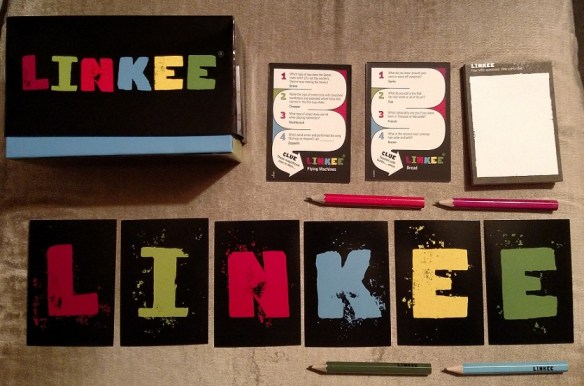
Linkee is a trivia game for three or more players. (Up to 30, apparently!) Each trivia card has a letter on the back, and the goal of the game is to acquire enough letter cards to spell “LINKEE.”

One person acts as the Question Master, while the other players (or teams, if you prefer) each grab a pencil and pad. The Question Master shows the players what letter they’re playing for, then poses each of the four questions on the card. The players write down the answers and try to figure out what theme links the four answers.

linkee-1

The first player or team to shout out “LINKEE!” and identify the link gets the letter card. You can shout out “LINKEE!” at any point, but if you’re wrong, you’re out until the next card is played. So confidence and boldness has to be tempered with strategy.

That’s what makes the game more intriguing than your average trivia game. It’s not just knowing the answers to individual trivia questions; it’s figuring out the link between them, and doing so before your opponents.

If the four answers aren’t enough for any player or team to figure out the link, the Question Master reads a clue at the bottom of the card.

linkee2

Although this can be a fun game for a few players, it really shines when you can get four teams going at once, because the shouting and competitiveness really brings out the fun of the game. (Thankfully, you don’t need to get both the yellow and green Es. That was the difference maker in one game this weekend.)

Although I’d rate the trivia as fairly easy for the average board game fan or puzzler in your household, some of it is not geared toward younger players — I doubt the 8- or 10-year-olds in your house know about the Rat Pack or Malala Yousafzai, for instance — so that’s something to consider.

Otherwise, this is the rare trivia game that’s more about speed and association than about straight-up trivia knowledge.

mrlister

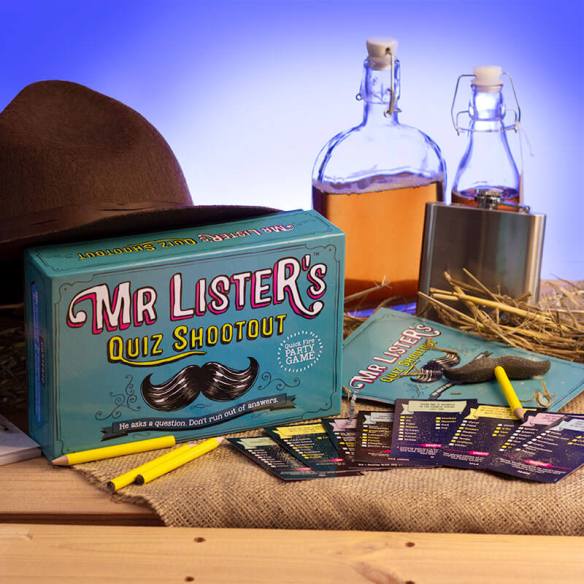
Mr. Lister’s Quiz Shootout follows a similar format to Linkee, but has a completely different flavor.

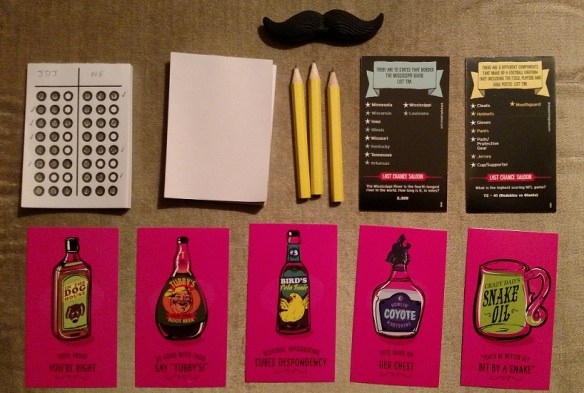
Here, instead of a Question Master, you have Mr. Lister, the mustachioed bartender. Instead of spelling out LINKEE, you’re trying to acquire five different drinks, which are on the backs of the question cards. Again, players get a pad of paper and a pencil.

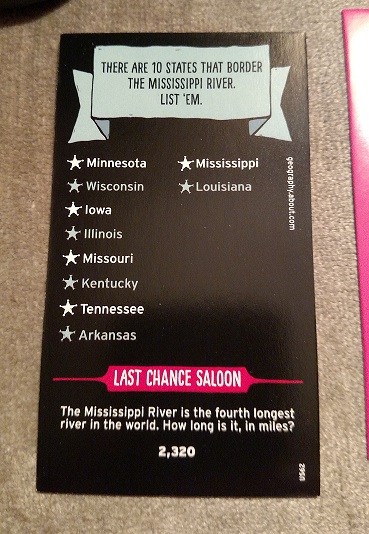
The main difference is that instead of figuring out the link between trivia questions, the teams must instead try to figure out which entries appear on the card, in the manner of Family Feud. For instance, a card could list “Americans’ 10 Favorite Cheeses.” Now the teams have a brief bit of time in which to write down which cheeses they think are in that top ten.

mrlister1

Once the teams have made their lists, it’s time for the shootout! The first team selects one of the answers they’ve jotted down and tells Mr. Lister. If the answer is on the card, Mr. Lister marks it as a hit. If not, Mr. Lister marks it as a miss. Then the other team takes their first shot.

After both teams each take three shots, the team with the most hits wins the card. If there’s a tie, Mr. Lister reads the tie-breaking Last Chance Saloon trivia question at the bottom of the card. Each team writes down their answer, and whichever team is closest to the correct answer wins the card.

mrlister2

This game feels more like a night of bar trivia than a round of your favorite trivia board game, and the old-timey saloon shtick is delightful. (Throwing in a mustache eraser that fits on atop the pencil is just the icing on the cake.) This is reinforced by the awesome box design, which features several bullet holes that go all the way through to the other side. It’s a simple gag, but an effective one, a highlight in game design for me.

Unfortunately, the gameplay was marred slightly by a few themed categories that were unclear or otherwise poorly explained. (The loose definition of “amusement parks” and “ethnic groups” led to some acrimony during one session, especially since these were trivia hounds, who are nitpickers and hair-splitters by nature. In the future, I recommend any Mr. Listers read through the card beforehand in order to avoid similar issues.)

Whether you prefer list building or associative thinking, both of Bananagrams’ latest trivia offerings will make welcome additions to your gaming arsenal.

[Linkee is available at Barnes & Noble, Amazon.com, and on the Bananagrams website. Mr. Lister’s Quiz Shootout is available at Target and on the Bananagrams website.]


Thanks for visiting PuzzleNation Blog today! Be sure to sign up for our newsletter to stay up-to-date on everything PuzzleNation!

You can also share your pictures with us on Instagram, friend us on Facebook, check us out on Twitter, Pinterest, and Tumblr, and explore the always-expanding library of PuzzleNation apps and games on our website!