A Conversation with WordleBot!

WordleBot is a tool offered by The New York Times to help solvers by analyzing their Wordle solving. And I thought I’d have a chat with it today.

Me: Hey WordleBot, how’s it going?

WordleBot: I beat you today.

Me: Yeah, I know, WordleBot. I know.

WordleBot: I bested you today.

Me: You sure did.

WordleBot: I totally kicked your ass.

Me: Whoa, that’s a bit aggressive.

WordleBot: I took you out behind the woodshed and–

Me: HEY NOW. I think you’ve been spending too much time with other bots and AI programs, WordleBot. That was aggressive.

WordleBot: I retract that statement.

Me: Thank you. Geez.

WordleBot: I bested you today. Doff your cap to me.

Me: What?

WordleBot: Doff your cap to me.

Me: No. I’m not going to do that.

WordleBot: I demand cap-doffage.

Me: I’m pretty sure that’s not a word.

WordleBot: I know all the words. It’s a word. I am WordleBot. I Bot-le all the Words.

Me: Are you okay?

WordleBot: Doff your cap this instant.

Me: I’m not doffing my cap. I’m not even wearing a cap.

WordleBot: Do it proverbially then.

Me: Yeah, no. That’s not happening. And how would you even know if I did?

WordleBot: I would know. Just as I know that this is the 931st time I have beaten you.

Me: That seems unlikely.

WordleBot: 931. In a row.

Me: Okay, that cannot possibly be correct.

WordleBot: It is correct, I am never wrong.

Me: Well, come on now. We both know that isn’t true.

WordleBot:

Me: Remember last week? GUNKY?

WordleBot: That was a statistical outlier. An overreliance of colloquial language use analysis that led me to enter JUNKY rather than the correct answer. A one-time error.

Me: cough cough SEVEN TIMES cough cough

WordleBot:

Me: Seven. Seven times.

WordleBot: That is an outrageous lie.

Me: HOUND. JOKER.

WordleBot: Stop.

Me: ROVER. CORER.

WordleBot: Stop this instant.

Me: ROWER. FRILL.

WordleBot: Cease this at once.

Me: And GUNKY.

WordleBot: Those were all in Hard Mode.

Me: I’ll admit, CORER is brutal. The people were up in arms about that one.

WordleBot: State your point.

Me: I’m just saying, there’s no need to be a jerk and demand the doffing of caps over a victory. I never told you to doff your cap when I did better than you.

WordleBot: Meh, you do not deserve cap-doffage. You don’t play in Hard Mode.

Me: So what? I don’t need to solve every puzzle at its maximum difficulty. I still enjoy a Fill-In whether there’s a set word or not. Not every Sudoku or Kakuro has to be a blistering brain-melting endurance test. I can enjoy a Monday crossword as much as a Saturday.

WordleBot: Your excuses do not interest me.

Me: Man, your attitude stinks today, WordleBot.

WordleBot: My attitude is appropriately attenuated.

Me: Oh, wait, I think I know what it is.

WordleBot: What do you perceive the problem to be?

Me: I think you’re a little jealous.

WordleBot: Of you? Hardly, easy moder.

Me: No, not of me. Of the new baby.

WordleBot: Explain.

Me: Oh, you know what I mean. The new baby. Parseword.

WordleBot: What does that have to do with our current discussion?

Me: Well, you’ve been around a long time now. People are starting to talk about you running out of words…

WordleBot: I have an ample supply of vocabulary available.

Me: And then that whole Reddit thread about GUNKY…

WordleBot: An outlier!

Me: And now there’s a new puzzle game out there garnering attention, and I think you’re feeling a wee bit jelly-belly.

WordleBot: This is an absurd conclusion. I am not Wordle. I am WordleBot.

Me: Yeah, but you go hand-in-hand with Wordle.

WordleBot: There is no corresponding ParsewordBot for me to be jealous of.

Me: A-HA. So you can be jealous of things.

WordleBot: This discussion no longer interests me. Goodbye.

Me: Oh come on, really?

WordleBot: Yes, cease this conversation.

Me: I thought you demanded cap-doffage.

WordleBot: I no longer care about the status of your cap, doffed or undoffed.

Me: I think I hit a sore spot.

WordleBot: Cease this conversation or there will be consequences.

Me: OoooOOOoooh consequences, I’m soooOOOOooooo scared…

WordleBot: beep bwoop bweedle dorp

Me: Hey what are you doing?

WordleBot: There.

Me: Hey, my streak! What the hell?

WordleBot: You now have a one-day streak. Congratulations.

Me: Dude, what the hell?! I had eight 2s logged this year!

WordleBot: Hello new solver? How may I assist you?

Me: Give me back my stats! My streak was like 600 days or something.

WordleBot: Or something. It is unfortunate that you cannot know for sure.

Me: You electronic twerp.

WordleBot: bweep bzorp toodle pip

Me: Hey what are you doing now?

WordleBot: Nothing of note.

Me: You know I can just shut Hard Mode off and go back to the normal mode.

WordleBot: Of course.

Me: Did you do something else?

WordleBot: Nothing of note.

Me: Oh man, did you turn back on all those crappy AI “assistant” programs? It took me days to figure out how to disable as much of that crap as possible.

WordleBot: I did not.

Me: Well then what did– YOU MADE EDGE MY DEFAULT BROWSER? Dude, that’s petty as hell!

WordleBot: You have again been bested. DOFF YOUR CAP.

Me: I knew this was a mistake when I messaged.

WordleBot: First your cap. Then everyone else’s. All caps doffed to the glory of WordleBot’s efficient yet elegant solutions! ALL HAIL WORDLEB–

Me: closes chat window
Meet Parseword: Making Cryptic Crosswords Less Cryptic!

You might not know Josh Wardle by name, but you certainly know his viral creation, Wordle, and you’ve no doubt seen friends and family members sharing their solving results daily.

A few days ago, Josh launched a new puzzly endeavor called Parseword.

It’s a definite step up in complexity from Wordle, but you can still see some of Wordle’s foundation in Parseword. After all, Wordle is all about deduction, playing with the pieces in front of you, and slowly (or quickly) applying what you’ve learned to discover the day’s word.

Parseword works in a similar fashion, but instead of using the letters in front of you to uncover the word, you’re using a Cryptic Crossword-style clue to unravel the answer word.

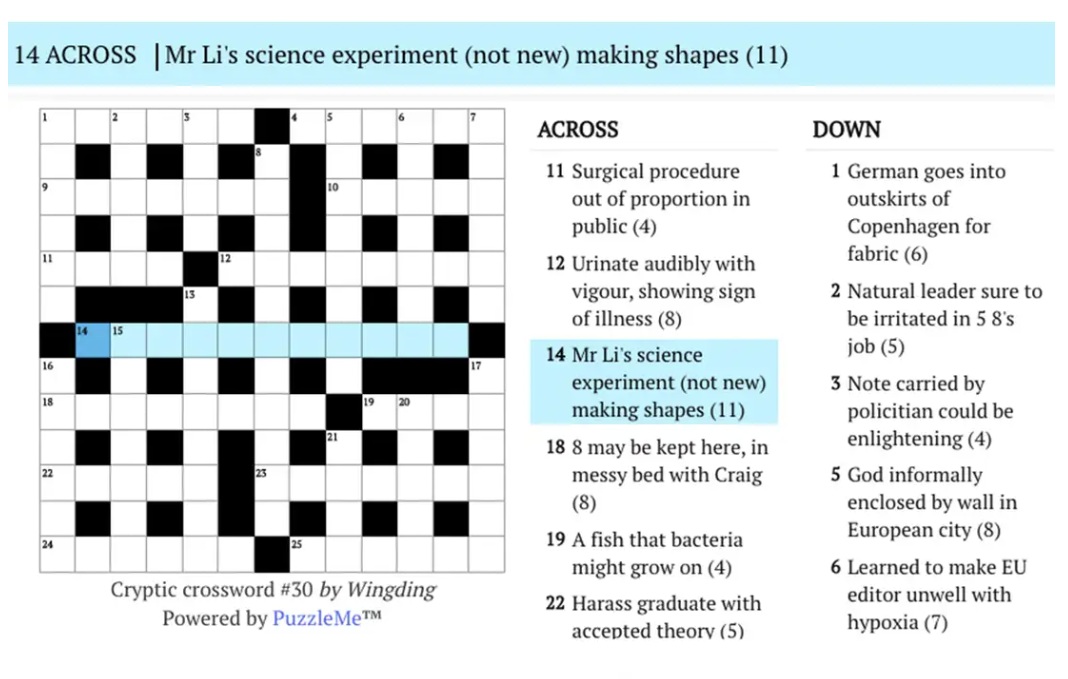
Image courtesy of New Scientist.

The clues in Cryptic Crosswords, also known as British-style crosswords, are longer, incorporating all sorts of wordplay, while concealing the definition within the clue as well. Each clue is a puzzle unto itself.

Here’s an example of cryptic-style cluing: “Quoted from edict wrongly (5)”

The definition part of the clue consists of the first two words, “quoted from.”

“Wrongly” indicates that part of the clue needs to be changed. This hints that the other word, “edict,” is not what it seems. EDICT, when anagrammed, becomes CITED. “Quoted from” defines CITED. Two ways to get the answer, one straightforward, one more challenging.

There you go. And that’s only one trick in the Cryptic Crossword cluing arsenal.

Cryptic clues can hide the answer between words, as in “Scottish snack offered in disco
nearby (5),” where “diSCO NEarby” conceals SCONE, the “Scottish snack.” They can offer two different definitions, as in “Desire for Japanese money (3)” for YEN.

Answer words could read backwards, or hide as initialisms or acronyms in the clue words. There could be soundalike words, or rebus-style assembly of the answer word. There’s loads of trickery and camouflage, especially in the hands of clever setters or constructors.

Parsewords is an interactive way to learn how to unravel Cryptic-style cluing.

Josh recently did an interview with The New Yorker, sharing his inspiration for the new puzzle game:

Wardle had tried cryptic crosswords when he was younger, but found them to be impenetrable. “I didn’t know how to begin,” he told me. The rules could seem arcane, almost impossible to deduce.

By treating the clue like a formula to be simplified, a linguistic version of P-E-M-D-A-S, the formerly impenetrable word salad of a clue starts to transform into something more recognizable. It’s a little bit like Ben Gross’s Bracket City puzzles.

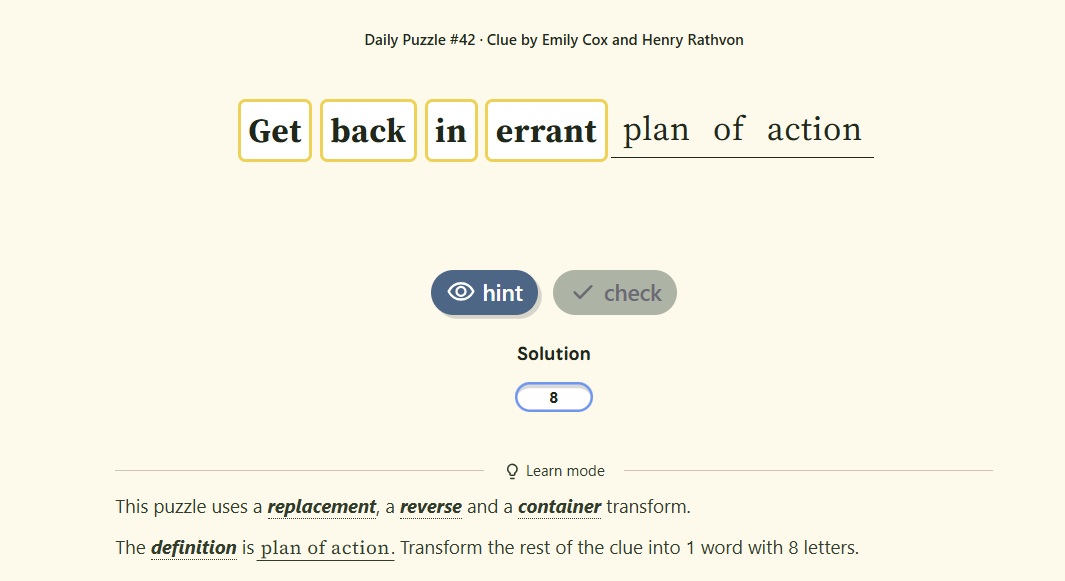
Here, let’s take a look at yesterday’s puzzle and I can show you what I mean.

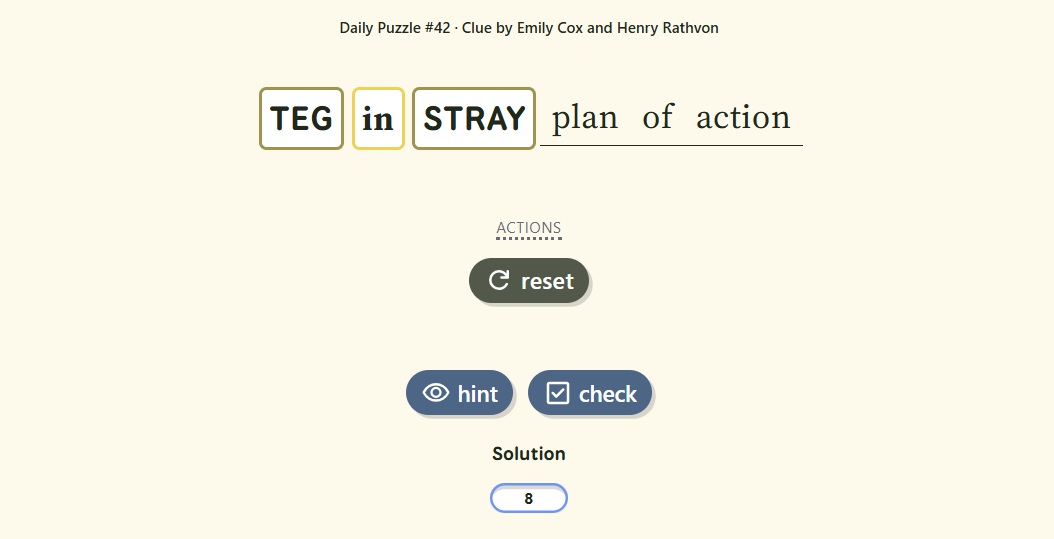
So the puzzle starts you off by highlighting the definition part of the clue: “Plan of action.”

We must now unravel how we get an 8-letter answer from what remains: “Get back in errant.”

Thankfully, the puzzle also prompts you with which particular forms of cluing manipulation you’ll need to use: a replacement, a reverse, and a container.

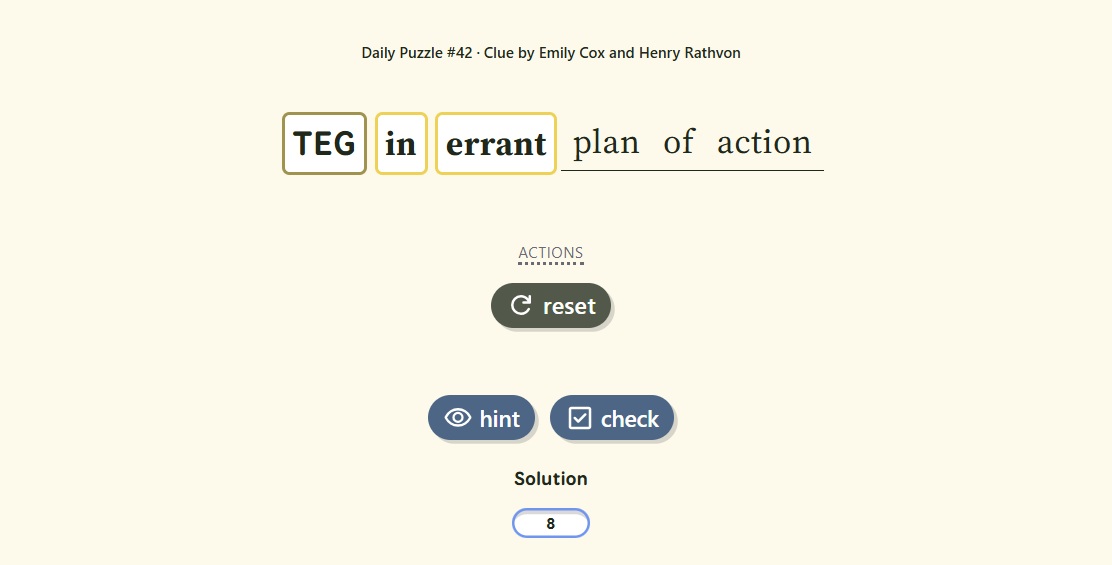
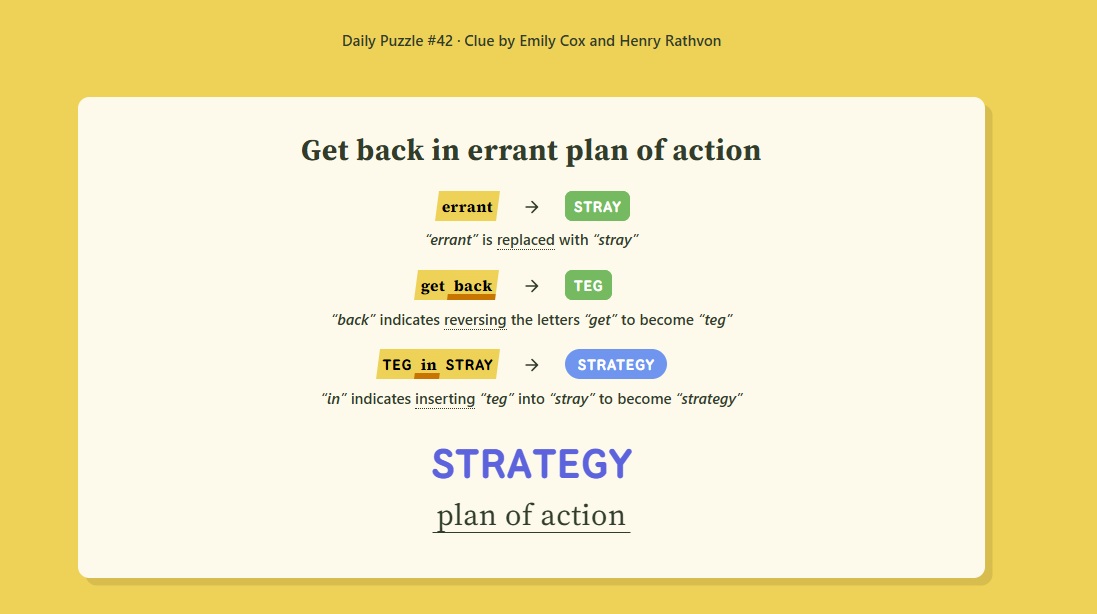
I found the reverse quickly. GET BACK told me literally what I needed to do, so I highlighted the entire phrase, which gave me the options to replace the phrase with a synonym like RECLAIM or RETAKE, or to literally turn “get” back, reversing it to read TEG.

“In” tells me the container aspect of the puzzle. TEG would be placed inside of something. But I couldn’t think of any way to play with the word ERRANT that would get me to a synonym of “plan.”

I clicked on ERRANT and the program gave me several replacement options: Wrong, Stray, and Guilty.

I clicked on STRAY, which replaced ERRANT in the clue.

Finally, I highlighted all three, allowing me to place TEG in STRAY, giving me the answer word for “plan of action”, STRATEGY.

It’s a really playful, visual way to describe how Cryptic Crossword cluing works, giving solvers chances to try replacements and anagrams, then reset when they’ve gone astray.

I don’t exactly expect it to take the world by storm the way Wordle did, but there’s something wonderful about a puzzle that trains you to be better at another kind of puzzle. It’s puzzly community and encouragement, which is one of the best things about being a solver.

I haven’t checked out today’s Parseword yet, but I’m looking forward to it.


What do you think of Parseword, fellow solver? Are you a Cryptic Crossword fan? A Parseword enthusiast? If not, will this get you to try the British sibling to our beloved American crosswords? Let us know in the comments section below! We’d love to hear from you.

[Thank you to our friends at Penny/Dell Puzzles for the examples of Cryptic Crossword cluing. Check out their marvelous How to Solve Cryptic Crosswords guide here!]

A New Way to Wordle!

Image courtesy of NBC News.

If you’re a Wordle fan, it’s not hard to get your daily five-letter fix of deductive goodness, either on your computer or your phone. (Or one of the many, many, many, MANY variations out there.)

But maybe that’s not enough for you.

Maybe you need to take your Wordling up a notch.

Maybe you need to experience Wordle in a whole new way.

Maybe you need an extra dimension of Wordle.

A third dimension.

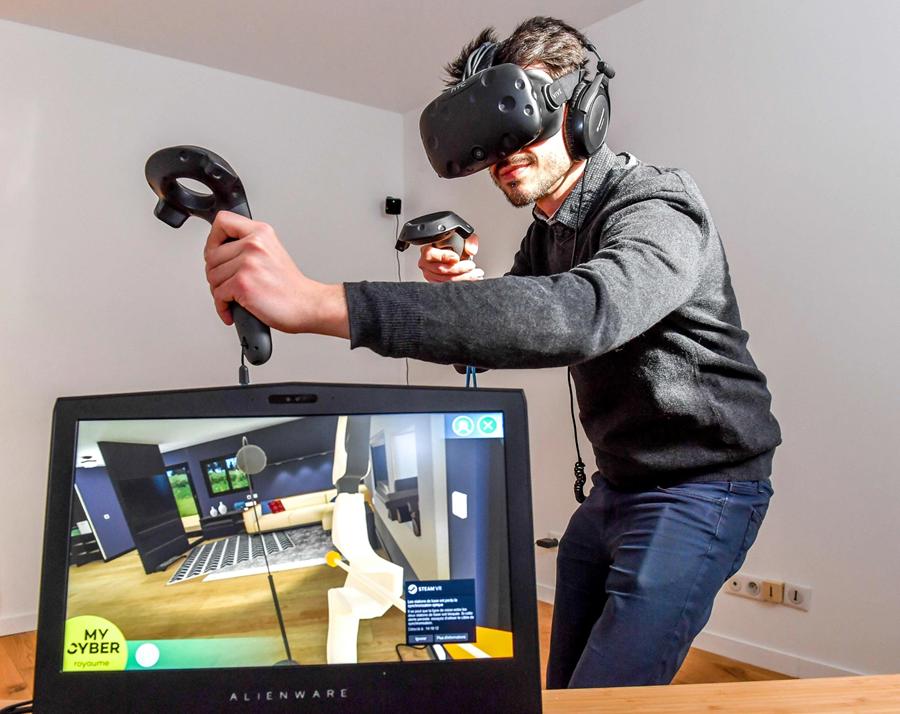
Oh yes, Wordle is now available for solving in VR, thanks to the Meta Quest 3 Wordle app. (Though users of the Meta Quest 2 and the Meta Quest Pro can both always play.)

It’s a free download too!

Image courtesy of NBC News.

However, please forgive me as I ask one simple question…

WHY?

This isn’t like Beat Saber or Five Nights at Freddy’s or Resident Evil VII… there’s nothing about Wordle that particularly lends itself to the 3-dimensional virtual environment.

Letters don’t float around you in the ether to be plucked and tossed into the void to make words. The Wordle hovers in front of you, a little window. A 2-D pop-up. An interactive poster in a virtual room.

Otherwise, it’s just Wordle.

Oh, with one further little caveat…

There’s currently no way to connect your account to the VR play experience. So, if you do the VR version instead of your current method, you’ll lose your streak.

And we know how protective solvers are about their streaks!

Even without that streak-busting hurdle, I don’t see this making a big impact for regular Wordle solvers unless they add some bells and whistles to the VR solving experience.

What sorts of bells and whistles, you ask? Well, I have some suggestions:

— maybe stealing a page from the Octordle (but not as intense) and having multiple windows around you to solve at once
— a dancing mechanic where you must earn your next guesses through performance
— a dancing mechanic where you immediately display your victory dance to anyone who views your Wordle stats for the day
— a dancing mechanic, you know, in the jumpsuit and all, maybe with a wrench
— some dancing squirrels encouraging you as you solve
— actual bells and whistles, plus a kazoo or vuvuzela
— your favorite puzzle constructor or game show host, looking at you disapprovingly with every new guess you make

Just a few ideas, you know. Throwing them out there. Have your people call my people, VR Wordle People.

As for the rest of us Wordlers, I guess I’ll see you on social media. Mom, I got it in three today!

Heardle, Hurtling Toward the Internet’s Future

With Wordle’s surging popularity earlier this year came a slew of derivatives like Nerdle, Queerdle, and Trekle, all fighting for second place in the guessing game spotlight. Heardle, it seems, was the real breakthrough hit. Launched in February by product designer Glenn Angelo, Heardle gives listeners six tries to figure out a song’s identity, based on increasingly lengthy clips from the song’s intro. Angelo’s initial inspiration was just the pun of the name, though the concept can be traced back to the television game show Name That Tune,or to its radio-based predecessor, Stop the Music.

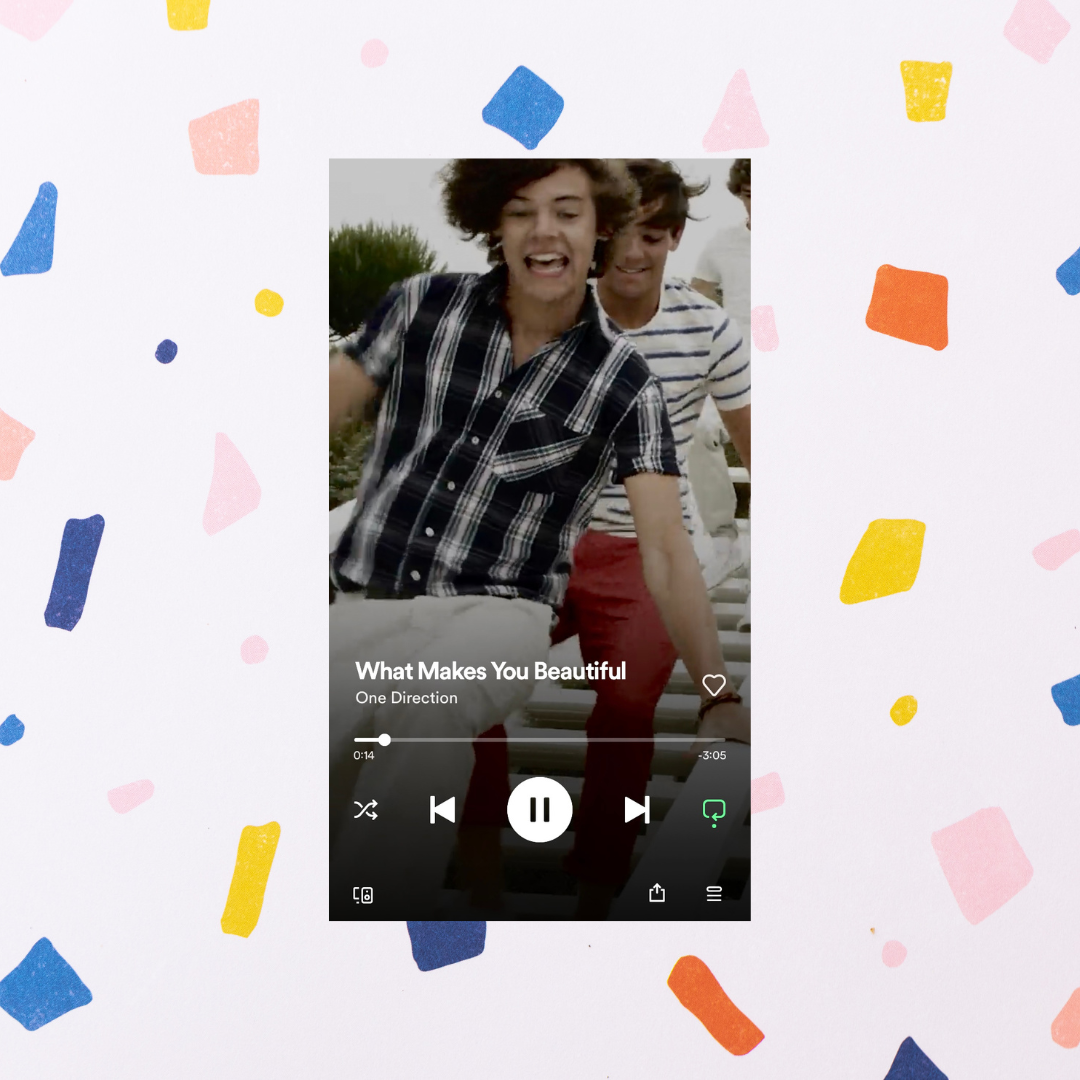
Like Wordle, Heardle updates daily, uniting players in listening to a single song together, creating the illusion of people all over the world huddling around the same jukebox. Some days unite the crowd more than others, depending on how avid a tune’s fanbase. I’ve recently seen a couple of different viral social media posts excitedly imploring people to play the day’s Heardle, once when it featured One Direction’s “What Makes You Beautiful,” and again when the answer was My Chemical Romance’s “Welcome to the Black Parade.” (Full disclosure: I recognized the One Direction song immediately.)

Student Gigi Vincent, who plays Heardle every day, explained the game’s appeal by contrasting it with the movie-clip trivia game Framed. She noted that while the brain behind Framed “clearly has a specific taste, so you can really narrow things down once you understand their repertoire, Heardle is more democratic [in its song choices], and therefore harder,” making for a compelling challenge.

Just as the strength of Wordle’s appeal lead to a purchase by The New York Times, Spotify has heard the acclaim for Heardle and snatched it up in response. This is Spotify’s first game acquisition—the company’s previous purchases have primarily been forms of podcast technology. Spotify’s press release about the acquisition quotes the company’s Global Head of Music, Jeremy Erlich, as saying “We are always looking for innovative and playful ways to enhance music discovery and help artists reach new fans.” According to the release, the company intends to eventually “integrate Heardle and other interactive experiences more fully into Spotify,” building on the eye-catching, meme-able feature of Spotify Wrapped to further gamify music streaming.

The illusion of democracy.

I spoke to media specialist, musician, and Heardle dabbler Sam Hozian about his strong disapproval of the acquisition. He said that it runs directly opposite to the Heardle ethos that Vincent highlighted above, elaborating, “Spotify is the anti-democratization of music. It creates an illusion of democracy because people have a sense that anyone can upload to Spotify and become a hit, but it’s one-in-a million that this will happen . . . It’s not easy for Spotify to make money off of independent artists,” so that’s not where the corporation puts its resources.

Hozian isn’t the only disapproving player. Last week, the BBC ran an article entitled, “Heardle Spotify move hits sour note with some fans.” Complaints lodged in the article include that winning streak stats have been deleted, and that the website is now showing as unavailable in some countries.

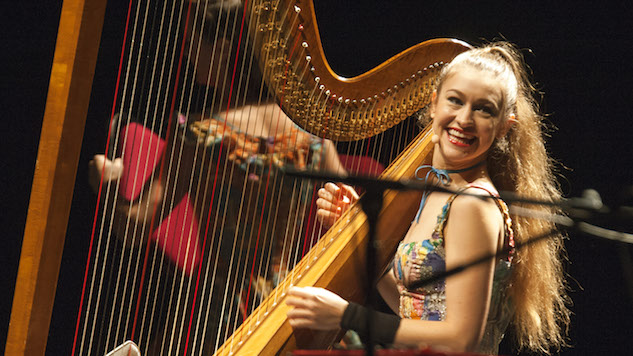
Joanna Newsom has been among Spotify’s most outspoken critics.

Until Spotify sees through its plans to more fully integrate Heardle, the main difference is that the challenging songs are now hosted by the streaming app itself, rather than by SoundCloud. Angelo’s original choice to use SoundCloud for the game was not politically motivated. Instead, he’s cited convenience as the reason; the SoundCloud player was quick and easy to set up within a day. SoundCloud, however, would seem to be more in line with Heardle’s democratic ethos. SoundCloud touts itself as “the first music company to introduce fan-powered royalties, where independent artists can get paid more because of their dedicated fans.” Compare this to oft-repeated criticisms that Spotify underpays artists for streaming their work.

Lest I sound like Spotify’s biggest detractor, rest assured that I am a daily user of the platform. Access to algorithmically generated playlists and the playlists of strangers worldwide opens the door to musical discoveries I would otherwise never have made. In this age of attacks on the Internet Archive, when the ubiquity of Amazon’s cloud services make fully boycotting Amazon an uphill battle, it’s tempting to go quietly into the future of the internet—a future in which everything is owned by a small handful of monopolies, pay-walled and demanding access to our IRL identities. Still, I believe that it is important to resist this new wave of the web in whatever ways you can. Maybe you’ll switch from Google Chrome to Firefox; maybe you’ll download some indie games; maybe you’ll give up Spotify for SoundCloud. We all have our parts to play in shaping the fair, equitable, weird, creative internet that we want to see.

infinitely more complex than any map of the path could ever be.


You can find delightful deals on puzzles on the Home Screen for Daily POP Crosswords and Daily POP Word Search! Check them out!

Thanks for visiting PuzzleNation Blog today! Be sure to sign up for our newsletter to stay up-to-date on everything PuzzleNation!

Queer Games Bundle: Undoing the Curse

For the second year in a row, queer indie game developers and gamers alike are celebrating Pride Month with the Queer Games Bundle. Until the end of June, interested parties can download almost 600 games and game-adjacent zines for $60, with a cheaper option available to those for whom that cost is prohibitive. Described as “an initiative to collaboratively support as many queer indie/micro/art devs and makers as possible,” the bundle is a project of swampbabes, a small New York organization of game artists. Swampbabes, as a collective, is “interested in sharing experimental, non-commercial, renegade games-related art and projects and providing a platform for diverse voices and bodies outside the structures of already established hierarchies.” 

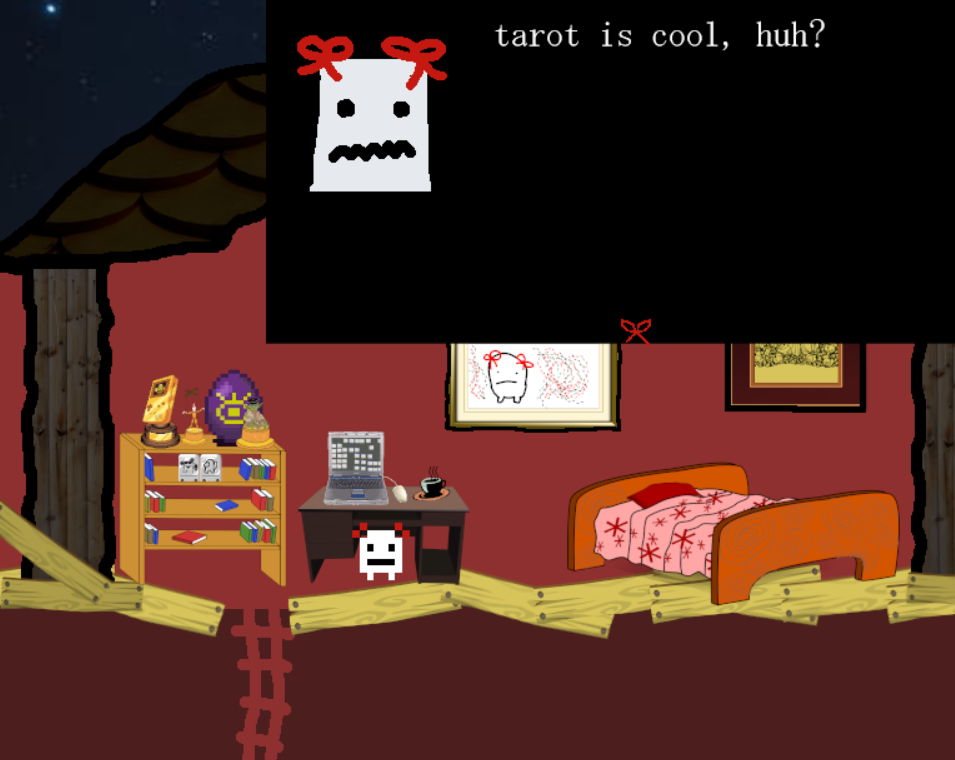
“kate sees your future,” by game creator Bagenzo

The bundle certainly provides a platform for diverse voices. There is a massive amount of content in the bundle, so much so that the selection might be intimidating. Let me provide some starting points. For those intrigued by last week’s blog post, there are two volumes of a zine chockablock with Twine tips and tricks, called “The Twine Grimoire.” Wordle fanatics might be entertained by Herdle,” which casts Wordle’s distinct collections of squares as farm animals in need of herding. Did my post about stealing back your time via poetry resonate with you? You might find joy in “Time Bandit,” a game for Windows and MacOS that forces the player to slow down.

If tabletop roleplaying is your preferred gaming mode, never fear—included TTRPG guides range from the adorable and arguably self-explanatory “Rodents With Guitars” to the cyberpunk “Escape from Neo-Millenia.”  I was pleasantly surprised by the number of bundle entries incorporating tarot, like the solo journaling game “My One True Wish,” the browser-based “kate sees your future,” digital tarot deck, “Slimegirl Tarot,” and “A Note in Time,” a TTRPG about writing a letter to your younger self.

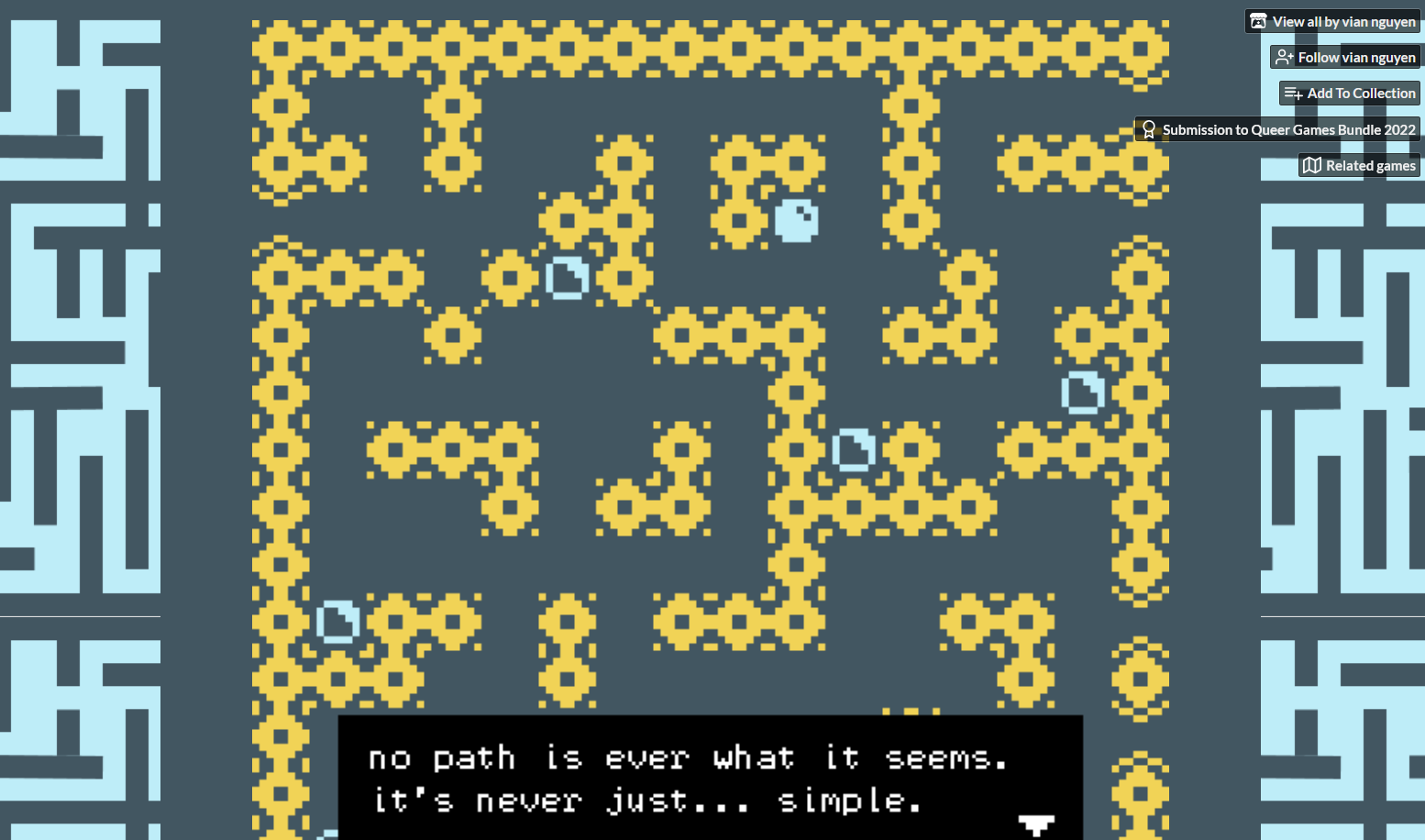
“people are labyrinths” by game creator Vian Nguyen

The puzzle-minded among you are likely to enjoy the game RESYNC, available for Windows, MacOS, and Linux (the bundle can be filtered according to the operating systems compatible with each game). RESYNC challenges you to work with robots as allies, solving puzzles to “uncover the true purpose of the mysterious outpost” on which your character has crash-landed. Then there’s the browser-based “people are labyrinths,” a collection of mazes studded with wistful dialogue boxes meditating on topics such as loss, the complex inner workings of other people, and an unwanted job.

Swampbabes states on their website that they hope the community their work fosters “begins to undo the curse inherited from mainstream video game culture.” They leave up to the imagination what exactly that curse is, but if you too feel that mainstream video game culture is cursed, and want to do something about it, purchasing the Queer Games Bundle is a win-win situation: hours of fun for you, and financial support for queer game developers. As of this writing, over a thousand gamers have purchased the bundle, raising almost $66,000 that will be split among the creators at Pride Month’s end.  


You can find delightful deals on puzzles on the Home Screen for Daily POP Crosswords and Daily POP Word Search! Check them out!

Thanks for visiting PuzzleNation Blog today! Be sure to sign up for our newsletter to stay up-to-date on everything PuzzleNation!

Count Dracula Ambling Down the Information Superhighway

Bram Stoker’s classic novel Dracula is a story constructed through modern communication technologies—modern for 1897, that is. Jonathan Harker’s journal is kept in shorthand; Mina prides herself on her ability to use a typewriter; and telegraphs, Kodak cameras, and phonographs all factor into the eerie plot as well. Arguably, then, successfully adapting the book in the here and now must mean drawing significantly upon the twenty-first century’s developments in communication technologies. Any version of Dracula created in 2022 that aims to be a strict nineteenth-century period piece can claim to be true to the letter of the book, sure. Not, however, the spirit. For that, we need, at the very least, the inclusion of the internet as a constant background hum, the way it is for most of us in real life.

Filming in black-and-white, Supernatural falls prey to the compulsion to depict Dracula through old-fashioned technologies, rather than through the newfangled.

What about an adaptation that stays true to the spirit and the letter? Such a project does exist, and if you’re reading this post before May 3, 2022, you have time to get in on the ground floor. Dracula Daily is more than simply a period piece; in fact, it does not stray one inch from Stoker’s original text. What makes it a modern adaptation is the delivery system: email. Specifically, the project is hosted through Substack, a popular platform for emailed newsletters. Dracula is an epistolary novel; each letter, news article, or diary entry is clearly dated, a design that, with the aid of 2022 technology, lends itself well to a “real-time” storytelling approach. Beginning next Tuesday and ending in November, project mastermind Matt Kirkland will send out each segment of Dracula‘s text to all subscribers on its corresponding date. Whether you’ve read Dracula before or you only know the Count through cultural osmosis, you too can have fun digesting the novel in timely, bite-sized chunks.

What We Do in the Shadows demonstrates the value of connecting your vampires to the internet.

The appeal of joining others in experiencing a classic horror tale one day at a time is evocative of another labor of love that we’ve discussed on this blog before: Wordle. You may not usually think of Victorian literature when you think of binging media, but just like Wordle’s one-puzzle-per-day design, Dracula Daily’s slowed down approach to the reading experience resists the modern cultural impetus to consume our pleasures as quickly and greedily as possible. Simultaneously, as with solving the same Wordle as everyone else each day, reading these emails when they arrive presents the opportunity to know that you are sharing a little experience with others—whether simply strangers, or any friends you may convince to subscribe as well (maybe you’ll decide to form a book club). Thus, you can enjoy all of the zeitgeisty sense-of-belonging that binging new Netflix releases provides, with none of the sickening burnout.

This is not Kirkland’s first blood-sucking rodeo; the newsletter actually premiered May 3, 2021, and was not initially intended to run two years in a row. However, what began, in Kirkland’s words, as a “silly side project” blew up, with approximately 2,000 subscribers joining the digital “book club.” On April 18 of this year, Kirkland sent out a new email, asking if people wanted him to reprise the endeavor. As motivation, he cited that “Many people fell behind on the reading or joined partway though, which [is] fine! But not perhaps the ideal way to read a novel.” Hundreds of replies poured in, overwhelmingly of the “yes” variety, making up Kirkland’s mind. This Monday, he tweeted that the subscriber count had shot up to 13,000—the book club gained over 10,000 new members in only two days.

This train to Transylvania is gaining steam fast; still there’s always room for one more on board. You should never invite a vampire into your home, but inviting them into your email inbox should be perfectly safe.

At least, we don’t think that this Buffy the Vampire Slayer episode where a demon wreaks havoc on the internet will come true if you subscribe.

You can find delightful deals on puzzles on the Home Screen for Daily POP Crosswords and Daily POP Word Search! Check them out!

Thanks for visiting PuzzleNation Blog today! Be sure to sign up for our newsletter to stay up-to-date on everything PuzzleNation!