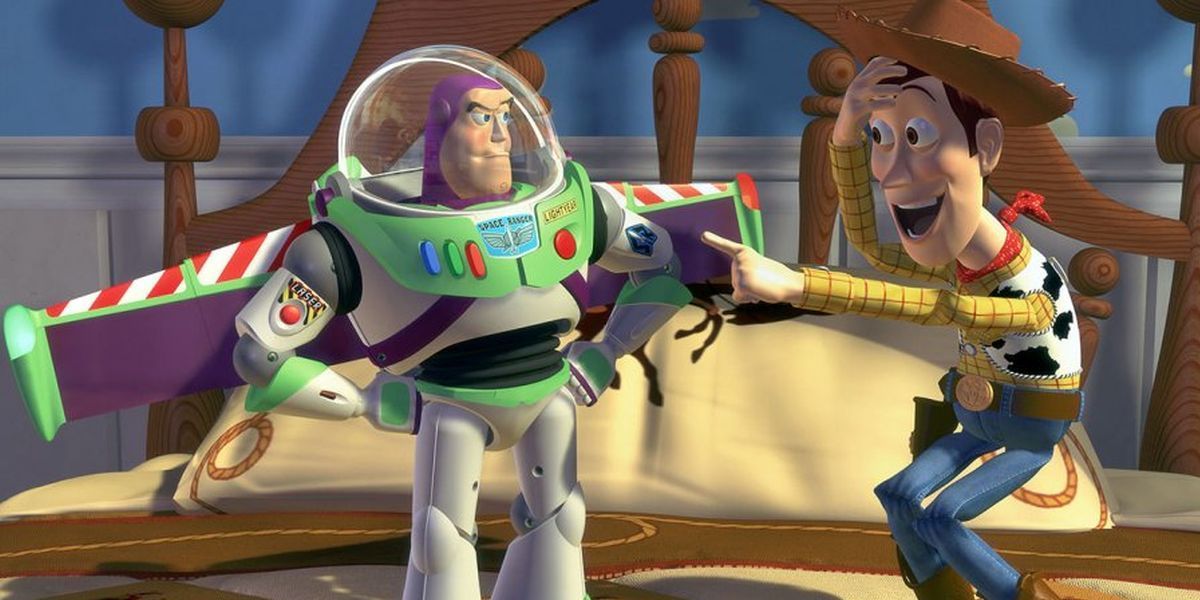
Overlaps: TV/Book Edition

One of my favorite go-to trivia games is Overlaps. Basically, the answer to the trivia question is a combination of two titles. You can use movies, celebrity names, anything really.

And I thought I’d share one of my Overlaps games with you today, fellow puzzler.

Here’s an example to get you started:

A hardworking midwestern mom is mistaken for an 11 year old orphan girl and goes to Avonlea.

And the answer is: Roseanne of Green Gables

Can you unravel these descriptions that overlap a TV show title and a book title?

Let’s find out!


A look at the day-to-day work lives of Thought Police working for Big Apple Brother.

A love quadrangle and an amateur play performance cross paths with a popular shape-named game show involving getting a partner to say the right word.

A talking horse says one thing and means his mother in this curious tale of trying to avoid fate.

Firemen, police, and EMTs in Los Angeles find themselves in a mental institution under the thumb of a tyrannical nurse.

Time and relative dimensions in space are bent by a curious visitor to a disfunctional middle-aged couple’s home after a university faculty party.

456 players compete for a grand prize as the political climate of Westeros changes forever.

With a sword and chakram in hand, a former marauder shares her story of balancing life in high school and her new royal duties.

Wacky hijinks ensue as a man shares the story of courting a famous author of fairy tales and nursery rhymes.

A high schooler with grand ambitions and a habit of stopping time to talk to the camera endures struggles with mental health after her aspiring post-college writing career fails to materialize.

Piloting giant mechanical battle suits to battle angels, the Pevensie children liberate a magical land from the White Witch.

A programming startup company deals with funding issues and a dependence on drugs to navigate turbulent personal and professional relationships in New York City after World War II.

A video diary to a newborn baby from her older sibling serves as the golden ticket to a peculiar candymaker’s legacy.

The misadventures of a young man and his scuffling siblings in a fictional Midlands town in the 1800s as issues of women’s rights, marriage, and political reform are explored.

Two secret service agents seek dangerous magical artifacts while listening to audio tapes recorded by a young woman who committed suicide.

Travel to a curious locale where dreams can come true, particularly for the one woman who lives there, waiting for her people to return for her.

A sharp-tongued and satirical look at the news is presented by a two-inch boy who looks just like a mouse.


How many did you unravel? Let us know in the comments section below! We’d love to hear from you.

Real or Fake Game: TV Shows!

Truth is often stranger than fiction, as they say, and as someone who regularly creates quizzes, games, and puzzles for friends to unravel, that’s a core tenet of one of my favorite game styles: Real or Fake Games.

Real or Fake Games are quite simple. I present the player(s) with something — a headline, an animal, a fortune cookie fortune, the plot synopsis of an episode of The Simpsons — and they have to tell me if it’s real or fake.

So today, I’ve crafted a Real or Fake Game for you, fellow puzzler. Below are titles of TV shows, accompanied by a brief description. Can you sort the genuine article from the ones I made up?

Let’s find out!


1: Something Rotten in Denny’s

In this short-lived translation of Hamlet into an American restaurant, Ham tries to endure the mistreatment of management and find happiness while serving big ol’ stacks of pancakes.

2: Small & Frye

Nick Small and Chip Frye are a private-eye team with a twist. Frye has the ability to shrink to six inches in height, which gives him a slight advantage in investigating cases.

3: The Secret Diary of Desmond Pfeiffer

A black English nobleman is chased out of England due to gambling debts and becomes President Abraham Lincoln’s valet during the civil war. Oh, and it’s a comedy. About slavery.

4: Byrds of Pray

A comedy about all the shenanigans involved in running a small-town church that’s ALL about the fundraisers, this stars George Gaynes as Reverend Nehemiah Byrd, a bumbling priest who means to do good… but does it badly.

5: Occasional Wife

When his boss won’t promote unmarried men, Peter strikes a deal with a pretty young woman named Greta Patterson. If Greta pretends to be Peter’s wife, in return Peter will pay for her art lessons and set her up in an apartment two floors above his. (All their scampering up and down the fire escape gave the unnamed man who lived in the apartment between them — credited as Man-in-Middle — quite a bit to watch!)

6: Dial S for Santa

Yeah, this one has Santa Claus helping his detective daughter solve crimes in his off-time during the year. By checking the naughty list, sneaking into houses through the chimney, and occasionally throwing coal to distract bad guys, Santa (played by Ed Asner) and a young Teri Polo give this one socks.

7: The Second Hundred Years

A 33-year-old prospector in 1900 is buried in a freak Alaskan avalanche. 67 years later another avalanche thawed him out and he was returned alive to his astonished 67-year-old son and 33-year-old grandson. Although chronologically Luke was 101 years old, physically he was still 33 years old, just like his grandson. The two looked nearly identical but acted nothing alike.

8: The Vidocq Society

Appearing on TV two decades before true crime conquered the world, this short-run pseudo-documentary follows volunteer detectives and off-duty law enforcement solving cold cases. Too gritty for the time, people would be ALL over this one nowadays.

9: The Same Deep Waters as You

In the heyday of the soap opera boom, a harbor town is a haven for smuggling, betrayal, and sexy PG trysts. Featuring a little-seen cameo from young Tom Hanks, as well as soap opera powerhouses Eric Braeden and Deidre Hall, this late ’70s offering only lasted two seasons.

10: Mr. Smith

A top secret formula bestows upon an orangutan the power of speech and an IQ of 256. Now smarter than most humans, the orangutan formerly known as Cha Cha was given the name Mr. Smith and a job with the United States government as a consultant, advising top-level politicians on the most classified of subjects. He dressed in suits and wore glasses.

11: Woops!

An ensemble comedy about the six least likely survivors of a nuclear accident. The series was set in the aftermath of accidental global nuclear war, started when two boys playing with a toy at a parade accidentally set off a nuclear missile, which soon led to a nuclear apocalypse.

12: The Carolina

A sinister drama about a hotel frequented by celebrities (based on the Dakota), The Carolina jammed drug abuse, murder, and satanic rituals into only eight episodes, ending on a completely bonkers note when a secret spiral staircase in the basement leads directly to Hell!

13: West Virginia, MD

Three years before Dr. Quinn, Medicine Woman and The Adventures of Brisco County, Jr., we got a funny frontier doctor with a cowboy twist in West Virginia, MD. This gun-toting doctor was screwed out of his reputation and ventured west to help out during the gold rush. Kind to Indians and women (SHOCKER), this show only lasted one season.

14: Flockstars

A group of eight celebrities engage in sheepherding. The stars, which included actresses, a rapper, and a Paralympic athlete, were mentored by sheepherding experts. Its one saving grace was how attractive the shepherds who mentored the celebrities were.

15: Poochinski

The touching story of a police officer whose soul is absorbed into a flatulent bulldog’s body after he is killed in the line of duty. Voiced by Peter Boyle, Stanley Poochinski is easily the weirdest crime show character in history.

16: Dead at 29

One of the first edgy cable dramas, this one-season wonder features a young woman on the run from the government after escaping a lab after being experimented on. When a plague causes half the population to die the day before their 30th birthday, Callie Sparrow discovers that she and other subjects were helping the government CREATE the plague, not cure it.

17: Pour One Out

A middle-aged bartender (played by James Cromwell) has a knack for getting people to admit their secrets, and he teams up with (you guessed it!) a police detective to solve mysteries in a gritty Gotham-esque New York City neighborhood. But when they discover a mob boss is immune to his powers, they must go on the run to protect themselves and take Big Vinnie down.

18: Manimal

This single-season NBC sci-fi show followed Dr. Jonathan Chase, who inexplicably had the power to turn into any animal at will, and used his power to solve crime.

19: The Cuddlebugs!

What if bed bugs, but cute? This failed kids show featured the weird world between your mattress and the boxspring, and for some reason was populated with brightly colored bugs. For totally understandable reasons, this one only lasted 30 episodes.

20: Oh Sit!

The original title of this series was Extreme Musical Chairs. Basically, contestants compete in ridiculous obstacle courses while a live band plays in the background, and their performance determines how much money they win.


Were you able to tell the real TV shows from the figments of my imagination? Did you remember some of these short-lived television disasters? Let me know in the comments section below, I’d love to hear from you!


Antonym TV Shows!

In today’s post, I’ve got a silly little puzzly challenge for you. I’m going to give you the antonym of a television show’s title, and you need to give me the show.

For example, “Not at All Justified” would mean “Justified” or “Lawlessness and Chaos” would be “Law and Order.”

And yes, they do get wackier, more specious, and more elaborate as we go.

So, without further ado, let’s play!


ANTONYM TV SHOWS

  1. Enemies
  2. Found
  3. The Idle Alive
  4. Less Peculiar Nothings
  5. Misery
  6. Before Twelve
  7. Southern Obscurity
  8. Me
  9. Saving Adam
  10. White Non-Reflective Surface
  11. The First of Them
  12. Ugly Large Honest People
  13. Heaven’s Dining Room
  14. The Small Pop Certainty
  15. Very Vulnerable
  16. The Basses
  17. Unfettered Lack of Progress
  18. Water Walk
  19. Near Stay
  20. Many Whole
  21. Unseriousness Rises
  22. Truth Angel
  23. Attachment
  24. Drives and Work
  25. Minor Childless Man
  26. Keep a Potato in Pristine Condition
  27. Bullgirl Classical
  28. Legal Disobeys
  29. Uncertain Key
  30. Jeers

How many did you get, fellow solver? And how many did you groan at when you figured them out? Let me know in the comment section below!

Puzzles in Pop Culture: The Escapism of White Collar

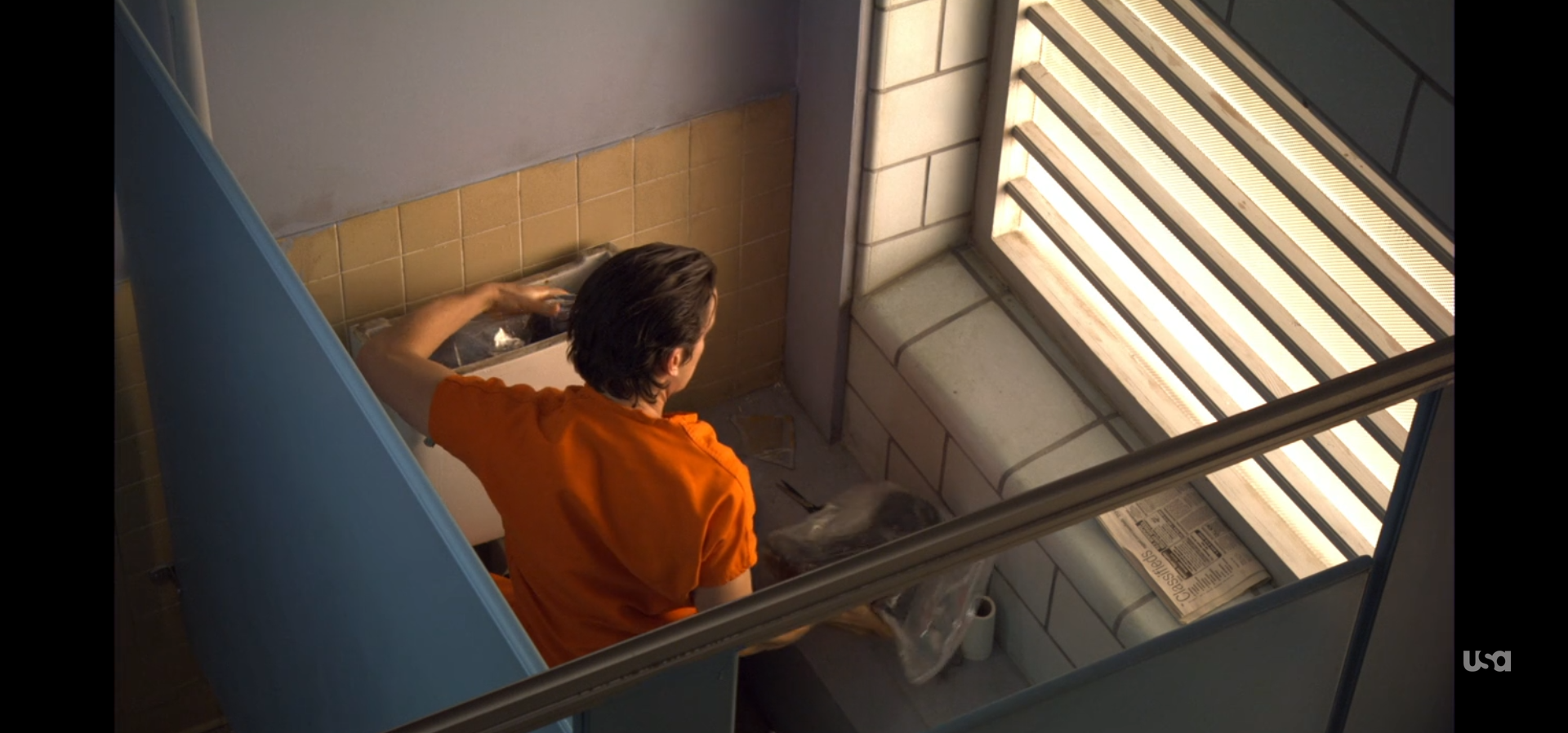
White Collar begins with an escape. Not from an escape room—the stakes are much higher; I’m talking about a prison break. Art thief, bond forger, and all-around con artist Neal Caffrey (played by Matt Bomer) has devised a plan to escape from his super-maximum security correctional facility. He changes his appearance rapidly by shaving, slicking his hair back, and donning a prison guard uniform stashed in a staff bathroom toilet tank. Accompanied by jaunty music, he strolls unrecognized past guards and fellow inmates. When he slides a key card through a gate’s reader, the light turns green. He’s free.

Four hours after Neal has disappeared into Manhattan, Peter Burke (Tim DeKay), the FBI agent who first arrested Neal, is called, and begins to interrogate the warden and marshals about the details of Neal’s escape on the way to Neal’s cell. Where did Neal get the guard uniform? Online uniform supply company. Where’d he get the credit card to buy the uniform? It belonged to the warden’s wife.

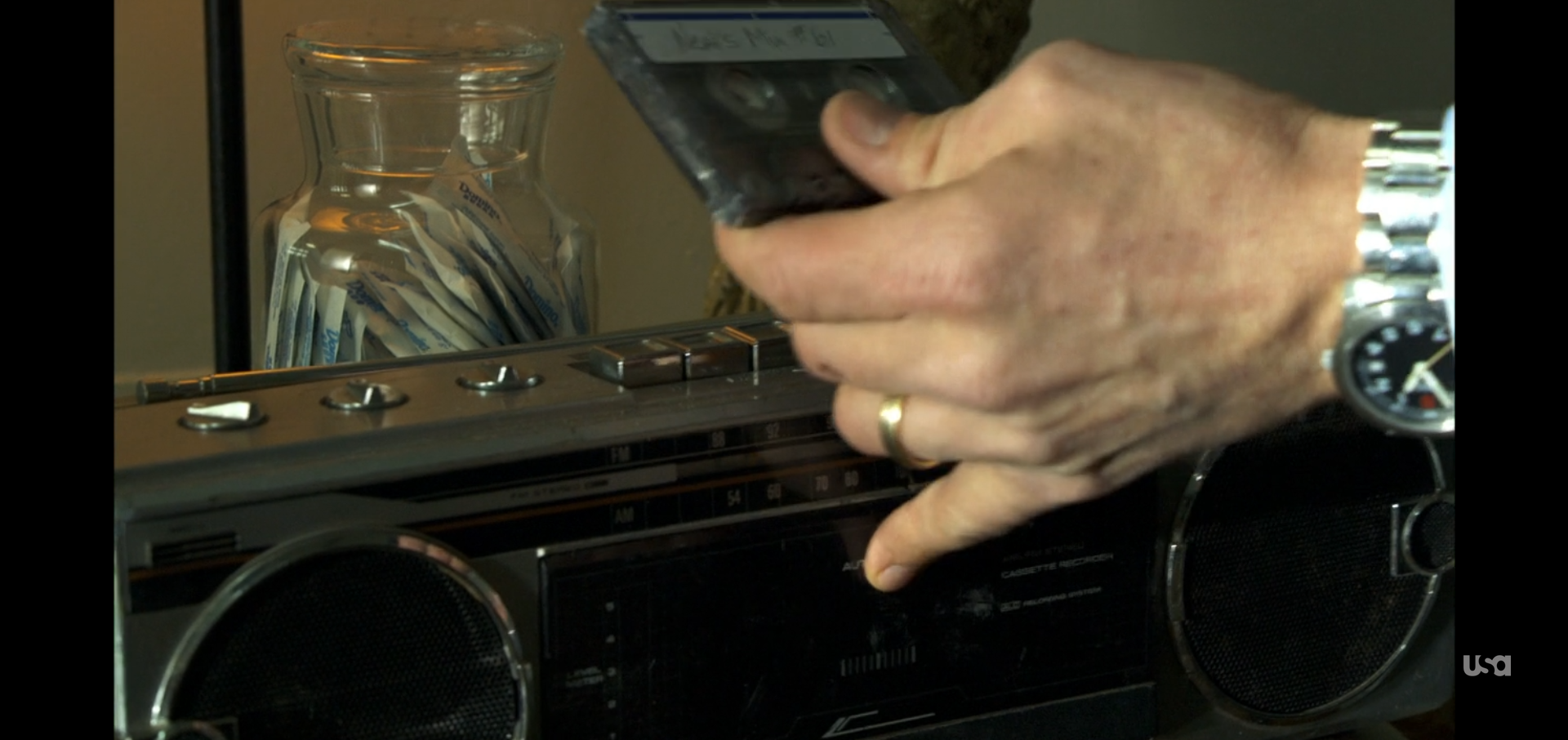
Neal’s cell is heavily decorated—with sketches, hash marks, poetry magnets. Where’d Neal get the key card for the gate? “We’re thinking he restriped a utility card using the record head on that,” the Warden says, nodding at the tape player. Peter examines the tape player, the wall decorations, the books and brochures on Neal’s bed. From all of the accumulated detritus of Neal’s imprisoned life, Peter begins to piece together where Neal would go and why. Neal’s escape was low on puzzles compared to an escape room, but the real puzzle comes now for Peter. Peter is an expert puzzler—his house is full of New York Puzzlethon trophies.

The solution is anticlimactic. Peter finds Neal on the floor of Neal’s ex-girlfriend’s emptied apartment, moping over her absence. Neal makes no further attempt to flee, but does make an opening gambit in the long game of securing his freedom; he asks Peter to meet with him back in prison if he can provide crucial intel on the elusive criminal Peter’s been chasing. What would have been four years in prison for running becomes four years released into Peter’s custody as an FBI consultant. With a GPS tracking device around his ankle, Neal walks into the sunlight once again. Thus, the show’s premise is established: Peter and Neal, FBI agent and con artist, taking down white collar crime together while going endlessly back and forth on whether they can trust one another.

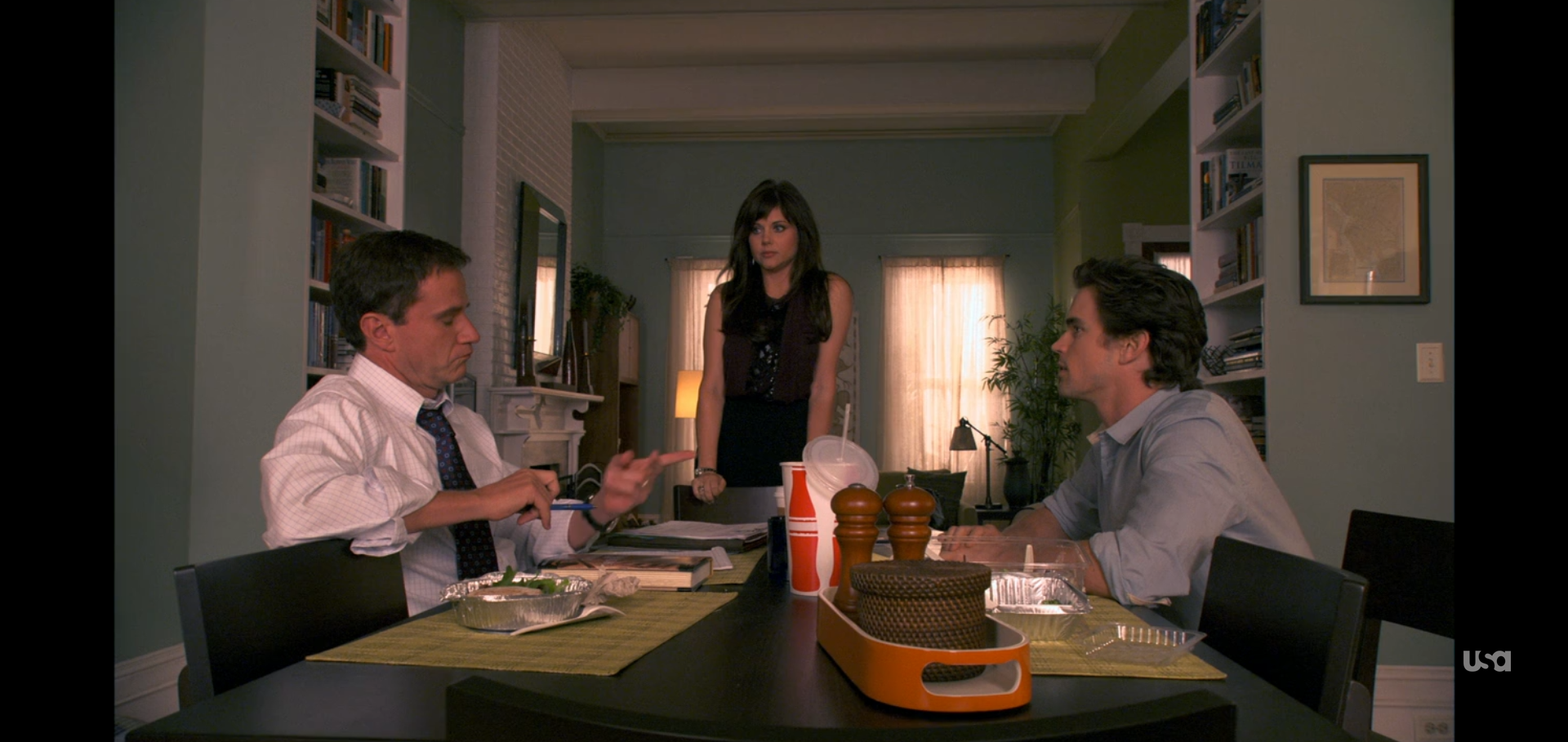
Peter, Elizabeth, and Neal congregate in the Burke home.

Though it has its moments of suspenseful intrigue and poignant drama, White Collar is more lighthearted than many crime procedurals. The mood is kept buoyant partially by Neal’s charm, and by the chemistry between the leads (including Tiffani Thiessen as Elizabeth Burke—Peter’s wife—and Marsha Thomason and Sharif Atkins as Peter’s fellow FBI agents). Beyond that, however, there is an infectious playfulness woven into the screenwriters’ approach to storytelling. Whether the characters are planning heists or solving crimes, it feels like the show is presenting us with a game.

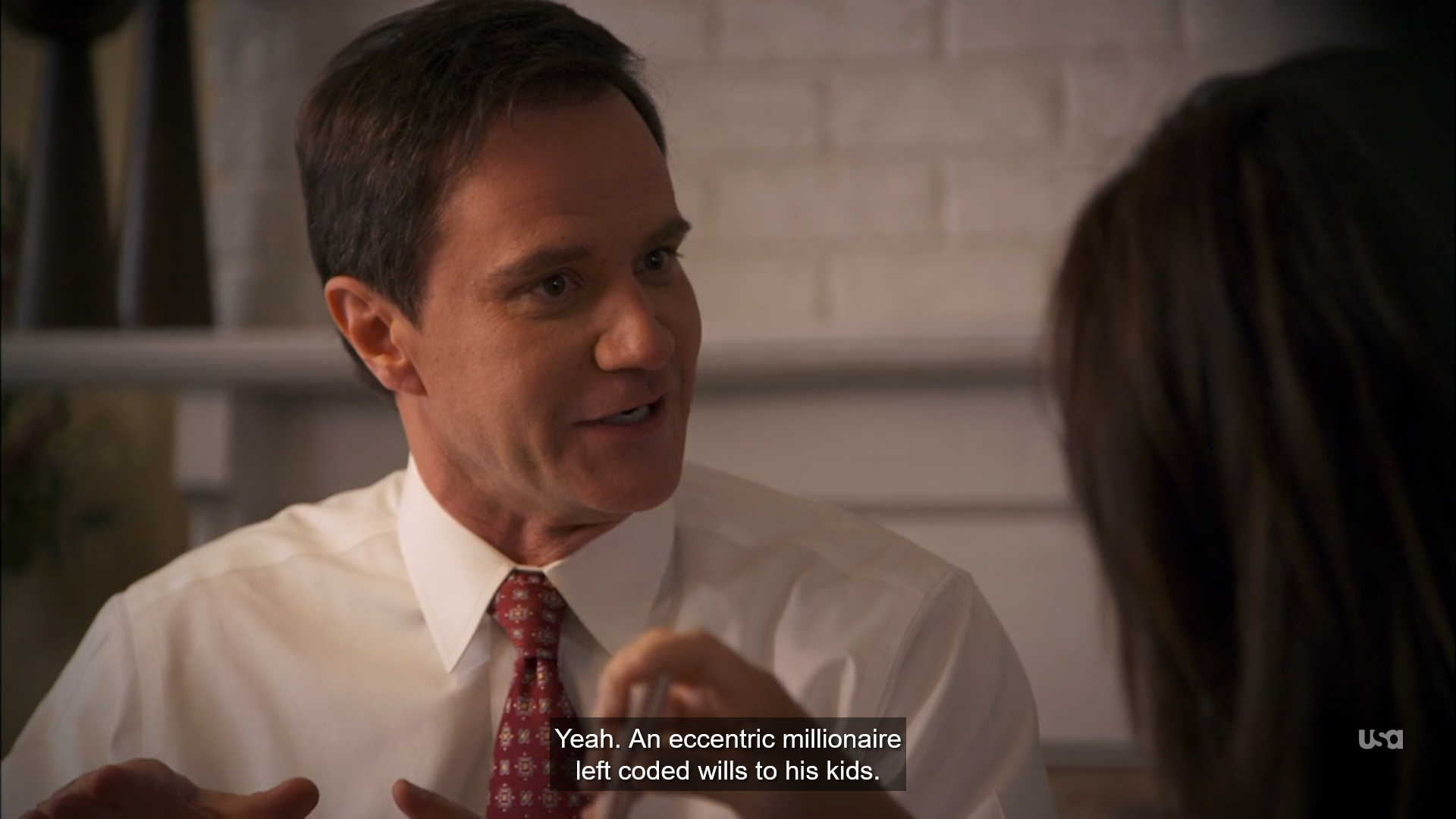
One episode draws out this undercurrent of playfulness, as Peter and Neal are literally presented with a game. The season three episode “Where There’s a Will” centers around a dispute over a $40 million inheritance. Brothers James (Danny Masterson) and Josh Roland (Christopher Masterson) each have a supposed copy of their father’s will, one with a relatively equitable distribution of funds, and one saying that James gets everything. Neal, as an expert forger, has been called in by the bureau to authenticate the wills.

Neal, noticing that the same person is responsible for all of the signatures on both wills, determines that both are forged, but it gets weirder. Handwriting analysis concludes that the deceased himself forged all of the signatures on his own wills. Weirder still, the witness names are anagrams of one another. Peter and Neal get to work puzzling out what other names might be hidden in those letters, and come to the same conclusion: Tycho Brahe, a 16th century Danish astronomer.

Then comes the biggest surprise thus far. Holding the stacked wills up to the sunlight, Neal realizes that, when overlaid, the wills include a drawing that resolves into what look like streets and a compass rose. “This isn’t a message,” Neal says. “This is a map.” The Roland sons have a slightly different take, recognizing the “compass rose” as actually “the sundial in La Monde Garden” (a fictitious location). The sons go on to imply that treasure hunts are an activity their dad once engaged in often, but neither seems interested, even when Neal posits that the real will is likely at the end of the hunt.

Peter is happy to return the wills to evidence. Neal, however, is still intrigued, trying his hardest to entice Peter into joining him at the sundial. Peter won’t bite, so Neal meets up at La Monde Garden with his criminal accomplice and best friend, Mozzie (Willie Garson). They notice faint numbers along the bottom of the wills’ pages, probable times, but those times on the sundial don’t seem to point to anything. Alternatively, they theorize that maybe something will happen when the sun hits 4:30—four hours from now.

Neal texts Peter, who’s at home with Elizabeth, for help, and Peter and Elizabeth dive into the puzzling readily. When Peter spots a little drawing of a tulip next to the times, Elizabeth supplies that tulips stand for spring and rebirth, and Peter’s inspiration is sparked. It isn’t spring now, but with the use of a sextant and a couple of mirrors, they can recreate the shadow that the angle of the springtime sun would cast at 4:30. Each of the times, in fact, have a different seasonal symbol associated with them.

Elizabeth and Peter join Peter and Mozzie to create the necessary shadows. Each shadow they cast points to a different letter on the sundial, spelling out “BSH,” an acronym that means nothing to any of them. Their stumped wondering is interrupted by a call with a startling revelation; James Roland’s young daughter has been kidnapped, and the kidnapper demands $6.4 million. This is enough motivation for Josh Roland to get involved in the treasure hunt, since the real will should give him the ability to pay his niece’s ransom. He knows what “BSH” stands for: Big Sky Hunting, what his dad always called going to the planetarium. Peter and Neal are off to their next destination.

I’ll refrain from spoiling the second half of the episode, but rest assured, even as the mood should have darkened with the girl’s kidnapping, an undampened spirit of playfulness remains threaded throughout. We’re back in the realm of the high-stakes escape room. Now, though, rather than orchestrating his own escape, Neal is playing a game for someone else’s freedom. Rather than scheming by himself, he’s relying on a gaggle of allies to help him each step of the way. The show may have started with Neal and Peter each as independent figures facing off against one another, but as I said, that form of game-play only leads to anticlimactic reveals. Real satisfying drama, in the world of White Collar, comes from games played together, absent self-reliance and self-interest.

With the GPS tracker around his ankle, Neal might not be as free as he was the moment he first stepped out of prison in the pilot. With friends on his side, however he’s much better equipped to mastermind a real escape. A real win.


You can find delightful deals on puzzles on the Home Screen for Daily POP Crosswords and Daily POP Word Search! Check them out!

Thanks for visiting PuzzleNation Blog today! Be sure to sign up for our newsletter to stay up-to-date on everything PuzzleNation!

Puzzles (and Games) in Pop Culture: “Strange Things Happen at the One Two Point”

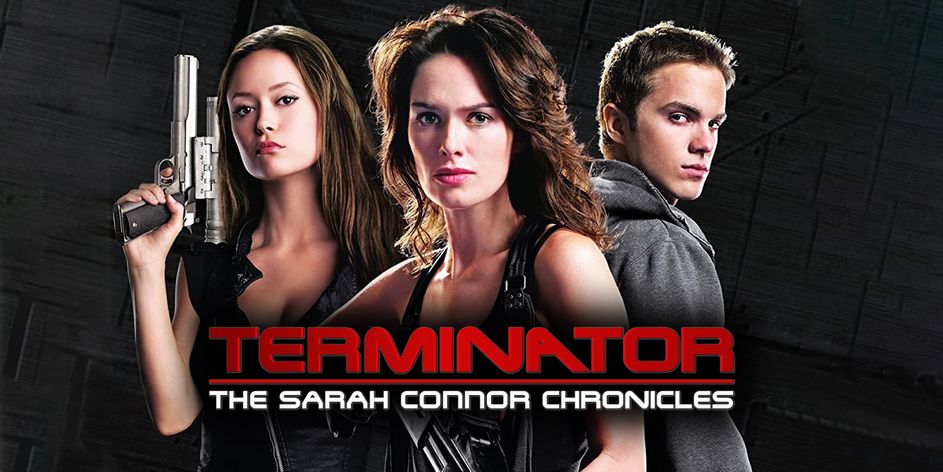
“Strange things happen at the one-two point,” is a proverb based on the ancient East Asian board game Go. As summarized by cybernetic Cameron (played by Summer Glau) in Terminator: The Sarah Connor Chronicles,“It means the usual rules don’t always apply.” More specifically, the proverb refers to the strategic idiosyncrasies of certain playing positions on the Go board; “the heuristic principles of fighting along the sides or in the [center] often fail in the corner,” Go wiki Sensei’s Library clarifies. When we fight our way into tight corners, the laws of reality that we previously knew shimmer and warp. The more boxed-in we become, the more we need to expect the unexpected.

This is a fitting sentiment to feature in Terminator: The Sarah Connor Chronicles, the fourth installment in a media property dealing with time travel and its resultant paradoxes and alternate timelines. The show depicts its characters having fought their way deep into tight, reality-bending corners in their attempts to prevent apocalypse. By the second-season episode titled for the Go proverb, the rules established in 1984’s The Terminator—what we can expect from time travel, who’s an ally and who’s an enemy, what to do if you want to live—have been thoroughly warped.

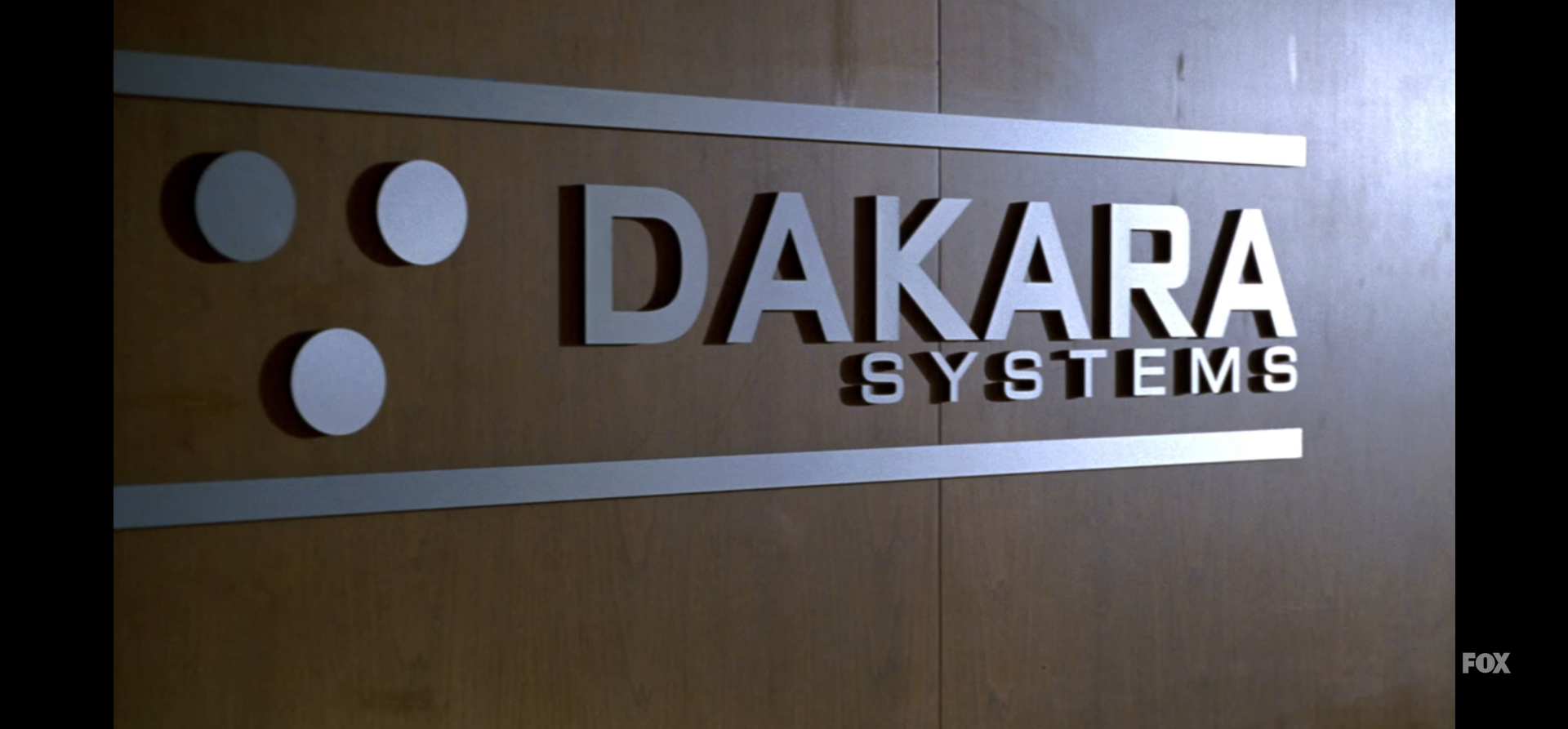
In the episode “Strange Things Happen at the One Two Point,” Sarah Connor (Lena Headey) is deeply fixated on a pattern of three dots. Earlier in the series, another time traveler left her a message in blood on a safe house wall: a list of important names with three dots next to it. Seeing these dots in her dreams, Sarah is convinced that there’s more to them then the smeared fingerprints of a dying comrade; her investigation leads her to Dakara Systems, a tech start-up with a logo of three dots. She and Derek (Brian Austin Green) break in late at night, stealing all of the computers’ hard drives and bringing them back to Sarah’s teenage son, John (Thomas Dekker), an accomplished hacker.

On the hard drives, John discovers designs for an artificial intelligence system, a find that sets off Sarah’s internal alarms, but John explains that the designs are useless in light of Dakara Systems’ lack of processing power. Derek calls it a dead end, accusing Sarah of instigating a wild goose chase, an accusation she rebuts with, “Artificial intelligence, the company logo, the three dots—”

“Are fingerprints,” Derek says. “It’s just blood.”

“Everything on that wall has meant something,” Sarah argues. “It’s all blood.”

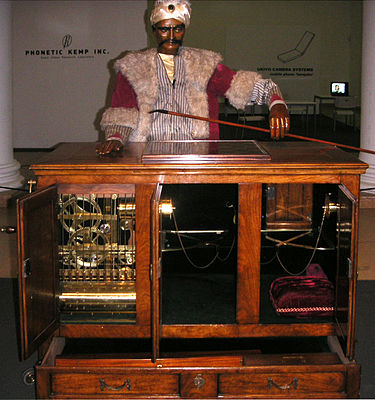
Sarah is sure that The Turk, the chess-playing AI that she’s been hunting for since it was stolen from inventor Andy Goode, can be traced to Dakara Systems. Derek has lost faith. While John initially has his doubts too, by the next morning, he’s made Sarah and Cameron an appointment to meet with the heads of Dakara Systems. He explains his change of heart: “Andy Goode was building a chess program . . . It always starts small.”

A 1980s reconstruction of the original chess-playing Mechanical Turk.

Dressed up in their best wealthy-investor chic, Sarah and Cameron meet with father-and-son team Alex (Eric Steinberg) and Xander (Eddie Shin) Akagi of Dakara Systems. Probing for connections to The Turk, Cameron poses a crucial question to Xander while Sarah and Alex grab coffee: “Do you like chess?” Later, when Sarah asks her what all of the evidence is adding up to, Cameron says, “Not The Turk. Xander doesn’t play chess. He prefers Go.” She pulls out a folding wooden board inscribed with a grid. “Xander said it’s been calculated that there are more possible Go games than atoms in the universe,” she continues, laying out black-and-white discs in the board’s center. “He’s offered to teach me how to play.

Sarah counters, “Did he offer to tell you about his AI?” and when Cameron reiterates that Xander’s AI is not The Turk, Sarah says, “But it could be a piece of the puzzle. We’ve seen that before.”

Cameron responds, “Strange things happen at the one-two point.”

I won’t spoil for you which strange things happen here, at this point where Sarah Connor and her allies have boxed themselves in strategically by changing reality countless times in an effort to stave off nuclear apocalypse. Instead, let’s dwell together on the beauty of that phrasing, the “strange things,” as a way of describing action in a game so deceptively simple: black and white stones laid out on a grid. They don’t seem like they should stack up next to the strange things that happen in a work of science fiction—the way the air crackles and sparks with blue light whenever a new time traveler tears a hole through the decades; how a Terminator’s robotic skeleton designs a chemical bath for itself that allows its flesh and skin to regrow; the liquid metal CEO played by Garbage lead singer Shirley Manson, whose arms extend at will into gleaming daggers.

By placing Go on the same playing field as these miraculous, speculative sights, Terminator: The Sarah Connor Chronicles reminds us that games needn’t be elaborate to be magical, needn’t be novel to be surprising. As long as each player is an elaborate, novel human being, an ancient game like Go can continue to startle and move, to belong meaningfully alongside us in the twenty-first century—and further onward still.

have thought to look for otherwise.


You can find delightful deals on puzzles on the Home Screen for Daily POP Crosswords and Daily POP Word Search! Check them out!

Thanks for visiting PuzzleNation Blog today! Be sure to sign up for our newsletter to stay up-to-date on everything PuzzleNation!

Six Characters in Search of Free Will

Last week, we traveled back in time, before the dawn of escape rooms, to what was nonetheless a perfect example of escape room horror: the Twilight Zone episode “Five Characters in Search of An Exit.” Now, let us jump forward, past the present, into the near-future. A clear thematic descendant of “Five Characters in Search of An Exit,” Black Mirror‘s speculative “USS Callister” takes the “everyone is a toy” premise of “Five Characters” further than the Twilight Zone episode carried it (the Black Mirror showrunners have even described the episode as “Adult Toy Story).

In contrast to “Five Characters,” the setup of “USS Callister” is not especially simple. We begin in a clear Star Trek homage as the starship USS Callister‘s crew, helmed by Captain Robert Daly (Jesse Plemons), celebrates a victory. Abruptly, the show cuts from this slick, primary-colored setting, to a world much drabber and closer to our own. Daly is revealed to be the unassuming founder of a virtual-gaming company called Callister, and a fan of the retro sci-fi television show Spacefleet. Each of his crew members from the opening scene reappears in the Callister office as a different coworker; all, at best, seem indifferent to Daly’s existence.

Enter newly hired programmer Nanette Cole (Cristin Milioti), who is as big a fan of Daly’s work as Daly is of Spacefleet. She and Daly awkwardly hit it off, until the company’s co-founder, James Walton (Jimmi Simpson), waltzes in and steals Cole’s attention. Next thing we know, Daly returns home to sign into his VR game and reappear on the USS Callister‘s bridge. There, we see a side of him that was not immediately obvious before: he is power-hungry, violent, reveling in belittling the crew.

The next time Daly is in the office, he steals Cole’s thrown-away coffee cup and takes it home, where he uses her DNA to create a sort of virtual clone of her. This clone, despite Daly’s desire to play god, is not a mere plaything; she is fully sentient, retaining all of the original Cole’s memories, feelings, and personality. When she awakes on the USS Callister, miniskirted and vintagely coiffed, she is terrified. Without Daly present, the other crew members explain the situation, that she is stuck forever in a modded version of the VR game the original Cole programs: Infinity. They are all digital clones, all stuck.

Walton describes the situation as “an eternal waking nightmare from which there is no escape,” but Cole tries to escape regardless, running through the ship’s halls until Daly transports her back onto the bridge. She refuses to play along with the Spacefleet roleplay premise, so he uses his God-like powers to torture her until she agrees to cooperate. Still, that first flight from the bridge is not Cole’s last attempt to wiggle free of Daly’s clutches. Her schemes just get more strategic. Even when she learns that the reason Walton plays along is that Daly has Walton’s son’s DNA on a lollipop in his minifridge, Cole sees this as further motivation to take Daly’s toys away from him.

After another fumbled escape attempt that provokes Daly’s sadistic ire, Cole finally hits upon a winning plan. She spots a wormhole out the ship’s window, representing an incoming update patch to the game. Cole suggests flying straight into the wormhole, thereby deleting all of their code, killing them. Freeing them. First, however, it’s necessary for someone out in the real world to destroy the DNA hoarded in Daly’s minifridge.

The plan is for Cole to go on a mission to a planet’s surface alone with Daly, where she distracts him. Meanwhile, the crew beams up the device that Daly uses to control the game and contact the outside world. The crew is able to contact the real-world Cole, and blackmail her with the cloned Cole’s knowledge. They compel her to order a pizza to Daly’s apartment so that he’s forced to temporarily exit the game, then, while he’s occupied, to: 1. steal all of the DNA in the minifridge, and 2. replace the nodule he uses to connect to the game with a decoy that does nothing.

Cole distracts Daly by luring him into a lake.

The end result is that the crew of the USS Callister is able to successfully fly into the update patch wormhole without Daly’s interference. Contrary to their prediction, this does not erase their code; they are not killed, but they are free. They are transported from Daly’s personal, modded version of Infinity to the greater Infinity, which lives in the Cloud. Meanwhile, Daly, in his attempt to chase after them, has gotten himself stuck in his own game.

This is a much more optimistic ending than that of “Five Characters.” The characters not only are able to transform themselves from playthings to game-players; in doing so, they escape the confines of their limited world—within reason. While they are no longer imprisoned within Daly’s computer, able instead to roam the Cloud-stored game universe, they are still technically bound, forever, to the starship.

If we classify this as escape room horror, with a requirement of the genre being that someone must escape the room alive, then we are working with a more ephemeral, existential understanding of what constitutes a “room.” The characters’ ultimate goal is not to escape their physical surroundings, but to escape the game rules that have been put in front of them. The horror herein is not about literal claustrophobia, but about the gnawing psychological claustrophobia that comes from an absence of free will. They are not escaping from the ship; they are escaping from hierarchy. It is the perfect distillation of escape rooms as a team-building exercise, driving home that there is no “dictator” in “team.”

A review of the episode in The Atlantic pointed out that whereas so much of Black Mirror‘s storytelling is about “the terror of being connected,” “USS Callister” goes in the opposite direction. What begins as a seeming cautionary tale against the horrors of video games becomes, instead, an ode to collaborative approaches to gaming. The fact that the crewmembers still have each other and an infinite universe to explore is presented, unequivocally, as a happy ending. It’s a happy ending that anyone who finds joy in shared game experiences like escape rooms, multiplayer video games, or tabletop role-playing will no doubt find resonant. Hell is not other people; it is other people having undue power, and stripping us of our personhood.


You can find delightful deals on puzzles on the Home Screen for Daily POP Crosswords and Daily POP Word Search! Check them out!

Thanks for visiting PuzzleNation Blog today! Be sure to sign up for our newsletter to stay up-to-date on everything PuzzleNation!