The Great Rebus Debate

I love Reddit. You can find a subreddit to discuss practically any topic. You can share memes, share thoughts, share opinions, and debate other users for eternity there. I’ve learned a lot, laughed a lot, and been baffled quite a few times during my Reddit journeys.

So you can imagine my surprise when I stumbled across a post about crosswords in the subreddit r/mildlyinfuriating, a subreddit designed for all the little indignities, inconveniences, and choices that leave users slightly miffed.

The title of the post said it all: The crossword I’m working on expects me to know that I need to write multiple letters in one square.
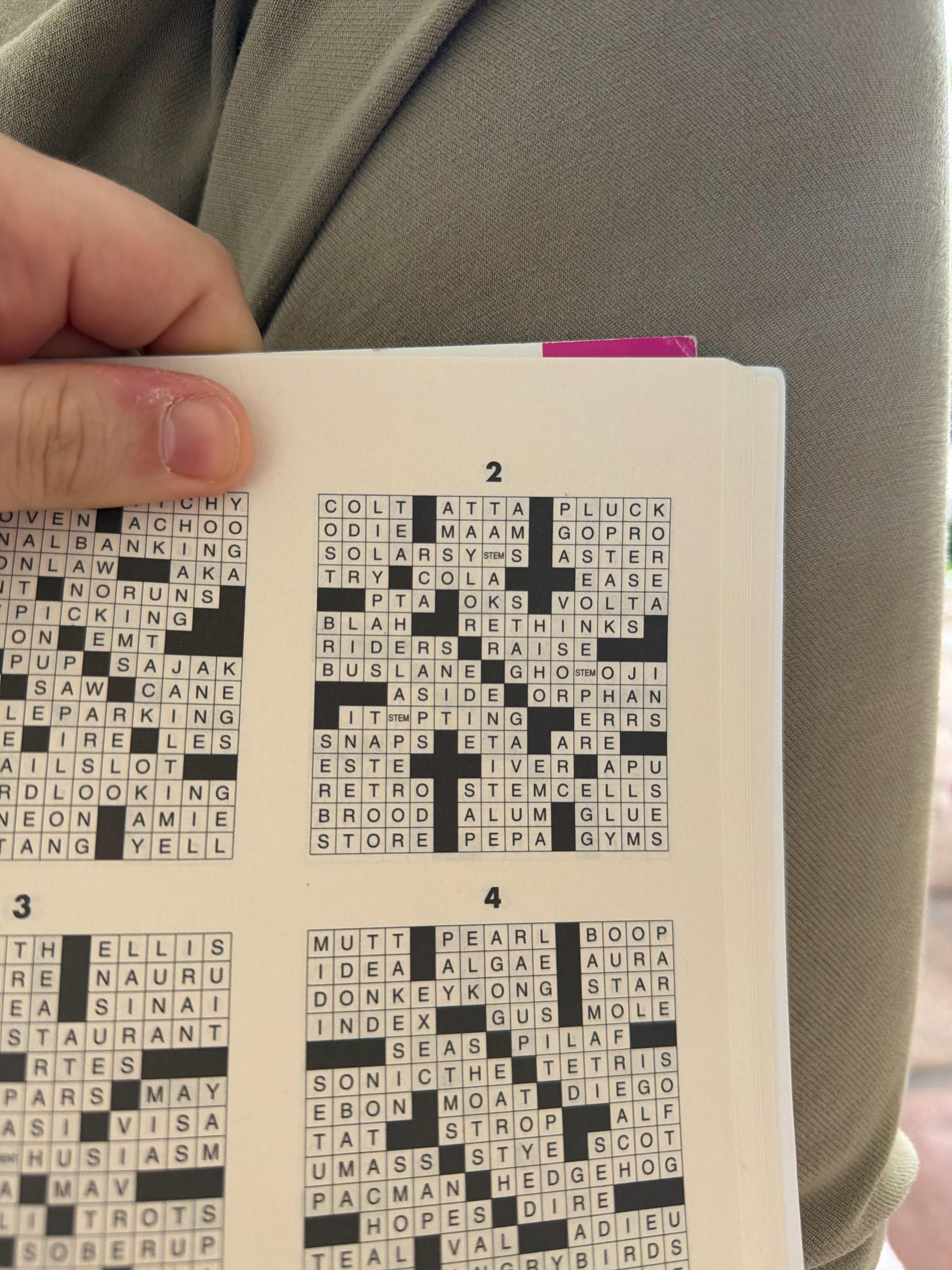
You see, gentle reader, this person had just encountered a rebus puzzle for the first time.

For the uninitiated (welcome!), a rebus puzzle is any crossword that requires you to disregard the one-letter-per-cell rule of crosswords, placing a symbol, a number, or multiple letters into a single cell.

They are one of the more devious tricks in the cruciverbalist arsenal, and there’s no denying that the first time you encounter a rebus, it feels like you’re going mad. You know the answer, but it seems too long, or not quite right, and it won’t fit.

AND CROSSWORDS ARE ALL ABOUT MAKING IT FIT.

Reddit user grubas summed it up nicely: When you don’t know a rebus is coming it’s the worst thing ever.

Yes, there’s usually a clue or a title slyly mentioning the trickery afoot, but for a new solver or one unfamiliar with rebuses, that can often feel like not enough of a hint.
In two days, this post has accumulated TWENTY-SIX THOUSAND up votes and over a thousand comments.

Some users said that rebus puzzles are the reason they stop solving the weekly NYT crossword after Wednesdays. Some claimed they stopped solving the NYT altogether. That’s a bummer.

Many others, even rebus fans, acknowledged that the first time you encounter a rebus puzzle, it’s brutal. Plenty of those commenters now see it as a welcome challenge, and even an expected one when Thursday rolls around.

I do enjoy a rebus, though I’m frequently flummoxed by the ones where the rebus involves one answer reading down and a different one reading across in the same box. But either way, the confusion and occasional frustration I feel with them is usually worth it when I finally crack what’s going on and complete the puzzle. That’s a great feeling.

Several users requested a symbol or sign to warn them of a rebus puzzle. It’s a nice idea, but it also immediately spoils the chance for the a-ha moment when you realize you’re solving a rebus puzzle. I must confess I’m not a huge fan of this idea (unless it can be concealed in a Hint feature or something, and not be immediately evident from the jump).

The OP (original poster) later clarified their position on crosswords, stating that they view crosswords more as a trivia challenge than a “how do I make the right answer fit” challenge. Which is totally understandable.

In a world fraught with so much uncertainty, people like their routine, their comfort diversions, and for one of those comforts to suddenly not make sense, it can be genuinely unpleasant. I absolutely get that!

A day later, someone shared the post on the r/crossword subreddit, with the title Rebuses don’t seem so popular outside of r/crossword based on the comments here!

But, funnily enough, the debate was just as enthusiastic there as it was on the r/mildlyinfuriating subreddit!

Several commenters commiserated with the original post, understanding that for some crossword solvers, a rebus is a step too far. As Shepherd77 put it, “Rebuses are a hat on a hat and my head is already warm enough.”

Other solvers were surprised that the additional challenge wasn’t welcome among fellow puzzlers, citing that rebuses and other crosswords that break from the traditional rules were pleasant surprises and some of their favorites.

Everyone’s welcome to their opinion. I mean, I don’t go a week without hearing some solvers complain that the cluing and entries are too antiquated or unwelcoming to new solvers, while other solvers complain that there’s too much modern slang/pop culture in the puzzles.

Of course, if everyone’s complaining, that’s usually the sign of a good compromise.

I tried to read as many of the comments as I could to get a good sample from all sides. And I think xanoran84 had a terrific response to the vitriol in both subreddits:

Mostly, I’m very baffled by how much anger people express at puzzles being tricky. If I can’t figure out a puzzle, I just assume I’m not good at it yet, I don’t get mad at the puzzle for being a puzzle. But I guess just… People are different.

Ain’t that the truth.


So where do you stand on the great rebus debate, fellow solver? Do you like them? Love them? Loathe them? Think they should be marked as a rebus from the start?

Let us know in the comments section below. We’d love to hear from you!
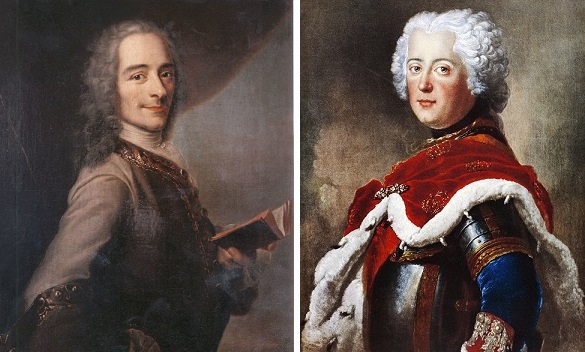
Voltaire and Frederick the Great: Puzzle Pals?

frederick and voltaire

One of the most curious – and tumultuous – friendships in history was that of Frederick the Great and Voltaire.

Voltaire, the 18th-century philosopher and writer, never shied from criticizing the monarchy in his outspoken defenses of civil liberties. That makes it all the more curious that he became friends with the Prussian King Frederick II, aka Frederick the Great.

They bonded over a shared interest in the arts — a passion for Frederick all his life, despite his father’s disapproval.

From Joshua Figueroa’s marvelous article on KMFA.org:

Through Frederick’s public admiration, Voltaire was given a status few other philosophers of the era had. Likewise, Voltaire helped spread the word of Frederick’s flattering image as a philosopher-king.

As it turns out, they were mutual wordplay enthusiasts as well.

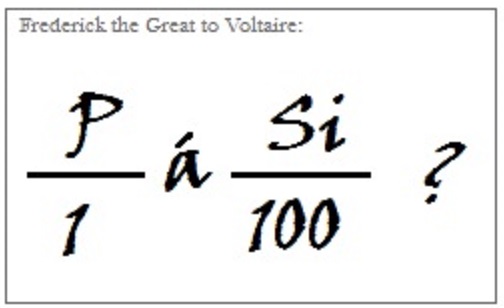
The story goes that Frederick the Great wanted to invite Voltaire to lunch, but did so with a rebus:

the question

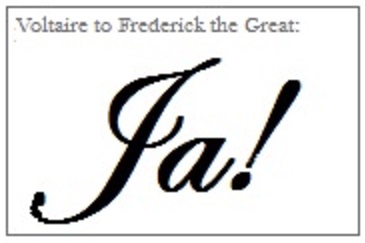
Voltaire replied simply:

the answer

Which left Frederick confused as to why Voltaire would reply in German. Voltaire retorted that he hadn’t.

There’s a lot going on here, all to do with how things sound when said aloud.

Let’s look at Frederick’s message first:

the question

You have the letter P above the number 1 and the word Si above the number 100, with the letter a between them.

Anyone familiar with rebuses knows that a horizontal line between two words means “over/above” or “under.”

But remember that we’re working in French. So that’s un for 1 and sous for under. Un sous p.

Aloud you get un souper, or “a supper.”

Following the same logic, you’ve got 100 (cent) under (sous) si, which sounds like Sanssouci, Frederick’s castle.

Put it all together, and it’s the lunch invite Frederick intended, souper à Sanssouci. Pretty clever.

But what about Voltaire’s reply?

the answer

It sure looks like the German word for yes.

But if you’re very literal about what you’re seeing, you’ve got a large J and a small A.

Large in French is grande (as Starbucks customers know). Small in French is petit.

J grande A petit.

Or, said aloud, J’ai grand appétit. Which means “I have a great appetite.”

You know, I’m starting to see why these two became pals.


Thanks for visiting PuzzleNation Blog today! Be sure to sign up for our newsletter to stay up-to-date on everything PuzzleNation!

You can also share your pictures with us on Instagram, friend us on Facebook, check us out on TwitterPinterest, and Tumblr, and explore the always-expanding library of PuzzleNation apps and games on our website!

Sometimes, You Can’t Trust the “Rules” of Crosswords

There are a lot of things you learn as you solve more and more crosswords.

You learn vocabulary, both words that are simply new to you AND words that are common to crosswords. You learn cluing tropes, like question marks indicating wordplay or quotation marks indicating informal speech or exclamations.

You also start to learn some of the constructors’ tricks.

Now, there are all sorts of ways that constructors can play with solvers, but all told, they seem to fit into three overall categories: clue trickery, theme gimmickry, and grid manipulation.

We’ve spoken about clue trickery loads of times in the past, and no doubt will again. And theme gimmickry will be the subject of a future post.

But today, we’d like to focus on grid manipulation.

tumblr_nltrvaQWZN1qafoq6o1_400

So, what do we mean by that? Well, essentially, grid manipulation is our catchall term for the most devious arrow in the constructor’s quiver. It’s when the standard accepted rules of crosswords no longer apply.

No matter what sort of symmetry is involved or how the grid is constructed, there are generally three accepted rules of crosswords:

  • Across words read across.
  • Down words read down.
  • One letter per square.

These are the fundamental rules, Newton’s three laws of crosswords. They’re the rules every solver expects to be in play when they sit down to solve a crosswords.

But that’s not always true.

gopher

Over the years, crafty constructors have found ways to push the boundaries of what you can do with those iconic grids of black and white squares.

Some constructors have literally gone outside the box, creating puzzles where letters of answers are placed beyond the grid itself, as in Sid Sivakumar’s American Values Club crossword “Bursting With Pride” a year or two ago (with the letters LGBTQIA+ appearing in sequence).

Byron Walden’s Fasten Your Seatbelts puzzle from the AVC crossword in 2019 also extended beyond the grid. Extra letters served not only as “bumps” along the otherwise smooth sides of the grid, but spelled out various bumps, like RAZOR, SPEED, and GOOSE.

Other constructors find fresh ways to pack more into a grid than expected.

The most common form is the rebus puzzle, whether multiple letters can be placed in a single grid square. Sometimes, it’s only a single square in a themed entry where multiple letters fit. Other times, you can get whole strings of them. The exact puzzle escapes me, but I can remember a crossword where two down entries all had rebus squares, so instead of one film title in that down entry, two would fit in each.

One impressive example that comes to mind is Andy Kravis’s “Currency Exchange” puzzle from the 2019 Indie 500 puzzle tournament.

The puzzle actually had little ATM graphics in various grid boxes, and they represented different currencies concealed in the theme entries. Plus, the across and down entries that shared an ATM had different currencies in their entries. For instance, one ATM represented WON in SMALL WONDER and DINAR in ORDINARY.

Other puzzles, known as quantum puzzles, feature multiple possible answers in the same space.

1996 election puzzle gif

The most famous example is the 1996 Election Day crossword. The puzzle “predicted” the outcome of the election quite cleverly by allowing for either CLINTON ELECTED or BOB DOLE ELECTED to read out, depending on how the solver answered seven down clues.

Arguably the most impressive one I’ve ever seen was published in 2014. Constructors Kacey Walker and David Quarfoot combined some considerable Scrabble skills and a dynamite crossword grid to create an amazing puzzle.

You see, clues 26-Across, 36-Across, and 44-Across all featured seven letters, like a rack in Scrabble. It was up to the solver to find the anagram of each rack that fit the grid. Walker and Quarfoot designed the puzzle so that each of those clues had three possible correct answers — for 26-Across: ROWDIER, WORDIER, and WORRIED all fit the down clues — meaning there were a staggering 27 possible correct solutions!

Still, those puzzles followed the standard across and down rules. But other puzzles don’t.

In those puzzles, entries don’t go the way you’d think, bending or taking unexpected twists in the grid. One example was Patrick Berry’s brain-melting Puzzle 5 from the 2016 American Crossword Puzzle Tournament, “Changing Lanes,” where answers zigzagged across the grid.

A less complex puzzle with a similar gimmick appeared in the 2019 Boswords tournament. “Spill the Tea” by John Lieb and David Quarfoot featured longer entries than would fit in the given spaces. The trick was to shorten in by removing a brand of tea from the answer, and letting it read down off that across entry, rather than inside it. So, for instance, HOTEL CHAIN read HOTELCN across, because CHAI was reading down from the C instead.

thatsnoneofmy

Lieb and Quarfoot incorporated five such “spills” in the grid, and clued each tea reading down simply with “Oops.” It was an immensely clever way to utilize the across and down entries in a unique, unexpected way.

As you can see, puzzle innovation can come in virtually any form, and often, the very foundational rules of crosswords can be bent or broken to create an ambitious, brain-twisting, and (ultimately) satisfying solve.

So be on the lookout, fellow puzzlers. You truly never know how constructors will challenge you next.


Thanks for visiting PuzzleNation Blog today! Be sure to sign up for our newsletter to stay up-to-date on everything PuzzleNation!

You can also share your pictures with us on Instagram, friend us on Facebook, check us out on TwitterPinterest, and Tumblr, and explore the always-expanding library of PuzzleNation apps and games on our website!