It’s hard to know sometimes what qualifies as art.
Artists and entrepreneurs are constantly pushing the boundaries of visual and intellectual expression. Everything from paint and stone to light and shadow are used to realize artistic visions. Christo wraps buildings and calls it art.
That can make it tough for those who are less familiar with the fluid definition of art.
There was a famous incident back in May when a seventeen-year-old left his glasses on the floor of an art gallery and many patrons mistook them for an art installation.
This has only grown more complicated with the advent of interactive art pieces. Some works of art can only be viewed from a specific vantage point, while others actively engage patrons.
The 91-year-old woman was visiting the Neues Museum in Nuremberg with a senior citizens group when she found the piece, “Reading-work-piece” by artist Arthur Koepcke, and began filling in the empty grid.
These days, you can understand her confusion and sympathize with her mistake. I mean, the exhibit did say “insert words,” after all. Those sound like instructions to me.
Plus the grid has remained incomplete since its creation in 1965. It’s about time somebody finished the puzzle.
Thanks for visiting PuzzleNation Blog today! Be sure to sign up for our newsletter to stay up-to-date on everything PuzzleNation!
Anamorphic illusions are all about perspective. Making the illusion work requires you to either be in a specific place (positioned a certain distance away and facing a certain direction) or the use of a mirrored cylinder or cone.
Using mirrored objects is called catoptric anamorphosis and using specific perspectives is known as oblique anamorphosis. It’s oblique anamorphosis we’ll be focusing on today.
Most of us have probably seen an example of anamorphosis recently, as it’s become a popular form of urban outdoor art. The ground is painted or colored to provide a fake perspective, and by standing in the proper spot, the illusion is formed.
This creates ample opportunity for some terrific photographs:
[Did you know we’ve got an entire Pinterest page dedicated to this?]
Having a hard time visualizing anamorphosis? Well, the folks at Brasspup have a fantastic YouTube page devoted to science and illusions, and they have several videos featuring some mind-blowing anamorphic illusions.
You can even use light to assist your illusion, as they do here:
What’s even more amazing is that these perspective tricks can move beyond two-dimensional works like paintings and photographs. If you know how to manipulate the viewer, three-dimensional illusions are within your grasp.
Check out this Escher-inspiring creation, built from pens and Jenga blocks! It looks positively impossible!
It really is baffling when you consider how many ways there are to trick the eye. From Necker cubes and shape illusions to forced perspective and anamorphosis, optical illusions are alive and well as a puzzly art form worth exploring.
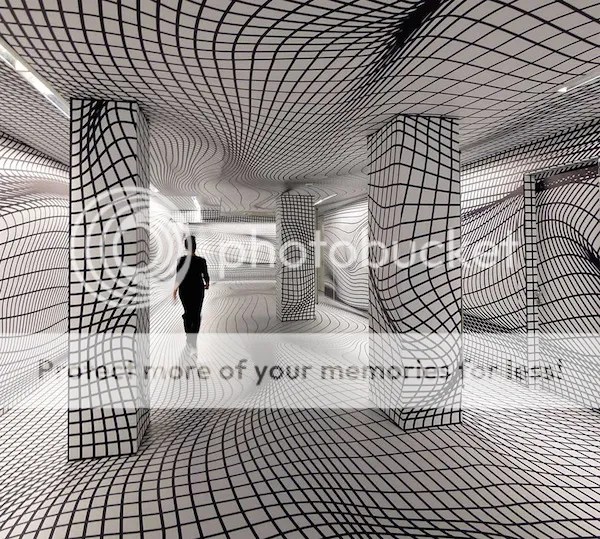
Heck, look at what we can do with nothing more than black lines!
Imagine trying to walk a straight line in that room. Wow.
Thanks for visiting PuzzleNation Blog today! Be sure to sign up for our newsletter to stay up-to-date on everything PuzzleNation!
By this time, you know the drill. Follow-Up Friday is a chance for us to revisit the subjects of previous posts and bring the PuzzleNation audience up to speed on all things puzzly.
And today, I’d like to return to the subject of puzzle art!
I stumbled across this terrific art print from 30 Squared a while back, and I thought it would make a fun puzzly challenge for the PuzzleNation readership.
We’ve got twelve famous vehicles from movies and television, presented in pixelated form.
Can you identify the TV shows or movies that featured these iconic vehicles? Let’s put your pop culture knowledge to the test!
Thanks for visiting PuzzleNation Blog today! Be sure to sign up for our newsletter to stay up-to-date on everything PuzzleNation!
Welcome to another edition of PuzzleNation Blog’s interview feature, 5 Questions!
We’re reaching out to puzzle constructors, video game writers and designers, writers, filmmakers, and puzzle enthusiasts from all walks of life, talking to people who make puzzles and people who enjoy them in the hopes of exploring the puzzle community as a whole.
And I’m excited to have David Kwong as our latest 5 Questions interviewee!
Puzzlers by nature play with words, but none quite like David Kwong, a top-flight puzzle constructor and magician. Adept at sleight of hand and wielding a flair for puzzle constructing that makes me very jealous, David crafts illusions and puzzle grids with equal deftness, often doing so in front of a live audience!
In addition to his own creative endeavors, David serves as a magic consultant for film and television, and has contributed to The Mindy Project, The Incredible Burt Wonderstone, and most notably, the magic-infused heist thriller Now You See Me.
David was gracious enough to take some time out to talk to us, so without further ado, let’s get to the interview!
5 Questions for David Kwong
1.) How did you get started with puzzles?
My mother and I always bonded over being word-nerds. When I was a child, we would play Scrabble and solve crosswords. After college, I began writing crosswords with my friend Kevan Choset (I suppose I was jealous of his James Bond themed puzzle). Our first puzzle was the April Fool’s Day puzzle in 2006. I think we waited three years for it to get published!
[Glenn’s note: The James Bond puzzle refers to one of Choset’s earliest, where “007” not only appeared in the grid, but crossed “SEAN CONNERY.” The April Fool’s Day puzzle refers to a Choset/Kwong collaboration that actually required the solvers to write the word “THINK” outside the box (grid) four times.]
2.) Magic and crosswords might seem like separate enterprises, but they both involve a whimsical sense of playing with your audience’s expectations (magic with misdirection, crosswords with clever cluing and wordplay). What about magic and puzzles so appeals to you?
You nailed it. Magic and crosswords both involve misdirection, surprises and toying with conventions. Take for example if I were to vanish a coin, I would place it in my hand three or four times plainly before secretly feigning its placement on the fifth time. Magicians allow their audiences to become familiar with what is “normal” so that the “abnormal” goes undetected (or rather looks the same).
A crossword that toys with the rules of the puzzle operates much in the same way. The constructor leads solvers down a path of what seemingly looks like a normal puzzle, and then suddenly hits them with a twist.
(Check out this short video, which highlights David’s whimsical fusion of magic and crosswords.)
3.) What types of puzzles and feats of magic are your favorites or have most inspired you?
I love puzzles in which the twist hinges on the everyday words and phrases that we’ve come to expect as solvers. Ashish Vengsarkar had a great puzzle in which “Start of Quote” and “Part 2 of Quote” were revealed to be BRITISH WAITING LINE and SECOND PERSON SINGULAR.
Also, I know it’s been referenced a million times, but the BOB DOLE / CLINTON puzzle is the ultimate example of misdirection in a crossword. There’s no better way to misdirect your audience before the final reveal than to have them think the trick is over!
[Glenn’s note: David is referencing the famous New York Times puzzle that appeared the day before the 1996 presidential election, a puzzle that famously offered either “BOB DOLE ELECTED” OR “CLINTON ELECTED” as an answer depending on how the solver filled in the grid.]
My favorite magic tricks are the ones in which the subterfuge is taking place right under the spectators’ noses. As performers, we call these “bold” moves and take a particular delight in executing them effectively. Often this means no intricate contraptions, no smoke and mirrors — just a strong ability to misdirect. There’s a routine called “card under the glass,” which illustrates this concept. The performer declares, “I will again and again place your card underneath this glass. See if you can catch me.”
And the audience never stands a chance.
4.) What’s next for David Kwong?
“Now You See Me” was such a big hit that we’re making a sequel. There are a number of Houdini projects in the works as well. I’ve also consulted recently on “The Imitation Game,” which is the story of Alan Turing and Bletchley Park cracking the German enigma cipher machine. There’s a great line in that script: “[Alan,] you just defeated Nazism with a crossword puzzle.”
5.) If you could give the readers, writers, puzzle fans, and magic lovers in the audience one piece of advice, what would it be?
Magic and puzzles are both forms of storytelling. If you’re creating magic tricks or constructing puzzles, think about how you can take your audience on a journey, even if just for a few minutes. Play into their expectations and hit them with twists and turns.
Finally, look for fresh combinations of seemingly unrelated things. You might be surprised that their cross-pollination can yield something innovative and original. Who would have thought that magic and puzzles could be synthesized?!
Many thanks to David for his time. You can learn more about David and his ever-expanding filmography on his website, DavidKwongMagic.com, and be sure to follow him on Twitter (@davidkwong) and Facebook (facebook.com/dkwongmagic) to see more of his mystifying exploits.
Crowdsourcing has become an increasingly popular method for scientists and deep thinkers to solve problems that would otherwise be far too staggering a challenge to tackle on their own.
I’ve written in the past about crowdfunding efforts, but this is something different: actually handing over the problem to the public. It’s citizen science!
The National Museums Scotland are trying to reassemble the shattered design on a Scottish relic dated back to the year 800 or so, hoping that reaching out to nonprofessionals will help them to restore the intricate designs that once adorned a sandstone slab centuries past.
Every fragment has been scanned into a 3-D model and catalogued, making each a small piece of a truly monumental puzzle to be solved. (And without the picture on the box to guide you!)
The pieces will be grouped into categories — for example, corner pieces, or parts of the design’s knotwork. That will help users organize the work into manageable subtasks, as if they were working collectively on a huge jigsaw puzzle. Suggested solutions to parts of the puzzle would be judged by fellow users, and then passed on to the professionals.
This mix of science and puzzle-gaming has engendered marvelous successes before. The Search for Extraterrestrial Intelligence (or SETI) utilizes dozens of citizen computers for processing power in order to more efficiently scan the skies for signs of intelligent life beyond Earth. The FoldIt program led to the crowdsourced discovery of the structure of a monkey HIV virus in ten days, after a decade of attempts by scientists.
(There are similar puzzle-game attempts being made to map the human brain, explore the potential of DNA, and catalogue animal species. Check out this IO9 link for further details.)
This is yet another amazing example of puzzle solving making a true contribution to our understanding of the world. And it’s always nice to remind ourselves that puzzles can be all fun and games, but they can also be something much much more.
Scavenger hunts have a special place in my heart as a puzzler, because they’re the pinnacle of puzzly thinking on the fly. Deductive reasoning, creativity, ingenuity, a penchant for plotting and executing step-by-step moves to conquer a challenge… scavenger hunts combine all of these features (and throw in some exercise, for better or for worse).
Now, for the uninitiated, scavenger hunts at their simplest are games where individuals (or, more often, teams) are assigned a list of items to obtain or actions to perform, and the first person or team who completes the list is the winner.
Scavenger hunts by definition incorporate a spirit of silliness, lightheartedness, and frivolity. Whether you’re hunting down the gaudiest things you can find at a tag sale or photographing yourself getting a piggyback ride from a police officer, the goal of most scavenger hunts is to have fun.
And it seems like scavenger hunts are becoming more creative and more diabolical with every passing day. Let’s take a look at two of the most ambitious scavenger hunts challenging players these days.
GISHWHES combines the playfulness of scavenger hunts with a humanitarian ideal, challenging players to make the world a better and more interesting place through their challenges.
Designed to be played around the world through the Internet, GISHWHES has previously tasked its players to perform such varied feats as performing puppet shows for sick kids and documenting a session of ski yoga. Creating art, doing good, and being gloriously silly is what GISHWHES is all about.
A high-concept game that became a brilliantly-clever fundraiser when Goldman Sachs got involved, Midnight Madness is a fiendishly challenging series of puzzles and activities scattered throughout New York City.
Goldman Sachs employees — every division of the company is represented — race around the city, unraveling electrical puzzles, playing laser mini golf, and deciphering complex clues, all in the hopes of determining the location of the next challenge.
The most recent edition of the game lasted fifteen hours and raised over a million dollars for charity. While it’s much more exclusive than GISHWHES, Midnight Madness has the same humanitarian spirit and the same sense of ambitious lunacy at its heart.
For puzzly fun on the run, scavenger hunts can’t be beat.




 PuzzCulture