New Puzzle Sets for the Penny Dell Crosswords App!

Oh yes, we’ve got a bonus post for you today, and it’s loaded to the brim with puzzly goodness for both the Android and iOS versions of the Penny Dell Crossword App!

Let’s go!

Let’s start October right with the October 2016 Deluxe Set! You get 30 easy, medium, and hard puzzles, plus 5 themed bonus puzzles to keep you on your toes!

But maybe you’re looking for something a touch less spooky?

How about our new Deluxe Fun Set 8? It’s loaded with 30 easy, medium, and hard puzzles, plus 5 bonus puzzles!

And if that’s not enough Dell-brand deluxe crossword goodness for you, we’ve got you covered!

If you want a little more bang for your buck, a few extra treats in your trick or treat bag of goodies, check out the Deluxe Fun Combo, which offers double the puzzles to choose from! That’s right, 70 puzzles ready and waiting for you to solve!

And that’s not all! For the prolific puzzlers and savvy solvers amongst you, we’ve just launched the perfect puzzle bundle. Collection 16 offers 150 puzzles designed to satisfy and challenge any puzzler!

With these four new puzzle sets to choose from, we proudly continue to set lofty standards for ourselves with puzzle quality and variety! PuzzleNation means terrific puzzles right in your pocket, and when you nab these puzzle sets, we know you’ll agree!

Happy solving!


Thanks for visiting PuzzleNation Blog today! Be sure to sign up for our newsletter to stay up-to-date on everything PuzzleNation!

You can also share your pictures with us on Instagram, friend us on Facebook, check us out on TwitterPinterest, and Tumblr, and explore the always-expanding library of PuzzleNation apps and games on our website!

PuzzleNation Product Review: The Oregon Trail Card Game

For gamers and puzzlers of a certain age, there are many fond memories of a certain historical journey that tested your wits, your luck, your tactical skills, and your endurance. I’m speaking, of course, of The Oregon Trail, a computer-game classic that not only taught millions of young minds about the perilous journey, but probably introduced most of them to the concept of death by dysentery.

Ick.

For those not in the know, The Oregon Trail was a computer game designed to explore 19th-century pioneer life on the long journey between Independence, Missouri, and Oregon’s Willamette Valley. Players would manage food, supplies, and the pace of the trek in their covered wagon, occasionally dealing with dangers like disease, thieves, broken equipment, accidents, and treacherous rivers to cross.

A classic in the eyes of many, this beloved game has made the jump from the digital realm to the analog one with a card-game variation released this year by Pressman Toys.

Pressman Toys have outdone themselves with this nostalgia-fueled adaptation. The trail cards themselves evoke the classic black-and-green screen of old-school computers, while the supply and calamity cards are pixelated in a style more akin to 8-bit video games.

I daresay, though, that the card game is harder than the computer game. I don’t know that I’ve ever encountered a game that stacks the deck against the player quite so brutally.

To make the journey to Oregon successfully, players must traverse 50 trail cards, avoiding illness and unpleasant twists of fate along the way (represented by the calamity cards that come up all too often), managing meager supplies, and testing their luck against river crossings (where a roll of the die determines your fate).

This quickly becomes a strategic battle of resource management, trying to hold onto fort and town cards for as long as possible (since they provide some of the rare opportunities to gain new supplies), playing trail cards (which must link up in a continuous line), and deciding whether it’s better to spend medicine and clean water supplies on saving fellow players stricken by illness or letting players die and hoarding supplies for the survivors.

I’ve played the game a few times now — each session has lasted about 30 minutes, with the team failing to reach Oregon both times (though we made it more than halfway on the second try) — and it remains an engaging, enjoyable play experience. Yes, it can be disheartening to see a player die early on (as I did by rattlesnake bite in my very first turn one game), but the group play experience — pitting all of you against the game itself — is only enhanced by the difficulty.

There are some aspects of the computer game — hunting, for instance — missing from the card-game experience, but I suspect the development of simple house rules (like spending a bullet card and letting a handful of dice rolls determine your success hunting, to more closely recreate the computer game’s hunting mechanic, for instance) would enrich the gameplay.

Whether you’re a fan of the classic computer game or a newcomer to the franchise, I suspect The Oregon Trail will delight you (and challenge you!) like few card games ever have.

[The Oregon Trail Card Game is available at Target stores and through online outlets.]


Thanks for visiting PuzzleNation Blog today! Be sure to sign up for our newsletter to stay up-to-date on everything PuzzleNation!

You can also share your pictures with us on Instagram, friend us on Facebook, check us out on TwitterPinterest, and Tumblr, and explore the always-expanding library of PuzzleNation apps and games on our website!

Puzzly World Records!

I was perusing the latest edition of The Guinness Book of World Records, and wouldn’t you know it, there was a whole two-page spread devoted to puzzly world records!

It seems appropriate to start with Rubik’s Cube records, since we just featured a speed solver in Friday’s post.

There are lots of world records involving twisty puzzles. The most Rubik’s Cubes solved while riding a unicycle? 18. The most solved underwater? 5 cubes in 1 minute, 18 seconds.

What about the smallest Rubik’s Cube? It’s only 10 mm, and it can be turned and solved just like a regular-sized Rubik’s Cube.

You know, friend of the blog Hevesh5 has helped set a few world records, but that should come as no surprise, really. Domino records are being set and then shattered all the time. I recently stumbled across a video where a top domino artist and his team set the record for the most mini-dominoes toppled:

And for something a little grander in scale, check out this video of a curious domino world record: the longest human mattress domino toppling:

How about the largest domino ever toppled? Prudential Financial created a domino that was over 30 feet tall, 15 feet wide, and 4 feet thick, which they toppled as the last domino in a chain where each domino increased in size until the world-record domino fell.

And for an amazing endurance test, a team of 60 people maintained a domino circle that toppled for 35 minutes, 22 seconds, continuously replacing dominoes as they fell around and around and around again.

Here’s one for the Scrabble fans in the audience. The highest opening score in a Scrabble tournament is 126 points for the word MUZJIKS (using a blank for the U), played by Jesse Inman in the 2008 National Scrabble Championship.

Speaking of personal achievements, Ashish Dutt Sharma of Rajasthan, India, created the world’s largest word-search puzzle! Inside a grid of 129,600 letters, you can find over TEN THOUSAND words on Sharma’s list.

Of course, given its size, it’s actually impossible to have a definitive list of words in the puzzle, because of the vast number of potential letter combinations in the grid. All the words that were intentionally placed in the list mix with hundreds more formed unintentionally.

[Image courtesy of Getty Images.]

To close out this rundown of world-record puzzles, let’s return to the time of King William III and Queen Mary II of England, who commissioned a hedge maze in Hampton Court Palace in Surrey, which still stands today, more than three hundred years later, as the oldest hedge maze in the world.

These are just a sample of the amazing puzzly accomplishments that have been achieved all over the world by intrepid puzzle fans. I can’t wait to see what my fellow puzzlers come up with next.


Thanks for visiting PuzzleNation Blog today! Be sure to sign up for our newsletter to stay up-to-date on everything PuzzleNation!

You can also share your pictures with us on Instagram, friend us on Facebook, check us out on TwitterPinterest, and Tumblr, and explore the always-expanding library of PuzzleNation apps and games on our website!

It’s Follow-Up Friday: Rubik’s Race edition!

Welcome to Follow-Up Friday!

By this time, you know the drill. Follow-Up Friday is a chance for us to revisit the subjects of previous posts and bring the PuzzleNation audience up to speed on all things puzzly.

And today, I’d like to return to the subject of Rubik’s Cubes!

You know, every time I think I’ve seen it all when it comes to Rubik’s Cube, some enterprising solver proves me wrong yet again. I mean, in writing three blog posts a week here for years, I’ve seen a LOT of cool things done with Rubik’s Cubes.

I’ve seen the world’s largest Rubik’s-style cube being solved, a building turned into a solvable Rubik’s Cube, a new speed-solving world record of 5.25 seconds, and a Rubik’s Cube solved one move at a time by strangers across the globe.

And now, we’ve got our first cross-disciple Rubik’s race. Anthony Brooks, a Rubik’s speed solver, pitted his twisty puzzle skills against the speed of Usain Bolt from his 9.81 second run in the 100 meters at this year’s Summer Olympics.

So…how did he do?

Granted, I think it would have been a fairer fight if Brooks was running on a treadmill or something at the time, but it’s still a funny comparison. Apparently, not all contests of speed are created equal. (Says the guy who just ate eight chicken nuggets in the time it took Bolt to run 100 meters. I don’t know if that means I won or I lost.)


Thanks for visiting PuzzleNation Blog today! Be sure to sign up for our newsletter to stay up-to-date on everything PuzzleNation!

You can also share your pictures with us on Instagram, friend us on Facebook, check us out on TwitterPinterest, and Tumblr, and explore the always-expanding library of PuzzleNation apps and games on our website!

The Art & Design of a Geometric Puzzle

It’s rare to get a glimpse inside the puzzly creative process.

Sure, plenty of crossword constructors are happy to share how particular puzzles of theirs came to be, but many constructors and designers, whether we’re talking mechanical puzzles, pen-and-paper puzzles, or electronic puzzles, keep their techniques and tricks secret. They’re like magicians that way.

So when a puzzler takes you behind the curtain, it’s a rare and special treat. The website Gamasutra recently hosted such an event when app designer and puzzler Paul Hlebowitsh explained in detail how he designs the puzzles for his app RYB.

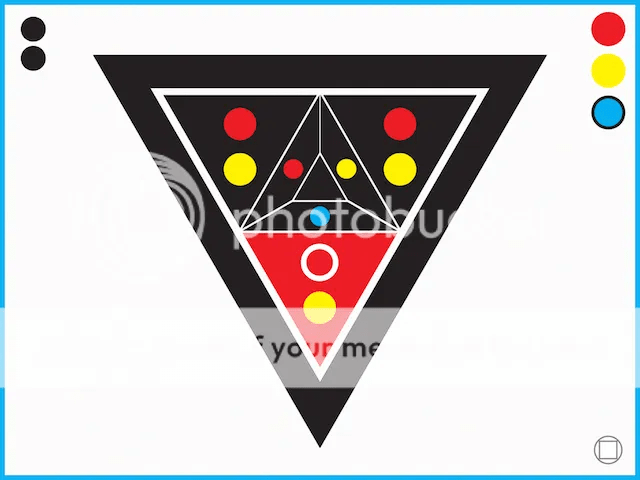
In Paul’s words, “RYB is very similar to ‘Minesweeper’ or ‘Hexcells,’ but instead of using numbers or symbols, it uses colors. The colored dots inside of a shape tell you how the neighboring shapes are colored.”

I love the devilish simplicity behind the solving. It’s so universal that it transcends the language barrier. Simply show another person the first step, and they’ll pick it up immediately.

Paul goes on to explain how one particular puzzle evolved as he sought the perfect mix of puzzly challenge and unique solvability.

He took this:

and eventually ended up with this:

It’s a fascinating read, one I can’t do justice to with a brief summary, so I suggest everyone check out the full post to watch an impressive constructor at work. Being walked step-by-step through a build by the designer is a delight.

I also have to praise the puzzles themselves. The mix of geometric shapes and colors creates a truly striking image. I think I’m gonna get a print made of this one and put it on my wall:


Thanks for visiting PuzzleNation Blog today! Be sure to sign up for our newsletter to stay up-to-date on everything PuzzleNation!

You can also share your pictures with us on Instagram, friend us on Facebook, check us out on TwitterPinterest, and Tumblr, and explore the always-expanding library of PuzzleNation apps and games on our website!

5 Questions for Author Derek Taylor Kent (Plus a Puzzly Announcement!)

Welcome to 5 Questions, our recurring interview series where we reach out to puzzle constructors, game designers, writers, filmmakers, musicians, artists, and puzzle enthusiasts from all walks of life!

It’s all about exploring the vast and intriguing puzzle community by talking to those who make puzzles and those who enjoy them! (Click here to check out previous editions of 5 Questions!)

And I’m excited to continue this series with Kubrick’s Game author Derek Taylor Kent as our latest 5 Questions interviewee!

Derek is a screenwriter, musician, and author, and his works have spanned print, TV, virtual reality, and soon, film. Although he’s better known for his middle grade efforts like Simon and the Solar System and the Scary School series, he has recently ventured into books for adults with his cinematic puzzle-fueled thriller Kubrick’s Game (which I recently reviewed here).

He has an exciting announcement connected to Kubrick’s Game to share with you, but before we get to that, let’s spend a little time getting to know this ambitious and amiable author, shall we?

Derek was gracious enough to take some time out to talk to us, so without further ado, let’s get to the interview!


5 Questions for Derek Taylor Kent

1. Was Kubrick’s Game your first foray into combining puzzles and writing? If so, what inspired the union of the two? If not, which came first for you, puzzles or writing?

In terms of puzzles being the crux of a plot, yes. I had incorporated some riddles and simple puzzles into some of my children’s fiction before, but only as a small element.

My primary inspiration for combining the two came from reading Ernest Cline’s Ready Player One back in 2011. In that book, the characters have to solve three intricate puzzles based on ’80s pop culture. The author was obsessed with 80s movies, music, and video games, so I began ruminating about what my subject would be if I were to write such a story. The obvious choice was Stanley Kubrick. He had been my favorite director since I was in high school and I was obsessed with his movies and all of the mystery that surrounded them.

As I delved further into it, the choice became more and more clear. Kubrick himself was an avid gamesman who loved puzzles, symbolism, and subliminal messages. The more I studied, the more I realized that it was not only believable, but almost likely, that he might have created a complex puzzle connecting each of his films. From there, it was just a matter of playing it out using markers that were already present.

[Image courtesy of Cinema Research Institute.]

2. How did the puzzles in the book come together? What did Kubrick’s game look like in its earliest iteration?

I had specific ideas for several of the puzzles and a general idea for others that I wanted to incorporate. Early in the process, I recruited two of the premiere puzzle-creators alive — Bob Glouberman and Larry Toffler of Fantastic Race. They create city-wide scavenger hunts, escape rooms, and puzzles for TV and movies. Luckily, they happened to be just as obsessed with Kubrick as I was and were very excited to come on board to help me create them.

If I were to write a book based on diabolical puzzles, I knew the book could only be as good as the puzzles themselves. While I could have probably created okay puzzles myself, I knew that theirs would be incredible and indeed they blew my mind.

I also knew that I wanted the puzzles to be Kubrickian, or cinematic in nature. That is, the clues would incorporate imagery, music, editing, and symbols, as opposed to wordplay or mathematical riddles. Also, they could only be solved by those familiar with the filmmaking process and masterful in its techniques, such as editing, lighting, projection, and sound design.

The final puzzle, which I dare not give away here, was present from the very beginning and had me most excited to write the book. I knew it had to end in that very special place, and was a type of puzzle that had never been created before, but it also made total sense considering the themes and hidden meanings of Kubrick’s final films.

3. If you’d been presented with a mystery like the one in your book, would you have taken the UCLA approach, the USC approach, or the antagonist’s approach?

Since the UCLA teammates are our protagonists, they were enacting my personal approach…most likely. They were most concerned with playing the game how Kubrick would have wanted it to be played, as opposed to other groups who, shall we say, put ethics aside for the sake of victory.

4. What’s next for Derek Taylor Kent?

Depending on how well Kubrick’s Game is received, I have plans for a continuation of cinema-themed puzzle adventure novels. I am also still writing middle-grade fiction and picture books and hope to have more of those released in the near future. I also wrote a horror feature film that is currently in pre-production, which will hopefully be coming out winter of 2018.

If your readers are interested in checking out any of my other work, everything is at DerekTaylorKent.com. Oh, and if you go to the Fun and Games section of ScarySchool.com, there’s a memory game you can play, and beating it will earn you the weirdest trophy you’ve ever seen.

5. If you could give the readers, writers, film enthusiasts, and puzzle fans in the audience one piece of advice, what would it be?

Well, since that is a very wide range of people, I think I will share my favorite piece of advice I ever received, which happened to come from the great actor Robert Forster. He told my class: “99% of everything you ever hear in your life will be somebody trying to convince you of something that’s not true in order to get into your pockets.”

What I like best about it, besides the encouragement of skepticism, is that as a novelist, I love being able to make a living selling something that isn’t BS. I can honestly tell kids, parents, or now my grown-up readers, that for a very reasonable price, my books will give you many hours of entertainment, and perhaps some enlightenment.


And speaking of hours of entertainment, it’s time for Derek’s big announcement!

As a marvelous real-world tie-in to Kubrick’s Game, Derek has launched The Game, an interactive solving experience guaranteed to challenge solvers and delight puzzlers worldwide!

This is a game for all readers to play.
If you’re reading this, play has already begun.
Six different puzzles each month to the day
Need to be solved for the game to be won.

That’s just a snippet of the introduction to set the scene. You can click here for full details — the first clue was revealed yesterday! — and sign up for his newsletter (bottom of the page here) to keep up on all things Derek Taylor Kent and Kubrick’s Game! (And, of course, you need to read the book to give yourself a fighting chance at solving The Game and finding the treasure!)

I think it’s an awesome way to expand on the world of the novel and to give solvers a puzzly conundrum to look forward to cracking! Good luck, my fellow puzzlers and PuzzleNationers!

Thank you, Derek, for taking the time out for 5 Questions! I can’t wait to see how The Game unfolds!


Thanks for visiting PuzzleNation Blog today! Be sure to sign up for our newsletter to stay up-to-date on everything PuzzleNation!

You can also share your pictures with us on Instagram, friend us on Facebook, check us out on TwitterPinterest, and Tumblr, and explore the always-expanding library of PuzzleNation apps and games on our website!