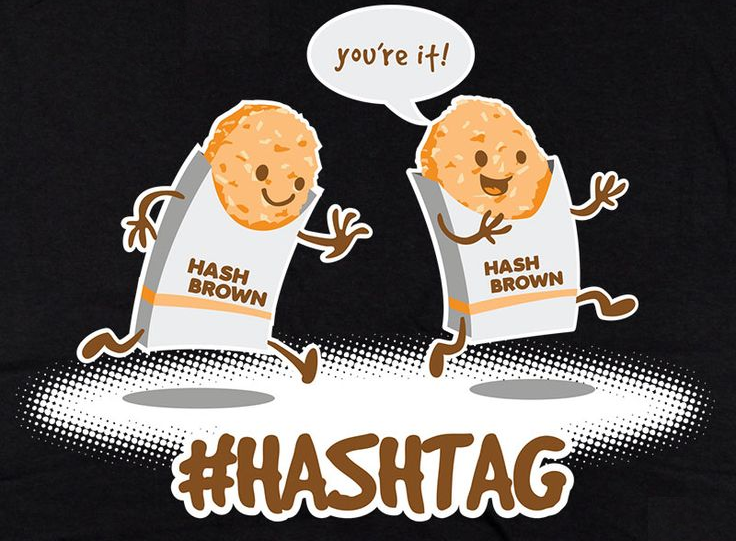
Yes, yes, it’s that time again. It’s hashtag game time!
For years now, we’ve been collaborating on puzzle-themed hashtag games with our pals at Penny Dell Puzzles, and this month’s hook was #PennyDellPuzzleToys, mashing up Penny Dell puzzles with action figures, cars, dolls, brands, characters, and anything else related to toys!
Examples include: Connect Four Square, Ouija Exchange Boards, and Bop-It’s Your Move.
So, without further ado, check out what the puzzlers at PuzzleNation and Penny Dell Puzzles came up with!
Flower Pow-Pow-Power Wheels Pow-Power Wheels POWER WHEELS!
One of our contributors went above and beyond in musical fashion, resurrecting the old Crossfire riff for some puzzly fun:
It’s some Timed Framework in the future The ultimate challenge CROSSWORDS! CROSSROADS! You’ll get caught up in the CROSSBLOCKS! CROSS PAIRS! You’ll get up in the CROSS ARITHMETIC! CROSS ANAGRAMS! CROSSOUT QUOTE! CROSSNUUUUMMMBBBEEEEEERRRRRRSSS!!!!
Have you come up with any Penny Dell Puzzle Toys entries of your own? Let us know! We’d love to see them!
Thanks for visiting PuzzleNation Blog today! Be sure to sign up for our newsletter to stay up-to-date on everything PuzzleNation!
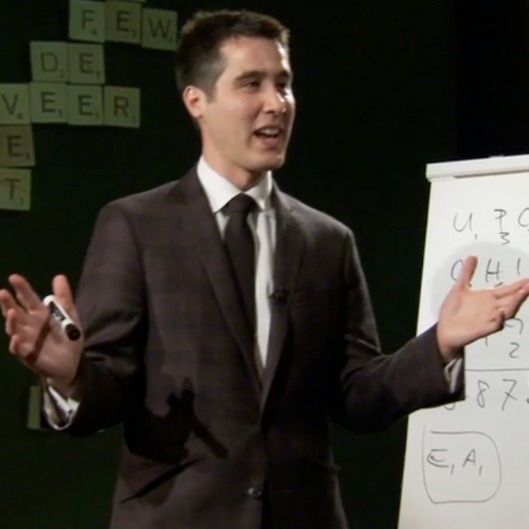
[Crossword constructor and magician David Kwong wows an audience.]
There is a certain sense of wonder that accompanies a well-constructed puzzle. The skill and artistry it takes to craft a quality crossword or brain teaser, weaving together words and leaving a finished puzzle in your wake, rather than a bundle of crosswordese and obscurities is truly something remarkable.
But that’s not the sort of puzzle magic we’re discussing today. No, instead, we’re returning to the CW summer series Penn and Teller: Fool Us to observe the magic of another puzzly entertainer at work.
For the uninitiated, Fool Us is a show where magicians and performers from all around the world present their best tricks, illusions, and bits of magical wizardry to try and stump the famous duo.
And on a recent episode, magician John Michael Hinton performed two acts of magical trickery involving a Rubik’s Cube.
Check out this video where he dazzles Penn and Teller:
That final reveal was a thing of beauty!
You can check out more of John Michael Hinton’s magic on his YouTube page! And let me know if you’ve seen any other acts of puzzle magic! I’d love to check them out!
Thanks for visiting PuzzleNation Blog today! Be sure to sign up for our newsletter to stay up-to-date on everything PuzzleNation!
By this time, you know the drill. Follow-Up Friday is a chance for us to revisit the subjects of previous posts and bring the PuzzleNation audience up to speed on all things puzzly.
And today I’d like to return to the subject of puzzle magic!
Oh yes, puzzle magic is most definitely a thing. Arguably the most famous practitioner is friend of the blog and crossword constructor David Kwong, who not only contributes both puzzles and magic to television shows and film projects, but has created some truly mindblowing magic tricks involving puzzles.
The other night, I was watching Penn and Teller: Fool Us, a show where magicians and performers from all around the world present their best tricks, illusions, and bits of magical wizardry to try and stump the famous duo. And lo and behold, another master of puzzle magic appeared!
But where David Kwong works his magic with crosswords, Steven Brundage uses a different puzzly tool: Rubik’s Cubes.
Check out this video where he dazzles Penn and Teller with several quick solves and feats of puzzly manipulation:
That behind-the-back trick was pretty fantastic, wasn’t it? You can check out more of Steven’s magic on his YouTube page! And let me know if you’ve seen any other acts of puzzle magic! I’d love to check them out!
Thanks for visiting PuzzleNation Blog today! Be sure to sign up for our newsletter to stay up-to-date on everything PuzzleNation!
Whether made of wood, metal, plastic, or rope, mechanical brain teasers can be some of the most challenging and well-crafted puzzles a solver will ever encounter.
Engaging both the solver’s deductive skills and patience, these puzzles often involve removing one key piece from an elaborate interconnected grouping, be it a ball from a seemingly solid maze of wooden posts or a heart from a web of unyielding metal linkages.
The cunning and clever brains at ThinkFun have put their own unique spin on the mechanical brain teaser with their latest product, Houdini, putting you in the legendary escape artist’s shoes and pitting you against numerous scenarios, all intended to keep the magician’s plastic namesake firmly trapped.
Although Houdini’s body and arms are one solid piece — representing his wrists being shackled together — his legs are felt, allowing you to bend and twist them in ways that replicate Houdini’s legendary flexibility. As the ropes are wound around and through both Houdini’s limbs and various obstacles designed to prevent his movement, it’s up to the solver to find the hidden loophole that will allow Houdini to escape scot-free.
With only a lock, a barrel, a solid ring, the three-looped base, and a few easy-clip ropes, ThinkFun has conjured 40 layouts of increasing difficulty, and I admit, some of these seriously taxed my puzzly skills.
The later puzzles involve multiple steps to free Houdini, utilizing tricks you’ve learned solving the earlier puzzles. It’s a brilliant slow-build solving experience, one that ThinkFun has employed with similar success with Laser Maze, Gravity Maze, and other products.
Houdini is not only a wonderful tribute to an entertainment legend, it’s a terrific puzzle toy that introduces a new world of brain teasers to younger solvers.
Welcome to another edition of PuzzleNation Blog’s interview feature, 5 Questions!
We’re reaching out to puzzle constructors, video game writers and designers, writers, filmmakers, and puzzle enthusiasts from all walks of life, talking to people who make puzzles and people who enjoy them in the hopes of exploring the puzzle community as a whole.
And I’m overjoyed to have James Ernest as our latest 5 Questions interviewee!
James Ernest represents Cheapass Games, a company with a brilliantly simple rationale: they know you have board games at home, so why jack up the price of their games by making you buy more dice, chips, or tokens? Their games contain exactly what you need to play the game, and describe precisely what you’ll need to scrounge up from other games in order to play.
As president and game designer, James is instrumental not only in maintaining the Cheapass Games legacy of great games for a fair price, but he’s also adept at utilizing Kickstarter campaigns and social media to communicate directly with the devoted board game and card game audience. In doing so, he’s helped introduce numerous hilarious and innovative games to the market, including:
Unexploded Cow: a card game where you try to rid the world of mad cows and unexploded ordnance.
U.S. Patent Number One: a game where you and your opponents build time machines and race back in time to register for the very first patent. [Glenn’s note: Currently out of print, but one of my all-time favorite board games.]
Veritas: a Risk-like strategy game where you try to become the predominant Truth in Dark Ages France while monasteries burn down around you. (Check out our full product review here!)
James was gracious enough to take some time out to talk to us, so without further ado, let’s get to the interview!
5 Questions for James Ernest
1.) For nearly two decades now, the Cheapass Games brand has been synonymous with affordable games with tongue-in-cheek humor and high replay value. How do you know when a game is right for your brand? What role do you play in bringing these games to market?
I’m the designer as well as the publisher for Cheapass Games, so I play nearly all the roles. I try to create products that fit into that format. When I make something that doesn’t fit the format, I often look for other ways to bring it to market, such as finding another publisher, or using a separate imprint under Cheapass Games.
For a while I used “James Ernest Games” as an imprint for my higher-priced games, though I currently release everything as Cheapass. I also used the “Hip Pocket” brand for smaller, more abstract games, and that one will be coming back next year.
2.) Many of the games in your library rely on a combination of strategy and step-by-step chain thinking, both skills most puzzle enthusiasts have in spades. Are you a puzzle fan? And what about that style of gameplay appeals to you?
The challenge in creating a strategy game is to make a puzzle with variety, so it can be replayed without getting dull. Part of that variety comes from rules that can give rise to meaningfully different game paths, and part of it comes from the interaction of players with different strategies.
As you’ve mentioned, I also like games to have stories, and that works in a similar way: the story has to be open-ended enough that it can proceed differently each time. The game is more like an environment where the players tell their own stories, rather than a way to tell a linear story. This is obvious for RPGs [roleplaying games] but I think it’s true for other games as well.
3.) You’ve created games of your own as well as helping others bring their games to life. What puzzles and board games, either in gameplay or in the experience of producing them for sale, have most influenced you?
I learned a lot about game construction from playing and working on Magic: the Gathering. A lot of my games have decks of different card types, balanced to produce the right mix of hands, based on my experience doing deck construction in Magic.
I also draw a lot of my approach to games from Pitch, which is a cutthroat trick-taking game. In a nutshell, you can choose different strategies in that game, either to play conservatively and win slowly, or to take risks and have the potential to win quickly or move backwards. Neither of those strategies is dominant and that makes the game good. Of course I also play a lot of poker, which contains similar choices.
4.) What’s next for James Ernest?
My next project is Pairs, a “New Classic Pub Game,” which I will be Kickstarting in February. After that, I have a couple of older Cheapass Games that I want to bring back into print. And I’m working on a new tabletop miniatures game called Cagway Bay, which is pirate-themed and diceless. I have a number of new game projects as well, but right now I’m not announcing any of them because I can’t be sure when they will be ready.
5.) If you could give the readers, writers, aspiring game designers, and puzzle fans in the audience one piece of advice, what would it be?
If you want to create things, there is no substitute for practice. Don’t just read about games; don’t just play them. You have to make a lot of games.
Welcome to another edition of PuzzleNation Blog’s interview feature, 5 Questions!
We’re reaching out to puzzle constructors, video game writers and designers, writers, filmmakers, and puzzle enthusiasts from all walks of life, talking to people who make puzzles and people who enjoy them in the hopes of exploring the puzzle community as a whole.
And I’m excited to have David Kwong as our latest 5 Questions interviewee!
Puzzlers by nature play with words, but none quite like David Kwong, a top-flight puzzle constructor and magician. Adept at sleight of hand and wielding a flair for puzzle constructing that makes me very jealous, David crafts illusions and puzzle grids with equal deftness, often doing so in front of a live audience!
In addition to his own creative endeavors, David serves as a magic consultant for film and television, and has contributed to The Mindy Project, The Incredible Burt Wonderstone, and most notably, the magic-infused heist thriller Now You See Me.
David was gracious enough to take some time out to talk to us, so without further ado, let’s get to the interview!
5 Questions for David Kwong
1.) How did you get started with puzzles?
My mother and I always bonded over being word-nerds. When I was a child, we would play Scrabble and solve crosswords. After college, I began writing crosswords with my friend Kevan Choset (I suppose I was jealous of his James Bond themed puzzle). Our first puzzle was the April Fool’s Day puzzle in 2006. I think we waited three years for it to get published!
[Glenn’s note: The James Bond puzzle refers to one of Choset’s earliest, where “007” not only appeared in the grid, but crossed “SEAN CONNERY.” The April Fool’s Day puzzle refers to a Choset/Kwong collaboration that actually required the solvers to write the word “THINK” outside the box (grid) four times.]
2.) Magic and crosswords might seem like separate enterprises, but they both involve a whimsical sense of playing with your audience’s expectations (magic with misdirection, crosswords with clever cluing and wordplay). What about magic and puzzles so appeals to you?
You nailed it. Magic and crosswords both involve misdirection, surprises and toying with conventions. Take for example if I were to vanish a coin, I would place it in my hand three or four times plainly before secretly feigning its placement on the fifth time. Magicians allow their audiences to become familiar with what is “normal” so that the “abnormal” goes undetected (or rather looks the same).
A crossword that toys with the rules of the puzzle operates much in the same way. The constructor leads solvers down a path of what seemingly looks like a normal puzzle, and then suddenly hits them with a twist.
(Check out this short video, which highlights David’s whimsical fusion of magic and crosswords.)
3.) What types of puzzles and feats of magic are your favorites or have most inspired you?
I love puzzles in which the twist hinges on the everyday words and phrases that we’ve come to expect as solvers. Ashish Vengsarkar had a great puzzle in which “Start of Quote” and “Part 2 of Quote” were revealed to be BRITISH WAITING LINE and SECOND PERSON SINGULAR.
Also, I know it’s been referenced a million times, but the BOB DOLE / CLINTON puzzle is the ultimate example of misdirection in a crossword. There’s no better way to misdirect your audience before the final reveal than to have them think the trick is over!
[Glenn’s note: David is referencing the famous New York Times puzzle that appeared the day before the 1996 presidential election, a puzzle that famously offered either “BOB DOLE ELECTED” OR “CLINTON ELECTED” as an answer depending on how the solver filled in the grid.]
My favorite magic tricks are the ones in which the subterfuge is taking place right under the spectators’ noses. As performers, we call these “bold” moves and take a particular delight in executing them effectively. Often this means no intricate contraptions, no smoke and mirrors — just a strong ability to misdirect. There’s a routine called “card under the glass,” which illustrates this concept. The performer declares, “I will again and again place your card underneath this glass. See if you can catch me.”
And the audience never stands a chance.
4.) What’s next for David Kwong?
“Now You See Me” was such a big hit that we’re making a sequel. There are a number of Houdini projects in the works as well. I’ve also consulted recently on “The Imitation Game,” which is the story of Alan Turing and Bletchley Park cracking the German enigma cipher machine. There’s a great line in that script: “[Alan,] you just defeated Nazism with a crossword puzzle.”
5.) If you could give the readers, writers, puzzle fans, and magic lovers in the audience one piece of advice, what would it be?
Magic and puzzles are both forms of storytelling. If you’re creating magic tricks or constructing puzzles, think about how you can take your audience on a journey, even if just for a few minutes. Play into their expectations and hit them with twists and turns.
Finally, look for fresh combinations of seemingly unrelated things. You might be surprised that their cross-pollination can yield something innovative and original. Who would have thought that magic and puzzles could be synthesized?!
Many thanks to David for his time. You can learn more about David and his ever-expanding filmography on his website, DavidKwongMagic.com, and be sure to follow him on Twitter (@davidkwong) and Facebook (facebook.com/dkwongmagic) to see more of his mystifying exploits.



 PuzzCulture