It’s Follow-Up Friday: Single Letter Answers edition!

Welcome to Follow-Up Friday!

By this time, you know the drill. Follow-Up Friday is a chance for us to revisit the subjects of previous posts and bring the PuzzleNation audience up to speed on all things puzzly.

And today, I’ll be posting the answers to the single letter puzzles from Tuesday’s blog post all about the power of single letters in puzzles!

The first puzzle was a brain teaser.

There’s a word in the English language in which the first 2 letters signify a male, the first 3 signify a female, the first 4 signify a great man, and the whole word signifies a great woman. What is that word?

The word is HEROINE. The first two letters are HE, the first three are HER, and the first four are HERO.


The second puzzle involved the first letters of words forming a pattern, and I asked you to both deduce the pattern and provide the next entry in the series.

O, T, T, F, F, S, S, E, ?

The next entry in the series is N, for Nine. These are the first letters of numbers — One, Two, Three, Four, Five, Six, Seven, Eight.

J, F, M, A, M, J, J, A, S, O, N, ?

The next entry in the series is D, for December. These are the first letters of the months of the year.

S, M, H, D, W, M, ?

The next entry in the series is Y, for Year. These are the first letters for increasing lengths of time — Second, Minute, Hour, Day, Week, Month.

M, V, E, M, J, S, U, ?

The next entry in the series is N, for Neptune. These are the first letters of the planets in the solar system, from closest to the sun to furthest from it.

D, K, P, C, O, F, G, ?

The next entry in the series is S, for Species. These are the first letters of the classification system for all life on Earth — Domain, Kingdom, Phylum, Class, Order, Family, Genus.


The third and final puzzle involved the first letters of words, but with numbers added, and I asked you to deduce what the letters represent.

3 F in a Y: 3 feet in a yard

366 D in a LY: 366 days in a leap year

12 S in the Z: 12 signs in the Zodiac

4 Q in a D: 4 quarters in a dollar

13 C in a S: 13 cards in a suit


How did you do? Did you solve them all, or did these crafty single letter puzzles stump you?

Thanks for visiting PuzzleNation Blog today! You can share your pictures with us on Instagram, friend us on Facebook, check us out on TwitterPinterest, and Tumblr, and be sure to check out the growing library of PuzzleNation apps and games!

One Letter Makes All the Difference

I spend a lot of time on this blog talking about the power of words, and rightly so. Words are the foundation of civilization. They’re how we communicate, how we express ourselves, how we interpret and process and quantify the world around us.

And playing with them is a cornerstone of entertainment. Jokes and puns depend on wordplay, as do riddles, brain teasers, and so many puzzles. Whether they’re being crossed, anagrammed, or shared with friends on an online Scrabble board, words are puzzle power.

That’s true even of letters. A single letter can not only speak volumes, it can be the key to unlocking an entire puzzle.

For instance, let’s talk crosswords. Knowing one across entry is a plural often allows you to place an S, giving you an anchor for the down entry that crosses it.

Cryptograms often offer a single letter as a hook to get you started. In addition, anytime you see a lone letter in a quote, you know it’s an I or an A.

Numerous anagram puzzles involve adding a single letter to a word, anagramming the result, and getting something new and unexpected.

That sort of letter addition reminds me of a brain teaser:

There’s a word in the English language in which the first 2 letters signify a male, the first 3 signify a female, the first 4 signify a great man, and the whole word signifies a great woman. What is that word?

In all of these examples, single letters are part of a greater puzzle. But what about puzzles composed entirely of single letters?

Easy. I can think of two.

In the first, single letters are the first letters of words forming some sort of pattern. Can you deduce the pattern AND provide the next entry in the series?

  • O, T, T, F, F, S, S, E, ?
  • J, F, M, A, M, J, J, A, S, O, N, ?
  • S, M, H, D, W, M, ?
  • M, V, E, M, J, S, U, ?
  • D, K, P, C, O, F, G, ?

In the second, the single letters are still the first letters of words, but we’ve added numbers and it’s up to you to deduce what the letters represent.

  • 3 F in a Y
  • 366 D in a LY
  • 12 S in the Z
  • 4 Q in a D
  • 13 C in a S

All of this, sprung from a single letter. Pretty impressive, isn’t it? No wonder we can accomplish so much with words, given building blocks like these.

Thanks for visiting PuzzleNation Blog today! You can share your pictures with us on Instagram, friend us on Facebook, check us out on TwitterPinterest, and Tumblr, and be sure to check out the growing library of PuzzleNation apps and games!

“Outside the Box” Brain Teaser Solving!

Over the past few months, we’ve focused on logic puzzles quite a bit. Whether we’re figuring out Cheryl’s birthday, determining the weights of island castaways with a seesaw, or puzzling out which members of the starship Enterprise crew are fierce Fizzbin players, we’ve been fixating on deduction as a key puzzle-solving skill.

But outside-the-box thinking can be just as valuable when it comes to puzzling, especially when brain teasers are involved.

If there are ten birds on a telephone wire and you shoot one, how many are left?

At first glance, the answer is nine. But if you think beyond the mechanics of the question and into the real world consequences, you’ll realize the real answer is zero, because the other nine birds would take off when they heard the gunshot.

Let’s apply this kind of thinking to a mathematical brain teaser that reportedly baffled 96% of America’s top math students.

I can already sense eyes glazing over at the prospect of applying formulas and delving into high-end mathematics, but trust me: a little outside-the-box thinking will simplify this puzzle immensely.
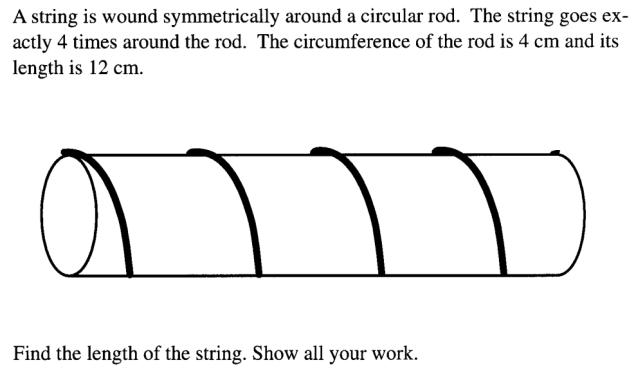
Now, remember that the string is wound symmetrically around the rod. That’s key to this. When you look at the rod, the distance from the string to the next loop of the string is the same. So each loop is 3 centimeters.

How does this help us? Well, we know the circumference of the rod is 4 centimeters. Between these two pieces of information, we can ignore the rod entirely and mentally flatten it out into a rectangle.

Now we’re not dealing with a rod and a string, we’re dealing with four diagonal lines. And with one of the best known mathematical principles — the Pythagorean theorem — we can determine the length of one of those lines.

We’ll treat the diagonal as the longest side of a right triangle. The rod has a circumference of 4 centimeters, which means the triangle has a length of 4 centimeters. Each loop has a width of 3 centimeters, which means the triangle has a width of 3 centimeters. And the Pythagorean theorem — A squared + B squared = C squared, meaning 4 squared + 3 squared = our diagonal squared — gives us 16 + 9 = our diagonal squared. So 25 = our diagonal squared, which means 5 = our diagonal.

And since that diagonal appears four times, since our string wraps around the rod four times, our total length of string is 20 centimeters.

Okay, yes, that was a lot of math, but it would have been much MORE math had we not thought outside-the-box and tackled it from a different angle.

Now, I realize that I tend to pass myself off as a topnotch puzzler and brain-teaser specialist, but there have been plenty of times in the past when a brain teaser has bested me because I wasn’t thinking outside the box.

Here’s one that stumped me recently.

You have a set of 3 light switches. One of them controls a light in a room upstairs. You can turn the light switches on or off as many times as you like.

You can go upstairs — one time only — to see the light. You cannot see the whether the light is on or off from downstairs, nor can you change the light switches while upstairs.

No one else is in the room to help you.

Based on the information above, how would you determine which of the three light switches controls the light inside the room?

Let me give you a minute to think about this one.

Okay, did you get it?

Now, the key here is maximizing the amount of information you can get from that single trip upstairs to observe the light. And it takes thinking outside-the-box to do that.

Here’s what you do:

Flip the first switch, and leave it on for a few minutes. Then shut it off, and flip the second switch. Leaving the second switch flipped, head upstairs.

Now, visually, there are two possible outcomes: either the light is on or it’s off. If the light is on, you know the second switch controls the light.

If the light is off, however, there are still two possibilities. In this problem, it’s easy to fixate on information from your eyes, but the solve depends on another sense.

Remember how we flipped the first switch and left it on for a while? Well, if the first switch controls the light, we’ll be able to feel residual warmth from the light being on if we touch the light. If the third switch controls the light, the light will still be cool.

And there you go: one trip upstairs, one answer.


So, now that we’ve handed deduction puzzles and outside-the-box stumpers, you should be ready to tackle any riddles and brain teasers you encounter!

Thanks for visiting PuzzleNation Blog today! You can share your pictures with us on Instagram, friend us on Facebook, check us out on TwitterPinterest, and Tumblr, and be sure to check out the growing library of PuzzleNation apps and games!

It’s Follow-Up Friday: Birthday Puzzle edition!

Welcome to Follow-Up Friday!

By this time, you know the drill. Follow-Up Friday is a chance for us to revisit the subjects of previous posts and bring the PuzzleNation audience up to speed on all things puzzly.

And today, I’d like to return to the subject of birthday brain teasers!

Working on the Cheryl’s Birthday brain teaser a few days ago reminded me of another birthday-fueled puzzle that’s been around forever.

How many people do you need to enter a room before the probability of any 2 or more people sharing a birthday (day and month only, not year) is greater than 50%?

Assume for the sake of the puzzle that birthdays in the population at large are equally spread over a 365 day year.

Now, given that there are 365 days in the year, you’d assume the number of people necessary to get that probability of a shared birthday above 50% would be more than half of 365, or 183 people.

But it turns out that, statistically speaking, you don’t need anywhere near that many people.

Let’s break it down. Person A has a birthday. Person B has a birthday. There’s only one possible pairing, A-B. Person C has a birthday, but creates three possible birthday pairings: A-B, A-C, and B-C.

Person D could have a different birthday, but the introduction of Person D begins escalating the number of POSSIBLE shared birthdays. With these four people, we have SIX possible pairings: A-B, A-C, A-D, B-C, B-D, and C-D.

Our fifth person, Person E, allows for TEN possible pairings: A-B, A-C, A-D, A-E, B-C, B-D, B-E, C-D, C-E, and D-E. The probability of a shared birthday is increasing much faster with each new person.

As it turns out, it only takes 23 people to give us a 51% probability of a shared birthday.

And that would certainly save on catering.

Thanks for visiting PuzzleNation Blog today! You can share your pictures with us on Instagram, friend us on Facebook, check us out on TwitterPinterest, and Tumblr, and be sure to check out the growing library of PuzzleNation apps and games!

Are you smarter than a Singaporean student?

We love brain teasers here at PuzzleNation Blog. Whether we’re dealing with curious parking spaces, men in hats, the crew of the Enterprise playing games, or the seesaw-based conundrum that so baffled Captain Holt on Brooklyn Nine-Nine, we thoroughly enjoy tackling these often diabolical and curious logic problems.

And one has been making the rounds on Facebook, Twitter, and other social media platforms recently. This one comes from a Singaporean classroom, and has made headlines all over the Internet.

Hmmm, doesn’t seem like a lot of information, does it?

So, we have ten possible dates.

Let’s put them in a chart to organize them as best as we can.

Now, let’s analyze each statement in order, since the progression is the key to solving this brain teaser.

Albert says: I don’t know when Cheryl’s birthday is, but I know that Bernard does not know too.

Since Albert is told the month, and there are multiple options for each month, there is no way he could know. At first. But he does know Bernard doesn’t know either. How?

Deduction. If Cheryl told Bernard 18 or 19 (the only days that appear once), Bernard WOULD know Cheryl’s birthday. So Albert can eliminate those two options.

And for Albert to KNOW that, Cheryl cannot have told him May or June, since those were the only months with days that appear once.

A lot of information in a single sentence. Let’s move on to the next sentence.

Bernard says: At first I don’t know when Cheryl’s birthday is, but I know now.

Bernard is on the same track as Albert. He’s eliminated May and June. And he says he knows Cheryl’s birthday. If you look at our chart now, there are three singlet dates (15 for August 15, 16 for July 16, and 17 for August 17). If he was told 14, he wouldn’t know if it were July or August, so we can eliminate those.

From ten possible days, we’re down to three. And Albert’s final sentence finishes the job.

Albert says: Then I also know when Cheryl’s birthday is.

Since Albert is only told the month, it has to be July, because there are two possible dates left in August.

Therefore, in impressively brisk fashion, both Albert and Bernard have deduced that Cheryl’s birthday is July 16. And so have we!

We’ve also deduced that Cheryl is sort of a pain in the ass. But I suspect that wasn’t much of a brain teaser.

Thanks for visiting PuzzleNation Blog today! You can share your pictures with us on Instagram, friend us on Facebook, check us out on TwitterPinterest, and Tumblr, and be sure to check out the growing library of PuzzleNation apps and games!

PuzzleNation Product Review: Houdini

Whether made of wood, metal, plastic, or rope, mechanical brain teasers can be some of the most challenging and well-crafted puzzles a solver will ever encounter.

Engaging both the solver’s deductive skills and patience, these puzzles often involve removing one key piece from an elaborate interconnected grouping, be it a ball from a seemingly solid maze of wooden posts or a heart from a web of unyielding metal linkages.

The cunning and clever brains at ThinkFun have put their own unique spin on the mechanical brain teaser with their latest product, Houdini, putting you in the legendary escape artist’s shoes and pitting you against numerous scenarios, all intended to keep the magician’s plastic namesake firmly trapped.

Although Houdini’s body and arms are one solid piece — representing his wrists being shackled together — his legs are felt, allowing you to bend and twist them in ways that replicate Houdini’s legendary flexibility. As the ropes are wound around and through both Houdini’s limbs and various obstacles designed to prevent his movement, it’s up to the solver to find the hidden loophole that will allow Houdini to escape scot-free.

With only a lock, a barrel, a solid ring, the three-looped base, and a few easy-clip ropes, ThinkFun has conjured 40 layouts of increasing difficulty, and I admit, some of these seriously taxed my puzzly skills.

The later puzzles involve multiple steps to free Houdini, utilizing tricks you’ve learned solving the earlier puzzles. It’s a brilliant slow-build solving experience, one that ThinkFun has employed with similar success with Laser Maze, Gravity Maze, and other products.

Houdini is not only a wonderful tribute to an entertainment legend, it’s a terrific puzzle toy that introduces a new world of brain teasers to younger solvers.

Thanks for visiting PuzzleNation Blog today! You can share your pictures with us on Instagram, friend us on Facebook, check us out on TwitterPinterest, and Tumblr, and be sure to check out the growing library of PuzzleNation apps and games!