Forrest Fenn’s Treasure: Found?

Well, it looks like someone took my advice.

On June 6th, Forrest Fenn announced on his blog that his treasure has been found.

In such quiet fashion ends a ten-year search undertaken by an estimated 350,000 people, one that sadly cost five of those people their lives.


In 2010, Forrest Fenn hid a treasure chest full of gold and diamonds, purported to be worth millions, somewhere in the Rocky Mountains. The only clues offered — nine, to be specific — were hidden in his poem, “The Thrill of the Chase.”

[Image courtesy of Westword.]

After eight years — and several of the deaths mentioned above — Fenn offered a few new clues in the hopes of preventing any further tragedies:

The treasure chest is not under water, nor is it near the Rio Grande River. It is not necessary to move large rocks or climb up or down a steep precipice.

Please remember that I was about 80 when I made two trips from my vehicle to where I hid the treasure.

In the two years since those clues were released, many more attempts have been made to find the treasure.

And now, with this brief announcement, it appears to be over:

It was under a canopy of stars in the lush, forested vegetation of the Rocky Mountains and had not moved from the spot where I hid it more than 10 years ago. I do not know the person who found it, but the poem in my book led him to the precise spot.

I congratulate the thousands of people who participated in the search and hope they will continue to be drawn by the promise of other discoveries.

So the search is over. Look for more information and photos in the coming days.

Fenn claimed in a local interview that the chest had been found “a few days” before he broke the story. Additionally, he told the Santa Fe New Mexican:

“The guy who found it does not want his name mentioned. He’s from back East,” he said, adding that it was confirmed from a photograph the man sent him.

The paper then reported that Fenn “declined to produce the photograph Sunday.”
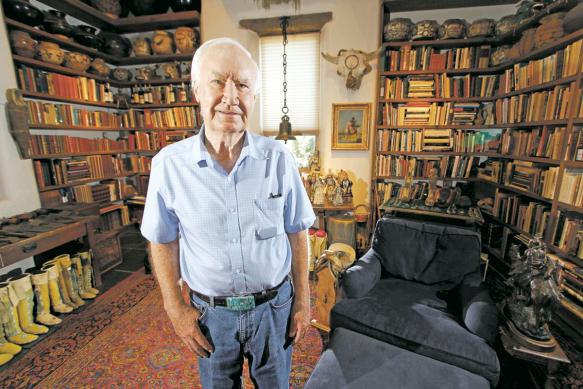
forrest fenn

[Image courtesy of the Santa Fe New Mexican.]

But, as you might expect when there are millions of dollars at stake, this news is not without controversy.

A real estate attorney in Chicago alleges that she solved the puzzle but was hacked and had the solution stolen from her. Supposedly, the thief had been taunting her through text messages for months. She is suing not only to prevent the unnamed treasure hunter from selling any of the treasure, but also to have the court award the chest to her as well.

This seems like a peculiar scenario. Unless she was unwisely braggadocious about her solve, how would someone she doesn’t know “hack” her, steal her solution, and then beat her to the treasure?

(Having traveled between Chicago and Santa Fe over twenty times as part of her search, she claims she’s spent between $10,000 and $30,000 trying to locate the treasure, only to have it stolen out from under her.)

This isn’t the only lawsuit tied to Fenn’s treasure hunt. He was previously sued for $1.5 million by a Colorado man who claimed Fenn cheated him out the treasure through misleading clues and fraudulent statements. (This case was thrown out by a judge in late February, but the claimant is petitioning to have it reopened.)

A third case is pending, and the plaintiff believes Fenn is fraudulently announcing the treasure has been found in order to undermine his case.

Of course, there are folks who believe the treasure was found years ago, but Fenn never told anyone, using the mystery to feed fame and book sales.

And then, there are those who claim the treasure never existed at all.

[Image courtesy of Wikipedia.]

I must admit, I can understand the doubters’ skepticism. It’s a little too perfect, isn’t it? Exactly ten years after he first hid it, despite no new clues for two years, suddenly the treasure is found.

And yet, we have no photograph, no identity for who found it, and court cases already claiming theft and chicanery. All we’re left with is a brief announcement, a small flurry of press, and more questions.

Who found Forrest Fenn’s treasure?

Was the solution stolen?

Did the treasure ever exist in the first place?

Perhaps we’ve waited ten years only to end up with a new mystery.


Thanks for visiting PuzzleNation Blog today! Be sure to sign up for our newsletter to stay up-to-date on everything PuzzleNation!

You can also share your pictures with us on Instagram, friend us on Facebook, check us out on TwitterPinterest, and Tumblr, and explore the always-expanding library of PuzzleNation apps and games on our website!

Missing This Year’s Indie 500 Crossword Tournament…

Originally, this post was scheduled to hype up the return of one of the most inventive and enjoyable crossword tournaments in recent memory, the Indie 500.

Scheduled for June 6th, the sixth annual edition of the tournament would have featured clever clues, some dynamite puzzles, and pie. (There’s always pie.)

Unfortunately, the ongoing COVID-19 crisis has scuppered many events large and small over the last few months. Crossword fans missed out on the American Crossword Puzzle Tournament back in March, though many of them — 1,815 solvers! — enjoyed the wonderful Crossword Tournament From Your Couch event that was organized in its stead.

The organizers of the Indie 500 posted back in March that they were working on a solve-at-home event to be held this summer, but as of this posting, no further details have emerged.

But do not fret. If you’re looking for some puzzly challenges to dive into over the weekend, the Indie 500 team have made the tournament puzzle packs for ALL FIVE previous tournaments available for free on their website, which is an incredibly generous and kind gesture.

And if you’re looking to get a sense of what sort of challenges and delights the tournament has to offer, we have write-ups covering each of the five previous editions of the tournament for you to check out.

Here’s hoping we still get to indulge in some fresh Indie 500 treats this summer. It truly has become one of the highlights of the puzzly calendar, one that I look forward to every year.


Thanks for visiting PuzzleNation Blog today! Be sure to sign up for our newsletter to stay up-to-date on everything PuzzleNation!

You can also share your pictures with us on Instagram, friend us on Facebook, check us out on TwitterPinterest, and Tumblr, and explore the always-expanding library of PuzzleNation apps and games on our website!

Answer to the Fiendish Second Conway Puzzle, The Ten Divisibilities!

John_H_Conway_2005_(cropped)

Last month, in honor of mathematician and puzzly spirit John Horton Conway, we shared two of his favorite brain teasers and challenged our fellow PuzzleNationers to crack them.

Two weeks ago, we shared the solution to puzzle #1The Miracle Builders, and offered a few hints for puzzle #2, The Ten Divisibilities.

Now that we’ve heard from a few solvers who either conquered or got very close to conquering the second puzzle, we happily share both the solution and how we got there.


The Ten Divisibilities

I have a ten digit number, abcdefghij. Each of the digits is different, and:

  • a is divisible by 1
  • ab is divisible by 2
  • abc is divisible by 3
  • abcd is divisible by 4
  • abcde is divisible by 5
  • abcdef is divisible by 6
  • abcdefg is divisible by 7
  • abcdefgh is divisible by 8
  • abcdefghi is divisible by 9
  • abcdefghij is divisible by 10

What’s my number?

[To clarify: a, b, c, d, e, f, g, h, i, and j are all single digits. Each digit from 0 to 9 is represented by exactly one letter. The number abcdefghij is a ten-digit number whose first digit is a, second digit is b, and so on. It does not mean that you multiply a x b x c x…]

And here are the hints we offered to help:

-If you add all the digits in a number, and the total is divisible by 3, then that number is also divisible by 3.
-If the last two digits of a number are divisible by 4, then that number is divisible by 4.
-If the last three digits of a number are divisible by 8, then that number is divisible by 8.


The solution is 3816547290.

So, how do we get there?

First, we use process of elimination.

Any number divisible by 10 must end in a zero, so j = 0.

Any number divisible by 5 must end in a zero or a five, so e = 5 (because each digit only appears once).

That gives us abcd5fghi0.

But that’s not all we know.

If a number is divisible by an even number, that number must itself be even. So that means b, d, f, and h must all be even numbers (i.e. some combination of 2, 4, 6, and 8). That also means that a, c, g, and i must all be some combination of the remaining odd numbers (1, 3, 7, and 9).

That’s a lot of information that will come in handy as we solve.

So, where to next? Let’s look at one of those even-numbered spots.

We’ve been told that abcd is divisible by 4. But any number is divisible by 4 if the last two digits are divisible by 4. So that means cd is divisible by 4.

So, if c is odd, d is even, and cd is divisible by 4, that limits the possibilities somewhat. cd must be 12, 16, 32, 36, 72, 76, 92, or 96.

So d is either 2 or 6.

That will be helpful in figuring out def. And knowing def is the key to this entire puzzle.


One of the clues we offered in our last post was that if the sum of a number’s digits is divisible by 3, then that number is also divisible by three. We know abc is divisible by 3, so that means a + b + c is also divisible by 3.

And if something is divisible by 6, then it’s also divisible by 3, so a + b + c + d + e + f is divisible by 3.

Here’s where things get a little tricky. Since a + b + c + d + e + f is divisible by 3, and a + b + c is divisible by 3, then when you subtract a + b + c from a + b + c + d + e + f, the result, d + e + f would also be divisible by 3.

Why is that helpful? Because it means we can look at def instead of abcdef, and we know a lot about def right now.

d is either 2 or 6. e is 5. f is either 2, 4, 6, or 8. And the sum of d + e + f is divisible by 3.

So that gives us two possibilities to deal with, either 2 + 5 + f, where the sum is divisible by 3, or 6 + 5 + f, where the sum is divisible by 3.

Since each number is only used once, that’s six possible equations:

  • 2 + 5 + 4 = 11
  • 2 + 5 + 6 = 13
  • 2 + 5 + 8 = 15
  • 6 + 5 + 2 = 13
  • 6 + 5 + 4 = 15
  • 6 + 5 + 8 = 19

Only 258 and 654 have sums divisible by 3, so they’re our two possibilities for def.

We’ll have to try both of them to see which is the correct choice. How do we do that?

Let’s start with the assumption that def is 258.


That would mean our answer is abc258ghi0. We know b and h have to be even numbers, and only 4 and 6 are left as options. Since fewer numbers are divisible by 8 than by 2, let’s look at abc258gh.

One of the other hints we offered was that if the last three digits of a number are divisible by 8, then the whole number is divisible by 8.

So that means if abc258gh is divisible by 8, then 8gh is divisible by 8. That’s much more manageable.

So, f is 8, h is 4 or 6, and g is either 1, 3, 7, or 9. That gives us eight possibilities for 8gh: 814, 834, 874, 894, 816, 836, 876, and 896.

Dividing each of these by 8 reveals only two possible choices: 816 and 896. That means, in this scenario, h is 6, b is 4, and our number is a4c258g6i0.

What’s next? Well, remember that trick we did with abcdef before? We’re going to do it again with abcdefghi.

Any number divisible by 9 is divisible by 3. Our rule of sums tells us that a + b + c + d + e + f + g + h + i is also divisible by 3. And since a + b + c + d + e + f is divisible by 3, subtracting it means that g + h + i is also divisible by 3.

With 816 and 896 as our possibilities for fgh, that means our possibilities for ghi are 16i and 96i. That gives us the following possibilities: 163, 167, 169, 961, 963, 967, where the sum of our answer must be divisible by 3.

  • 1 + 6 + 3 = 10
  • 1 + 6 + 7 = 14
  • 1 + 6 + 9 = 16
  • 9 + 6 + 1 = 16
  • 9 + 6 + 3 = 18
  • 9 + 6 + 7 = 22

963 is the only one that works, which gives us a4c2589630. With only 1 and 7 remaining as options, our possible solution is either 1472589630 or 7412589630.

But, if you divide either 1472589 or 7412589 by 7 — which is faster than running every one of the 10 conditions through a calculator — neither divides cleanly. That means 258 is incorrect.


I know that was a lot of work just to eliminate one possibility, but it was worth it. It means 654 is correct, so our solution so far reads abc654ghi0.

And we can use the same techniques we just employed with 258 to find the actual answer.

We know b and h have to be even numbers, and only 2 and 8 are left as options. Again, since fewer numbers are divisible by 8 than by 2, let’s look at abc654gh.

4gh is divisible is 8. So, f is 4, h is 2 or 8, and g is either 1, 3, 7, or 9. That gives us eight possibilities for 4gh: 412, 432, 472, 492, 418, 438, 478, and 498.

Dividing each of these by 8 reveals only two possible choices: 432 and 472. That means b is 8, and our number is a8c654g2i0.

Now, let’s look at ghi.

With 432 and 472 as our possibilities for fgh, that means our possibilities for ghi are 32i and 72i. That gives us the following possibilities: 321, 327, 329, 721, 723, 729, where the sum of our answer must be divisible by 3.

  • 3 + 2 + 1 = 6
  • 3 + 2 + 7 = 12
  • 3 + 2 + 9 = 14
  • 7 + 2 + 1 = 10
  • 7 + 2 + 3 = 12
  • 7 + 2 + 9 = 18

Okay, that leaves us four possibilities for ghi: 321, 327, 723, and 729.

Stay with me, folks, we’re so close to the end!

Let’s look at our four possibilities:

  • a8c6543210 (79)
  • a8c6543270 (19)
  • a8c6547230 (19)
  • a8c6547290 (13)

Next to each number, I’ve placed the only digits missing in each scenario, two for each.

That means there are only 8 possible ways to arrange the remaining numbers:

  • 7896543210
  • 9876543210
  • 1896543270
  • 9816543270
  • 1896547230
  • 9816547230
  • 1836547290
  • 3816547290

So let’s do what we did last time, and divide each chain at the seventh number by 7.

  • 7896543 / 7
  • 9876543 / 7
  • 1896543 / 7
  • 9816543 / 7
  • 1896547 / 7
  • 9816547 / 7
  • 1836547 / 7
  • 3816547 / 7

Only one of the chains can be cleanly divided by 7, and it’s 3816547.

Which means the solution for abcdefghij is 3816547290.


I know this was a monster of a solve — it rivals our Brooklyn Nine-Nine seesaw puzzle solution in complexity — but it’s one that every one of our fellow PuzzleNationers are capable of puzzling out.

How did you do on this diabolical brain teaser, folks? Let us know in the comments section below. We’d love to hear from you!


Thanks for visiting PuzzleNation Blog today! Be sure to sign up for our newsletter to stay up-to-date on everything PuzzleNation!

You can also share your pictures with us on Instagram, friend us on Facebook, check us out on TwitterPinterest, and Tumblr, and explore the always-expanding library of PuzzleNation apps and games on our website!
Intersections of Puzzle and Poetry

The more you look, the more you can find puzzles in all sorts of interesting places. We find them in literature, in historical documents, and in popular culture.

So it should come as no surprise that puzzles can be found in the world of poetry as well.

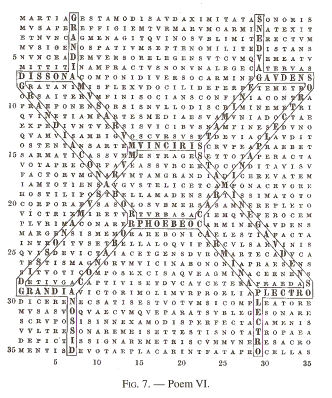
We’ve covered a few examples where poetry and puzzles have overlapped in the past, whether it’s the creations of Peter Valentine, the works of Edgar Allan Poe, or the art of carmina figurata.

carminafig7

But that’s only scratching the surface.

One of the most common ways that puzzly techniques find their way into poetry is through acrostics. Acrostics spell out messages with the first letter of each line or verse.

One of the most famous is a poem by Lewis Carroll at the end of Through the Looking-Glass where he reveals the identity of the girl who inspired his famous stories:

A boat beneath a sunny sky,
Lingering onward dreamily
In an evening of July—

Children three that nestle near,
Eager eye and willing ear,
Pleased a simple tale to hear—

Long has paled that sunny sky:
Echoes fade and memories die.
Autumn frosts have slain July.

Still she haunts me, phantomwise,
Alice moving under skies
Never seen by waking eyes.

Children yet, the tale to hear,
Eager eye and willing ear,
Lovingly shall nestle near.

In a Wonderland they lie,
Dreaming as the days go by,
Dreaming as the summers die:

Ever drifting down the stream—
Lingering in the golden gleam—
Life, what is it but a dream?

Carroll certainly offers the most famous example, but I must confess that my favorite example comes from a story on Wikipedia. Poet Rolfe Humphries was banned from Poetry Magazine for life for an acrostic aimed at a diplomat and former president of Columbia University. The acrostic quite bluntly read “Nicholas Murray Butler is a horse’s ass.”

Of course, the message reading down — also known as an acrostich — isn’t the only way these messages can be hidden.

There are also examples of mesostich — where the word or message is spelled with letters in the middle of the verse — and telestich, where the last letters of each line spell a name or message.

Dd8mL6_UwAA3OTY

[Image courtesy of Twitter.]

These techniques were also used in ancient Greek inscriptions, where one particular example, AL205, featured acrostich, mesostich, and telestich messages at the same time.

Other puzzly stylings have also allowed poets to flex their wordplay muscles.

For instance, David Shulman wrote a 14-line sonnet about George Washington’s famous river crossing where every line is an anagram of “Washington crossing the Delaware”:

A hard, howling, tossing water scene.
Strong tide was washing hero clean.
“How cold!” Weather stings as in anger.
O Silent night shows war ace danger!

The cold waters swashing on in rage.
Redcoats warn slow his hint engage.
When star general’s action wish’d “Go!”
He saw his ragged continentals row.

Ah, he stands – sailor crew went going.
And so this general watches rowing.
He hastens – winter again grows cold.
A wet crew gain Hessian stronghold.

George can’t lose war with’s hands in;
He’s astern – so go alight, crew, and win!

There are also ABC poems, a form where the goal of each poem is to use words starting with each letter of the alphabet in order. You can find some entertaining and impressive examples here.

Some poets, however, have flipped the puzzle poem on its head by treating the poems like puzzles. The folks at UVA’s Puzzle Poetry group utilize Tetris-like puzzle pieces with words on them to assemble poems.

poetry_puzzle_da_header_3-2

[Image courtesy of the University of Virginia.]

The concept dates back to 2017, a creation of Neal Curtis and Brad Pasanek, serving as a way to both explore and deconstruct the art of poetry itself by making a puzzle out of it.

It’s a very cool idea, reminiscent of how magnetic poetry sets allow you to turn your fridge into a canvas by assembling and reworking the order of the various available words.

Puzzles by their very nature are about finding a solution, bringing order out of chaos, whether it’s assembling puzzle pieces, answering devious crossword clues to fill a grid, or unraveling a tricky brain teaser that pushes you to think in a different way.

And since poetry is all about expressing truths in a personal way, it makes a lovely sort of sense that puzzly techniques would intertwine with this thoughtful, elusive form of art.


Thanks for visiting PuzzleNation Blog today! Be sure to sign up for our newsletter to stay up-to-date on everything PuzzleNation!

You can also share your pictures with us on Instagram, friend us on Facebook, check us out on TwitterPinterest, and Tumblr, and explore the always-expanding library of PuzzleNation apps and games on our website!
Answers to the Morphy_me Puzzly Challenge!

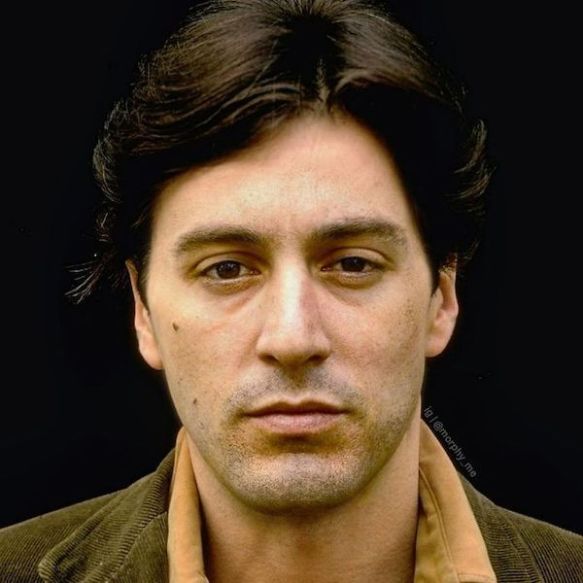
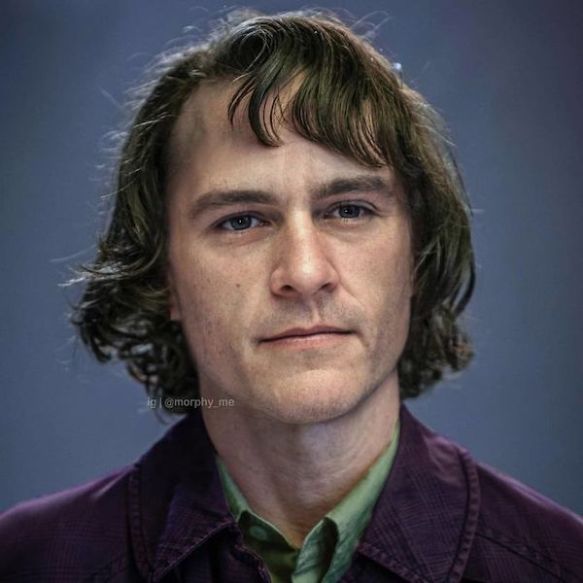
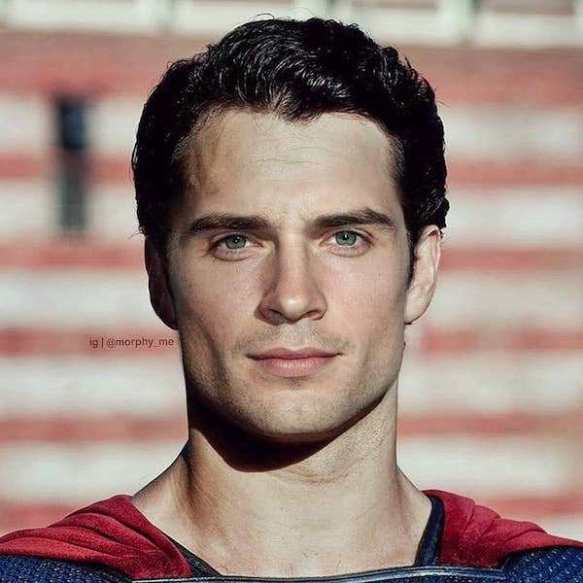
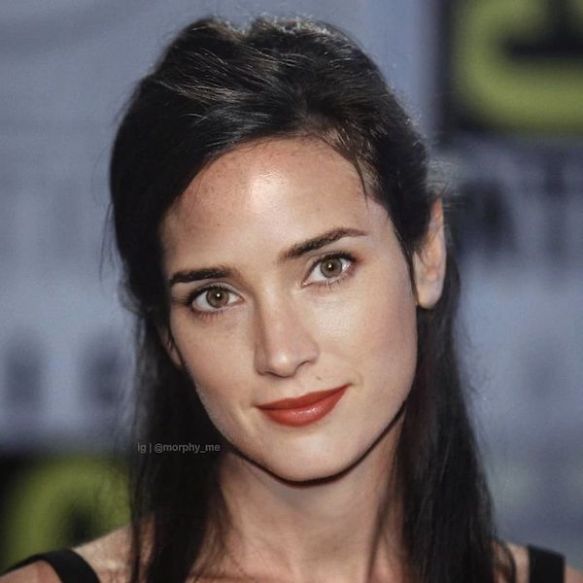
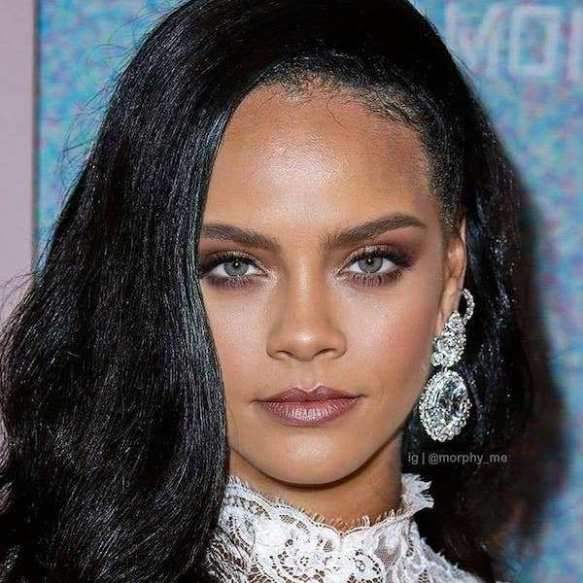
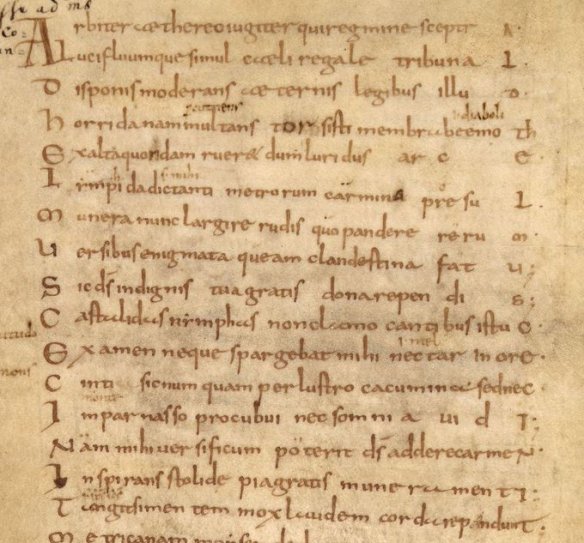
A few weeks ago, we challenged our fellow puzzlers and PuzzleNationers to puzzle out an artistic challenge created by an Instagram account called morphy_me.

The account, credited only as Benji, features images that merge elements of both celebrities, somehow creating an image that is reminiscent of both, and yet feels strangely new.

Did you puzzle out which pairs of celebrities formed these images? Let’s find out!


#1

benji 1

Answer: Emily Blunt and Katy Perry

#2

benji 2

Answer: Al Pacino and Robert DeNiro

#3

benji 3

Answer: Jessica Alba and Ariana Grande

#4

benji 4

Answer: David Bowie and Kurt Cobain

#5

benji 5

Answer: Kim Kardashian and Taylor Swift

#6

benji 6

Answer: Robert Pattinson and Christian Bale
(a future and former Batman)

#7

benji 7

Answer: Margot Robbie and Sharon Tate

#8

benji 8

Answer: Heath Ledger and Joaquin Phoenix
(an all-Joker edition)

#9

benji 9

Answer: Tom Welling and Henry Cavill
(an all-Superman edition)

#10

benji 10

Answer: Winona Ryder and Jennifer Connelly

#11

benji 11

Answer: Billie Eilish and Scarlett Johansson

#12

benji 12

Answer: Rihanna and Cara Delevingne

#13

benji 13

Answer: Bill Nye and Bill Nighy
(that’s just delightful wordplay)

#14

benji 14

Answer: Tom Holland and Jake Gyllenhaal
(hero AND villain from the latest Spider-Man film)

#15

benji 15

Answer: Zendaya and Vanessa Hudgens


How many did you get? Let us know in the comments section below! We’d love to hear from you!

Thanks for visiting PuzzleNation Blog today! Be sure to sign up for our newsletter to stay up-to-date on everything PuzzleNation!

You can also share your pictures with us on Instagram, friend us on Facebook, check us out on TwitterPinterest, and Tumblr, and explore the always-expanding library of PuzzleNation apps and games on our website!
Crimes Against Crosswords!

688262

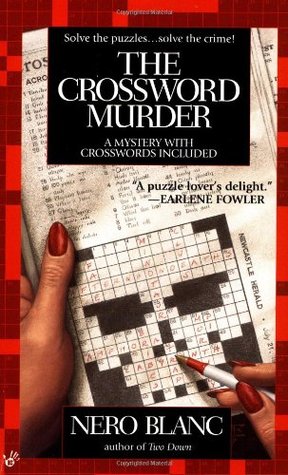
[Image courtesy of Goodreads.]

I know what you’re thinking. “Crimes against crosswords? Isn’t that a bit dramatic?”

Sure it is. You might think it’s over the top to shudder every time someone promises a crossword but publishes a crisscross instead.

But it’s true. There are numerous ways people can transgress against the noble crossword, harming both the body and the spirit of the crossword itself.

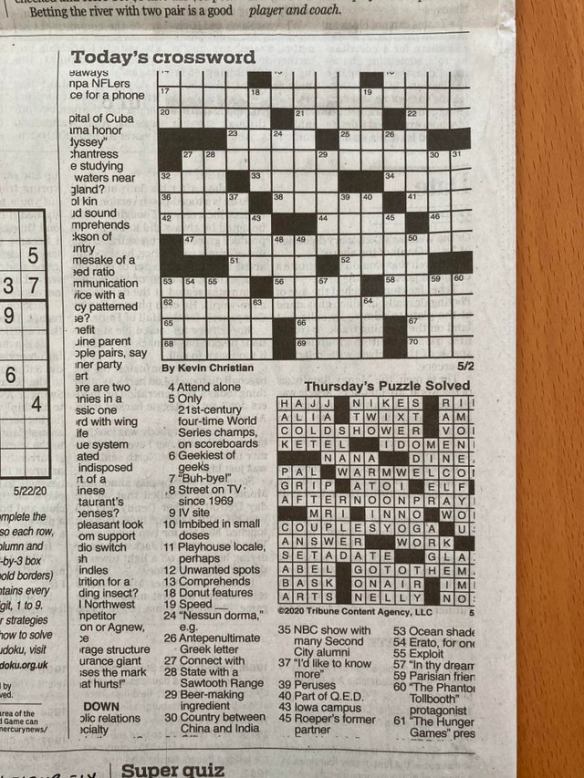
For instance, check out this picture of a crossword from The Los Angeles Times,  republished in a local newspaper, which was shared on reddit:

4i43bit52c051

Look at it! They cropped all four sides of the puzzle in order to fit the available space. Good luck figuring out which across word is clued by “mesake of a ed ratio” or one of the many other mangled clues along the left-hand side of the puzzle.

That is a crime against crosswords.

They’re not always so obvious and clumsy, though.

No, sometimes, a crossword is harmed by crummy fill or an abundance of nonsense abbreviations or numerous Naticks formed by crossing obscure words with other obscure words.

Granted, these are far rarer in the major outlets. (Unless you’re checking out r/crossword or reading Rex Parker’s blog, where they find so-called crossword indignities by the dozens. Good lord.)

But in reality, the vast majority of crossword venues won’t publish puzzles so undermined by careless choices.

evan 5

Yeah, you noticed I didn’t say “all crossword venues.”

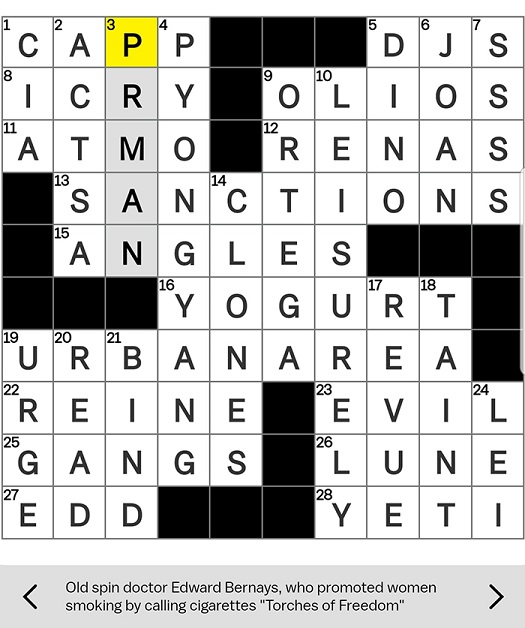
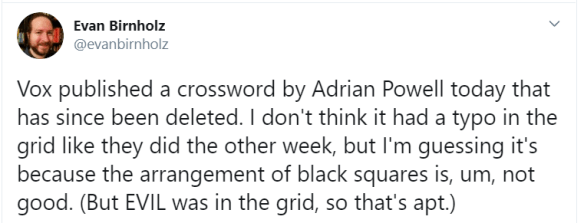
This unfortunate grid was published by Vox, but it was later deleted, as reported on Twitter by constructor Evan Birnholz:

evan 4 may 22

Evan is an avid follower of the Vox crossword, but not because he’s a fan. No, Evan has been dunking on the Vox crossword for what feels like forever. He’s not doing it to make his own puzzles look better by comparison; as a top-flight constructor, he doesn’t need to.

His criticisms are never unfair or mean-spirited; on the contrary, they’re founded in trying to make the puzzle better by pointing out poor choices.

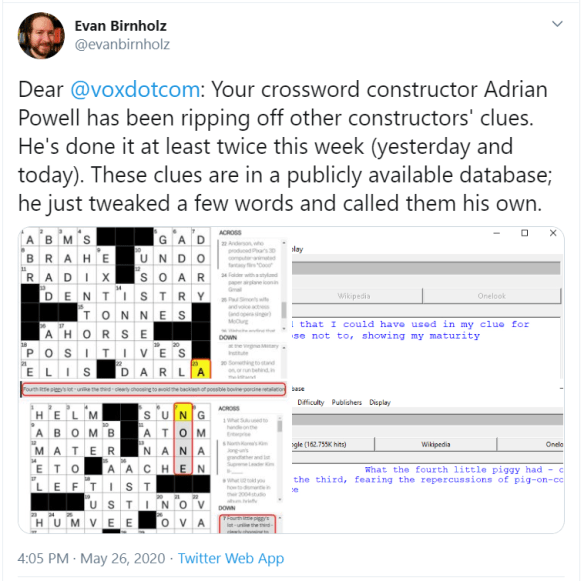
They’re also founded in defending the work of fellow constructors. Evan’s keen eye has caught more than a few questionable examples of clues that seem to have been pilfered wholesale or altered slightly by Vox constructors.

evan 1

Now, the first puzzle I posted was silly. Sure, it made the crossword nigh-unsolvable, but there’s no malice there. The second puzzle, the one with the unpleasant pattern, doesn’t deserve the same benefit of the doubt. It was a poor choice, and a puzzle that never should have made it to solvers.

But as for stolen clues, that’s something else entirely. If that’s what is happening here — and Evan makes a fairly compelling case — that’s not just a crime against crosswords, it’s a crime against fellow constructors. It’s a sign of disrespect.

I love shouting out smart clues by constructors, not only so other people can enjoy the wit and wordplay, but so that the right person gets the proper credit. The crossword community is a brilliant group of people; they’re clever and hardworking and constantly innovating.

And it sucks to see some members of the community take advantage of others. It hurts the community as a whole, far more than any bad cropping of a puzzle ever could.


Thanks for visiting PuzzleNation Blog today! Be sure to sign up for our newsletter to stay up-to-date on everything PuzzleNation!

You can also share your pictures with us on Instagram, friend us on Facebook, check us out on TwitterPinterest, and Tumblr, and explore the always-expanding library of PuzzleNation apps and games on our website!