Puzzling in the Past with the Fantastic Club Drosselmeyer Radio Show!

Over the previous four years, the organizers of Club Drosselmeyer have hosted an event in Boston set in a nightclub during World War II. The events have featured era-appropriate costumes, music, puzzle solving, dancing, and even a swing-time version of the Nutcracker Suite!

But given the current global circumstances, this year they redesigned their magical December event, and for the first time, folks outside the Boston area took part in a virtual Club Drosselmeyer puzzle experience presented as a radio show from the same era.

The first event was this Saturday, and your friendly neighborhood puzzle blogger was in attendance. And I just have to say… I was absolutely blown away by the show.

I’ve done a lot of puzzle-from-home things, from crossword tournaments to escape rooms, but none of them had the same style, ambiance, and energy as the Club Drosselmeyer Radio Show.

Allow me to explain a bit more.

Participants could either order a box of physical material to be delivered to the house (your Drosselbox) or download and print the necessary materials. But either way, you had puzzles and helpful items in front of you during the show.

drosselbox

[Some of the contents of your Drosselbox.
Puzzle materials excluded to avoid spoilers.]

Then you log into your account online, which gives the Club Drosselmeyer team your phone number and sets up your unique radio show page, which you have running online.

Every participant — or group, since you could play with up to five people (or more if people wanted to share roles) — had a scheduled two-hour window for the full solving experience. The radio show itself serves as musical performance, ambiance, and a built-in two-hour timer for your solve!

Plus you would periodically call into the Drosselmeyer Industries Switchboard with your phone to interact with prerecorded performances with the characters. A push-button system allowed you to answer questions and input puzzle solutions, which is already really cool. But, during the scheduled performance times, at points, you would be kicked over to the ACTUAL PERFORMER who voiced the prerecording you had just interacted with!

I must confess, I was startled virtually every time a voice said “Hello?” and then called me by name.

The interactions were so cool, and really immersed you in this fun roleplay aspect of the game as you gave them your solutions and were directed what to do next. The performers weren’t just professional, they were charming and helpful and it was an absolute treat to have these unique interactions with them.

Plus, your phone interactions would affect your individual radio show as you listened. You could trigger plot-specific updates and one of SEVEN different conclusions based on your contributions to the night’s events!

Oh, and what were the night’s events? Well…

In this scenario, puzzlers take on the role of an air raid warden and a civilian defense unit during World War II. It’s supposed to be a quiet night in Massachusetts while you listen to your favorite radio show. But suddenly, an air raid siren blares into the night, and you’re called into action!

I won’t go into the puzzles themselves, since solvers can still interact with the automated system, but I do want to highlight the radio show itself.

The music and sound design were absolutely top-notch, really adding to the whole experience. The music varied from soft lilting pieces to absolute big-band bangers, and it all felt so perfect for the time period. (I actually had to go back to listen to some of the song performances afterward, because I was so in-the-zone with my puzzle solving that I barely registered them.)

There was a post-show videochat so that players and performers could show off their period-specific costumes and interact, and I had the pleasure of speaking to several of the performers. They were incredibly welcoming and interested in the players’ solving experiences, and the mellow after-show aspect was a delight.

drosschar0

[Just some of the characters you interact with through prerecorded messages AND live chats during the actual show!]

I inquired whether they’d be doing another Club Drosselmeyer Radio Show in the future, but the performers seemed quite anxious to get back to their usual live show format. I can appreciate that, but I sincerely hope they do this again. Eschewing videochats for a pure radio show-style feel was so engaging and felt so fresh and vibrant, and the phone interaction system (both automated and live) was truly impressive.

I simply cannot say enough good things about this experience. The puzzles were cleverly designed and varied in challenge (to allow for easier solving paths for less-experienced players or puzzle-light listening experiences), and the performances were outstanding. The entire team, from puzzlers to technicians to performers to musicians, should be very proud.

The Club Drosselmeyer Radio Show was an absolute blast. I loved every minute of it. (Yes, even the minutes wasted making dumb mistakes on a puzzle. *laughs*)

[Please check out their website here for all things Club Drosselmeyer.]


Thanks for visiting PuzzleNation Blog today! Be sure to sign up for our newsletter to stay up-to-date on everything PuzzleNation!

You can also share your pictures with us on Instagram, friend us on Facebook, check us out on TwitterPinterest, and Tumblr, and explore the always-expanding library of PuzzleNation apps and games on our website!

A Bit of Holiday Wordplay Around the Virtual Fireplace!

Long-time readers know that we often host in-house wordplay contests. Not only do we invite our friends at Penny/Dell Puzzles to participate, but our fellow puzzlers and PuzzleNationers as well!

It’s the holiday season, so we embraced it with this month’s game! Yup, it’s a Penny Pressmas and a Jingle Dell Rock!

Essentially, we challenged our fellow puzzlers to unleash their punny creativity on all things holidays. They could mix and match puzzles with holiday songs, seasonal trappings, and more!

They could create their own puzzly holiday and tell us about the traditions and celebrations! Heck, they could make a puzzly holiday card, if they wished! Anything that struck their fancy, so long as it was puzzle-fueled and holiday flavored.

So, without further ado, let’s see what they came up with!


Some submissions stuck to our traditional holidays:

Here We Come A-Puzzling

Holi-Daisy

It’s the Most Wonderful Timed Framework of the Year

God Bless Us Every One and Only!

Blackout! Friday

The First and Last Noel

Merry Christmas to All Fours, and to All a Good Night!


Others suggested new puzzly holidays:

Saturnabout-nalia

Fest-and-Last-ivus

Boxes Day / Letterboxes Day

All Four Kwanzaa

Yule Know the Odds


“I tried to make a crossword without a certain letter in it… but I couldn’t manage it. Alas, my No-L puzzle will have to be submitted another holiday.” — a participant who wishes to remain anonymous.


One clever puzzler submitted this delightful visual mashup! Do you get it?

Screen Shot 2020-12-10 at 9.40.13 AM


And finally, your humble PN blogger couldn’t resist throwing in his own little bit of puzzly holiday fun for you…

He knows when you’re sleeping
And he knows when you’re awake
Plus he knows if you’ve been BAD or GOOD (based on which answer fits in the available grid squares)
Perhaps be good for goodness’ sake

You might not know his name
So let’s all take time to meet him now
Oh who could this figure be
Let’s all say his name aloud

Volumes of puzzles to deliver each year
In dozens of places, and even right here!
Now you know of the legend, you’ve read all the rhymes
Gotta ask Sylla Claustic to make it on time!


Do you have any punny puzzly holiday ideas? Let us know in the comments below. We’d love to hear from you!

Thanks for visiting PuzzleNation Blog today! Be sure to sign up for our newsletter to stay up-to-date on everything PuzzleNation!

You can also share your pictures with us on Instagram, friend us on Facebook, check us out on TwitterPinterest, and Tumblr, and explore the always-expanding library of PuzzleNation apps and games on our website!

5 Questions for Game Designer Ellie Dix

Welcome to 5 Questions, our recurring interview series where we reach out to puzzle constructors, game designers, writers, filmmakers, musicians, artists, and puzzle enthusiasts from all walks of life!

It’s all about exploring the vast and intriguing puzzle community by talking to those who make puzzles and those who enjoy them! (Click here to check out previous editions of 5 Questions!)

And we’re excited to welcome Ellie Dix as our latest 5 Questions interviewee!

I first encountered Ellie Dix after stumbling upon the Kickstarter campaign for The Imp Box, a family-friendly game collection designed to look like a Christmas cracker. (Naturally, it immediately made the list of games to include in this year’s Holiday Puzzly Gift Guide.)

I soon discovered that she, much like this intriguing game set, was far more than meets the eye. Ellie Dix is not only the designer of every game under the Dark Imp umbrella, but she’s also the owner of the company. A puzzle designer, game designer, author, and more, Ellie Dix is a self-made dynamo, representing the entrepreneurial spirit that has grown to define the industry during the modern board game renaissance.

With The Imp Box now available for sale worldwide and a new Kickstarter campaign on the horizon, I have no doubt that Ellie Dix is a name we’ll be hearing about for many years to come.

Ellie was gracious enough to take some time out to talk to us, so without further ado, let’s get to the interview!


5 Questions for Ellie Dix

1. How did you get started in the games industry?

I’ve been designing games as a hobby for some time, but when I sold my Education company I decided to focus full time on game design and publishing. Before that I’d used games in teaching and training. I’ve also been a hobby board gamer myself for a long time (and my parents before me). So when I finally made the switch, I just jumped in with both feet. I wrote a book called The Board Game Family: Reclaim your Children from the Screen, which came out in July 2019. My first games were published in November 2019. Since then it’s been a full on schedule of design, development and publication.

How has your experience been as a woman designing games and running a board game company, either in terms of challenges or general insight from your perspective?

Honestly, I expect the challenges have been very similar to those that a person of any other gender would experience. The board gaming community is so inclusive that my own gender seems completely irrelevant. I do, however, realise that I’m in the minority in this industry. I suppose the only thing of note is that I’ve been approached several times by other cis-females who’ve commented that they’re pleased to see the success of another woman in the industry. So clearly it can be helpful to others to see a woman doing what I’m doing.

2. What’s the key to a great family-friendly game?

Getting something that the kids and the adults will all want to play. Family games aren’t children’s games. Family games have to hook in and hold the interest of everyone. For me – complexity isn’t always an issue. Kids can cope with all sorts of levels of complexity. But making sure the game is fairly fast-paced is important. I don’t mean short, necessarily, but minimising downtime is crucial. Games with simultaneous play, actions for passive players or very quick turns work well. The theme has to hook the family in too!

3. We’re currently in the midst of a board game renaissance, with greater exposure than ever for all sorts of games and play styles. What’s one trend in the industry you’d like to see more of and what’s one trend you’d like to see less of?

I love asymmetric games and I’d love to see more of them. Games with varying player powers or factions. This increases replayability. I’ve recently created an asymmetric family game – Uranus! – which is currently in the final of the Board Game Workshop’s annual design contest.

For me, I struggle to get into the big campaign games (Pandemic Legacy, The King’s Dilemma, Gloomhaven). I suspect there are too many on the market for the people who are playing them to actually play. They’re often too much work for regular gamers and families to get into.

4. What’s next for Ellie Dix?

I’m developing a range of roll & write PnP games for any number of players. These are all games that can be played by zoom. I’ve got several out already and they’ve been going great guns during the lockdowns. More are coming out before Christmas. Uranus! will be coming to Kickstarter in early March 2021. I’m also working on some exciting school projects next year! It’s going to be another busy year.

5. If you could give the readers, writers, aspiring game designers, and puzzle fans in the audience one piece of advice, what would it be?

It’s easy to get paralysed by perfectionism. Very few great games started out as a great games. Be brave and just put your game out there, as early as you can, with any sort of back-of-the-cereal packet prototype you can. Find a great playtesting group full of other designers (not friends and family) or create one yourself.

The playtesting process is so vital to development. It’s a waste of time to make sure all the cards are perfectly balanced before you get it in front of people. You could spend weeks on a game that ultimately nobody wants to play. A playtesting group will help you to find the fun and ultimately make a better game.


A huge thank you to Ellie for her time. You can follow her on Twitter for updates on all things Dark Imp, and be sure to check out her puzzles and games through Instagram, YouTube, her game blog, and of course, the Dark Imp website. Whatever she cooks up next, you know it’s going to be great.

Thanks for visiting PuzzleNation Blog today! Be sure to sign up for our newsletter to stay up-to-date on everything PuzzleNation!

You can also share your pictures with us on Instagram, friend us on Facebook, check us out on TwitterPinterest, and Tumblr, and explore the always-expanding library of PuzzleNation apps and games on our website!
The Boswords 2020 Fall Themeless League Has Come to a Close!

boswords new

After two months of delightful weekly solving, the Boswords 2020 Fall Themeless League has come to a close.

If you’re unfamiliar, the Boswords 2020 Fall Themeless League was a clever weekly spin on traditional crossword tournament-style solving. Instead of cracking through a number of puzzles in a single day (or two), the Fall Themeless League consisted of one themeless crossword each week, scored based on your accuracy and how fast you complete the grid.

Each week’s puzzle only had one grid, but there were three sets of clues, each representing a different difficulty level for solvers. Smooth was the least challenging, Choppy was the middle ground, and Stormy was the most challenging. (When solvers registered to participate, they chose the difficulty level that suited them best.)

Hundreds of solvers signed up for the challenge of two months of themeless puzzle solving and a bit of friendly competition, and now that it’s over, I’d like to share a few thoughts about my experience in the League.

questions-banner-860x280

I confess, I was skeptical about entering the league. No, it didn’t have anything to do with the puzzles themselves. I knew the constructing team was top-notch, and with John Lieb, Andrew Kingsley, and Brad Wilber running things, I knew the competitors were in excellent hands.

I simply don’t solve themeless puzzles that often. In fact, this tournament probably marks the most themeless puzzles I’ve ever solved in this short an amount of time. They’re simply not part of my usual solving rotation, save for championship themeless puzzles in various tournament packets, and the occasional puzzle here and there (like Doug Peterson and Patti Varol’s Friday NYT themeless last week, congrats on your debut, Patti!).

But I really enjoyed seeing what creative constructors could do with crosswords once freed from the shackles of a theme. The long, crossing entries can certainly be intimidating at the start — especially if you read three or four clues in a row and feel like your brain has gone blank — but the sheer inventiveness of the entries you get to see, often stacked close together, is really cool.

exercise-brain-crossword-670x335

And, like a jigsaw puzzle, the solving experience sneaks up on you. You get a few words here, a few letters there, and suddenly everything starts to fall into place. Clues that eluded you make total sense on a second or third reading, or the now-obvious wordplay punches you in the face.

Eventually, you’re left with a full grid and a real sense of accomplishment. (Not to mention a growing sense of wonder that the constructor managed to make all those crossings work.)

This tournament showed me how much I’d been missing by not solving themeless crosswords more often.

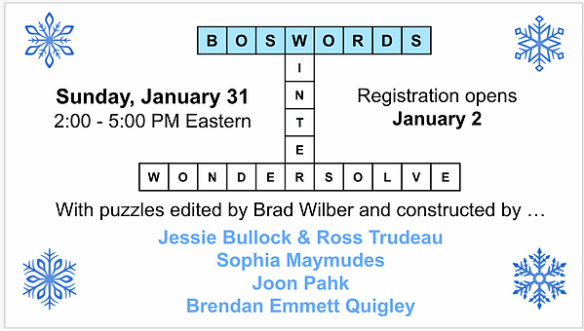
And with the promise of future Boswords-hosted events in 2021 like the Winter Wondersolve and the Spring Themeless League to come, it’s nice to have exciting puzzle events to look forward to in the near future.

I ended up placing 85th out of 400 or so competitors, which I am pretty pleased with! And now I’ll try to do better in the next one. It’s always good to have goals.

Kudos to everyone who helped bring this marvelous project together, and kudos to everyone who participated. It was a blast.


Thanks for visiting PuzzleNation Blog today! Be sure to sign up for our newsletter to stay up-to-date on everything PuzzleNation!

You can also share your pictures with us on Instagram, friend us on Facebook, check us out on TwitterPinterest, and Tumblr, and explore the always-expanding library of PuzzleNation apps and games on our website!

Answer to our Thanksgiving Logic Puzzle!

Last week, we celebrated Thanksgiving with a social distance-themed logic puzzle in honor of this time of year and the peculiar circumstances of 2020.

So let’s take a look at how to untangle this puzzle and sort things out so everyone enjoys the holiday, shall we?


First, a quick reminder about the puzzle, so the clues are fresh in our minds (and you have one last chance to solve it before we walk you through the solution).

On a curious Thanksgiving in 2020, five housemates were social distancing, each engaged in different activities throughout the day. (One was streaming Hulu.)

Each housemate (including Brian) wore a different outfit — one was wearing a tank top and shorts — and was doing their activity at a different time that day (1 PM, 2 PM, 2:30 PM, 3 PM, or 3:30 PM).

From the information provided, can you determine what time each housemate did which activity, as well as what outfit they were wearing?

1. The person doing Zoom trivia did so earlier than Alex but later than the one who wore a t-shirt and jeans.

2. Luke’s activity was earlier in the day than Denise’s, but later than that of the person who wore a Christmas sweater and pants.

3. Alex (who was wearing a Pokemon onesie) had her activity earlier than the person texting Grandma but later than Denise.

4. The person playing Among Us did so later than the person Facetiming their Mom, but earlier than the one wearing pajamas (who did their activity earlier than Adam).


Okay, first things first, let’s organize the information we have.

  • There are five housemates: Adam, Alex, Brian, Denise, Luke.
  • There are five activities: Facetiming Mom, playing Among Us, streaming Hulu, texting Grandma, doing Zoom trivia.
  • There are five outfits: Christmas sweater/pants, Pajamas, Pokemon onesie, Tanktop/shorts, T-shirt/jeans.

Since many of the clues reference who or what happened earlier or later than other events, it makes sense to use the times as our anchor points, so our starting grid should look like this:

turkey logic 1

And we can immediately mark down who did the activity at 1 PM. In clue 1, the person doing Zoom trivia did their activity earlier than Alex, so Alex wasn’t the person at 1 PM. Clue 2 tells us that both Luke and Denise had someone doing activities before them, so it couldn’t be them at 1 PM. And Clue 4 tells us that the person in pajamas did their activity before Adam, so he couldn’t be the 1 PM person either. That leaves Brian as the 1 PM person.

That information tells us more as well. Alex can’t be the 2 PM person, because Clue 1 says both the Zoom trivia person and the person in t-shirt and jeans did activities before Alex. Denise can’t be the 2 PM person, because Clue 2 says both Luke and the person in the Christmas sweater did activities before Denise. And Adam can’t be the 2 PM person because Clue 4 says that both the person playing Among Us and the person wearing pajamas did activities before Adam. So Luke must be the 2 PM person.

Not only that, but since Luke did his activity after the person in a Christmas sweater and pants, that makes the sweater/pants Brian’s outfit.

We can fill in one person based on time as well. Clue 3 tells us that Alex’s activity was after Denise’s, so Alex can’t be the 2:30 PM person. And Clue 4 tells us that Adam’s activity happened after the person Facetiming Mom, the person playing Among Us, and the person in their pajamas, so Adam can’t be the 2:30 PM person. That leaves Denise as the 2:30 PM person.

So now our chart looks like this:

turkey logic 2

Let’s look at the outfits now. We know from Clue 3 that Alex is wearing the Pokemon onesie, but we’re not sure where to place Alex yet. But we can place the pajamas based on what we know.

In Clue 4, we’re told that the person wearing pajamas has their activity after the person Facetiming Mom and the person playing Among Us, and before Adam. So Adam is out. Alex and Brian are also out, because we know what they’re wearing. And Luke can’t be the person in pajamas, because his activity is second (2 PM) and at least two activities have to be done before the person wearing pajamas. That leaves Denise as the person in pajamas.

That leaves only two outfits unaccounted for: the tanktop/shorts and the t-shirt/jeans. But we can eliminate those as well. In Clue 1 we’re told that the person in t-shirt and jeans does their activity before both the person doing Zoom trivia and Alex. But Adam can’t be that person, because Adam’s activity happens after the person Facetiming Mom, the person playing Among Us, and the person wearing PJs. So Adam is wearing a tanktop and shorts, and Luke is wearing a t-shirt and jeans.

Let’s look at our chart now:

turkey logic 3

As you can see, I’ve added notes below for person/outfit combos we know that we can’t yet place.

But the information above does tell us something else.

Clue 4 tells us that the person playing Among Us did so later than the person Facetiming Mom, but earlier than the person wearing pajamas. And we know the person wearing pajamas is Denise. So that means Luke is playing Among Us and Brian is Facetiming Mom.

This information also tells us what Alex is doing. Clue 1 tells us Alex is not doing Zoom trivia, and Clue 3 tells us that Alex is not texting Grandma. And since she can’t be playing Among Us or Facetiming Mom, the only remaining option is streaming Hulu.

This same process of elimination can tell us who did the last two activities. We know Denise isn’t playing Among Us, Facetiming Mom, or streaming Hulu. But Clue 3 tells us she wasn’t texting Grandma either, so she must have been doing Zoom trivia.

Which means Adam was the one texting Grandma.

And since Clue 3 tells us that Alex’s activity happened before the person texting Grandma, we can complete our grid:

turkey logic 4

How did you do? Did you manage to unravel this holiday puzzler? Let us know in the comments section below! We’d love to hear from you!


Thanks for visiting PuzzleNation Blog today! Be sure to sign up for our newsletter to stay up-to-date on everything PuzzleNation!

You can also share your pictures with us on Instagram, friend us on Facebook, check us out on TwitterPinterest, and Tumblr, and explore the always-expanding library of PuzzleNation apps and games on our website!
PuzzleNation Product Review: Homeworlds

[Note: I received a free copy of this game in exchange for a fair, unbiased review. Due diligence, full disclosure, and all that.]

One of the coolest moments in a board game player’s life comes when you’re immersed in a game, and someone walks by, stops, and simply must ask, “What is that?” Because you’re showing them something new.

Homeworlds got that reaction the very first time I played it at the office. A coworker walked by, saw what is essentially an array of colorful triangles on the table, and asked the question. They didn’t know what it was, but they were intrigued.

Honest praise doesn’t come much higher than that, does it?

Homeworlds is a difficult game to review, because there’s so much to cover. The rules are expansive and complex, even though the elements are simple. It’s three sets of Looney Pyramids each in four different colors: red, blue, green, and yellow. And yet, it might be the most involved, complicated game we’ve ever reviewed on PN Blog.

And to be fair, we’re going to spend way less time than usual covering the rules. There’s simply too much to explore, and to be frank, throwing a novella of rules at you doesn’t tell you about the game and why it’s worth your time.

So let’s try it a little differently today.

Homeworlds is chess plus Risk set in space. But unlike those games — or basically any strategy games with territory control and resource management elements — which require lots of different pieces and a host of tabletop real estate to enjoy, Homeworlds can easily be toted around and played on any flat surface. And it still manages to encapsulate all the complexity, variety, and tactical planning of those games.

You and your opponent are both playing spacefaring races that are trying to wipe the other player’s influence from the universe. You can do so by eliminating their fleets (through capture or destruction), destroying their Homeworld, or forcing them to leave their Homeworld defenseless.

There are specific rules governing how you build your fleet, how you travel to different star systems, and what you can do when you arrive there. These are all dictated by the colors of the ships in your fleet, which allow you to build new ships, travel, attack, or transform ships (swapping them out for ones with different abilities).

Any pieces not currently in use by the players sit in a communal bank, waiting to be pulled and deployed as either new star systems or new ships. (I love this aspect of the game. It’s like every time you travel to a new star system, you pull that place out of the ether and place it onto the table in front of you. You essentially make each game space you need to use.)

The communal bank adds a third player of sorts to the table, since you must always keep an eye on the bank to not only manage your resources but prevent your opponent from capitalizing on your moves. For instance, you must pull the smallest sized pyramid available for a given color. But size of the pieces does matter. So if you impulsively pull the last small green pyramid, you’ve left the bank open for your opponent to grab a medium or a large pyramid, leaving them with a more powerful ship than you.

Trust me, it’s a lot to take in at once, like the first time you play chess and you’re overwhelmed trying to remember how the little horse-shaped ones move while all the other pieces are doing their own thing. Unless you watch a detailed how-to video, your first few games of Homeworlds are going to be a wash. Because, like chess or Risk, there are important steps you need to take first before you can really get into the game.

But those early learning sessions are still great fun. You slowly drink in all the rules. You figure out choosing your Homeworld can affect the entire scope of the game (by determining how many or how few spaces away your opponent’s homeworld is). You puzzle out devious little tricks like sacrificing one ship in order to take multiple actions, sometimes even undoing that sacrifice in the same term, like you’ve built a perpetual motion machine or found a loophole in the rules.

As the game progresses, what was an overwhelming jumble of complexity becomes an elegantly balanced logic tree of possible options unfolding in front of you.

Catastrophes you might have accidentally caused in earlier games — or studiously avoided in later ones — become tactical moves you intentionally inflict in order to tilt the battle in your favor. Any reader who has sacrificed a piece in chess in order to capture a more important piece from their opponent knows exactly what we mean here.

That fluidity of play, the endless potential to affect the game, makes Homeworlds as exciting and dynamic as possible. In Risk, for example, one country is always the same number of moves from another. But in Homeworlds, an aggressive play can make the trip from your Homeworld to your opponent’s Homeworld perilously quick.

This game will undoubtedly be daunting at first. The instructional booklet alone is two or three times bigger than that of any other Looney Labs game I can think of. But when you get past that, you’ll find a game that is endlessly rich, challenging, and satisfying, one where every new game feels like a positive step forward.

You get to look out at that same eye-catchingly baffling array of colors and shapes that made someone stop and ask you “what is that?” and in an instant, you see moves, countermoves, chances to be taken, and gambits to be foiled.

And that’s pretty cool.

I don’t think there’s another game in the expansive Looney Pyramids library that gets so much out every aspect of the pyramids. The color, size, and arrangement of each is absolutely essential to the gameplay, and choosing the wrong pyramid at the wrong moment could be the difference between victory and defeat.

Homeworlds perfectly captures everything great about strategy games, tosses aside extraneous game boards, tokens, and pieces, and delivers a killer play experience at a fraction of the price.

[Homeworlds is available from Looney Labs and select online vendors for $20, and is part of PuzzleNation’s 2020 Holiday Puzzly Gift Guide, so be sure to check out this game and other offerings from Looney Labs in this year’s edition of the Gift Guide!]


Thanks for visiting PuzzleNation Blog today! Be sure to sign up for our newsletter to stay up-to-date on everything PuzzleNation!

You can also share your pictures with us on Instagram, friend us on Facebook, check us out on TwitterPinterest, and Tumblr, and explore the always-expanding library of PuzzleNation apps and games on our website!