It’s Follow-Up Friday: Rubik’s Race edition!

Welcome to Follow-Up Friday!

By this time, you know the drill. Follow-Up Friday is a chance for us to revisit the subjects of previous posts and bring the PuzzleNation audience up to speed on all things puzzly.

And today, I’d like to return to the subject of Rubik’s Cubes!

You know, every time I think I’ve seen it all when it comes to Rubik’s Cube, some enterprising solver proves me wrong yet again. I mean, in writing three blog posts a week here for years, I’ve seen a LOT of cool things done with Rubik’s Cubes.

I’ve seen the world’s largest Rubik’s-style cube being solved, a building turned into a solvable Rubik’s Cube, a new speed-solving world record of 5.25 seconds, and a Rubik’s Cube solved one move at a time by strangers across the globe.

And now, we’ve got our first cross-disciple Rubik’s race. Anthony Brooks, a Rubik’s speed solver, pitted his twisty puzzle skills against the speed of Usain Bolt from his 9.81 second run in the 100 meters at this year’s Summer Olympics.

So…how did he do?

Granted, I think it would have been a fairer fight if Brooks was running on a treadmill or something at the time, but it’s still a funny comparison. Apparently, not all contests of speed are created equal. (Says the guy who just ate eight chicken nuggets in the time it took Bolt to run 100 meters. I don’t know if that means I won or I lost.)


Thanks for visiting PuzzleNation Blog today! Be sure to sign up for our newsletter to stay up-to-date on everything PuzzleNation!

You can also share your pictures with us on Instagram, friend us on Facebook, check us out on TwitterPinterest, and Tumblr, and explore the always-expanding library of PuzzleNation apps and games on our website!

The Art & Design of a Geometric Puzzle

It’s rare to get a glimpse inside the puzzly creative process.

Sure, plenty of crossword constructors are happy to share how particular puzzles of theirs came to be, but many constructors and designers, whether we’re talking mechanical puzzles, pen-and-paper puzzles, or electronic puzzles, keep their techniques and tricks secret. They’re like magicians that way.

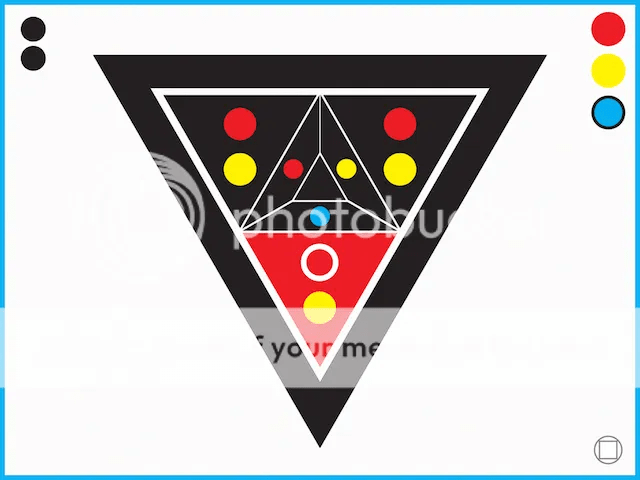
So when a puzzler takes you behind the curtain, it’s a rare and special treat. The website Gamasutra recently hosted such an event when app designer and puzzler Paul Hlebowitsh explained in detail how he designs the puzzles for his app RYB.

In Paul’s words, “RYB is very similar to ‘Minesweeper’ or ‘Hexcells,’ but instead of using numbers or symbols, it uses colors. The colored dots inside of a shape tell you how the neighboring shapes are colored.”

I love the devilish simplicity behind the solving. It’s so universal that it transcends the language barrier. Simply show another person the first step, and they’ll pick it up immediately.

Paul goes on to explain how one particular puzzle evolved as he sought the perfect mix of puzzly challenge and unique solvability.

He took this:

and eventually ended up with this:

It’s a fascinating read, one I can’t do justice to with a brief summary, so I suggest everyone check out the full post to watch an impressive constructor at work. Being walked step-by-step through a build by the designer is a delight.

I also have to praise the puzzles themselves. The mix of geometric shapes and colors creates a truly striking image. I think I’m gonna get a print made of this one and put it on my wall:


Thanks for visiting PuzzleNation Blog today! Be sure to sign up for our newsletter to stay up-to-date on everything PuzzleNation!

You can also share your pictures with us on Instagram, friend us on Facebook, check us out on TwitterPinterest, and Tumblr, and explore the always-expanding library of PuzzleNation apps and games on our website!

5 Questions for Author Derek Taylor Kent (Plus a Puzzly Announcement!)

Welcome to 5 Questions, our recurring interview series where we reach out to puzzle constructors, game designers, writers, filmmakers, musicians, artists, and puzzle enthusiasts from all walks of life!

It’s all about exploring the vast and intriguing puzzle community by talking to those who make puzzles and those who enjoy them! (Click here to check out previous editions of 5 Questions!)

And I’m excited to continue this series with Kubrick’s Game author Derek Taylor Kent as our latest 5 Questions interviewee!

Derek is a screenwriter, musician, and author, and his works have spanned print, TV, virtual reality, and soon, film. Although he’s better known for his middle grade efforts like Simon and the Solar System and the Scary School series, he has recently ventured into books for adults with his cinematic puzzle-fueled thriller Kubrick’s Game (which I recently reviewed here).

He has an exciting announcement connected to Kubrick’s Game to share with you, but before we get to that, let’s spend a little time getting to know this ambitious and amiable author, shall we?

Derek was gracious enough to take some time out to talk to us, so without further ado, let’s get to the interview!


5 Questions for Derek Taylor Kent

1. Was Kubrick’s Game your first foray into combining puzzles and writing? If so, what inspired the union of the two? If not, which came first for you, puzzles or writing?

In terms of puzzles being the crux of a plot, yes. I had incorporated some riddles and simple puzzles into some of my children’s fiction before, but only as a small element.

My primary inspiration for combining the two came from reading Ernest Cline’s Ready Player One back in 2011. In that book, the characters have to solve three intricate puzzles based on ’80s pop culture. The author was obsessed with 80s movies, music, and video games, so I began ruminating about what my subject would be if I were to write such a story. The obvious choice was Stanley Kubrick. He had been my favorite director since I was in high school and I was obsessed with his movies and all of the mystery that surrounded them.

As I delved further into it, the choice became more and more clear. Kubrick himself was an avid gamesman who loved puzzles, symbolism, and subliminal messages. The more I studied, the more I realized that it was not only believable, but almost likely, that he might have created a complex puzzle connecting each of his films. From there, it was just a matter of playing it out using markers that were already present.

[Image courtesy of Cinema Research Institute.]

2. How did the puzzles in the book come together? What did Kubrick’s game look like in its earliest iteration?

I had specific ideas for several of the puzzles and a general idea for others that I wanted to incorporate. Early in the process, I recruited two of the premiere puzzle-creators alive — Bob Glouberman and Larry Toffler of Fantastic Race. They create city-wide scavenger hunts, escape rooms, and puzzles for TV and movies. Luckily, they happened to be just as obsessed with Kubrick as I was and were very excited to come on board to help me create them.

If I were to write a book based on diabolical puzzles, I knew the book could only be as good as the puzzles themselves. While I could have probably created okay puzzles myself, I knew that theirs would be incredible and indeed they blew my mind.

I also knew that I wanted the puzzles to be Kubrickian, or cinematic in nature. That is, the clues would incorporate imagery, music, editing, and symbols, as opposed to wordplay or mathematical riddles. Also, they could only be solved by those familiar with the filmmaking process and masterful in its techniques, such as editing, lighting, projection, and sound design.

The final puzzle, which I dare not give away here, was present from the very beginning and had me most excited to write the book. I knew it had to end in that very special place, and was a type of puzzle that had never been created before, but it also made total sense considering the themes and hidden meanings of Kubrick’s final films.

3. If you’d been presented with a mystery like the one in your book, would you have taken the UCLA approach, the USC approach, or the antagonist’s approach?

Since the UCLA teammates are our protagonists, they were enacting my personal approach…most likely. They were most concerned with playing the game how Kubrick would have wanted it to be played, as opposed to other groups who, shall we say, put ethics aside for the sake of victory.

4. What’s next for Derek Taylor Kent?

Depending on how well Kubrick’s Game is received, I have plans for a continuation of cinema-themed puzzle adventure novels. I am also still writing middle-grade fiction and picture books and hope to have more of those released in the near future. I also wrote a horror feature film that is currently in pre-production, which will hopefully be coming out winter of 2018.

If your readers are interested in checking out any of my other work, everything is at DerekTaylorKent.com. Oh, and if you go to the Fun and Games section of ScarySchool.com, there’s a memory game you can play, and beating it will earn you the weirdest trophy you’ve ever seen.

5. If you could give the readers, writers, film enthusiasts, and puzzle fans in the audience one piece of advice, what would it be?

Well, since that is a very wide range of people, I think I will share my favorite piece of advice I ever received, which happened to come from the great actor Robert Forster. He told my class: “99% of everything you ever hear in your life will be somebody trying to convince you of something that’s not true in order to get into your pockets.”

What I like best about it, besides the encouragement of skepticism, is that as a novelist, I love being able to make a living selling something that isn’t BS. I can honestly tell kids, parents, or now my grown-up readers, that for a very reasonable price, my books will give you many hours of entertainment, and perhaps some enlightenment.


And speaking of hours of entertainment, it’s time for Derek’s big announcement!

As a marvelous real-world tie-in to Kubrick’s Game, Derek has launched The Game, an interactive solving experience guaranteed to challenge solvers and delight puzzlers worldwide!

This is a game for all readers to play.
If you’re reading this, play has already begun.
Six different puzzles each month to the day
Need to be solved for the game to be won.

That’s just a snippet of the introduction to set the scene. You can click here for full details — the first clue was revealed yesterday! — and sign up for his newsletter (bottom of the page here) to keep up on all things Derek Taylor Kent and Kubrick’s Game! (And, of course, you need to read the book to give yourself a fighting chance at solving The Game and finding the treasure!)

I think it’s an awesome way to expand on the world of the novel and to give solvers a puzzly conundrum to look forward to cracking! Good luck, my fellow puzzlers and PuzzleNationers!

Thank you, Derek, for taking the time out for 5 Questions! I can’t wait to see how The Game unfolds!


Thanks for visiting PuzzleNation Blog today! Be sure to sign up for our newsletter to stay up-to-date on everything PuzzleNation!

You can also share your pictures with us on Instagram, friend us on Facebook, check us out on TwitterPinterest, and Tumblr, and explore the always-expanding library of PuzzleNation apps and games on our website!

It’s Follow-Up Friday: Domino Wonder edition!

Welcome to Follow-Up Friday!

By this time, you know the drill. Follow-Up Friday is a chance for us to revisit the subjects of previous posts and bring the PuzzleNation audience up to speed on all things puzzly.

And today, I’d like to return to the subject of our recent 5 Questions interviewee, Lily Hevesh, aka Hevesh5.

You might have seen the above video from Hevesh5, the amazing triple spiral, which we shared on our Facebook and Twitter accounts.

It’s honestly one of the coolest, most staggering domino creations I’ve ever seen, a 15,000-domino work of kinetic art that took Lily 25 hours to assemble, and I couldn’t resist sharing it with my fellow puzzlers and PuzzleNationers.

Apparently, I wasn’t alone in that. The spiral got FOUR MILLION views in two days. It got major attention on Reddit, the YouTube front page, CNN, CBS News, and more!

It has amassed over TEN MILLION views in less than a fortnight.

And, as you might expect, Lily was not only humble, but grateful for the support of puzzlers and domino fans like.

Check out this video discussing the video’s success, as well as Lily’s plans for the future:

So great to see such positive attention for her and her work. It couldn’t have happened to a nicer person.


Thanks for visiting PuzzleNation Blog today! Be sure to sign up for our newsletter to stay up-to-date on everything PuzzleNation!

You can also share your pictures with us on Instagram, friend us on Facebook, check us out on TwitterPinterest, and Tumblr, and explore the always-expanding library of PuzzleNation apps and games on our website!

1 word, 3 letters, a world of possibilities

As I was writing Tuesday’s post and returning to the world of crossword-inspired art, it made me wonder what other puzzly works are out there, waiting to be discovered, appreciated, and perhaps mistakenly filled in.

So I did a little digging, a little Googling, and a little research, and I thought I’d introduce you, my fellow puzzlers and PuzzleNationers, to some of the crossword-infused works of art I discovered.

So, without further ado or hullabaloo, let’s get to it!


This work from 2005, entitled “I Can’t Read,” is a collage of crossword and newsprint, and although I discovered it on Crossword City, it was originally posted on the DeviantArt account of content creator PrairiePunk.

This Untitled piece by artist Juliet A is just one of several crossword-inspired pieces I found on the website Milliande.com. They featured themed weeks for posts, and “crossword puzzles” apparently provided plenty of inspiration for several impressive, engaging creations.

This wonderful bit of crossword-fueled street art, discovered in Ghent, Belgium, was posted on Pinterest.

Inspired by the Mendel Art Gallery in Saskatoon, as well as the Saskatoon art scene itself, this work by Megan Mormon was developed for partygoers to play with and solve (with post-its provided). The clues and entries are all geared toward local art.

My personal favorite was this piece by Tony Blue, entitled Crosswords 2, a work of mixed media on canvas.

Puzzles meet performance in this sketch by Emily Jo Cureton, based on key words from the May 16, 2008, New York Times crossword.

Crosswords have even found their way into the world of nail art, as typified by this design by Hannah Rox Nails, created for Girls’ Life. [Note: the link leads to a YouTube page.]

I’ll close out today’s gallery with this intriguing piece of interactive crossword puzzle art, created by Gary Hill. The ever-shifting view of the grid only allows you to examine small portions at once, leaving you curiously adrift as you solve along with the artist.


This is only the tip of the iceberg when it comes to crossword-inspired art. A quick Google search or targeted Pinterest hunt will reveal many more.

For a few more pieces of crossword art, complete with commentary from the artists themselves, check out this article from CrosswordUnclued.com.


Thanks for visiting PuzzleNation Blog today! Be sure to sign up for our newsletter to stay up-to-date on everything PuzzleNation!

You can also share your pictures with us on Instagram, friend us on Facebook, check us out on TwitterPinterest, and Tumblr, and explore the always-expanding library of PuzzleNation apps and games on our website!
Making a Profit Through Puzzly Vandalism!

[Image courtesy of Thoibao.today.]

Hey there, fellow puzzlers and PuzzleNationers. Do you remember that post I did a month or two ago about the woman who defaced a piece of crossword-inspired art?

If you don’t recall, a 91-year-old woman was visiting the Neues Museum in Nuremberg with a senior citizens group when she found the piece, “Reading-work-piece” by artist Arthur Koepcke, and began filling in the empty grid, mistakenly thinking it was an interactive art work.

The museum was none too pleased with her efforts, and restored the piece to its original condition.

But as it turns out, that’s not the end of the story.

You see, the woman claims — in a seven-page rebuttal to the German police’s investigation of her vandalism — that she has not harmed the work, instead arguing that she has brought the work greater public attention thanks to her efforts, reinvigorating interest in the piece and increasing its value.

[Image courtesy of Bill Watterson.]

Amazingly, that is not all. According to Ars Technica UK:

Frau K.’s lawyer claimed that her additions meant that she now held the copyright of the combined artwork — and that, in theory, the private collector might sue the museum for destroying that new collaboration by restoring it to its original state.

Yes, they assert that the private collector who loaned the Koepcke work to the Neues Museum might not only approve of her defacement of the piece, but be angry with the museum for their efforts to ensure that the piece was returned to him in the same condition.

Well, that’s certainly doubling down on your hand. It takes a certain confidence and bombast to make a claim like that, but the woman believes she’s in the right artistically.

The argument is based around the spirit of Koepcke’s work, which was part of the Fluxus movement. They go on to explain that “Fluxus artists did not agree with the authority of museums to determine the value of art, nor did they believe that one must be educated to view and understand a piece of art.”

It will certainly be interesting to see where the case goes from here. Naturally, I can’t help but wonder. Heck, if Da Vinci had been a Fluxus devotee. I could’ve drawn a mustache on the Mona Lisa and made millions.


Thanks for visiting PuzzleNation Blog today! Be sure to sign up for our newsletter to stay up-to-date on everything PuzzleNation!

You can also share your pictures with us on Instagram, friend us on Facebook, check us out on TwitterPinterest, and Tumblr, and explore the always-expanding library of PuzzleNation apps and games on our website!