Think outside the house…

[A friendly reminder that not everything is available online.
Stickers (and the story of their creation) can be found here.]

Summer’s almost here, and although we all love puzzles (and we’ve been talking about apps a lot lately), I think it’s safe to admit that puzzles have always been something of an indoor activity. So what’s a parent to do when puzzle-loving kids don’t want to go outside?

Why, take the puzzles outside, of course!

Do your kids enjoy shapes? Why not create some large-scale tangram puzzles for them? All you’d need is a sheet or two of posterboard and a pair of scissors. There are numerous designs online that you could recreate (minus the lines that show how the pieces make each shape) and challenge your young solvers to mimic with their pieces!

You could even cut the posterboard into Tetris pieces and play a game of Tetris where each kid takes a turn placing a piece, trying to leave as few open spaces between pieces as possible. (Though you’d have to be a real magician to make complete lines disappear like in the game!)

Do your kids like trivia? Why not grab a few frisbees, a hula hoop or two, and create a mini-game show!

[Frisbee golf provides the perfect model for an easily improvised puzzle game.]

Different hula hoops could be different categories or difficulty levels (either prop them up or let them sit on the ground), and the kids could show off their athleticism AND their trivia knowledge in one fell swoop! (Replace the frisbees with beanbags or softballs or whatever you like. This is a game meant to be cobbled together from whatever’s on hand.)

And of course, there’s always the ultimate fusion of outdoor adventure and puzzly skills:

Scavenger hunts are great, because you can tailor them to your audience. Do your kids love puzzles? Make the clues as puzzly as possible, incorporating riddles and anagrams and wordplay galore. Do your kids like searching more than puzzling? Be creative in crafting the list of items to find.

Since the dawn of the modern era of mobile phone technology, a new variation on the scavenger hunt has emerged: the photo scavenger hunt. Instead of finding numerous items and bringing them back to a predetermined spot, you take pictures of various items (or provide photographic proof that you’ve completed certain activities or accomplished certain tasks) and bring your phone back as evidence.

Some companies, like our friends at The Great Urban Race, offer city-specific scavenger hunts for adults, replete with puzzles, physical challenges, and all kinds of outdoor fun. Their website is a treasure trove of ideas for your own adventures.

Actually, you know what? That sounds great. Forget the kids, I’m gonna go recruit some people and go scavenging!

Thanks for visiting PuzzleNation Blog today! You can share your pictures with us on Instagram, friend us on Facebook, check us out on TwitterPinterest, and Tumblr, and be sure to check out the growing library of PuzzleNation apps and games!

5 Questions with Rena Nathanson of Bananagrams

Welcome to another edition of PuzzleNation Blog’s interview feature, 5 Questions!

We’re reaching out to puzzle constructors, video game writers and designers, board game creators, writers, filmmakers, musicians, and puzzle enthusiasts from all walks of life, talking to people who make puzzles and people who enjoy them in the hopes of exploring the puzzle community as a whole.

And I’m overjoyed to have Rena Nathanson as our latest 5 Questions interviewee!

Rena Nathanson is the CEO (aka the Top Banana) of Bananagrams, a puzzle company built around family-friendly dice and tile games with anagram, pattern matching, and word building elements.

Bananagrams and its fellow puzzle games have won numerous awards and accolades from family groups, and the brand is in good hands with Rena at the helm, continuing to add new products to the Bananagrams puzzle family in the spirit and tradition of Bananagrams patriarch Abe Nathanson.

Rena was gracious enough to take some time out to talk to us, so without further ado, let’s get to the interview!

5 Questions for Rena Nathanson

1.) Bananagrams is a game designed by a family for families. Can you tell us a little bit about how Bananagrams came to be, and how the family dynamic contributes to the company as it stands today?

First and foremost, Bananagrams is a labor of love. As a family we loved playing games, especially word games, but we wanted something fast-paced that the whole family of varying ages could play together. At first we intended to create something just for us, but we showed it to a few friends and family, and everyone said, “You must share this with the world!”

My Dad (who was 75 at the time), myself, and my two kids, Aaron (then age 7) and Ava (then age 11) created the game. My mother, who was in theater and set design, created the pouch… we literally sewed the first few by hand.  My Dad came up with the name, exclaiming: “This anagram game is driving me bananas!,” hence “Bananagrams.”  We created Bananagrams as a family, for families (and friends!) to play together.

[The distinctive Bananagrams pouch, beside a game in progress]

2.) In addition to several English versions, you also have Bananagrams sets designed for other languages. How do you choose which languages get their own edition of Bananagrams, and are there any new editions forthcoming?

Bananagrams is currently available in French, Spanish, Italian, German, Norwegian and Hebrew. Swedish and Icelandic are in production. Our criteria for producing a foreign language edition is: do people want it!? If there is sufficient demand, we are happy to produce it.

3.) You’ve got several variations on the letter-tile puzzle, including Appletters, PairsinPears, and Zip-It. Were these all created in-house, or were they pitched to you? How do you know when a game is right for the Bananagrams family?

We created all our games in-house. We developed Appletters and PairsinPears in response to fans looking for a Bananagrams-like game for a younger audience. As for Zip-It, our fans requested something that would capture the magic of Bananagrams, but that could be played in a more compact space.

All our games “travel well,” but Zip-It is the ultimate travel game. It takes up a lot less real estate than Bananagrams, so you can play it on a plane or airplane tray, and the scoring mechanism is on the pouch itself via zippers and numbers.

[A look at the extended Bananagrams puzzle family.]

4.) What’s next for Rena Nathanson and Bananagrams?

My goal is that every school and every household on earth has a set of Bananagrams. Global Domination! Nothing too lofty or anything!  Ha!

But seriously… my father had many aspirations for Bananagrams, and there are many things I would like to see to fruition in honor of him. There is still a long way to go in building and strengthening his legacy.

5.) If you could give the readers, writers, aspiring game designers, and puzzle fans in the audience one piece of advice, what would it be?

If you have an idea, be passionate about it, don’t take no for an answer and be prepared for some very hard work! Also, know when to ask for help. None of us knows everything, and I wouldn’t be where I am today without all the support and help and advice from various people in all aspects of the industry, which I continue to receive gratefully to this day!

Many thanks to Rena for her time, as well as Bananagrams PR wizards Lesley Singleton and Judee Cohen for their time and assistance. Be sure to keep up on all things Bananagrams by checking out their website and following them on Twitter (@Bananagrams). I can’t wait to see what they come up with next!

Thanks for visiting the PuzzleNation blog today! You can like us on Facebookfollow us on Twitter, cruise our boards on Pinterest, check out our Tumblr, download our puzzle apps and iBooks, play our games at PuzzleNation.com, or contact us here at the blog!

A day for puzzles and games galore!

Aloha, friends and fellow puzzle fiends! Just a quick reminder that tomorrow (March 30th) is International TableTop Day!

For the uninitiated, International TableTop Day is the brainchild of Internet superstars and gaming devotees Wil Wheaton and Felicia Day, a day devoted to board games, card games, dice games, roleplaying games (RPGs), and any other communal game-playing activity played on a table or any convenient flat surface.

(And with so many puzzle-based games out there, from Boggle and Scrabble to Jenga and Hex, I think it definitely merits mention here on the PuzzleNation blog.)

While the term “TableTop” was originally coined to differentiate one style of gaming or roleplaying from another. TableToppers were your Magic card-carrying, dice-rolling, character sheet-wielding gamers, as opposed to those who played video games or engaged in Live-Acting Roleplaying (LARPing).

Obviously, the definition has since expanded to include many other types of games, so long as you play with others around a table.

As not only a self-confessed puzzlin’ fool, but a devoted player of Dungeons & Dragons and other RPGs, I’m happy to tell you that some of my all-time favorite puzzles have come from my experiences as a roleplayer.

I remember being trapped in a dungeon in my friend’s game, and there was this elaborate machine that would open the door with flowing water if you could direct the water properly. You did so by way of numerous levers located in various rooms around the dungeon. And as a bare-bones adventuring party, we didn’t have anything with which to draw a map of the labyrinthine corridors, so I basically had to memorize the route in my head, figure out what each of the levers did, then run around the dungeon pulling them in the precise order necessary to unlock the door.

It was mindbending and frustrating and a terrific time. That’s the kind of puzzle-gaming experience I’d love to share with others.

Since Easter is this Sunday and I’ll already be spending time with my nephews this weekend, I’m hoping to introduce them to some of my favorite board games and puzzle games. I’ll definitely be bringing my two-player version of Brick by Brick with me.

A variation on the classic Tangram-style of piece-moving puzzle solving, Brick By Brick puzzles offer a shadowed shape you need to form with irregularly shaped bricks. You can play by yourself or go head-to-head with an opponent, or even team up and use both sets of bricks to solve even tougher shadow puzzles. It’s great fun and a terrific brain-teaser.

I’m hoping it’ll be the gateway drug to other puzzle games as they get older, since they’re a little too young for some of my favorites. (Like U.S. Patent Number 1, the game where you’ve built a time machine, and so have your opponents, and you race to soup them up and travel back in time to register for the very first patent. It’s a blast.)

Oh, and Older Sister? Beware, I’m also bringing Upwords, a marvelous variation on Scrabble where you can place letters on top of other letters in order to form new words. You’re going down, sis!

Of course, in the midst of all this TableToppy goodness, I’ll be bending the rules a bit, since I also plan on sharing the spirit of International TableTop Day by playing some two-player PuzzleNation games with friends abroad. Hey, it’s much harder to gather around the table with an ocean between you.

In any case, I hope you indulge your puzzle fancy tomorrow with some communal puzzle-game goodness. Have a fantastic holiday!

When pigs fly? You’ve got yourself a deal!

I’m a sucker for a good mechanical puzzle. Figuring out which piece goes where to complete a given item or accomplish a certain task is a staple of many roleplaying games and video games, and coincidentally, that’s one of my favorite aspects of each.

Rube Goldberg machines, perhaps the pinnacle of mechanical puzzle tinkering, never cease to entertain or amaze me, as you can tell by some of the videos Eric and I have posted in this blog over the last few months.

(They also make for excellent set pieces in movies, The Goonies and National Treasure providing two entertaining examples.)

Like many of those who enjoy mechanical puzzles, I can trace my interest back to the board game Mouse Trap, which featured an elaborate multi-stage trap to snare your fellow mice. I don’t recall ever actually playing the game as instructed. Instead, friends and I would freely add pieces, complications, rules, and new wrinkles to the mouse trap itself before setting off the trap with glee.

I have plenty of fond memories solving (and designing) mechanical puzzles of all sorts. Unfortunately, I’ve been having a difficult time sparking the same interest in my nieces and nephews.

Sure, I’ve gotten them all hooked on LEGOs, which is a marvelous start for the tinkerer spirit, but more often than not, the kids would build the sets precisely as instructed, and then just leave them that way. No disassembly, no experimentation to build their own sets and ideas.

None of them have a bucket of random LEGO pieces made up from the fragments of a dozen or so disassembled sets, or know the joy of digging through the bucket laboriously in order to find the one perfect piece to finish a creation of their own design.

Thankfully, my cousin delivered the ideal solution as a gift for Nephew #3’s birthday, discovered by chance at Wal*Mart. The Smart Lab Weird & Wacky Contraption Kit.

This thing is great. The goal is to build a path from the top of a velcro-friendly wall to the bottom for a marble to traverse, traveling down slides and through obstacles of all sorts, in order to reach the landing pad at the bottom, which launches a spring-loaded celebratory pig into the air!

It’s similar to plenty of pipe-and-marble toys from years past, but with a lot more adaptability and flair, and it was an instant hit. Not only did every niece and nephew want a turn designing their own contraption, but they freely made suggestions (helpful and otherwise) for each other’s designs.

The best thing about it? When designs failed or the marble stalled, the kids didn’t get disheartened. It just encouraged them to try again and indulge their cleverness even further. It was a blast simply to watch.

And you better believe the adults got into it too, adding new wrinkles and complications to each contraption, and cheering just as loud when the pig was launched into the air after a successful run.

My cousin was roundly praised as king of the gift-givers that day, and I’ve been recommending the toy far and wide ever since. It’s a great mechanical puzzle and a fun time all at once. And it’s got a flying pig! What more could you want?

PuzzleNation Book Review: The Puzzling World of Winston Breen

Welcome to the second installment of PuzzleNation Book Reviews!

All of the books discussed and/or reviewed in PNBR articles are either directly or indirectly related to the world of puzzling, and hopefully you’ll find something to tickle your literary fancy in this entry or the entries to come.

Let’s get started!

Our book review post this time around features Eric Berlin’s novel The Puzzling World of Winston Breen.

That name might look familiar. Yes, Eric and I are both contributors to the PuzzleNation blog. You may think that biases my review in some way, but I assure you it doesn’t. Yes, we both work on the same blog, but Eric stole my lunch money once, and I think that evens things out nicely. Remember: coworker + stolen lunch money = objectivity.

Anyway.

Young Winston Breen is a puzzling fiend, and most everyone in his town knows his penchant for puzzles is unmatched. So when the box he buys his little sister for her birthday turns out to have a secret compartment with a puzzle inside, everyone assumes Winston is behind it. But he’s not, and worse yet, he can’t solve the puzzle at all.

Winston and his chums start investigating where the puzzle came from, but after a curious encounter with the town librarian and crossing paths with a few shady characters, he soon discovers his puzzle is part of a much larger mystery: an actual treasure hunt. Can Winston, his pals, and these strange treasure hunters unravel a 25-year-old puzzle? More importantly, who can Winston trust?

I’ve seen this book described elsewhere as The Da Vinci Code for younger readers, but honestly, I enjoyed this book a lot more than Dan Brown’s efforts. The Puzzling World of Winston Breen is not only a fun read and chock full of all sorts of puzzles — some central to the mystery, others as stand-alone little challenges — but it’s a delightful romp of a story.

The voices of the younger characters all ring true, avoiding the common YA pitfall of having preternaturally sharp protagonists and supporting characters. Winston is often flummoxed by the challenges and obstacles he encounters, but he never gives up, always looking for another solution or pathway to solving whatever problem he faces.

But I also appreciate the lingering sense of menace to the book’s central mystery. You never lose that feeling that there’s some potential danger involved. With break-ins, vague threats, and shady characters with their own agenda, that shadowy feeling doesn’t overwhelm the more carefree puzzle-solving fun of the book, but it does add some stakes to the treasure hunt itself, which I quite enjoyed.

A quick and immensely charming read — the first in a series — The Puzzling World of Winston Breen is perfect for younger readers and puzzlers alike. (Check out the website by clicking here!)

Well, I hope you enjoyed the latest installment of PuzzleNation Book Reviews, and I look forward to more book discussions in the future. In the meantime, keep calm, puzzle on, and I’ll catch you later.

Puzzling with the Kids: Fireboy and Watergirl

Kids just want to help. They want to help make dinner; they want to push the grocery cart all by themselves. And heaven knows they want to help solve that puzzle you’re working on. My daughter used to help me with the New York Times crossword by pointing to the few random words she was able to read and shrieking them with joy. Very helpful.

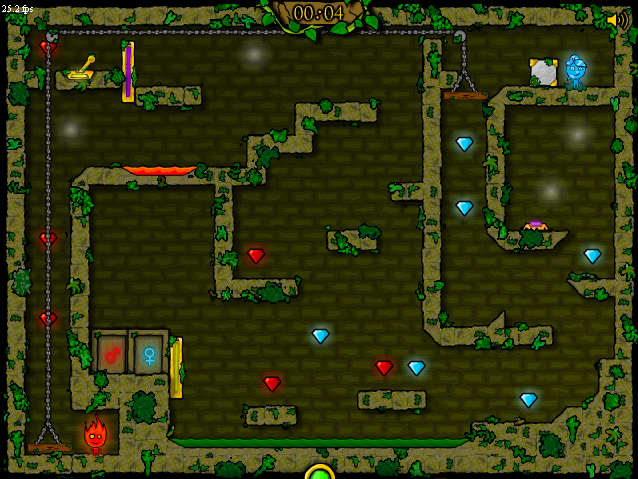
The Fireboy and Watergirl series of online video games really lets your kid help. Each level is a maze, which must be solved by two people working together. One player controls Fireboy, a smiling red flame, who will of course go up in smoke if he so much as touches water. The other player controls Watergirl, a sprightly blue splash, who naturally cannot enter the pools of lava that seem to be everywhere these days. Only through cooperation can the two friends make their way to the exit and the next, more challenging level.

The games — I believe there are four of them now — are perfectly accessible for even little kids: The only controls are right, left, and jump. (I started playing these games with my daughter when she was six.) But the puzzles themselves are no joke. After a few whet-your-appetite easyish mazes, things start getting challenging indeed. You’ll probably want to discuss strategy with your child — and you may be surprised how quickly your child sees the correct way forward. (“Okay, you stand on the blue button to lower the door and then I’ll go through and pull the lever so that the elevator descends, and you take the elevator to get the gem!”) Even so, certain levels will have to be attempted more than once — if either character touches something he or she should not, it’s curtains and back to the start.

We solve puzzles because it is satisfying to do so. Well, it is even more satisfying to solve a puzzle when your child is sitting on your lap, genuinely lending assistance every step of the way. Actually, wait — your child doesn’t merely “help” solve the Fireboy and Watergirl mazes. You and your child are, in fact, equals. You are helping each other.