
On December 28th, 1583, a merchant ship called the Ann Francis was sailing back from Spain after smuggling grain to the Iberian Peninsula (although the owners, “notorious smugglers” Francis Shaxton and his son of the same name, claimed it was returning from Hartlepool).
But the Ann Francis was caught up in a fierce storm. It was blown off course before coming to a terrible end on the Welsh coast near Port Talbot.
For many shipwrecks, this would be the end of the story. But for the Ann Francis, it was only the beginning of several strange twists and turns.
One parish record records the names of 14 sailors who perished in December 1583, which could be the crew of the Ann Francis, and the register states:
Perished upon the west coast coming from Spain: Richard Waller, Christopher Dodd, John Bunting, William Craven, George Page, Gregory Baxter, Christopher Baxter, Thomas Ayre, Henry Gouldsmith, Walter Marshall, Robert Archer, Oliver Cobb, William Barret and Richard Dye, whose deaths were brought to pass by the detestable working of an execrable witch of King’s Lynn whose name was Mother Gabley, by boiling or rather labouring of certain eggs in a pail full of cold water.
A merchant ship that was actually a smuggling ship, shipwrecked in a storm that was actually the work of a witch? Wow, and we haven’t even gotten to the lock mentioned in the title yet!
Some of the wreckage was plundered by locals and the wreck site fell into a legal battle between Sir Edward Mansell and the Earl of Pembroke, who both claimed the salvage rights in court. Agents of both Mansell and the Earl of Pembroke seized parts of the cargo and the ship itself.
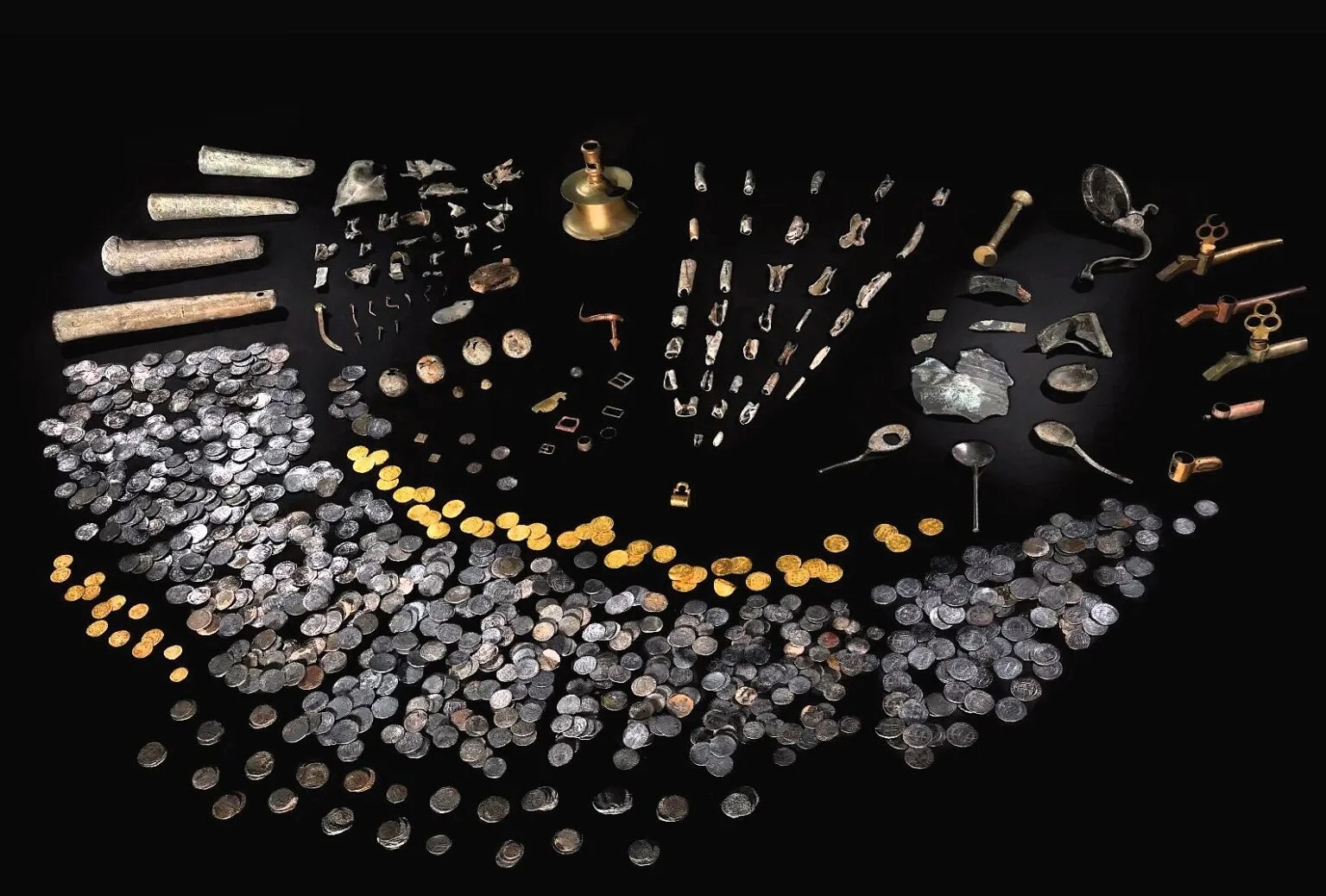
According to Mansell’s inventory, there were cannons, firearms, anchors, chests with broken locks, cloves, marmalade, and Spanish silver recovered from the wreck, among other items.
Although the Earl of Pembroke eventually won the case, Francis Shaxton did formally claim the wreck in March of 1584, and Mansell returned SOME of the impounded goods.
After that, the story goes quiet.
For centuries, the rest of the Ann Francis’s cargo rested beneath the sands of Margam Beach.
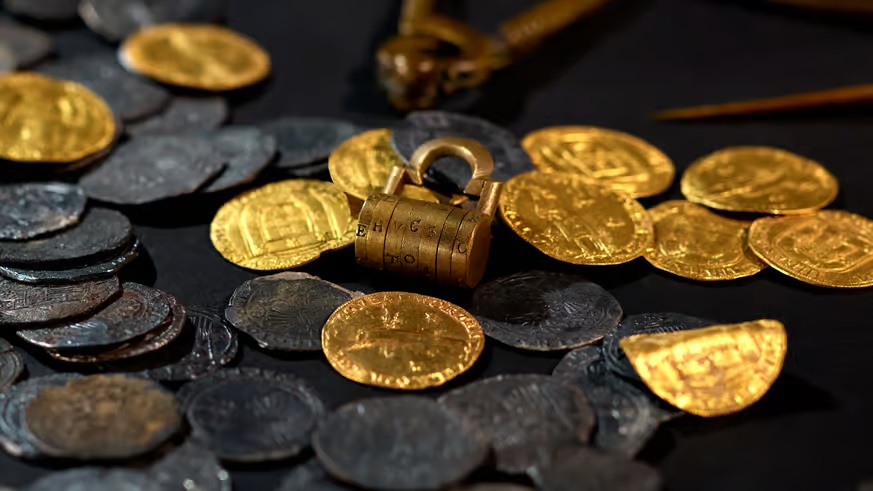
And that missing cargo was impressive: gold and silver coins in several currencies (German talers, Spanish and Mexican silver, and Portuguese gold), along with utensils, personal belongings, compasses, weapons, and small chests secured with padlocks.
Our story resumes in 1996, when Peter Hughes, a metal detector enthusiast, discovered some of the Ann Francis’s lost treasures. And over the next 21 years, Hughes would continue to uncover more of the remains of the lost ship’s precious cargo.
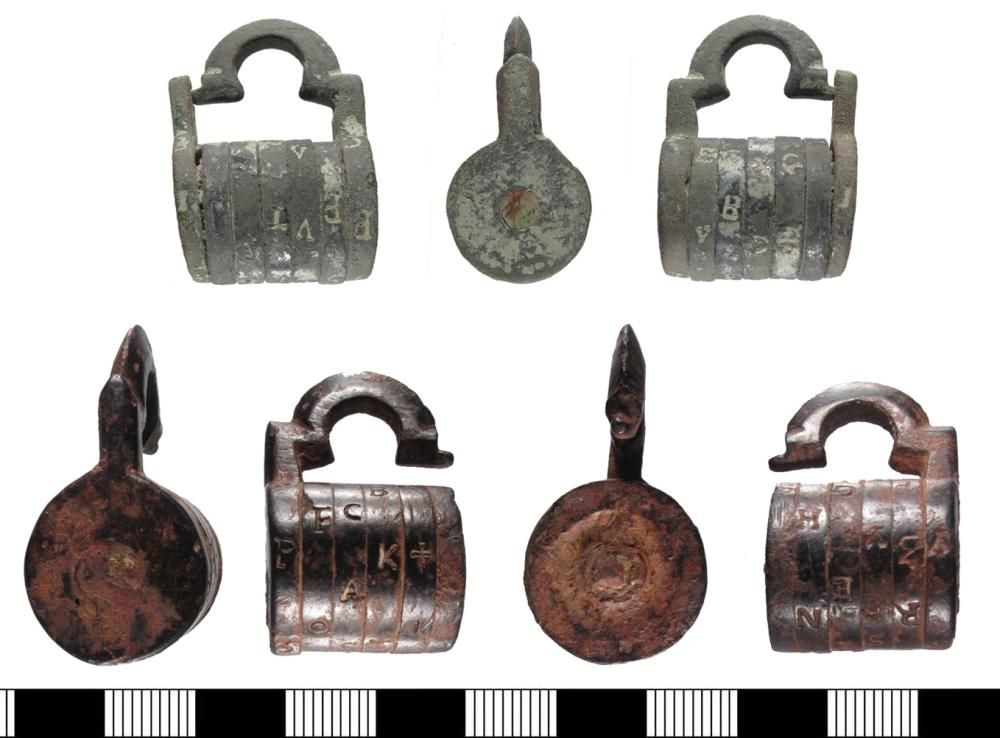
Among those many trinkets and valuables was a well-preserved padlock.
It was found near a collection of Spanish silver coins, so it most likely was affixed to a small chest of valuables that didn’t survive the shipwreck or the intervening centuries beneath the sand. And unlike the many pieces of other locks found in the ship’s wreckage, this padlock was completely intact.
Many items from the shipwreck were turned over to museum curators, and the lock immediately drew their attention.
The lock had four rotating dials on it, each with letters on them. Unfortunately, after a bit of testing, researchers from the Amgueddfa Cymru-Museum Wales believed there was sand or grit inside the lock, and continuing to manipulate it or trying to solve it could permanently damage the nearly four-hundred-and-fifty-year-old lock.
So they turned to modern technology.
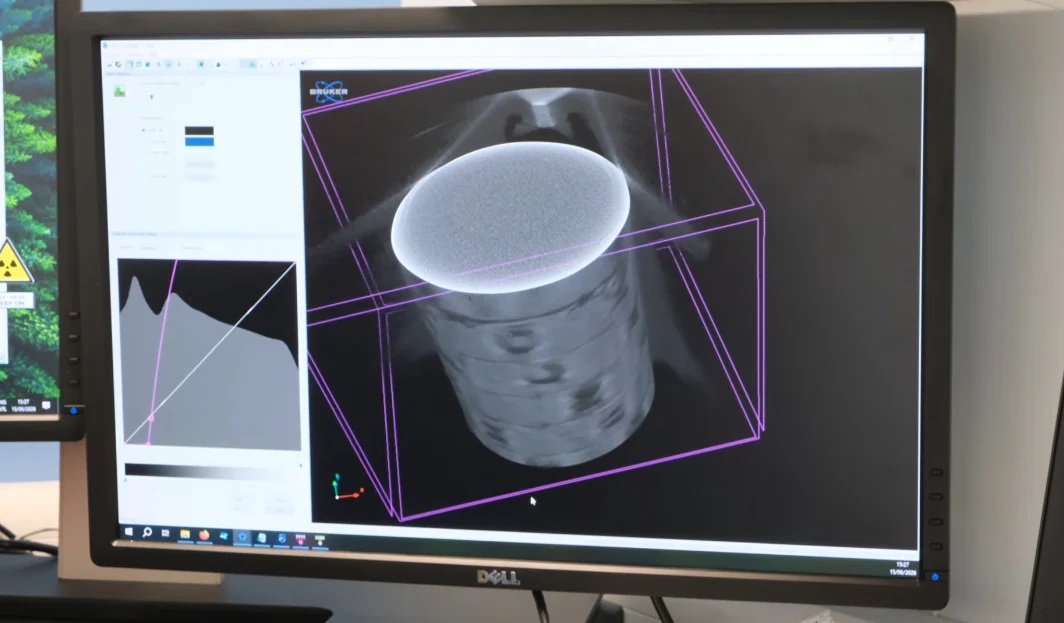
Using CT scans of the lock by David Williams of the Musculoskeletal Biomechanics Research Facility at Cardiff University, they were able to accurately 3D map the lock’s exterior and interior, determining the position of each of the four pins that would need to align to allow the lock to open.
Finally, they felt confident enough to try to turn the dials, causing the letters A, N, C, and E to read across the top of the lock. As soon as they did, the lock felt looser. The plan was working!
The passcode they’d assembled through CT scan imagery was correct, and they opened the lock for the first time in four centuries. This allowed them to remove the grit (protecting the lock) and take detailed photos and scans of the lock and its mechanisms to learn more about the creation process for the padlock.
They detail the entire endeavor in this video:
It’s such a cool use of modern technology to solve an old code, especially without damaging the artifact.
But the puzzler in me wants to know: what does it mean?
ANCE
There’s no Welsh word that matches it, so that’s out. One can’t help but notice the similarity between ANCE and “Ann Francis” (or even “Francis Shaxton” himself), and if that lock and chest were part of the Ann Francis’s standard equipment, that could make sense.
I’ve seen commenters online mention that combination locks from that time period often used short words, initials, or phonetic spellings for their code. They theorize it could be two sets of initials: A.N. and C.E.
But in the brief access to the Shaxton family tree I’ve found online, I didn’t see any initials like those. Nor did I find any initials matching those in The Greatest Smuggler in England, the biography of Francis Shaxton by Richard Lewis. It also doesn’t fit the initials of any of those possible crew members listed above.
And while I’m no expert in the combination locks of the era, I know a bit about modern combination locks, and I can’t help but consider the possibility that ANCE isn’t the solution.
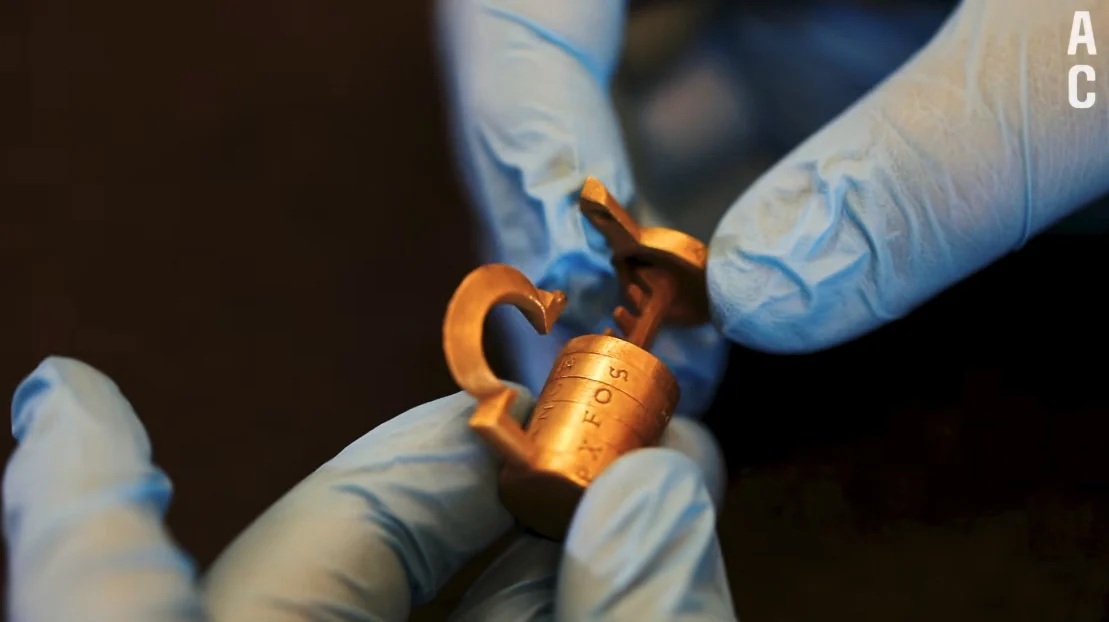
I mean, obviously that arrangement opened the lock. But I don’t think ANCE is the solution.
I don’t know how much lock design has changed over the centuries, but I have a collection of locks from hosting escape room events, and usually locks with dials like that don’t have the solution reading across the top where the locking bar is… because you can’t see it well.
The solution is usually what reads out 90 degrees from that locking bar. In front of the solver, with the locking bar on top.

It would also make sense for this to be the case with the Ann Francis lock, since there are letters on both sides of the lock, bookending the rotating dials. This means the answer wouldn’t be the four letters on the dial, but all six letters reading across the lock.
I can’t be sure without a better look at the lock or seeing how many letters are on the dials and on the ends of the lock, but it looks like the “solution” could be PXFOSR.
There’s no Welsh word that matches this, so it could be a collection of letter pairs or initials (as suggested above) or a purposely nonsensical set of letters, similar to modern password requirements. (Google kept telling me I had misspelled OXFORD. Thanks, Google.)
I’ve reached out to Amgueddfa Cymru-Museum Wales for more details, but haven’t heard back at the time of posting.
So that’s the story of the Ann Francis Lock.
It’s a tale that spans nearly 450 years. From the shipwreck to the CT scans that revealed the solution, this lock has been the linchpin of a story that covers smuggling, witchcraft, legal battles, fortuitous discoveries, careful research, technological innovation, and above all else, enormous patience.
The treasure was already found, and now the lock is open. It was a treasure hunt in reverse.
And yet, the mystery persists.
Like the answer to life, the universe, and everything in The Hitchhiker’s Guide to the Galaxy, the solution wasn’t the end of the journey.
Here’s hoping we find out more in the years to come.
What do you think of the saga of the Ann Francis lock, fellow puzzlers? Is ANCE the solution after all? Let us know in the comments section below. We’d love to hear from you!
Sources:
- Gizmodo: https://gizmodo.com/a-smugglers-padlock-stayed-locked-for-400-years-and-scientists-just-cracked-its-code-2000835694
- Cardiff University: https://www.cardiff.ac.uk/news/view/3118948-ct-scans-help-unlock-400-year-old-mystery
- Amgueddfa Cymru-Museum Wales Blog: https://museum.wales/blog/2912/Ann-Francis/
- The Greatest Smuggler in England by Richard Lewis

