
Home | In-house email game page | Archives
April 24, 2020 12:01 pm
The worlds of puzzles and mathematics overlap more than you might think. I’m not just talking about word problems or mathy brain teasers like the Birthday Puzzle or the jugs of water trap from Die Hard with a Vengeance.
For twenty-five years, Martin Gardner penned a column in Scientific American called Mathematical Games, adding a marvelous sense of puzzly spirit and whimsy to the field of mathematics, exploring everything from the works of M.C. Escher to visual puzzles like the mobius strip and tangrams. He was also a champion of recreational math, the concept that there are inherently fun and entertaining ways to do math, not just homework, analysis, and number crunching.
And on more than one occasion, Gardner turned to the genius and innovative thinking of John Horton Conway for inspiration.
[Image courtesy of Wikipedia.]
Conway was best known as a mathematician, but that one word fails to encapsulate either his creativity or the depth of his devotion to the field. Conway was a pioneer, contributing to some mathematical fields (geometry and number theory among them), vastly expanding what could be accomplished in other fields (particularly game theory), and even creating new fields (like cellular automata).
Professor of Mathematics, Emeritus, Simon Kochen said, “He was like a butterfly going from one thing to another, always with magical qualities to the results.” The Guardian described him in equally glowing terms as “a cross between Archimedes, Mick Jagger and Salvador Dalí.”
[Image courtesy of Cornell.edu.]
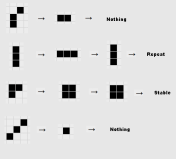
His most famous creation is The Game of Life, a model that not only visually details how algorithms work, but explores how cells and biological forms evolve and interact.
Essentially, imagine a sheet of graph paper. In The Game of Life, you choose a starting scenario, then watch the game proceed according to certain rules:
The process plays out from your starting point completely without your intervention, spiraling and expanding outward.
It’s the ultimate if-then sequence that can proceed unhindered for generations. It is a literal launchpad for various potential futures based on a single choice. It’s mind-bending and simple all at once. (And you can try it yourself here!)

[Image courtesy of Sign-Up.To.]
But that’s far from Conway’s only contribution to the world of puzzles.
Not only did he analyze and explore puzzles like the Soma cube and Peg Solitaire, but he created or had a hand in creating numerous other puzzles that expanded upon mathematical concepts.
I could delve into creations like Hackenbush, the Angel Problem, Phutball/Philosopher’s Football, Conway’s Soldiers, and more — and perhaps I will in the future — but I’d like to focus on one of his most charming contributions: Sprouts.
Sprouts is a pencil-and-paper strategy game where players try to keep the game going by drawing a line between two dots on the paper and adding a new dot somewhere along that line.
The rules are simple, but the gameplay can quickly become tricky:
Check out this sample game:

[Image courtesy of Fun Mines.]
It’s a perfect example of the playfulness Conway brought to the mathematical field and teaching. The game is strategic, easy to learn, difficult to master, and encourages repeated engagement.
In a piece about Conway, Princeton professor Manjul Bhargava said, “I learned very quickly that playing games and working on mathematics were closely intertwined activities for him, if not actually the same activity.”
He would carry all sorts of bits and bobs that would assist him in explaining different concepts. Dice, ropes, decks of cards, a Slinky… any number of random objects were mentioned as potential teaching tools.
Professor Joseph Kohn shared a story about Conway’s enthusiasm for teaching and impressive span of knowledge. Apparently, Conway was on his way to a large public lecture. En route, he asked his companions what topic he should cover. Imagine promising to do a lecture with no preparation at all, and deciding on the way what it would be about.
Naturally, after choosing a topic in the car, the lecture went off without a hitch. He improvised the entire thing.
Of course, you would expect nothing less from a man who could recite pi from memory to more than 1100 digits? Or who, at a moment’s notice, could calculate the day of the week for any given date (employing a technique he called his Doomsday algorithm).
Conway unfortunately passed away earlier this month, due to complications from COVID-19, at the age of 82.
His contributions to the worlds of mathematics and puzzles, not to mention his tireless support of recreational math, cannot be overstated. His work and his play will not soon be forgotten.
[Image courtesy of Macleans.]
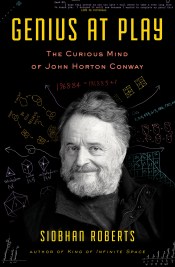
If you’d like to learn more about Conway, be sure to check out Genius at Play: The Curious Mind of John Horton Conway by Siobhan Roberts.
[My many thanks to friend of the blog Andrew Haynes for suggesting today’s subject and contributing notes and sources.]
Thanks for visiting PuzzleNation Blog today! Be sure to sign up for our newsletter to stay up-to-date on everything PuzzleNation!
You can also share your pictures with us on Instagram, friend us on Facebook, check us out on Twitter, Pinterest, and Tumblr, and explore the always-expanding library of PuzzleNation apps and games on our website!
Posted by gmdirect
Categories: Games, PuzzleNation, Puzzles
Tags: algebra, algorithm, angel problem, birthday puzzle, Brain teaser, cellular automata, conway, conway's game of life, conway's soldiers, cornell, coronavirus, covid-19, Die Hard With a Vengeance, doomsday algorithm, Escher, farewell, game of life, game theory, genius, genius at play, geometry, hackenbush, john conway, john horton conway, joseph kohn, M.C. Escher, manjul bhargava, Martin Gardner, math, math problem, math puzzle, Mathematical Games, mind tickler, number theory, philosopher's football, phutball, pi, princeton, professor, PuzzleNation, Puzzlin' fool, Scientific American, simon kochen, siobhan roberts, sprouts, the game of life, the guardian
Mobile Site | Full Site
Get a free blog at WordPress.com Theme: WordPress Mobile Edition by Alex King.
[…] week, we penned a post celebrating the life and puzzly legacy of mathematician John Horton Conway, and several of our fellow PuzzleNationers reached out with their own thoughts or questions about […]
By Two Brain Teasers, Courtesy of Conway | PuzzleNation.com Blog on May 1, 2020 at 12:01 pm