The UK Sudoku Championship! (Or should that be Sudo-UK?)

Hot on the heels of The Indie 500 crossword tournament last weekend, the UK is also gearing up for a major puzzle event: The UK Sudoku Championship!

The event spans June 10 through June 13, and chairman Alan O’Donnell of the UK Puzzle Association sent out the Instruction Booklet for this year’s event a few days ago, which kicks off a string of major puzzle events in Europe and across the world, including the UK Puzzle Championship in a few weeks.

Although the UK Sudoku Championship is only open to competitors from the UK — with the top two earning a place on the UK team for the 2016 World Sudoku Championship — international players are welcome to test their puzzly mettle as guest solvers.

But even if most PuzzleNationers aren’t eligible to compete, you can still enjoy the challenge of some topnotch Sudoku puzzles. Let’s take a look at some of the diabolical puzzles they’ve cooked up for this year’s event!

[An Extra Regions puzzle, a variation on Classic Sudoku.]

In addition to some Classic Sudoku, Extreme Sudoku, Sum-Doku (or Killer Sudoku), Jigsaw Sudoku (or Geometric Sudoku), and Thermo Sudoku — all of which I explored in detail in my Wide World of Sudoku post — there are some variants I’ve never seen before, like this Linked 6×6 Sudoku.

In this puzzle, you have two grids to complete, but with the additional wrinkle that no number placed in the left 6×6 grid will occupy the same square in the right 6×6 grid. So you have more solving information than expected, but it’s spread out across two grids.

This Deficit Sudoku puzzle also uses the 2×3 box format, but arrayed in a 7×7 grid. This means that any of the numbers 1 through 7 can be in each 2×3 grid, which makes it slightly harder than if you were only using the numbers 1 through 6.

(Plus you have no information on what number goes in that solo square in the center of the grid.)
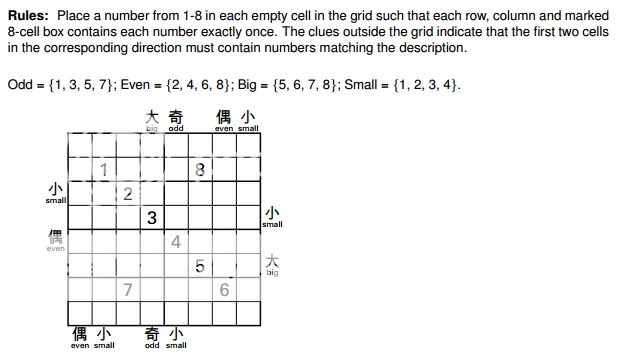
The curiously named Odd-Even-Big-Small Sudoku employs clues outside the grid to help you fill in some of the squares along the perimeter of the grid, telling you that two odd numbers, two even numbers, two small numbers, or two big numbers will occupy the nearest two spaces in that row or column.

This is a solving mechanic I’ve never encountered before in Sudoku, and I can see it posing an impressive challenge to the average Sudoku solver.

That unconventional style of cluing sets the tone for the rest of the unusual puzzles that competitors and solvers will encounter here. In the above grid, a Consecutive Pairs puzzle, those dots indicate that the neighboring numbers connected by those dots are consecutive numbers, like 5 and 6 or 2 and 1.

(You can also try Consecutive Pairs Sudoku in Will Shortz’s Sudoku and Sudoku Spectacular, both published by our friends at Penny Dell Puzzles.)
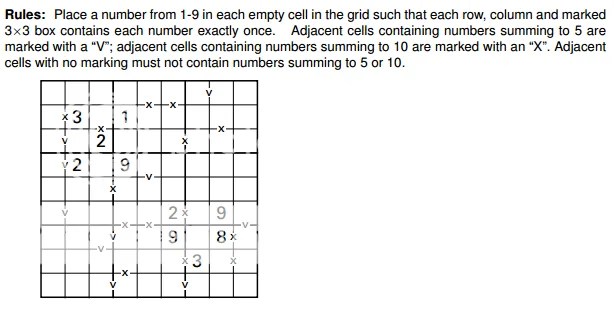
XV Sudoku works in similar fashion, with x’s and v’s instead of those little dots. The x’s mean the neighboring numbers add up to 10, and the v’s mean the neighboring numbers add up to 5.

This Eliminate Sudoku uses arrows to indicate that the number in the arrow box will not be repeated in any of the boxes that follow that arrow. So, for instance, if you place a 3 in that arrow box next to the 2 in the upper-right 3×3 grid, none of the boxes that arrow points at along that diagonal will contain a 3.

Like the dual grids in the Linked 6×6 Sudoku, this puzzle is interesting in offering more information on what’s NOT in a square than what IS.

The final new puzzle in the Instruction Booklet is my favorite, but that’s because I’m a sucker for palindromes in puzzles. This Palindrome Sudoku features gray lines that indicates spots where — you guessed it! — the chain of numbers reads the same backwards and forwards.

Similar to Thermo Sudoku in its solving style, Palindrome Sudoku takes advantage in the restrictive nature of Sudoku solving by adding a neat little twist.

You can check out the full Instruction Booklet here, and remember to keep your eyes peeled on June 10 when the actual puzzles go live!


Thanks for visiting PuzzleNation Blog today! Be sure to sign up for our newsletter to stay up-to-date on everything PuzzleNation!

You can also share your pictures with us on Instagram, friend us on Facebook, check us out on TwitterPinterest, and Tumblr, and explore the always-expanding library of PuzzleNation apps and games on our website!

Stopping at the McDonald’s on Memory Lane

I mentioned last month that I’ve been doing a bit of late-Spring cleaning, and the process continues. This weekend, I was poring through some McDonald’s toys my mother had saved over the years (and when you’re one of six kids, those toys add up quickly).

(One section of the counter absolutely covered with toys.)

And as I was organizing and sorting an egg box full of these silly little gems, I couldn’t help but find the puzzliest among them to share with my fellow puzzlers and PuzzleNationers.

It seems appropriate to start with toys that resemble the brand’s signature food items.

When it comes to puzzle toys, you really can’t go wrong with something that transforms. Figuring out the proper steps to reveal the hidden character or form inside can be simple or complex, depending on the toy. Obviously McDonald’s kept it simple with these Happy Meal handouts, but it didn’t make them any less weird or delightful.

These faux foods are from two different series of McDonald’s toys — the fries and hot cakes & sausage from 1986/1987, the burger and hotcakes from 1990 — and each transforms to reveal something unexpected.

As you can see, the late ’80s toys become robots (keeping in line with the whole Transformers mentality) while the 1990 toys become curious food/dinosaur hybrids.

1992 brought us these stackable circus characters, testing the balance and dexterity of younger minds to see what diabolical human towers they can cook up. In my house, this quickly became a Jenga-like game of each person selecting a piece and taking turns to stack them, often with disastrous results.

(My tower…just before it collapsed.)

But by far the puzzliest of the toys I uncovered was also one I’d completely forgotten about.

Back in 1991, McDonald’s partnered up with NASA to spark interest in space exploration with a run of Happy Meal toys all about astronauts, space technology, and more.

One of the best and most challenging sets was this small space module, complete with two astronauts, logos, and flames.

If memory serves, there were also a lunar rover and a satellite, all built with these wonderful double-sided cardboard pieces.

It was a blast to rediscover these puzzle-fueled delights amidst a plethora of TV and movie tie-in toys, animated characters, and other nuggets of fast-food childhood fun.

Did this post remind you of any puzzly toys you found in cereal boxes, fast food orders, or the like? Let me know in the comments section below!


Thanks for visiting PuzzleNation Blog today! Be sure to sign up for our newsletter to stay up-to-date on everything PuzzleNation!

You can also share your pictures with us on Instagram, friend us on Facebook, check us out on TwitterPinterest, and Tumblr, and explore the always-expanding library of PuzzleNation apps and games on our website!

It’s Follow-Up Friday: Indie 500 edition!

Welcome to Follow-Up Friday!

By this time, you know the drill. Follow-Up Friday is a chance for us to revisit the subjects of previous posts and bring the PuzzleNation audience up to speed on all things puzzly.

And today, I’d like to return to the subject of the Indie 500 crossword tournament!

Why, you ask? Because it’s tomorrow, June 4, and you still have time to register! Click here for all the details. You can compete in person in Washington, D.C., for just $30, or you can participate from home for only $10!

Not only that, but once again they’ve whipped up a meta-suite of puzzles to boot, and you name your own price for it!

This is the second year of the tournament, and I expect great things from the immensely talented team of constructors and directors they’ve assembled. With a prom theme, topnotch constructors, and pie (there’s always pie), you can’t go wrong!

Click here for the Indie 500 home page, here for an interview regarding this year’s event with constructor Andy Kravis, and here for a rundown of last year’s terrific puzzles!

Will you be competing? Or participating from home? Let us know in the comments below!


Thanks for visiting PuzzleNation Blog today! Be sure to sign up for our newsletter to stay up-to-date on everything PuzzleNation!

You can also share your pictures with us on Instagram, friend us on Facebook, check us out on TwitterPinterest, and Tumblr, and explore the always-expanding library of PuzzleNation apps and games on our website!

PuzzleNation Product Review: Slideways

One of the most popular forms of puzzle gaming involves placing four game pieces in a row on a board. Four-in-a-row games like Connect Four are rooted in the tactical simplicity of Tic-Tac-Toe or three-in-a-row solving, but take it a step further.

We’ve explored several four-in-a-row puzzle games before. ThinkFun’s All Queens Chess added a wrinkle by employing the rules of chess in four-in-a-row solving. Quarto used pieces of varying heights, colors, and shapes to create a more complex game play experience.

And now, Tricia McLaughlin and R&R Games bring us another evolutionary step in four-in-a-row puzzle gaming: Slideways.

At first glance, Slideways offers a simple 4×4 play area, where the blue squares can be rotated to reveal a gold or red square claimed by the player in a given turn. Each play claims one square per turn.

In this picture, two squares each have been claimed by the players. But Slideways allows the player to manipulate the play area itself by sliding a row one square in either direction, adding another dimension to the game.

So now players can claim blue squares or shift the rows to give themselves the best opportunity to not only get four in a row, but to thwart an opponent’s efforts to do the same. (Be careful, though, as the sliding feature can be a little clunky.)

But that’s not all. Slideways has one more trick up its sleeve.

Players also have the option of changing claimed squares to their own color! In this case, one player rotated a gold-claimed square into a red-claimed square.

And honestly, this is the feature that really separates Slideways from other four-in-a-row games, because it requires the player to constantly assess and reassess the game every single turn. You can’t take it for granted that a claimed square will stay claimed, or that the three squares you already have lined up will stay lined up.

There is one exception to this rule: you cannot reverse a square a player has just claimed. You have to wait a round before doing so.

So the red square claimed in the top row this turn cannot be immediately turned into a gold one. The other player has to wait until the next round, so instead, the other player changes one of the red squares in the third row into a gold one.

All of these possible moves — claiming a square, shifting a row, or taking an opponent’s square — make Slideways the most complex and controllable four-in-a-row puzzle game I’ve ever seen, and it can make for a fun and nerve-wracking playing experience, especially against a skilled opponent.

Plus games move so quickly (usually lasting less than 10 minutes) that you’re sure to play multiple rounds without giving up a huge chunk of your day. My opponent and I played 11 or 12 games in about half an hour, and each one felt new and different because of the many play options available to us.

(Plus there’s a three-player variation that starts with some squares flipped to red, others flipped to gold, and the third player uses blue as their color.)

Simple to learn, but tough to master, Slideways is a marvelous addition to the four-in-a-row puzzle game field, one that ensures you’ll take no move and no turn for granted. Portable and self-contained, this one is a treat.

[I discovered Slideways at the Connecticut Festival of Indie Games. You can pick it up on the R&R Games website for $11.99.]


Thanks for visiting PuzzleNation Blog today! Be sure to sign up for our newsletter to stay up-to-date on everything PuzzleNation!

You can also share your pictures with us on Instagram, friend us on Facebook, check us out on TwitterPinterest, and Tumblr, and explore the always-expanding library of PuzzleNation apps and games on our website!