How about Pong? While waiting to cross a street in Germany?
Someone has to import this to America ASAP.

How about Pong? While waiting to cross a street in Germany?
Someone has to import this to America ASAP.

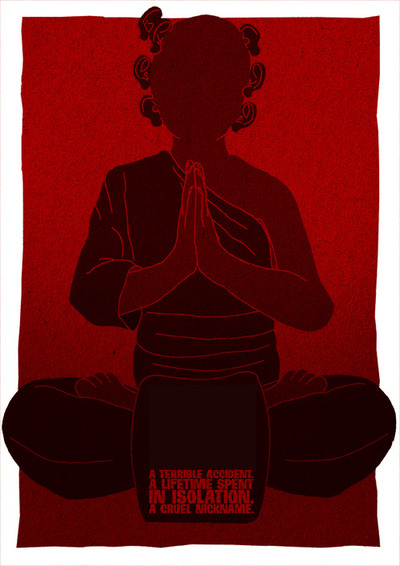
Some clever but anonymous soul has been deleting letters from various movie titles, and creating a poster for each new name. Before you click through to see all of them, can you figure out the title we’ve removed from the poster below?
 Hat tip: Neatorama.
Aloha, fellow puzzlers and solvers galore!
Last week, I mentioned that I’d be attending a Nerd Potluck this coming weekend. It’s a celebration of all things puzzle, game, and nerd-centric, and I’ve been working on a new word puzzle to challenge my fellow attendees.
And as promised, you’re getting the first peek at it. I call the puzzle “Word Personals.”
Word Personals is based on the singular parlance of personal ads and dating slang.
Your standard personal ad looks something like this:
SWM, 31, brown hair, brown eyes, calf muscles of a Roman gladiator, enjoys full contact rock-paper-scissors and the films of Ben Stiller…
The breakdown is pretty simple.
–SWM is short for single white male in standard personal ad jargon. SWF would be single white female. (SBF would be single black female, MWM would be married white male, etc.)
–That’s followed by the person’s age and a brief description.
So my idea was to employ this format, but make the ads themselves word puzzles to be decoded by a solver.
Here’s an example:
SWF, 6, one letter once, one letter twice, and one letter three times, enjoys hanging out and giving people the slip.
Again, the breakdown is pretty simple.
–SW stands for “single word.” (If it was “MW,” it would be “multiple words,” indicating a phrase.)
–The next letter, F, stands for “features,” indicating that characteristics of the word will follow. (If it was “M,” it would be “means,” indicating a definition, synonym, or hint toward the definition would follow.)
–The number that follows is the number of letters in the word or phrase.
–Finally, there’s the description, which is in two parts. The first part, as indicated by “F,” gives some characteristics of the word. The second part is a jokey clue to provide further information.
And there you have it, Word Personals. I’m sure you’ve solved the example one already, so how about we check out a few more?
1) SWM, 8, power or vigor, enjoys vowel conservation and Herculean qualities.
2) MWF, 11, can read backwards and forwards, enjoys formal greetings and the days before holidays.
3) SWF, 4, goes from one syllable to three by adding a letter, enjoys taking car trips in the past tense.
4) MWM, 9, stutter-stop way of talking, enjoys frequent breaks and a certain British inspector.
I admit, It’s a bit esoteric, but I like the concept quite a bit, and I think it’ll be a hit.
Naturally, your thoughts are welcome. What’s confusing? What works? Is it too prone to alternates? Too easy? Too difficult? Your input would be very much appreciated.
In the meantime, I hope Word Personals provided you with a bit of brain-teasing today. So keep calm, puzzle on, and I’ll catch you next time. Wish me luck!

Here’s a clever idea: A calendar you have to solve each and every day. The puzzle consists of ten tiles, which can be flipped, rotated, and overlapped to reveal the current date. Granted, you have to know the correct date in order to solve the puzzle, which somewhat goes against the very idea of a calendar, but hey: It’s a fun puzzle you can solve again and again, and that’s better than a normal calendar any day, right?
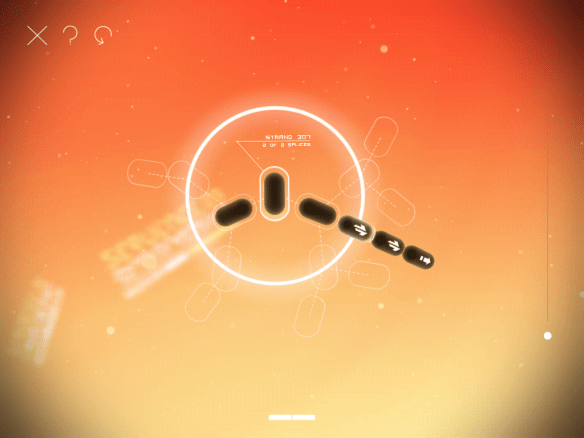 Splice is an elegant, minimalist new puzzle game, created by Cipher Prime and available for the iPad and on Steam. Each level presents you with a small number of genes, which you must organize into a precise shape. (Actually, I am not sure if these are “genes” or “microbes” or what, but only “genes” lets me use the headline pun. So it shall be.) Genes can be moved around — spliced — as long as you follow a couple of very simple rules: You only get a certain number of splices on each level, and each gene can have no more than two other genes connected to it. That’s pretty much it.
Sounds straightforward enough, but it is not always easy to predict what will happen as a result of a given splice, and making those predictions is the key to solving advanced levels. Be prepared to restart certain puzzles a few times, especially as special genes are introduced, making things even more complicated: There are genes that will mutate into two new ones, other genes that will destroy themselves and anything connected to them, and so on.
The puzzles, of course, grow increasingly devious, but it’s hard to feel tense about it when the game is this beautiful. Each level is simply presented, on a spacy mono-color background and with a calming piano soundtrack. iPad games have of late been following several tired trends — I downloaded one recently that was an exact duplicate of something I played months ago, but with different art — so it is always nice when something truly original comes along. Splice is not only original; it’s delightful, brain-crunching fun as well.
And here I thought all those games were rigged.
 PuzzCulture