PuzzleNation Product Review: Sword in Stone, Cathedral Door, and Grecian Computer

Puzzles come in many forms, all shapes and sizes, but there’s probably no puzzle genre that offers more variety and range in difficulty than mechanical brain teasers.

The physical element adds so much to the solving experience that cannot be replicated in other puzzle styles. Whether you’re assembling pieces into a given shape, manipulating two pieces to separate them (or put them together), or twisting and turning a puzzle until it becomes the desired shape, mechanical brain teasers offer a world of possibility.

And in today’s product review, we’ve got three different varieties of brain teaser to test out, all courtesy of the creative minds at Project Genius. All three are part of their True Genius line of wooden brain teasers, rated for ages 14 and up, and each has its own ranking on a scale of 1 to 5 in difficulty.

Without further ado, let’s get solving!
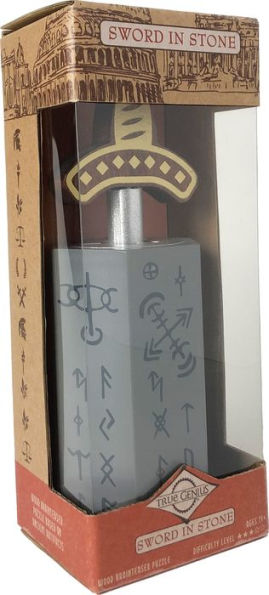
Our trilogy of puzzle styles begins with a 3-out-of-5-star difficulty brain teaser. To conquer Sword in Stone, you must live out the legend of an ancient knight who plunged his sword into a stone and must remove it from its new home.

The sword can move up or down depending on how you twist the hilt back and forth, hoping to outmaneuver a maze of different paths you cannot see. It’s a marvelous little puzzle where you have to build a model of its interior in your mind by process of elimination, turning the sword this way and that, lifting and lowering it in stages until it’s free.
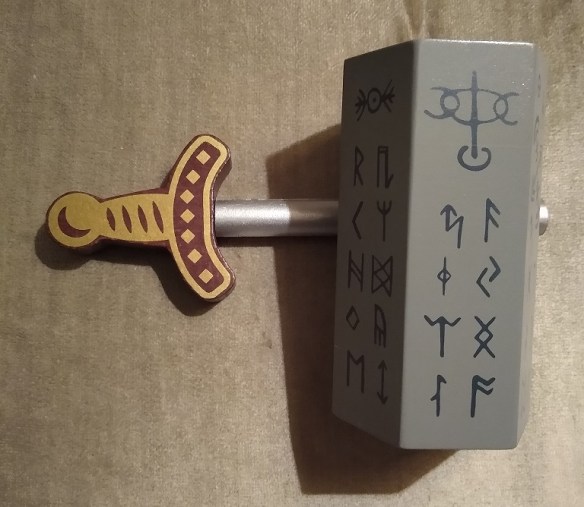
[Yes, I’m posting this to prove I solved it.
But I’ve hidden the key’s details to prevent spoilers.]

You really do feel like a champion once you’ve made the final twist and the sword slips from its forever tomb. There’s a playful give-and-take between you and the brain teaser that encapsulates the patience, determination, and deductive skill necessary to be a strong puzzler.

But then, once you’re completed the Herculean task, you have to put it back into place. And despite the fact that you’ve literally just performed the last few steps, doing them in reverse and returning the blade to the stone is even harder.

I thoroughly enjoyed tackling his mechanical puzzle. It hit the sweet spot of challenge and satisfaction without taking up too much solving time. It won’t take you 900 years to crack this one, but that doesn’t make it any less worthwhile.
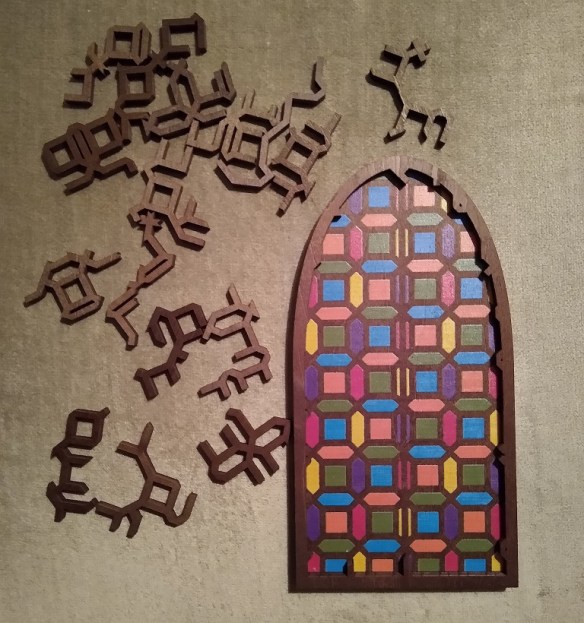
For a more traditional jigsaw-style solving experience, you can try Cathedral Door, a 4-out-of-5-star difficulty brain teaser. Again, the challenge laid before you sounds simple: reassemble this beautiful door by placing all of the pieces of wooden adornment into the stained glass pattern.

Yes, this one even helps you place the wooden pieces by offering a color pattern to follow, with various shapes leaving outlines for you to complete with the many wooden jigsaw-style pieces.
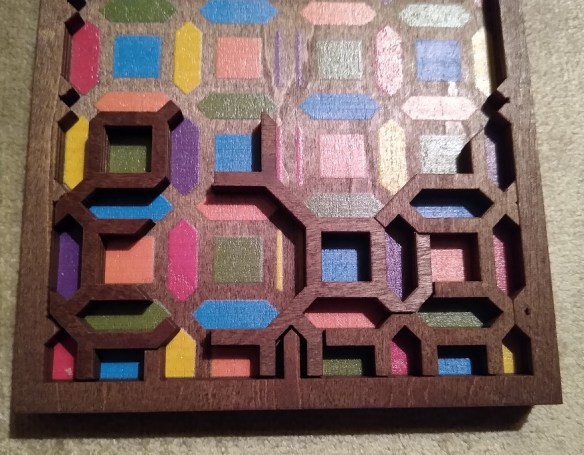
Of course, these pieces are unique in shape and design, some of them squat and complex, others long, thin, and rangy. It’s amazing how many ways you can place these puzzle pieces that seem to fit the pattern to a tee. With seemingly infinite permutations, how will you ever put them all back?

And yet, when you place a piece properly, it immediately feels right. It’s a very curious solving sensation — knowing for sure that a piece FITS somewhere, even if the other pieces around it haven’t been placed yet — but it’s one that makes solving Cathedral Door a very engaging challenge. I didn’t find it all that much harder than Sword in Stone, so I’m not sure a full star in difficulty difference is warranted, but this remains an eye-catching and challenging puzzle.
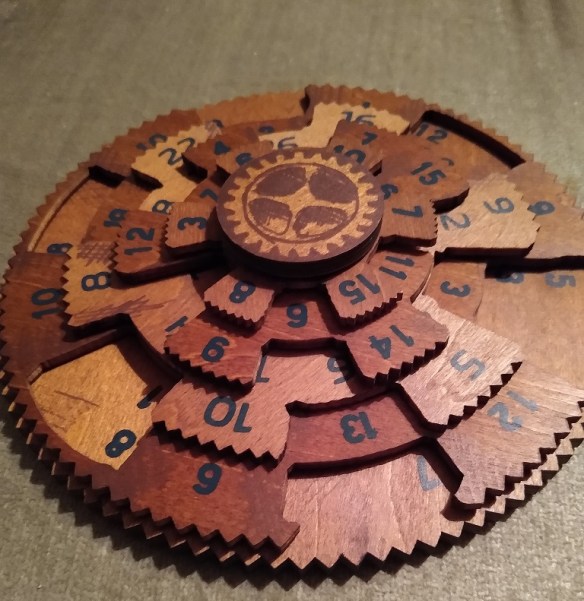
We round out our trifecta of brain teasers by maxing out the difficulty scale with this 5-out-of-5-star-ranked mathematical puzzle, Grecian Computer, created as a spiritual successor of the Antikythera Mechanism. And undoubtedly, this puzzle might leave people just as baffled as the piece that inspired it.

You must spin and twist this wooden “computer” until the numbers in all twelve columns add up to 42 at the same time. That’s daunting in and of itself. But it’s more than just spinning various dials.

There are cut-outs in some wheels where the numbers below can be shown, flaps that block other numbers, and joined pieces that spin together. Each of the four wheels — plus the base — have numbers at all 12 clock positions, and even a small rotation can vastly change the arrangement of numbers in front of you.
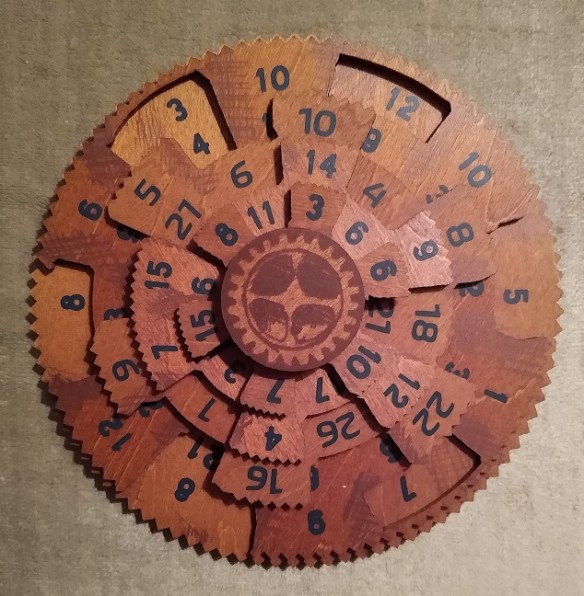
It genuinely feels like the mathematical equivalent of a Rubik’s Cube, each twist bringing one column to completion while leaving others further than ever from a unified solution. There are a lot of variables at play here, and it can be a little frustrating.

And yet, you never despair. You never feel like giving up. Each small victory, each alignment that makes sense in your head, inches you closer, and before long, you’re spinning and twisting like a dervish, eliminating false paths and unhelpful combinations en route to victory.

This brain teaser most definitely deserves the 5-out-of-5 difficulty rating, and it’s also beautifully engineered. The bottom wheel spins at the barest touch, and while others have more resistance, you can’t help but marvel at this well-made and devious machine.


Sword in Stone, Cathedral Door, and Grecian Computer are all available through Project Genius as well as certain online retailers.

Whether you’re looking for a deduction puzzle, an assembly puzzle, or a twisty puzzle, one of these impressive brain teasers from Project Genius is sure to hit the spot. And all three are part of this year’s Holiday Puzzly Gift Guide, coming soon, so be sure to check it out!

[Note: I received a free copy of each brain teaser in exchange for a fair, unbiased review. Due diligence, full disclosure, and all that.]


Thanks for visiting PuzzleNation Blog today! Be sure to sign up for our newsletter to stay up-to-date on everything PuzzleNation!

You can also share your pictures with us on Instagram, friend us on Facebook, check us out on TwitterPinterest, and Tumblr, and explore the always-expanding library of PuzzleNation apps and games on our website!
PuzzleNation Product Review: Knot Dice and Knot Dice Squared

knot dice

[Note: I received a free copy of this game in exchange for a fair, unbiased review. Due diligence, full disclosure, and all that.]

You can easily lose yourself in a Celtic knot design if you stare long enough. Elaborate unbroken paths, formed within circles, crosses, and other shapes, weave together in compelling patterns.

There are many dice games on the market today, but none of them capture the same intricate flow and beauty found in Celtic knots. Except for one, that is, which just so happens to be the subject of today’s review: Knot Dice.

dice types

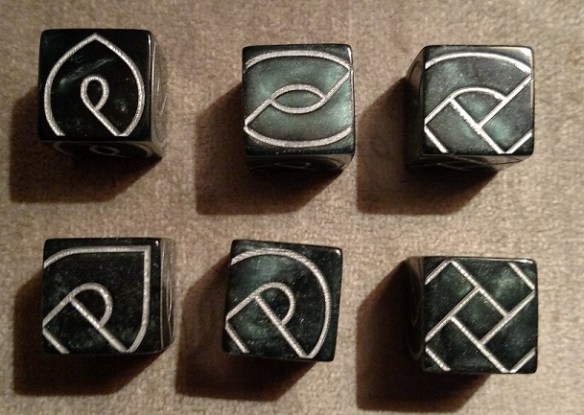
[The six faces of a Knot die. Top row: end-cap, chain, branch;
Bottom row: sharp corner, rounded corner, crossing.]

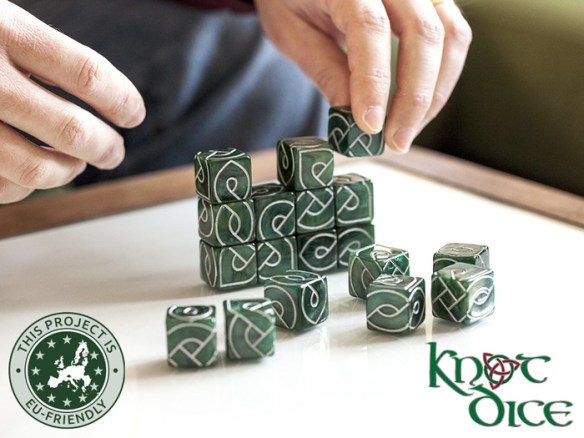
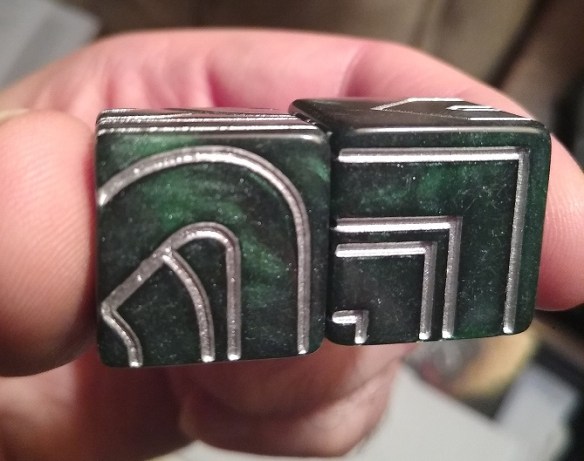
In the puzzle game Knot Dice, you have eighteen identical six-sided dice featuring a different pattern on each face of the die. In order to form a completed design — in either one dimension or three dimensions — a solver uses the patterns on each face to form unbroken paths.

You can create designs both simple and complex as you play around with these gorgeous dice. I’ve seen players just freeform different patterns as they explore the potential of the dice in front of them, their imagination coming to life as they tinker with all six sides.

There are two rulebooks included, one for single-player puzzles, and the other for single-player and multi-player games that utilize both the dice and a small selection of tokens.

dice stack

The puzzles center around completing designs by moving dice, sliding them, or rotating them, depending on the puzzle, and many of the puzzles begin with starting patterns provided by the game designer. These puzzles are simple and quite elegant, making wonderful use of the various patterns on each die.

The games are a bit more inventive, many of them centered around Celtic history and mythology. Whether you’re collaborating with other players to build elaborate knotworks, racing to complete different knots, or capturing your opponent’s token, there are numerous clever and creative ways to employ the patterned dice to their fullest potential. (There’s even a game board and a score sheet included in the rulebook.)

dice patterns

And those possibilities only expand when you incorporate Knot Dice Squared, a second set of dice that offer new puzzle opportunities and game options for solo solving and multi-player engagement.

Designed to work in conjunction with the original Knot Dice, Knot Dice Squared offers 26 dice with fresh patterns to create more elaborate designs and more involved gameplay styles.

Unlike the dice in the base game with their standard six-sides, the dice in the expansion consist of four types of knot dice: crossed, squared, rounded, and bridge. Not all of these dice line up perfectly with the originals, meaning you have to be more creative to complete the various designs as presented. This adds a delightful new wrinkle to each of the games already familiar to Knot Dice solvers.

dice pop

It cannot be overstated how beautiful these dice are. They’re arguably the best part about this game. Whether you’re using the classic green shading or the alternate blue dice (pictured below), the richness of color makes the intricate patterns pop, drawing the eye immediately.

The original game took almost a year to deliver to Kickstarter backers, and much of that time was spent making sure that the mass-produced dice for the game met the high standards of Matthew O’Malley’s early designs. He wanted the dice to be vivid, polished, and usable for the numerous puzzles and games that had been devised for the set. That rigorous attention to detail and demand for perfection has clearly paid off; it’s obvious in the dice, the packaging, the rulebooks, and the overall presentation of the entire product.

The end result is a truly eye-catching game as fun to look at as it is to play.

blue knot dice

Knot Dice and Knot Dice Squared take a step back from traditional dice games, injecting a patient, methodical, aesthetic style of puzzly engagement to the usual luck-of-the-draw rolling. By doing so, it puts a new twist on the genre, allowing for fluid gameplay and design that appeals to both puzzlers and game fans alike.

[Knot Dice and Knot Dice Squared are available from Black Oak Games and will be part of this year’s upcoming Holiday Puzzly Gift Guide, launching in a few weeks!]


Thanks for visiting PuzzleNation Blog today! Be sure to sign up for our newsletter to stay up-to-date on everything PuzzleNation!

You can also share your pictures with us on Instagram, friend us on Facebook, check us out on TwitterPinterest, and Tumblr, and explore the always-expanding library of PuzzleNation apps and games on our website!
December Deal of the Day!

Hello fellow puzzlers and PuzzleNationers!

Have you been checking out our Deals of the Day? If not, then you are missing out, my friends!

Every single day through the end of 2019, we’ll be offering a special deal for our puzzle apps!

We’re talking sales, discounts, special promotions, the works! And the best part? It’s something exciting and unique every single day!

And today is no different. Check out this awesome deal!

191208

It’s the December Deluxe Bundle, loaded with terrific seasonal puzzles and clues guaranteed to keep your puzzly wits engaged!

With 105 puzzles to solve, full of wintry fun and holiday cheer, plus the top-notch construction PuzzleNation is known for, how can you go wrong?

And don’t forget to keep your eyes peeled across all our social media (Facebook and Twitter especially!) for new announcements each and every day for the rest of the year!


Oh, and while you’re here, be sure to check out our Holiday Puzzly Gift Guide! It’s been updated with links to full reviews for some of the latest puzzly products included, as well as a few last-minute additions and surprises!

Happy shopping and happy solving!


Thanks for visiting PuzzleNation Blog today! Be sure to sign up for our newsletter to stay up-to-date on everything PuzzleNation!

You can also share your pictures with us on Instagram, friend us on Facebook, check us out on TwitterPinterest, and Tumblr, and explore the always-expanding library of PuzzleNation apps and games on our website!

PuzzleNation Product Review: Bananagrams Duel

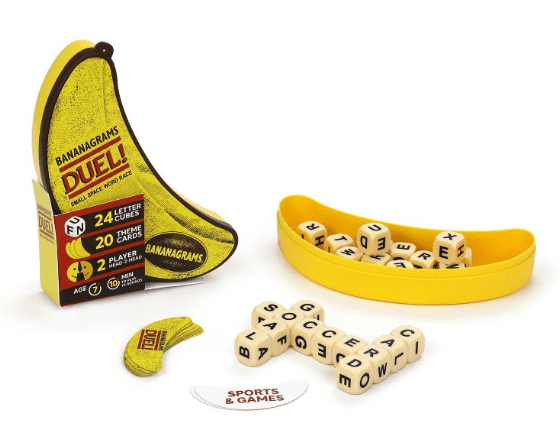
bananagramsduelsmall

[Note: I received a free copy of these games in exchange for a fair, unbiased review. Due diligence, full disclosure, and all that. /end disclaimer]

When it comes to word-forming tile games, the folks at Bananagrams are the masters. Their fruit-inspired packaging is synonymous with that particular brand of puzzling, giving Scrabble a run for its money in terms of letter-tile games. And they have an uncanny knack for putting new spins on classic puzzle-game tropes, breathing new life into the genre.

For instance, Bananagrams Duel replaces the iconic Bananagrams tiles with letter dice. Does this really make a difference in the game play? Let’s find out together.

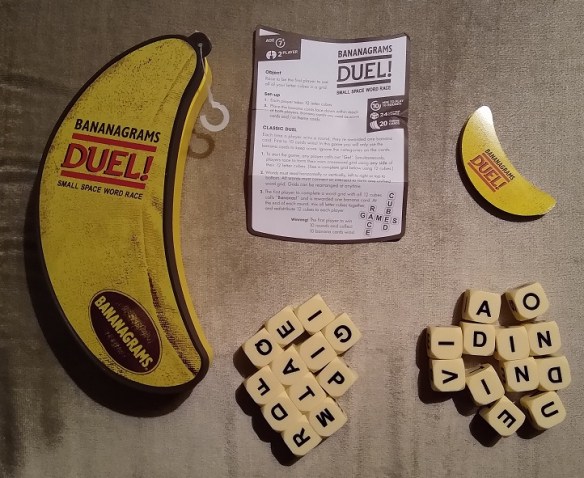
bananaduel1

Bananagrams Duel is a two-player word/grid-forming game, consisting of 24 six-sided letter dice, a handful of banana cards, and a handy carrying case. When it comes to travel-friendly puzzle games, it doesn’t get much simpler than this.

Instead of pulling from a shared pool of letter tiles, each player gets 12 of the 24 letter cubes. The goal is the same as a traditional Bananagrams game: to create a criss-crossing grid of recognizable words. You’re allowed to shift and flip any of your dice to other letters as needed, and the grid can change at any time. (Unlike, say, Scrabble, you’re not locked into a word if you’ve already spelled it. Anagramming is always an option.)

The first player to use all 12 letter dice and call out “Bananas!” wins the round and is awarded one banana card for the victory. First player to 10 banana cards wins.

bananaduel2

But those little banana cards do more than help you keep score. On the other side of each card is a theme. In one of the variant rule sets detailed in the little instructional guide, your completed grid must now contain at least one word that fits the given theme.

That little tweak can make a traditional Bananagrams game much more challenging. After all, if you’ve ever played the regular version of the game, you know how words can just evaporate from your vocabulary during play, only to suddenly return once your opponent has completed a grid. Now imagine that same feeling, but with a theme of sports or six-letter words attached to it.

In one of our test games, we actually made this harder on ourselves by trying to make EVERY word in the grid fit the theme.

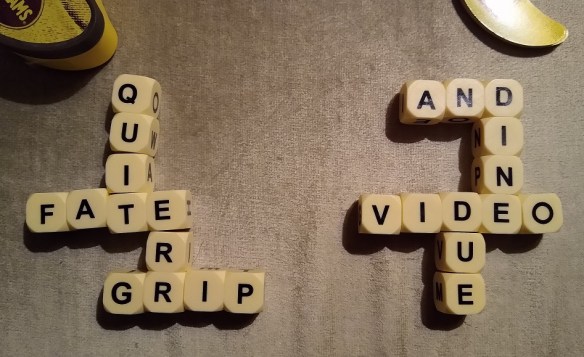
bananaduel3

As you can see here, we were allowed to choose our own theme, and we chose “Space/Astronomy.” I was devilishly close to completing my grid, but lacked the “L” I needed to spell Pluto. Meanwhile, my opponent went with a two-word grid that gelled nicely.

I don’t recommend trying it this way — unless you’re looking for a serious challenge — because the usual themed rules are tough enough.

Although an occasional bad pool of letter cubes can leave you without a letter — like, for instance, an L you really need — for the most part, it didn’t feel like the letter cubes were more restrictive or limiting than a traditional pool of Bananagrams letter tiles. All the dice shifting made for a different, yet familiar solving experience.

Plus it’s super-easy to come up with your own variant rules to enrich repeated games. The instructions list 5 alternate rule sets, and I would gladly recommend one that went well with us: having your opponent roll one of your dice for you and making you use it as the starting letter for a grid word.

Bananagrams Duel manages to boil down the Bananagrams formula to its most essential and playable form yet. And with a much faster clean-up (or pack-up and stash-away, if you’re on the road/in the airport), it’s more travel-friendly than ever before. They’re not lying when they call it a small space word race.


Bananagrams Duel is available from Bananagrams and participating local and online retailers, and it’s featured in this year’s Holiday Puzzly Gift Guide!

Thank you for visiting PuzzleNation Blog today! Be sure to sign up for our newsletter to stay up-to-date on everything PuzzleNation!

You can also share your pictures with us on Instagram, friend us on Facebook, check us out on TwitterPinterest, and Tumblr, and explore the always-expanding library of PuzzleNation apps and games on our website!

PuzzleNation Product Review: Waiter’s Tray, The Curated Collection, and Ghost Cube

Whether it’s a puzzle box, two joined pieces of twisted metal, or an elaborate wooden network of interconnected pieces, a mechanical brain teaser offers a physical dimension to puzzling that is often lacking in pen-and-paper puzzles and other traditional puzzle forms.

And in today’s product review, we’ve got three different varieties of brain teaser to test out, all courtesy of the creative minds at Project Genius.

So without further ado, let’s get solving!


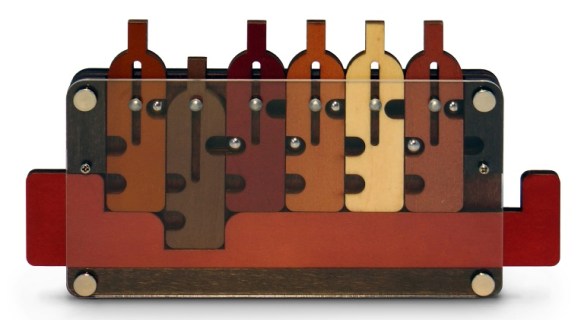
waitersmall

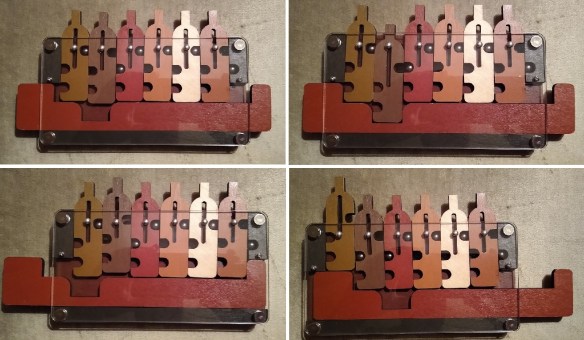
The goal in Waiter’s Tray is simple: maneuver the tray out from under the wine bottles. You can only lift one wine bottle at a time, though. Oh, and some of the bottles are locked in by marbles, so those have to be moved before the wine bottles can be lifted.

Okay, so maybe it’s not so simple.

Waiter’s Tray is a devious mechanical brain teaser that requires patience and a knack for planning in order to shift the wine bottles enough to free the tray.

wt1

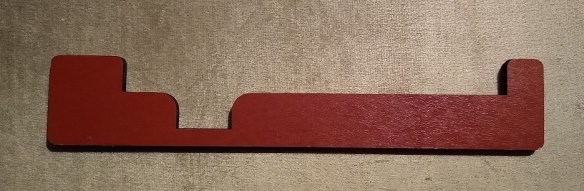
The peculiar shape of the tray both helps and hinders you, since you can lower one wine bottle with the dip in the tray, but the higher lip of the left-hand side of the tray often prevents you from moving forward and manipulating the other wine bottles.

But once you get into the rhythm of the solve, it’s a pretty satisfying feeling to see the tray slide closer and closer to escape.

wt2

Yeah, I’m posting this one to prove I solved it. =)


curatedsmall

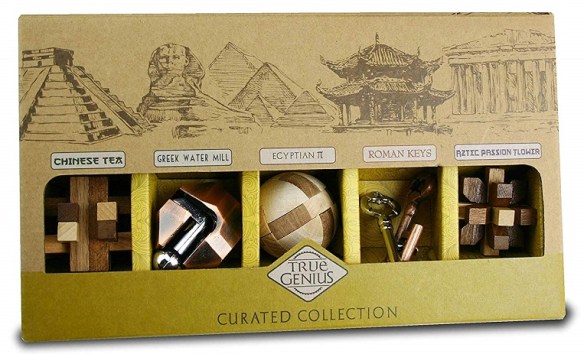
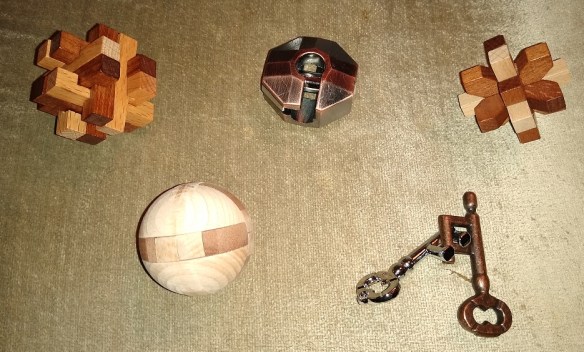
The five traditional brain teasers that compose The Curated Collection each represent a different culture and time period, adding a touch of historical context and beauty to some tricky and portable puzzles.

Each is ranked in difficulty from one to five stars — the Roman Keys are considered the easiest (2 stars) while Chinese Tea and Aztec Passion Flower top out at 5 stars — but the goal of each is the same: separate the pieces of each puzzle.

curated

Some of these brain teasers will look familiar, since puzzles like Chinese Tea and Egyptian Pi have been around forever, but there’s a good chance at least one of these puzzlers will be unfamiliar to solvers, offering multiple chances to keep you from cracking all five mysteries too quickly.

Personally, I found the star-rating system misleading, but your mileage may vary. (Also, some of the wooden puzzle pieces stuck together a bit, so more than once, I almost felt like I was breaking the puzzle, not solving it.)

That being said, getting to test my puzzly abilities in five curious ways at once was a real treat.


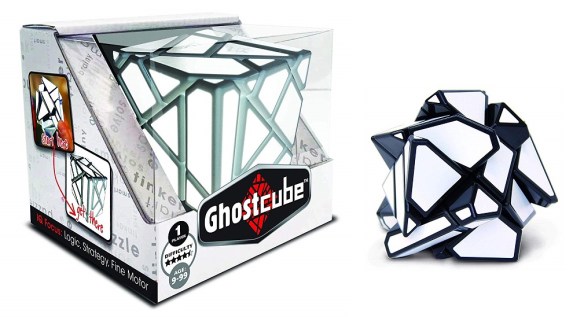
ghostcubesmall

With enough practice, the secrets of the Rubik’s Cube can be revealed. Those six colors, 3 rows, and 3 columns can be conquered. But what if the colors were gone and the rows and columns replaced with angles and unexpected twists?

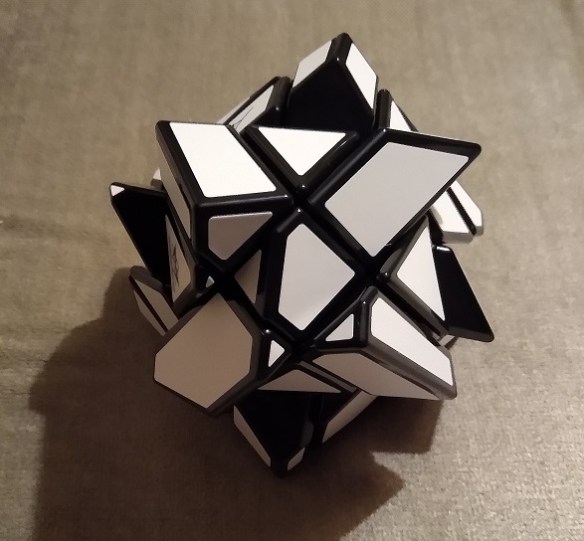
Ghost Cube offers an engaging variation on the classic twisty puzzle by making all the pieces spin and shift on an angle. Whereas the usual Rubik’s Cube is a riot of colors, the Ghost Cube is a maddening pointy shape instead.

gcube

Yet I find solving the Ghost Cube much more fun and satisfying than solving a Rubik’s Cube. (And trust me, I am not exactly a proficient Rubik solver.)

There’s just something about a tactile solve — rather than a color-based one — that makes manipulating the cube more engaging. I found myself prolonging the solving experience simply because I enjoyed working the Ghost Cube back and forth. It’s immersive in a way I didn’t expect.


Waiter’s Tray, The Curated Collection, and Ghost Cube are all available through Project Genius as well as certain online retailers.

Whether you’re looking for a deduction puzzle, a disassembly puzzle, or a twisty puzzle, one of these impressive brain teasers from Project Genius is sure to hit the spot. And all three are part of this year’s Holiday Puzzly Gift Guide, so check it out!

[Note: I received a free copy of each brain teaser in exchange for a fair, unbiased review. Due diligence, full disclosure, and all that.]


Thank you for visiting PuzzleNation Blog today! Be sure to sign up for our newsletter to stay up-to-date on everything PuzzleNation!

You can also share your pictures with us on Instagram, friend us on Facebook, check us out on TwitterPinterest, and Tumblr, and explore the always-expanding library of PuzzleNation apps and games on our website!
PuzzleNation Product Review: Smart10

smart100

[Note: I received a free copy of this game in exchange for a fair, unbiased review. Due diligence, full disclosure, and all that.]

If you’re familiar with trivia games, then you know there’s one answer per question, one crack at a pie wedge or a Linkee letter or a few steps forward or an answer point or whatever.

The subject of today’s post turns that convention on its head with a clever tweak: there are up to ten possible answers to each question, so you get more than one chance to earn points with your trivia knowledge.

Yup, you get multiple opportunities to “smarten” up with Smart10, the latest trivia game from the crew at Bananagrams.

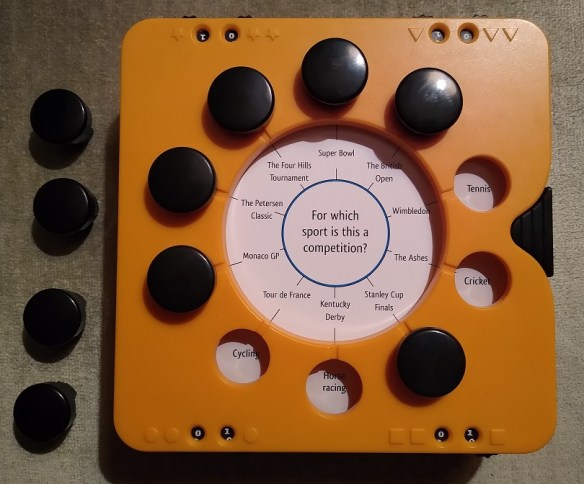
smart102

[Here you can see the Smartbox playing case, as well as the trivia question, the answer markers, and the score markers along the edge of the Smartbox.]

The concept is fairly straightforward. Once the trivia cards are loaded into the Smartbox, you pass it around, allowing each player/team the chance to answer the question and pull one of the answer markers. If they’re correct, they keep the answer marker in front of them. Then, pass the Smartbox to the next player.

The round ends when all the markers are pulled or players agree that there are no more correct answers to the question. Once the round is over, you add a point for each answer marker to the total indicated by your scoring wheel on the Smartbox. Then reset all the answer markers, pull the question card out, and put it at the bottom of the deck, and you’re ready for a new round.

smart101

Now, if you’ve never played this game before, you might be confused by how the round ends, since I mentioned two possibilities — all the markers being pulled or the players agreeing that there are no more correct answers. That’s because there are different kinds of trivia questions you’ll encounter while playing Smart10. There are six categories, each represented by a different colored circle that surrounds a given trivia question.

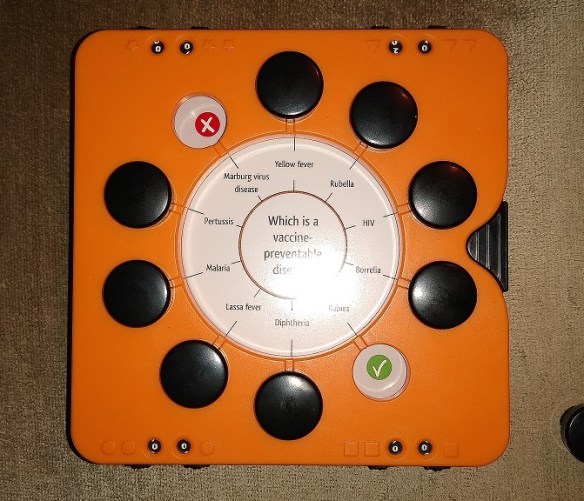
Some of them are true/false style, where you only want to pull the answer markers for the true answers. Others offer ten variations on a theme — like listing a piece of music and asking for the composer — which means the Smartbox gets passed around until all 10 variations have been answered.

This variety of question styles — covering everything from history and math to pop culture and language — keeps the game from becoming bogged down or repetitive. (The fact that every card is two-sided, meaning you have LOADS of questions to try, also helps in this respect.)

smart103

[Here you can see the checkmarks for the true/false type of question.]

Plus, the entire game is self-contained. You’ve got questions, answers, and score-keeping all built into one portable device. There are no decks of questions or game boards and pieces to tote around. That makes the game both travel-friendly and perfect for tossing around at a party without a lot of set-up time wasted.

The questions balance nicely between moderate difficulty and greater difficulty, so there’s little chance of the game feeling too easy or exclusionary in its challenge level. Pretty much the whole family can get in on the trivia goodness. And since you can play with up to 8 players (or teams), no one needs to feel left out of the fun.

All in all, Smart10 makes for a enjoyable and satisfying trivia experience that still feels mellow enough for casual get-togethers.

[Smart10 is published by Bananagrams and available from local and online retailers, plus it’s part of this year’s Holiday Puzzly Gift Guide!]


Thank you for visiting PuzzleNation Blog today! Be sure to sign up for our newsletter to stay up-to-date on everything PuzzleNation!

You can also share your pictures with us on Instagram, friend us on Facebook, check us out on TwitterPinterest, and Tumblr, and explore the always-expanding library of PuzzleNation apps and games on our website!