
A Boggle Grid Big Enough For Every Word?

Puzzly minds are often analytical minds, so I’m no stranger to wild attempts at puzzle-inspired calculation.

Puzzle people have previously calculated the human limit for solving a Rubik’s Cube, as well as the fastest known mechanical solve of a Rubik’s Cube. Years ago, I myself tried to figure out how many years it would take to use every unique Sudoku grid possible.

But optimization is something altogether different, and it’s a intriguing way to look at the potential of puzzles.

A Redditor by the name of AntiqueRevolution5 posed the following question a few days ago, and it absolutely fits the bill of both puzzly calculation and optimization:

What would a Boggle grid look like that contained every word in the English language?

Well, there are somewhere between 1 million and 1.5 million words in the English language, so I imagine it would be pretty big.

The redditor is an artist, and their goal is to make a sculpture composed of Boggle dice. And their concept is fascinating:

The idea for the piece is that it’s a linguistic Rorschach that conveys someone could find whatever they want in it. But it would be even cooler if it literally contained any word someone might reasonable want to say or write.
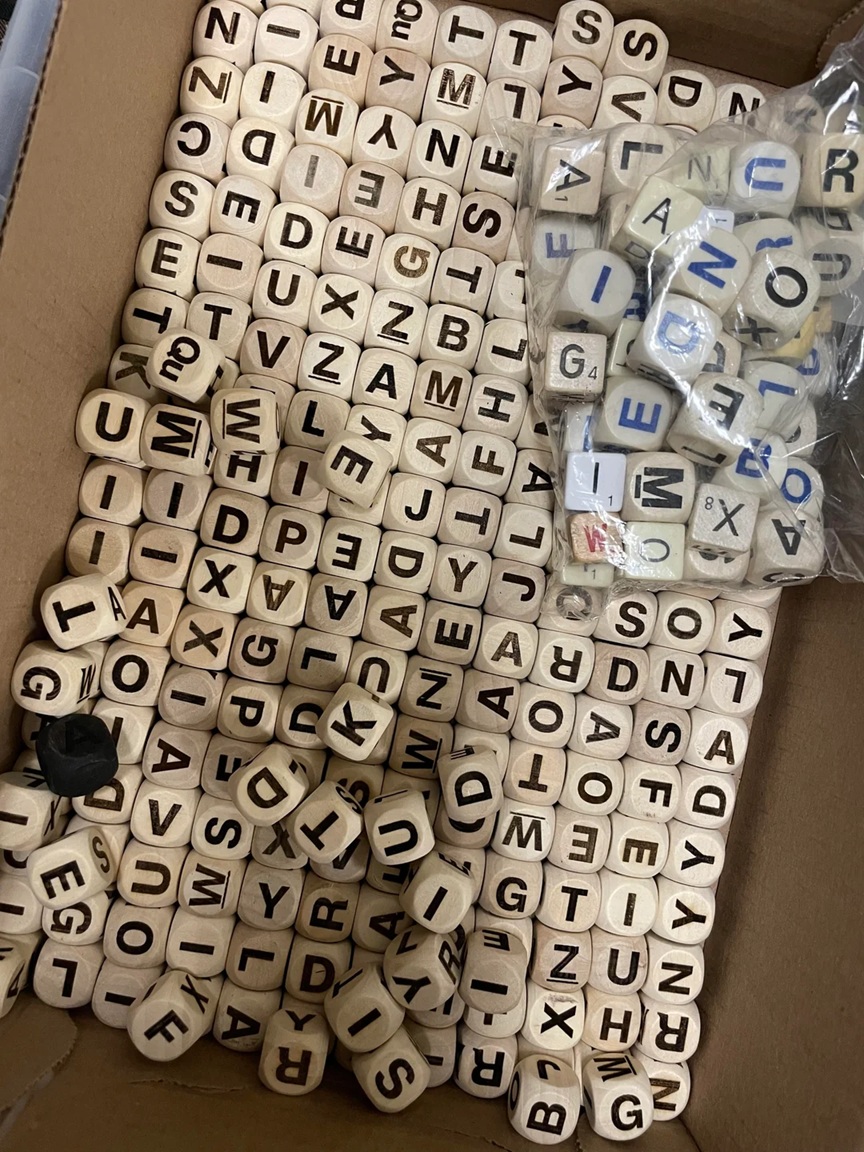
So, where do you start with something like this? Our artist has a suggestion:

To simplify, we could scope it to the 3000 most important words according to Oxford. True to the nature of Boggle, a cluster of letters could contain multiple words. For instance, a 2 x 2 grid of letter dice T-R-A-E could spell the words EAT, ATE, TEA, RATE, TEAR, ART, EAR, ARE, RAT, TAR, ERA. Depending on the location, adding an H would expand this to HEART, EARTH, HATE, HEAT, and THE...

What would be the process for figuring out the smallest configuration of Boggle dice that would let you spell those 3k words linked above? What if the grid doesn’t have to be a square but could be a rectangle of any size?


Naturally, creative minds accepted the challenge.

One user claimed that an online Boggle website called Squaredle has two 10×10 boards with just under 900 words of 4 or more letters.

Another user, a programmer, was able to create an 18×18 grid with approximately 450 words in under 10 minutes.
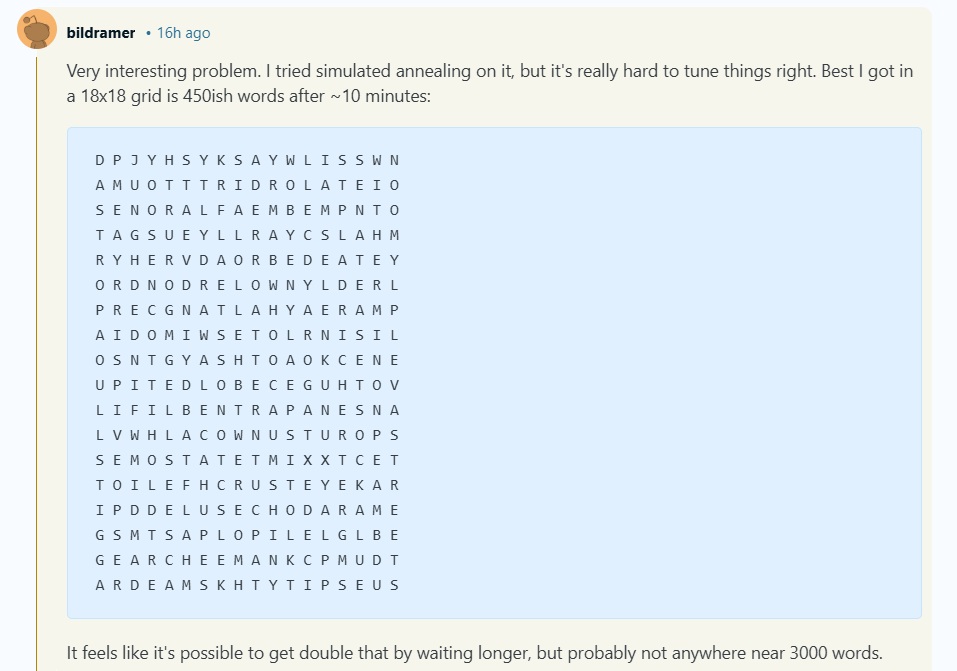
As you might expect, I was unable to resist diving into this one. But I’m not a programmer, so let’s do some meatball mathematics to get a sense of the scope of the puzzly conundrum before us.


We can extrapolate that if we get 450 words in an 18×18 grid, we’d need seven 18×18 grids connected to approach 3,000 words, assuming there’s some consistency in letter efficiency.

If we stick to the rectangular suggestion of the original post, a 63×36 rectangle (six 18×18 grids in a 2×3 arrangement, plus a 9×36 grid attached at the bottom) should allow for those 3,000 words.

Now, I can’t verify that. But 63×36 means 2,268 letters in the grid. Which, with a 3,000 word goal (including two- and three-letter words) kinda feels possible.

Of course, this is just to cover that 3,000 word list. Remember that the English language is estimated to contain between 1 million and 1.5 million words total.

That’s 333-and-a-third times more, if we use a million words. It’s 500 times more words if we assume 1.5 million words.

So, that’s 2,268 letters in our 3,000 word grid. Multiply that by 500 and you get 1,134,000 letters in the grid.

That means we’d need a grid that’s 1,065 x 1,065 to cover the entire English language.

So what does that mean in Boggle terms?

A standard six-sided die is 16 millimeters. That’s 17,040 millimeters, or 17.04 meters. That’s 67.09 inches. We’re talking about a Boggle game that’s FIVE AND A HALF FEET ACROSS.

That’s one heck of a Boggle grid.

Now, of course, these numbers are all estimates, and dubious ones at that. But I couldn’t resist TRYING to find an answer, even if it’s just a ballpark number.
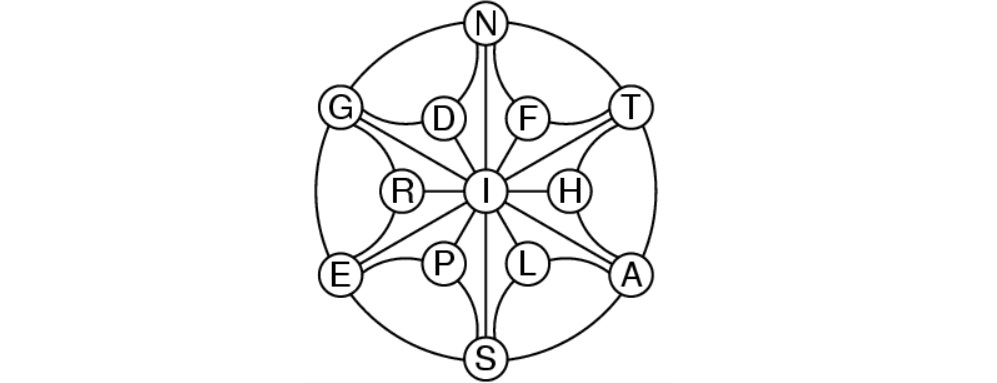

You see, fellow puzzlers, this brand of puzzle efficiency tickles something in my brain, as there are several Penny Press puzzles I quite enjoy that employ a similar idea.

Starspell (pictured above) involves finding words in a star-shaped grid, except unlike Boggle, you can reuse letters. So you could bounce back and forth from A to N and spell BANANA, for instance.

Word Maze involves a small grid with many words hidden inside Boggle-style (though it’s actually a themed word list, meaning it’s not optimized to just cram as many words inside as possible).

Letter Perfect is a reversal of the idea, seeing if the solver can arrange letters in a mostly-empty 4×4 grid to fit every word in a given wordlist. It’s excellent training for a challenge like this, since you learn about efficiency of letter placement and how many words can spell out with neighboring letters if you’re clever.


I don’t know if any programmers will figure out how to build a language-spanning Boggle grid, but I look forward to seeing them try!

Happy puzzling, everyone.

It’s Follow-Up Friday: Importmanteau edition!

Welcome to Follow-Up Friday!

By this time, you know the drill. Follow-Up Friday is a chance for us to revisit the subjects of previous posts and bring the PuzzleNation audience up to speed on all things puzzly.

And today, I’d like to return to the subject of portmanteaus.

[Image courtesy of upenn.edu.]

For the uninitiated, a portmanteau is a word that combines two words and represents aspects of both of them. Smog is a portmanteau of smoke and fog. Spork, avionics, brunch, labradoodle, cyborg, Pinterest, webinar, glitterati, Reaganomics, sharknado…these are all portmanteau words.

It can be a handy way to coin a term for a situation that doesn’t already have a word to describe it. For instance, I like to think of that unpleasant sensation that you’re going to drop your car keys down a storm drain as “sedanxiety.” A disastrous kiss? “Liplockalypse.”

And clearly I’m not the only one who enjoys crafting new portmanteaus.

Tom Murphy, not to be confused with Tom Swifty (another big name in wordplay), set himself a seemingly impossible challenge: create a portmanteau that includes every word in the English language. A lofty goal, considering there are around 100,000 words in our dictionary.

Utilizing a keen knowledge of French grammar, he coins this project a portmantout, using the French word for “all.”

And not only does he coin a few choice portmanteaus along the way, but he succeeds in creating a single portmanteau that contains every word in the English language:

Granted, that word is 611,000 letters long, but hey, it’s still a pretty impressive bit of coding and wordsmithing.

I look forward to a future video where he says the word out loud.


Thanks for visiting PuzzleNation Blog today! Be sure to sign up for our newsletter to stay up-to-date on everything PuzzleNation!

You can also share your pictures with us on Instagram, friend us on Facebook, check us out on TwitterPinterest, and Tumblr, and explore the always-expanding library of PuzzleNation apps and games on our website!

The Pros and Cons of Pronunciation

Tricky clues can come in all shapes and sizes, from wordplay that sends you down the wrong path (like “Intel processor?” for SPY) to clues with some tongue-in-cheek humor (like “Car bomb?” for EDSEL). But perhaps the most diabolical are clues that rely on alternate pronunciations to deceive solvers.

These clues are especially crafty, because oftentimes, it’s only when spoken aloud that the alternate meaning reveals itself. There were two prime examples of this cluing style in the Indie 500 puzzles I’ll be reviewing later this week.

At first blush, the clue “Layers of rock?” seems to point toward STRATA or something similar, except the question mark indicates some sort of wordplay is afoot. But if you use lay-ers (as in “those who lay”) of rock, suddenly the answer is apparent: MASONS.

Similarly, the clue “Water tower?” seems straightforward until you consider the question mark. But pronounce tower tow-er (one that tows) and you’ve cracked it: TUG.

Friend of the blog and Penny Press crossword guru Eileen Saunders also contributed a terrific example, “Sewer junction?” for SEAM.

Of course, the perils of pronunciation are hardly restricted to the world of crossword cluing. One need only travel abroad and encounter some of the towns in England to discover some curious pronunciations awaiting them.

In the music video below, chap-hop artist Sir Reginald Pikedevant, Esq. offers a litany of examples of curious British pronunciations in his song “Shibboleth.”

In the video, he defines shibboleth as a word which distinguishes between group members and outsiders by the way it is pronounced. The word comes from the Hebrew Bible, where the word itself was used to distinguish between Ephraimites (who could not pronounce the word properly) and Gileadites (who could).

And while historical uses of shibboleths usually had unpleasant connotations, Sir Reginald’s video is simply a whimsical look at the weirdness of language:

And now, given the subject at hand, I have a challenge for you, my fellow puzzlers and PuzzleNationers!

Below I’ve posted a poem called “The Chaos,” designed to highlight the many irregularities in spelling and pronunciation in the English Language. Created by Dutch writer and teacher Gerard Nolst Trenite, it has appeared in various formats for nearly a century, and it’s a taxing read, to be sure.

I hereby challenge any member of the PuzzleNation readership to create a video of you reading the poem in its entirety! [Note: this is, in fact, a truncated version, but I feel it would be torturous to make you read all 274 lines of this version!]

So, if you accept the challenge, post your video on Facebook, Twitter, YouTube, or wherever, and send me a link! The most impressive performance will earn a suitably puzzly prize!

Good luck!


The Chaos

Dearest creature in creation,
Study English pronunciation.
I will teach you in my verse
Sounds like corpse, corps, horse, and worse.
I will keep you, Suzy, busy,
Make your head with heat grow dizzy.
Tear in eye, your dress will tear.
So shall I! Oh hear my prayer.

********

Just compare heart, beard, and heard,
Dies and diet, lord and word,
Sword and sward, retain and Britain.
(Mind the latter, how it’s written.)
Now I surely will not plague you
With such words as plaque and ague.
But be careful how you speak:
Say break and steak, but bleak and streak;
Cloven, oven, how and low,
Script, receipt, show, poem, and toe.

********

Hear me say, devoid of trickery,
Daughter, laughter, and Terpsichore,
Typhoid, measles, topsails, aisles,
Exiles, similes, and reviles;
Scholar, vicar, and cigar,
Solar, mica, war and far;
One, anemone, Balmoral,
Kitchen, lichen, laundry, laurel;
Gertrude, German, wind and mind,
Scene, Melpomene, mankind.

********

Billet does not rhyme with ballet,
Bouquet, wallet, mallet, chalet.
Blood and flood are not like food,
Nor is mould like should and would.
Viscous, viscount, load and broad,
Toward, to forward, to reward.
And your pronunciation’s OK
When you correctly say croquet,
Rounded, wounded, grieve and sieve,
Friend and fiend, alive and live.

********

Ivy, privy, famous; clamour
And enamour rhyme with hammer.
River, rival, tomb, bomb, comb,
Doll and roll and some and home.
Stranger does not rhyme with anger,
Neither does devour with clangour.
Souls but foul, haunt but aunt,
Font, front, wont, want, grand, and grant,
Shoes, goes, does. Now first say finger,
And then singer, ginger, linger,
Real, zeal, mauve, gauze, gouge and gauge,
Marriage, foliage, mirage, and age.

********

Query does not rhyme with very,
Nor does fury sound like bury.
Dost, lost, post and doth, cloth, loth.
Job, nob, bosom, transom, oath.
Though the differences seem little,
We say actual but victual.
Refer does not rhyme with deafer.
Foeffer does, and zephyr, heifer.
Mint, pint, senate and sedate;
Dull, bull, and George ate late.
Scenic, Arabic, Pacific,
Science, conscience, scientific.

********

Liberty, library, heave and heaven,
Rachel, ache, moustache, eleven.
We say hallowed, but allowed,
People, leopard, towed, but vowed.
Mark the differences, moreover,
Between mover, cover, clover;
Leeches, breeches, wise, precise,
Chalice, but police and lice;
Camel, constable, unstable,
Principle, disciple, label.

********

Petal, panel, and canal,
Wait, surprise, plait, promise, pal.
Worm and storm, chaise, chaos, chair,
Senator, spectator, mayor.
Tour, but our and succour, four.
Gas, alas, and Arkansas.
Sea, idea, Korea, area,
Psalm, Maria, but malaria.
Youth, south, southern, cleanse and clean.
Doctrine, turpentine, marine.

********

Compare alien with Italian,
Dandelion and battalion.
Sally with ally, yea, ye,
Eye, I, ay, aye, whey, and key.
Say aver, but ever, fever,
Neither, leisure, skein, deceiver.
Heron, granary, canary.
Crevice and device and aerie.

********

Face, but preface, not efface.
Phlegm, phlegmatic, ass, glass, bass.
Large, but target, gin, give, verging,
Ought, out, joust and scour, scourging.
Ear, but earn and wear and tear
Do not rhyme with here but ere.
Seven is right, but so is even,
Hyphen, roughen, nephew Stephen,
Monkey, donkey, Turk and jerk,
Ask, grasp, wasp, and cork and work.

********

Pronunciation — think of Psyche!
Is a paling stout and spikey?
Won’t it make you lose your wits,
Writing groats and saying grits?
It’s a dark abyss or tunnel:
Strewn with stones, stowed, solace, gunwale,
Islington and Isle of Wight,
Housewife, verdict and indict.

********

Finally, which rhymes with enough —
Though, through, plough, or dough, or cough?
Hiccough has the sound of cup.
My advice is to give up!


You can submit your videos to any of our social media platforms below! Good luck!

Thanks for visiting PuzzleNation Blog today! You can share your pictures with us on Instagram, friend us on Facebook, check us out on TwitterPinterest, and Tumblr, and be sure to check out the growing library of PuzzleNation apps and games!