

Puzzly information is concealed in all sorts of ways. Rephrasings, anagrams, riddles, puns… these are all ways to challenge solvers by hiding information in plain sight.
But puzzle codes are one of the most prominent techniques… and one of the most ways to do so.
Codes in puzzles come in all shapes and sizes. And if you’re venturing beyond the confines of crossword-style puzzling, you’re bound to encounter a coded puzzle from time to time.
So, to better equip you for your puzzly sojourns in the future, today we’ll be breaking down a few common ways puzzles get encoded!
Letter Replacement
This is what you’ll see in your standard Cryptogram puzzle. Each letter in a quotation has been replaced with a different letter, and you need to notice utilize patterns, punctuation clues, and context in order to unravel what the letters in front of you truly represent.
For example:
Guvf vf n frperg zrffntr. Jryy, yrff frperg guna vg hfrq gb or, fvapr lbh’er nyzbfg svavfurq qrpbqvat vg.
Now, the order of letter replacement is usually randomized, but sometimes, a letter shift cipher has been applied. A letter shift cipher (like ROT13) means that there is a pattern to the letter replacement, rather than the randomness of traditional Cryptograms.
For example, A is actually M, B is actually N, and so on. Once you recognize the pattern, filling in the rest of the quote is easy.
Alphanumeric
After Letter Replacement, this is the most common style of coded puzzle. And like Letter Replacement codes, Alphanumeric puzzles can either be randomized or have a pattern.
For the former, each letter has been randomly assigned a number, and you need to figure out which number represents which letter. Our friends at Penny Dell Puzzles have a puzzle called Codewords that employs this code quite effectively:

By using a crossword-style or cryptic crossword-style grid, you can use letter repetition, placement, and frequency to figure out which letters go where.
But there are also alphanumeric puzzles that are not randomized. In these, each letter is replaced by the number that represents its order in the alphabet. A is 1, B is 2, all the way to Z is 26.
You can create a devious little puzzle by writing out a message, replacing each letter with its alphanumeric counterpart, and then jamming all the numbers together without spacing. Now the solver must figure out if that’s a 12 OR a 1 and a 2 next to each other.
For example:
25152118575202091477151541203154541621262612519225208919161591420
or, for a slightly easier version:
251521185 7520209147 715154 120 315454 1621262612519 225 208919 161591420
There are also puzzles that rely on older telephone keypads, where each digit represented several letters of the alphabet. 2 is ABC, 3 is DEF, all the way to 9 is WXYZ.
So each number in the sequence can represent three or four possible letters, and you need to puzzle out the message.
Coded Math
Letter Replacement can also work in reverse, where numbers in an equation have been replaced with letters, and you need to figure out which letter represents what number. Sometimes you’ll see this with a long-division problem (often employing 10 different letters to represent the digits 0-9).
Other times, it’s more of a logic puzzle where several equations are listed in sequence, like A + C = 10 and C – B = 4, and you must use the relationships provided to figure out what letters represent what numbers.
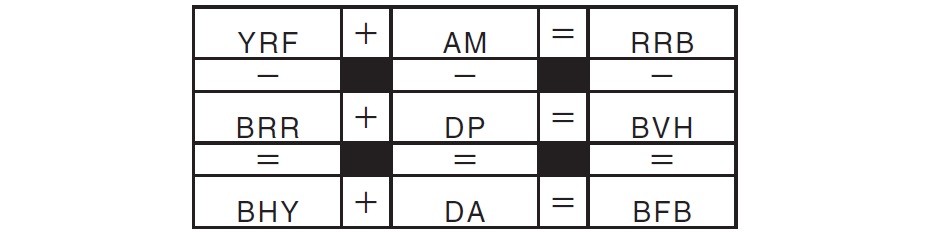
Another variation is combining Cryptogram-style letter replacement with logic puzzles. Imagine a 3×3 grid with equations overlapping, and all of the missing numbers are two, three, or four digits, but replaced with letters instead. This is called a Cross Arithmetic. Could you solve it?
Letter Blanks
Excluding letters from a word is also an effective way to create a puzzly code for someone.
There can be a pattern, like each word missing its center letter. (And then all the missing letters spell out a message).

Or perhaps there’s a pattern to the letters missing from several words (like a letter pair or a smaller word that’s been extracted from each incomplete word).

Or maybe there are multiple blanks in a word, and you need to figure out which letter fills every blank.

These are some of the codes and methods of obfuscation you’ll encounter in variety crosswords. How did you do? Did you unravel them all?
(Originally I was going to conclude this entry with Cryptic Crossword-style cluing, which is written in a coded language all its own, but I think that topic deserves a full blog post of its own.)
Happy puzzling, everyone!
 PuzzCulture