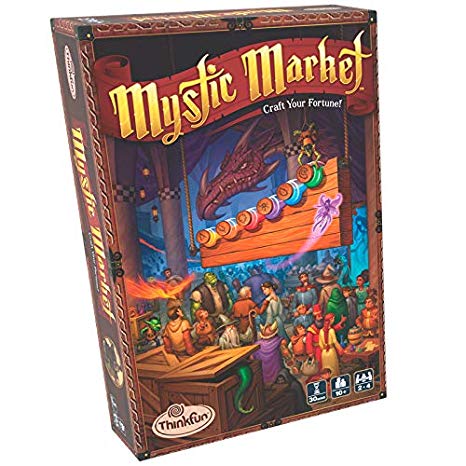
PuzzleNation Product Review: Mystic Market

mysticmarketheader

[Note: I received a free copy of this game in exchange for a fair, unbiased review. Due diligence, full disclosure, and all that.]

If you’re familiar with ThinkFun and their challenging and clever logic puzzle games, you know that most of them are one-player endeavors designed to pit the player against the game itself, playing repeatedly with increasing levels of complexity added as the Challenge Cards toss new twists and turns your way.

It is a formula that has worked well for them in the past, and yet, it’s one that they’ve completely put aside with their newest offering, Mystic Market.
mysticmarket4

Rather than focusing on deduction in some form — through completing tasks, paths, or circuits — Mystic Market requires players to react to both their opponents’ actions and the ever-shifting demands of the game moment-by-moment in order to achieve victory. You see, players at the Mystic Market are competing to earn the most money. But how do you do that?

By buying and selling magical ingredients, as well as the potions you can make from those magical ingredients, of course.

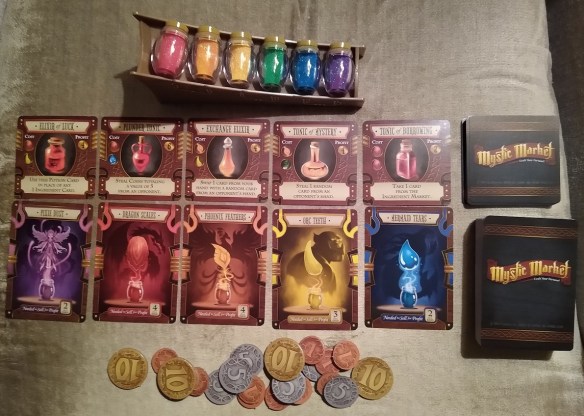
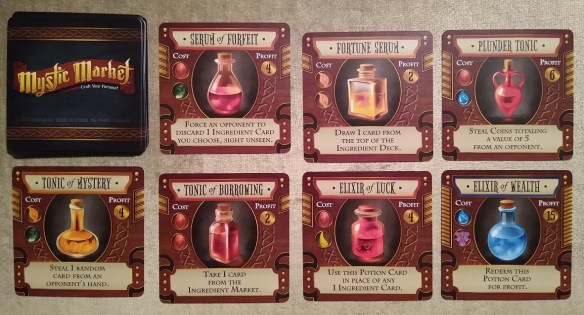
To start, players receive four ingredient cards and five one-point coins. They then take turns interacting with the communal Ingredient Market and Potion Market, where they can buy, sell, or swap ingredients, as well as craft or play potions.

Each potion you craft and play not only brings in a profit, but it also allows you to take actions that affect the game (even when it’s not your turn).

But here’s where things get much trickier. The cost of ingredients (when purchasing them) and the value of ingredients (when selling them) changes throughout the game.
mysticmarket1

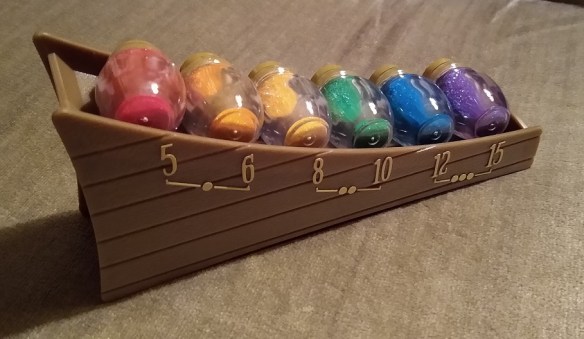
Say hello to the Value Track. This inclined plane contains samples of all six ingredients in the game, representing their current value on the market from least expensive to most expensive. (The numbers represent the value of ingredients when sold as a set, while the dots indicate the cost of ingredients.)

The value of ingredients can be altered in two ways: by player actions or by random supply shifts.

When a player sells ingredients — either as single cards or complete sets — they move the colored vial representing that ingredient to the top of the Value Track, lowering its current value (because there’s now more of that ingredient on the market, so the price comes down). The other vials shift as a result of this action, and any vials that were previously cheaper increase in value due to relative rarity in the market.

This mechanic not only brings an element of randomness to the game (because prices aren’t static, as they are in many other games), but it also introduces a deeper level of strategy and opportunism to the gameplay as well.
mysticmarket2

Because you can purposely affect the market, either inflating or deflating the value of ingredients through your purchasing and sales, you can create new chances for investment or spoil the attempted investments of your fellow players if you see them stockpiling certain ingredients.

You also have to keep a close eye on the Value Track, because you want to spend as little as possible when buying, and then strike while the iron is hot and sell when your ingredients are worth more.

There are a plethora of resource management games out there, with tons of mechanics for buying, selling, and swapping resources between players or with some sort of market or bank, but I can’t think of another game that simulates an ever-changing spectrum of prices and values for those resources as simply or as elegantly as Mystic Market does.

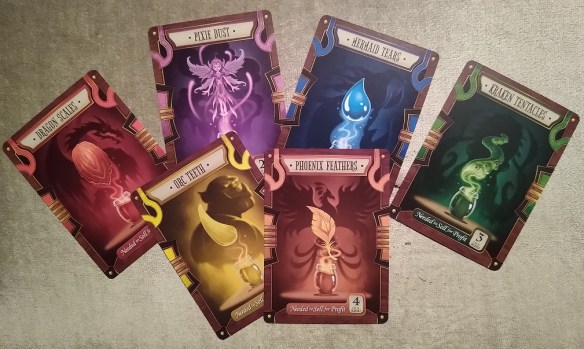
So, really, you have to play two games in one. You’re not just an alchemist working to create magical potions from otherworldly ingredients like phoenix feathers or mermaid tears; you’re also a savvy entrepreneur looking to corner the market on the ingredients you need and make a tidy profit from your investments.
mysticmarket3

It’s certainly a lot to manage, and it took a handful of playthroughs before I really felt like I had a good handle on balancing all of the game’s elements. But with each successive round of play, I understood and enjoyed the experience more than the previous game. Because as you get better at taking advantage of the Value Track, so do your opponents. Each game becomes the magical equivalent of an arms race as you try to build your fortunes and make the most of a dwindling supply of resources.

This isn’t the sort of game I’d expect from ThinkFun — competitive gameplay isn’t really their style — but that only made Mystic Market a delightfully surprising treat that still ably represents their core values: teaching through play. This time around, they manage to make business, investments, and the stock market all integral parts of a terrific gaming experience.

[Mystic Market is available from ThinkFun and other participating retailers.]


Thanks for visiting PuzzleNation Blog today! Be sure to sign up for our newsletter to stay up-to-date on everything PuzzleNation!

You can also share your pictures with us on Instagram, friend us on Facebook, check us out on TwitterPinterest, and Tumblr, and explore the always-expanding library of PuzzleNation apps and games on our website!
Puzzles in Pop Culture: The Challenge: War of the Worlds 2

wotw2logo

[Image courtesy of The Challenge Wiki.]

One of the first reality TV shows to make an impact was MTV’s The Real World, which debuted back in 1992. A show wherein seven strangers would live together in a house and have their lives and interactions taped, it is credited with helping launch the modern reality TV genre.

In the decades since, one of the show’s longest-lasting spin-offs has been The Challenge, a competition show where former Real World alums and other reality show figures compete against each other in physical and mental games, both individually and as teams. There is also a social element to the show, as players form alliances, scheme against other competitors, and often vote out players at regular intervals.

wotw2cast

[Image courtesy of People.com.]

As you might expect, puzzles have worked their way into The Challenge from time to time. Memory games, sliding tile puzzles, and variations on the Tower of Hanoi puzzle.

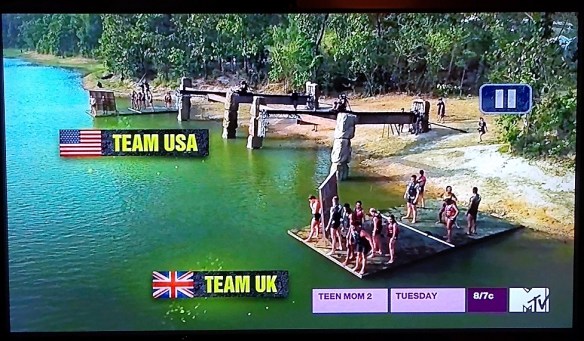
The most recent iteration of the show, The Challenge: War of the Worlds 2, pits a team of reality show contestants and former Challenge competitors from the UK against a team of previous Challenge competitors from the United States.

At this point in the game, the UK team had lost two players already (as one was sent home at the end of the previous episode, and another left the show for personal reasons).

challengewotw2

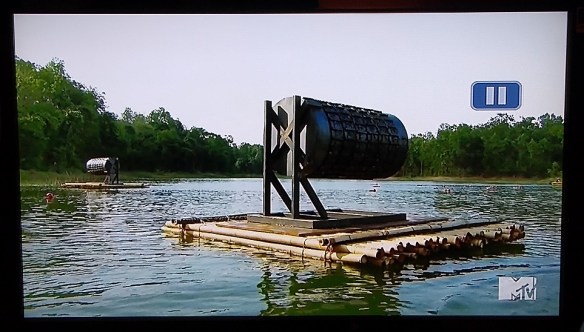
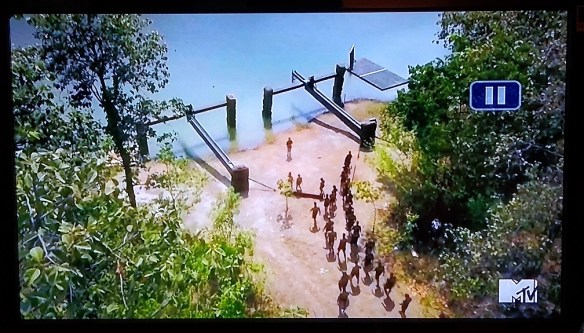
In last week’s episode, as the two teams arrived at a secluded lakeside area, there was a puzzly surprise waiting for them: Cryptic Crossbow.

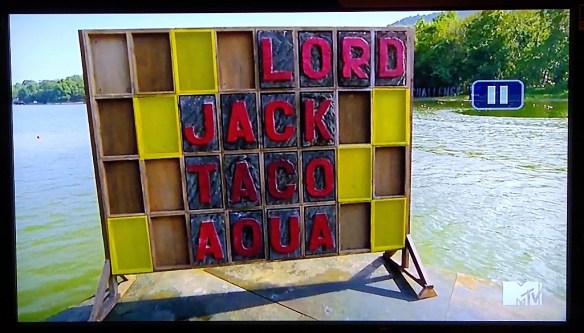
Each team had a giant crossbow, a grid with four four-letter words on it (as well as spaces for additional letters), and a platform from which to jump into the water.

challengewotw5

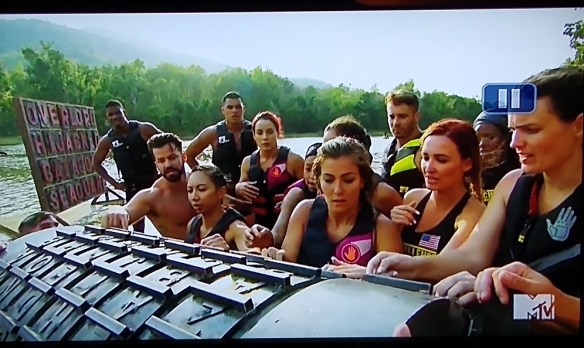
Eight competitors from each team had to swim out into the water and collect wooden tiles with letters on them. (One letter per tile, one tile per swimmer.) Once eight letters had been retrieved, a second wave of swimmers could jump into the water to retrieve the other eight tiles in the water.

Once all 16 tiles had been retrieved, each team had to add them to the grid in order to form four eight-letter words (using the preset four-letter words as clues). Two things would happen once all 16 tiles were placed on the board:

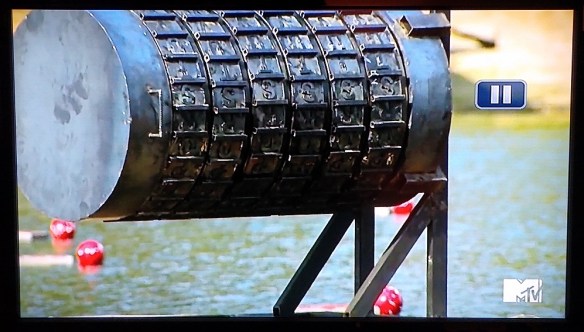
  • The crossbow would activate, and send one of the competitors out into the lake. That competitor would then swim out, retrieve a giant cryptex on a raft, and swim it back to the rest of the team to be solved.
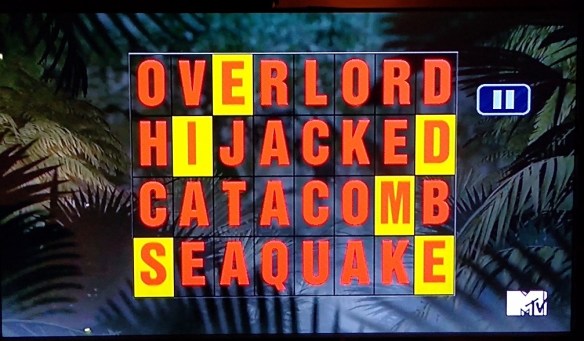
  • When the four eight-letter words in the grid were properly displayed, six highlighted letters in the grid would spell a code word that could be used to open the cryptex once it was delivered to the group.

challengewotw4

Both teams strategized ahead of time.

CT, the Challenge veteran on the UK team, urged his team to simply place all of the letters on the grid as quickly as possible, so they could launch their crossbow-loaded teammate into the water to retrieve the cryptex.

CT noted that the grid didn’t need to be correct for them to win — opening the cryptex was how a team achieved victory — so the grid didn’t matter, so long as they could mentally solve the puzzle and come up with the correct code word for the cryptex.

It’s a solid plan.

On the US side, Laurel pushed her teammates to solve the puzzle before their teammate was launched from the crossbow (to ensure they’d be able to open the cryptex on the first try), but Johnny Bananas had the same instincts as CT and pushed the idea of loading the grid quickly in order to launch their teammate and retrieve the cryptex.

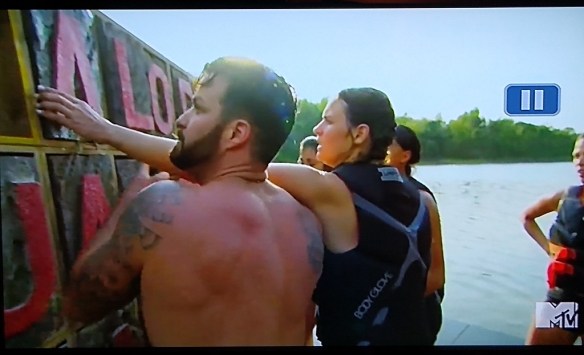
Once the battle plans were in place, the teams then determined who would swim to which letters (in order to use their best swimmers to travel the farthest distance the fastest).

challengewotw1

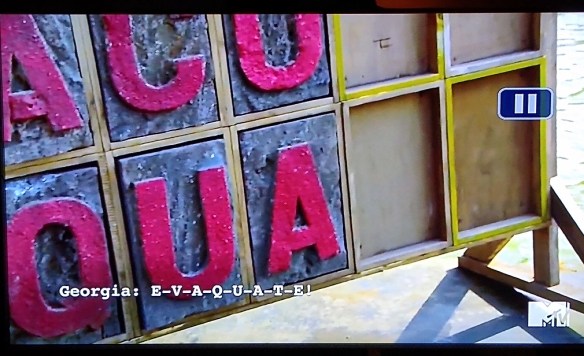
As a puzzler, after one glance at the grid, I immediately tried to figure out the possible eight-letter answers in my head. Naturally. AQUA was the easiest, because SEAQUAKE was the only relatively common word that fit.

Though UK competitor Georgia obviously disagreed with me, as she was certain EVACUATE would fit.

challengewotw6

Similarly, HIJACKED was the only common word that would fit for JACK.

TACO was harder, because it took me a while to come up with CATACOMB as the answer. It’s a cool word, but not one that jumped out at me.

LORD was the most challenging, because SLUMLORD, OVERLORD, LANDLORD, and DRUGLORD all came to mind, although some seemed less likely due to unpleasant connotations. (Not only that, but my nerdy brain kept suggesting possibilities like TIMELORD, STARLORD, DARKLORD, HIGHLORD, STALLORD, etc.)

challengewotw7

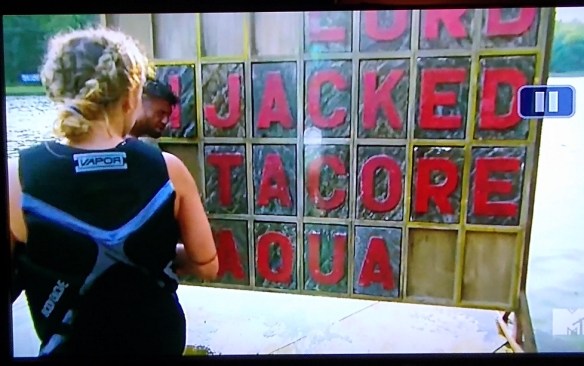
With stronger swimmers on their side, the US team retrieved all of their letters before the UK team did, and according to plan, they simply filled the grid randomly in order to trigger their catapult, launching teammate Jordan into the water and toward the cryptex. They then began mentally reworking the grid to solve the puzzle.

(We couldn’t see all of the available letters, but teammate Paulie correctly determined that the top word was, in fact, OVERLORD.)

challengewotw8

The UK side, on the other hand, struggled to get all 16 letters back to their grid in a timely fashion, and then compounded this mistake by trying to fill in the grid properly, delaying the launch of their crossbow-loaded teammate.

While they tried to solve the puzzle (and failed), Jordan had already unlocked the US team’s cryptex and started swimming it back to his team’s platform.

challengewotw3

Finally, the UK team listened to CT and just filled the grid in order to launch their teammate Joss into the water, but by this point, Jordan was more than halfway to the US team’s platform with their cryptex.

Joss had barely reached the UK team’s cryptex when the US team unlocked theirs with the code word DEMISE.

challengewotw9

The US team made it two Challenge event wins in a row, and the UK team was sent off to choose one member of their team for possible elimination.

In short, the UK team was decimated in this challenge. They were outswam, outpuzzled, and outstrategized by the US team. Although they were behind at the start due to some of their slower swimmers, they would’ve had a better chance if they’d follow the US team’s lead and just gotten their crossbow teammate into the water sooner while they worked out the puzzle. But alas, it was not meant to be.

challengewotw10

If only they had a PuzzleNationer on their team, this could’ve all been avoided.

Although this wasn’t the most difficult puzzle-based event I’ve seen in previous editions of The Challenge, it was a nice variation and certainly kept the competitors on their toes. I look forward to seeing if there are more puzzly obstacles awaiting the two teams as the competition continues.


Thanks for visiting PuzzleNation Blog today! Be sure to sign up for our newsletter to stay up-to-date on everything PuzzleNation!

You can also share your pictures with us on Instagram, friend us on Facebook, check us out on TwitterPinterest, and Tumblr, and explore the always-expanding library of PuzzleNation apps and games on our website!

A New Daily POP Record?

1200x628magglassfb

One of my favorite features offered by the Daily POP Word Search app is how it maintains records of your solving.

Not only can you see your fastest times for each theme day, but the app even keeps a running tally of how many days in a row you solve the free daily puzzles.

True, the app has only been out for a month or so, so even the most loyal PuzzleNationer hasn’t had the chance to compile a monster streak.

But users of the Daily POP Crosswords app also have a streak counter, and one of our faithful fellow puzzlers, Lori, just hit a milestone.

Check it out!

365screenshot

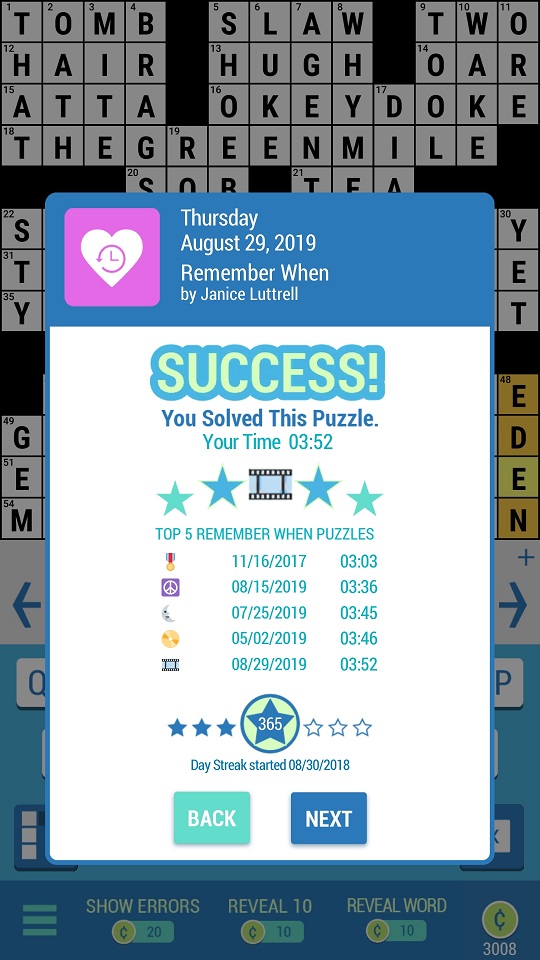
Not only did she score a top 5 performance for the August 29 “Remember When” puzzle, but she did so while solving her three-hundred-and-sixty-fifth puzzle in a row.

That’s a one year streak of Daily POP Crossword solving! Amazing!

(I must confess that my best attempt topped out around 150 or so before I missed a day.)

However, it’s certainly possible there’s a PuzzleNationer out there with an even more impressive streak going. If you’ve got a Daily POP streak that you’re proud of, whether it rivals Lori’s record or not, let us know in the comments below! We’d love to hear from you!

And hey, maybe we’re only 11 months away from celebrating our first year-long streak in Daily POP Word Search!

Wouldn’t that be something?


Thanks for visiting PuzzleNation Blog today! Be sure to sign up for our newsletter to stay up-to-date on everything PuzzleNation!

You can also share your pictures with us on Instagram, friend us on Facebook, check us out on TwitterPinterest, and Tumblr, and explore the always-expanding library of PuzzleNation apps and games on our website!
PuzzleNation Product Review: Star Trek Chrono-Trek

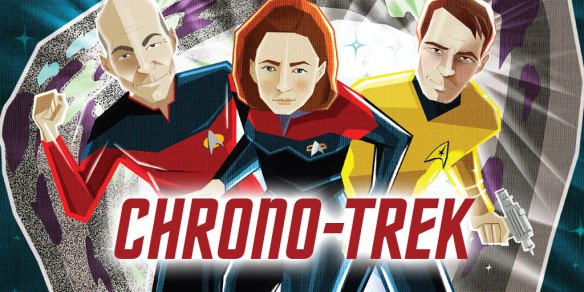
chronotrekheader

[Image courtesy of Trekcore.]

[Note: I received a free copy of this game in exchange for a fair, unbiased review. Due diligence, full disclosure, and all that.]

Some of the most important moments in the Star Trek franchise center around altering the past through time travel. Choosing to save Edith Keeler in the original series, the Enterprise-C sacrificing itself to bring peace to the Klingons and the Federation in Star Trek: The Next Generation, or Sisko preventing a Tribble bomb from killing Kirk in Deep Space Nine… iconic scenes both humorous and galaxy-changing involved rending the fabric of time and space. (Heck, the new film franchise was based entirely on changing the timeline from what we knew previously!)

So when I heard that Looney Labs updated their time-jumping strategy card game Chrononauts to include elements from the Star Trek universe, it seemed like a perfect fit. How did they do? Find out today as we review the new Star Trek Chrono-Trek card game.

chronotrek2

[A sample of each of the 11 different types of cards in the game.]

Much like its inspiration Chrononauts, Chrono-Trek is all about the cards. You’ve got assignment cards, ID cards, timeline cards that make up the playing space, artifact cards, cards that change history (and others that change it back), as well as cards that can help or hinder your fellow time travelers.

At the beginning of the game, the timeline cards are laid out in a 4×9 grid that represents the historical timeline from the Star Trek shows and films. Each player then draws an ID card representing a Star Trek character. Each character has certain victory conditions — some combination of events that must be preserved or changed in the timeline and artifacts to be acquired during play — that must be met for you to win the game. The ID cards are ranked by difficulty, indicating how complex the victory conditions are.

As for the other cards available to the player, they allow you to manipulate time, find artifacts, or manipulate the cards in your opponents’ hands. (For Fluxx players, some of these Action cards will seem very similar, as will the artifact cards, which are played just like keepers in Fluxx.)

chronotrek1

[A small glimpse of the timeline.]

The history-changing aspect is the puzzliest part of the game, as you determine what moments to change (and which to protect from your opponents) in order for your timeline to come to pass. But you must be careful, because you also need to ensure that you don’t accidentally end the game by allowing the anomaly from the series finale of Star Trek: The Next Generation — the Anti-Time Devron Anomaly — from preventing life on Earth. (In nearly every scenario, that’s a game over for all players. Pretty daunting, to say the least!)

And although bending time to your will and winning is certainly fun, watching the effect ripple down through the cards after making a bold history-altering move is arguably the best part of the game.

It will take one or two playthroughs — with easier ID cards only — to get used to the game mechanics, but after that, it’s a quick and easy deep-dive into the more complex victory conditions and a much more immersive and challenging play experience. (The game can go a bit too rapidly if you’re only using two players, so I’d recommend playing with four or more players to get the most out of the game.)

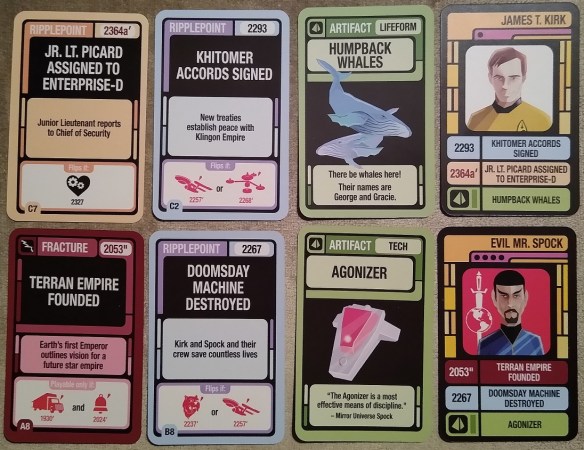
chronotrek3

[A comparison of a one-pip (easy) ID card and a four-pip (complex) ID card. Kirk simply requires you to protect one moment, invert another, and collect an artifact. Meanwhile, Evil Spock requires you to find the Fracture card, manipulate two events just to place the Fracture, and still maintain another moment AND acquire an artifact. That’s a much taller order.]

The designers did an impressive job figuring out which moments from the 50 years of Star Trek history to include in the timeline, which characters to offer as ID cards, and so on. For a Star Trek enthusiast, there are great references and little callbacks galore to favorite moments from the series. Not only that, but the game ups the ante from the original Chrononauts formula, keeping all of the best aspects of that game while making this one feel unique.

I posed the question in the intro asking how Looney Labs did marrying Star Trek and Chrononauts. The answer? They boldly went where no Star Trek card game had gone before, and created one heck of a fun adventure.

[Star Trek Chrono-Trek is available from Looney Labs and other participating retailers.]


Thanks for visiting PuzzleNation Blog today! Be sure to sign up for our newsletter to stay up-to-date on everything PuzzleNation!

You can also share your pictures with us on Instagram, friend us on Facebook, check us out on TwitterPinterest, and Tumblr, and explore the always-expanding library of PuzzleNation apps and games on our website!
Good News for Alex Trebek?

There have been two major stories in the world of Jeopardy! for the last year. One was the meteoric rise of gambler and champion James Holzhauer, the other was the saga of Alex Trebek’s battle against pancreatic cancer.

Although Holzhauer failed to topple Ken Jennings’ all-time winnings record, we are happy to report that Trebek’s story is on much more of an upswing.

Back when he first announced his diagnosis, Trebek stated, “I plan to beat the low survival rate statistics for this disease,” then joked, “I have to because under the terms of my contract, I have to host Jeopardy! for three more years.”

And in a recent video promoting the 36th season of Jeopardy!, Trebek seems cautiously optimistic:

These stories have been corroborated by producer Harry Friedman, who has worked with Trebek since 1997:

Alex is remarkable in many ways, not the least of which is he’s got an iron will and an unequaled determination to beat this. He underwent several rounds of chemo and that brought his numbers down. They were around 1,000 at one point and now they’re down into the high teens.

According to multiple sources, this is an unlikely and encouraging outcome, given the statistics surrounding the disease. Records from the American Cancer Society indicate that approximately 56,770 people will be diagnosed with pancreatic cancer this year, and nearly 80 percent will die from it.

Trebek recently participated in a Purple Stride walk with the Pancreatic Cancer Action Network. During the event, Alex discussed hopes that he would see his hundredth birthday:

As you all know, survivorship is measured starting from the date you are diagnosed with cancer. And on that scale, my gosh, I’m a 62-day survivor. Give me a break…But I’m working on it. And I promise you this: That if I become a 22-year survivor, you will all be welcomed at my 100th birthday.

Here’s hoping we’re all around to celebrate that joyous occasion with him.


Thanks for visiting PuzzleNation Blog today! Be sure to sign up for our newsletter to stay up-to-date on everything PuzzleNation!

You can also share your pictures with us on Instagram, friend us on Facebook, check us out on TwitterPinterest, and Tumblr, and explore the always-expanding library of PuzzleNation apps and games on our website!
PuzzleNation Product Review: Are You a Robot?

ayar0

[Note: I received a free copy of this game in exchange for a fair, unbiased review. Due diligence, full disclosure, and all that.]

Whether you’re playing a board game like Clue or a card game like Werewolf or Mafia, you and your fellow players have accepted the challenge of a very different form of puzzle gaming: the social deduction game.

Social deduction games operate under a simple premise — the cards determine the role you play — and from that point forward, you’re trying to determine who is secretly a danger to you and others in the game.

In this particular case, there might a robot lurking among the humans aboard your space station.

You see, in Are You a Robot?, all of the players randomly select a card. There’s always a human card for every person playing the game, plus one robot card. (So, for instance, if five people are playing, you have five human cards and one robot card in the deck.) You shuffle the cards, deal out one to each player, and put the last one aside. Everyone looks at their card (but doesn’t show anyone else) and discovers their role for the game.

Now, at this point, there’s between zero and one robots in the game, and the rest of the players are human. The humans want to suss out if there are any robots disguised as humans, and the robot wants to get the humans to accuse each other and whittle down their numbers so the robots can take over.

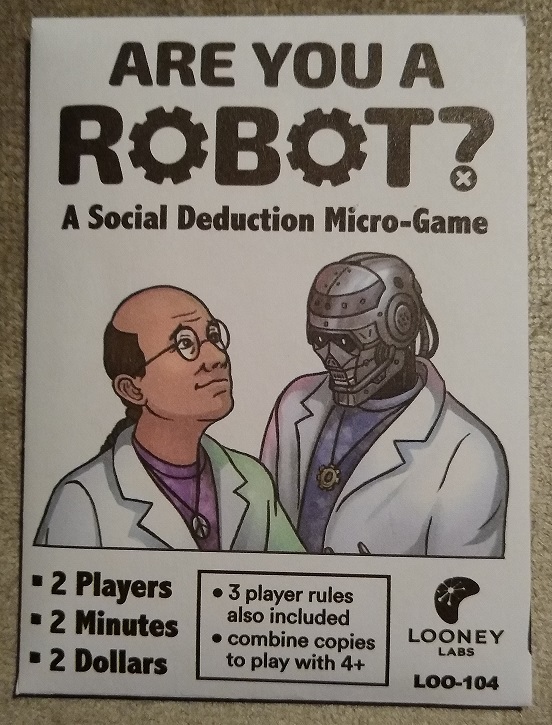
ayar1

[A whole lot packed into a little envelope.]

This is the social aspect of the game. There are three things players can do in order to figure out who is who: shake hands, shoot a laser gun at another player, or talk. If the players all agree that there are no robots in play, two players can agree to shake hands. If there are no robots in the game after all, the humans win. If a robot is present after all, the humans lose.

Humans can shoot other players, but robots cannot. If a robot is shot, it’s gone from the game and the humans rejoice. If a human is shot, three things happen: the shooter is immediately removed from the game, the human who was shot comes back to life and returns to the game, and there’s a chance another robot slips into the game.

This element of chance involves all of the players closing their eyes, any robots secretly revealing themselves, and all of the remaining players turning in their cards. Those cards are shuffled randomly, a robot card is introduced, and the cards are redistributed to the surviving human players.

It’s possible everyone remains human, and it’s possible one of the humans is now a robot in disguise.

The game now resumes, and the players must once again figure out if there are any robots in their midst. (And your mind immediately begins spiraling out with possibilities. “Did so-and-so not shoot me because he believes that I’m human? Or because he’s a robot and can’t shoot me?”)

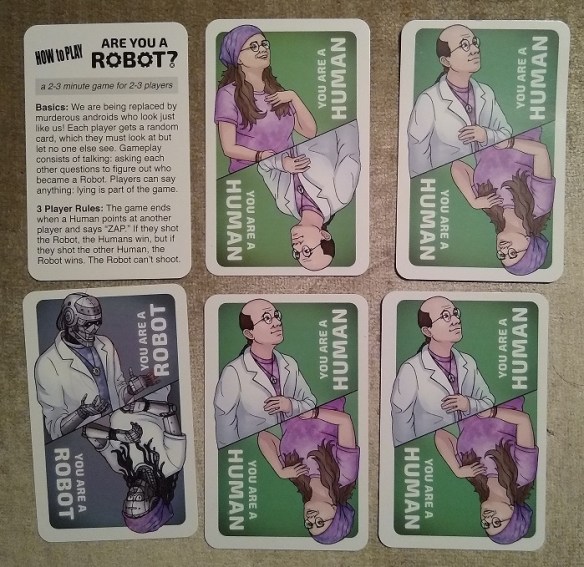
ayar2

[The set up for a four-person game: instructions, four human cards, and one robot card.]

Play continues until either the humans have eliminated any possible robots (and have shaken hands to confirm this) or the robots have overwhelmed the game and the humans have been whittled down to a single player.

In my estimation, Extended Mode, designed for 5 or more players, is the most interesting version of the game. The core game is for two or three players, consisting of two human cards and one robot card. Adding a second game allows for up to four players, a third game allows for up to six, and so on.

Our Extended Mode testing involved eight players (and four copies of the game), which allowed for multiple rounds of play, the introduction of several possible additional robots, and so on, making for a deeper, more engrossing (and nerve-wracking!) play experience.

And that’s the beauty of Are You a Robot? when compared to similar social detection card games like Mafia and Werewolf. Not only can you have satisfying play experiences with fewer people but the element of randomness that comes into play with more players adds tension to the game. (In Mafia and Werewolf, the number of antagonists is set at the start of the game. In Are You a Robot?, the number might increase, or it might not. It’s a simple change that adds so much.)

An elegant balance of silliness and suspenseful, consequence-loaded gameplay, Are You a Robot? is a winner with any number of players. Bring your laser gun, bring your skepticism, and bring along a couple of sets so everyone can play.

[Are You a Robot? is available (for $2!) from Looney Labs and other participating retailers.]


Thanks for visiting PuzzleNation Blog today! Be sure to sign up for our newsletter to stay up-to-date on everything PuzzleNation!

You can also share your pictures with us on Instagram, friend us on Facebook, check us out on TwitterPinterest, and Tumblr, and explore the always-expanding library of PuzzleNation apps and games on our website!