We’ve joked in the past about how bad or unclear handwriting can create quite the puzzly experience. Well, if you have a knack for deciphering the scribblings of others, then there’s a gig waiting for you in North Carolina.
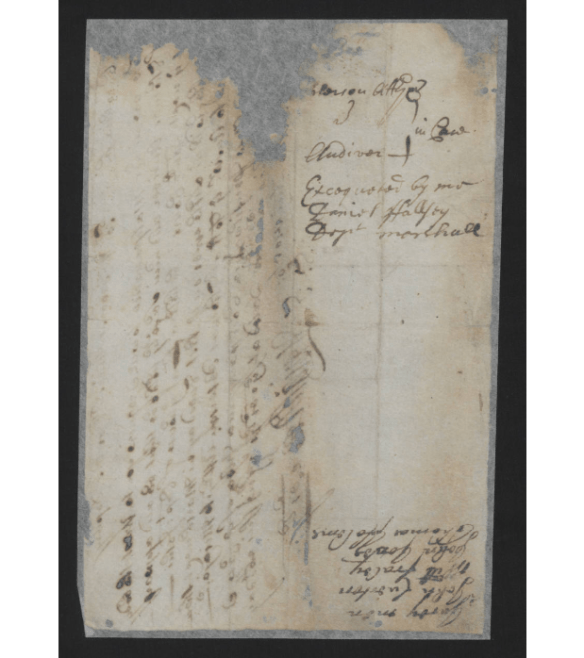
The State Archives of North Carolina are looking to transcribe dozens of documents from the colonial period, and they’ve turned to crowd-sourcing to accomplish this meticulous, Herculean task.
[One example of a crowd-sourced translation.]
Among the many documents are contracts, reports, records, and more, some of which concern local business dealings, and even the slave trade.
According to the organizers, “The handwriting can be quirky and the terms antiquated. Transcribing them will be like solving a word puzzle.”
It’s an impressive project that has already attracted numerous volunteers, but there’s plenty of work to be done. And as you can see, some pages are in far worse shape than others.
You can save a few pages of work as a guest translator or sign up to be part of the team and contribute more to the endeavor.
For more information, or to try your hand at some freelance puzzly transcription, click here!
Thanks for visiting PuzzleNation Blog today! Be sure to sign up for our newsletter to stay up-to-date on everything PuzzleNation!
It’s National Puzzle Day, also known as International Puzzle Day, depending on where you are and whether your puzzly activities extend across borders.
Maybe your puzzly Zoom group spans several countries. Maybe you and a friend are using remote-controlled robots to play Jenga. Maybe you’ve gotten hooked on Polish crosswords you’re solving through Google Translate. These are some of most common international ways to enjoy puzzling, of course. I’m sure you have plenty of additional suggestions.
But whether your Puzzle Day is National or International, we have some fun puzzly events and information to share with our fellow puzzlers and PuzzleNationers.
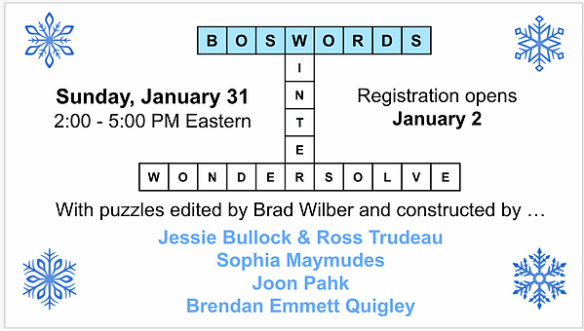
The first is that tomorrow marks the latest virtual puzzle event being hosted by the ever-inventive Boswords crew. After the wild success that was the Fall Themeless League, they’re hosting a one-day puzzle event on Sunday, the Winter Wondersolve.
Participants will have four puzzles awaiting them — three themed crosswords and a themeless — designed by top-notch constructors, and it’s only $20 to compete live! (If you just want to solve the puzzles outside the tournament, that’s only $10!)
Considering how terrific both the 2020 Boswords tournament and the Fall Themeless League were, I’m expecting a great day of puzzling from the Winter Wondersolve.
Speaking of puzzly events, the long-awaited fourth installment in the Crossword Mysteries series is debuting on Hallmark Movies & Mysteries on Sunday, February 14th at 8 PM Eastern.
And what would be more perfect for Valentine’s Day than a crossword-themed murder mystery about an elevator accident entitled Terminal Descent?
Exactly.
Of course, the easiest way to celebrate your (Inter)National Puzzle Day is to solve with us! Whether you enjoy crosswords, Sudoku, word seeks, or story-driven puzzling, we’ve got you covered with the click of a button!
Names like Normal Mailer, Mike Mussina, Beverly Sills, Neil Patrick Harris, and many more are proud puzzle fans, so I thought I’d whip up a quick little puzzle about famous crosswords solvers.
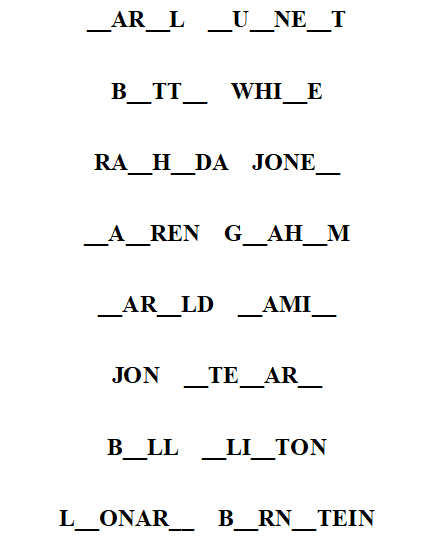
Below is a list of eight names.
As you can see, there are letters missing from each name. Coincidentally, those missing letters spell out the phrase CELEBRITY CROSSWORD ENTHUSIASTS.
Can you place the letters in the correct spots to reveal this octet of puzzle-solving celebs?
Good luck and happy solving!
Thanks for visiting PuzzleNation Blog today! Be sure to sign up for our newsletter to stay up-to-date on everything PuzzleNation!
[Note: I received a free copy of this game in exchange for a fair, unbiased review. Due diligence, full disclosure, and all that.]
Mechanical brain teasers can be incredibly complex, requiring many steps all taken in a particular order to achieve a goal. They can be devious, hiding components from sight and forcing you to deduce or luck your way into maneuvering the brain teaser in a certain fashion or from a certain angle.
But they can also be fairly simple in design and still retain a level of challenge and difficulty that makes the a-ha moment when you solve it just as sweet.
One of the traits that most ThinkFun puzzles or brain teasers have is accessibility. There’s nothing hidden from the solver. What you see is what you get, even if the path forward isn’t exactly clear.
The only thing that separates success from failure with a ThinkFun brain teaser is patience and puzzly skill. From age 8 to age 80, everyone starts on the same playing field.
This is exemplified by their latest brain teaser, Block Chain.
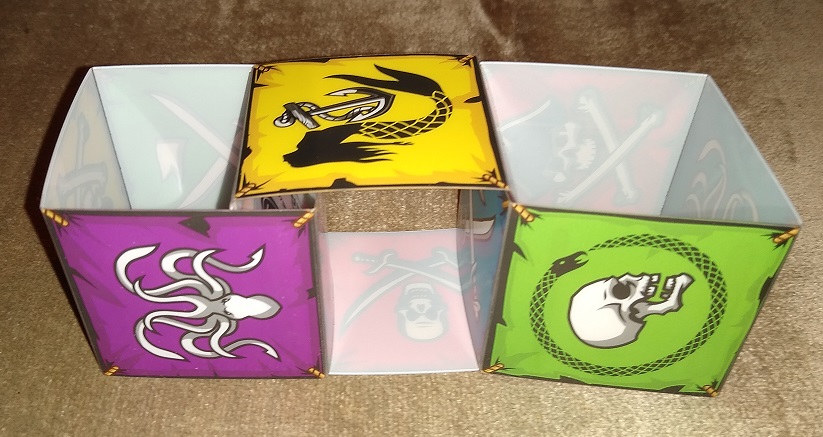
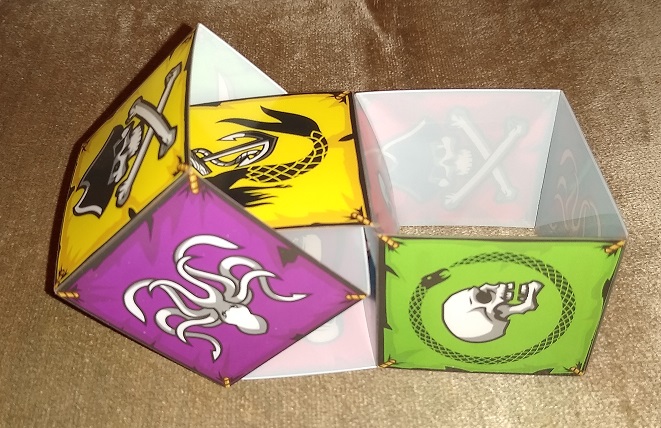
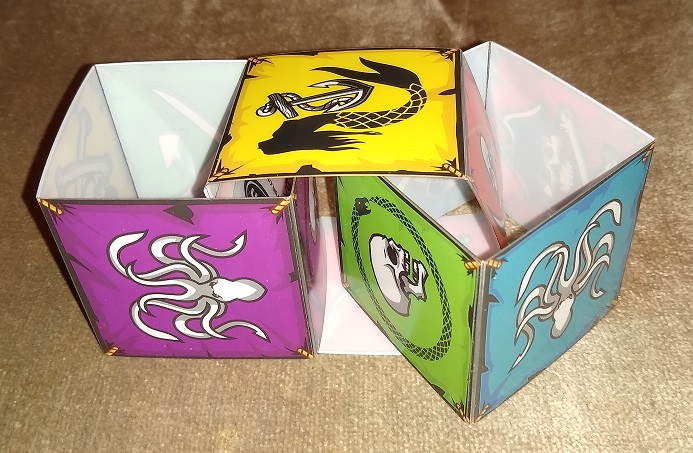
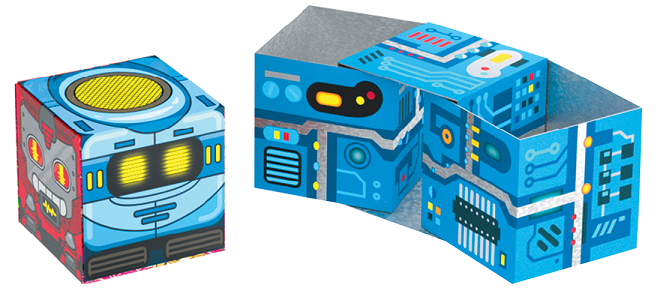
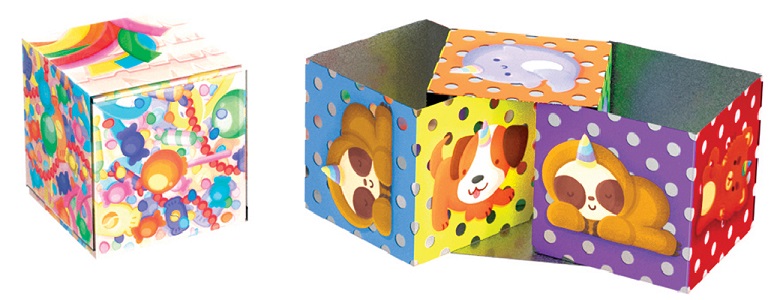
The concept is simple. You have three linked four-sided blocks. You can rotate each one independently of each other to show different faces.
You can also tilt the outside blocks in the chain up or down so that they slide over the center block, or swing the outside blocks so that they slide into the center block.
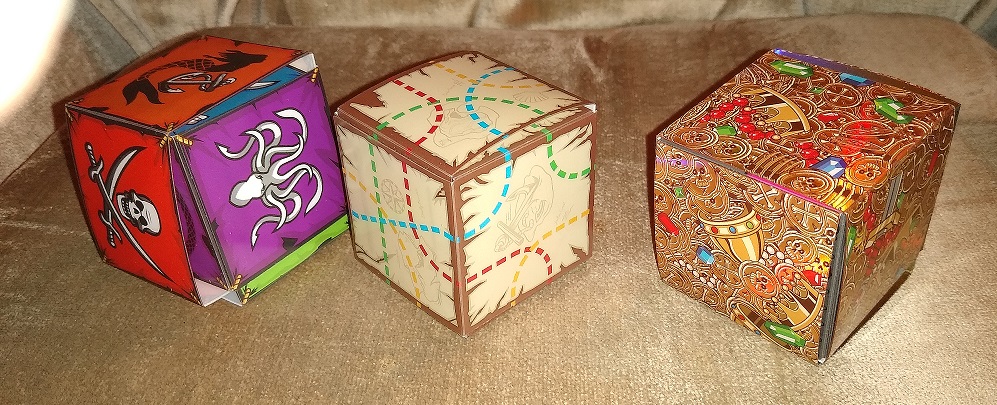
By swinging one block in and tilting the other block over, you create a single cube with different images on each face. Your job is to spin, swing, tilt, and tinker with each block chain until you form a cube that fulfills a certain condition.
And each package contains three different challenges for solvers to tackle.
One simply requires you to make all six sides match to fit one of two possible themes. For instance, this pirate-themed one could be all gold coin patterned, or all treasure chest patterned, depending on which side you twisted, swapped, and slid into place. So there’s two puzzles here, one on each side.
The second follows a more Rubik’s Cube-style solve style, as you have to manipulate the block chain so that a different color appears on every side of the cube.
The third involves multiple paths on each four-sided block, so you have to twist and maneuver the blocks so that the paths line up properly along each edge where the paths “meet.”
This was the most difficult of the three, because the patterning required much more attention from the solver. After all, you aren’t just matching a side — like the colored or themed ones — so the positioning of each block in the chain is more exact and deliberate than it is for the other cubes.
Block Chain brain teaser sets come in different themes — pirate, robot, and unicorn, for instance — adding a really fun visual aesthetic to what could be a fairly bland-looking puzzle. And their relative simplicity helps them serve as marvelous introductory puzzles for new solvers.
Although older solvers will blow through these fairly quickly, I definitely found myself returning to them more than once, enjoying the simple tactile joys of maneuvering the blocks around and over each other to make different shapes. They’re essentially a puzzly little fidget cube you can idly toy with as you solve!
Once again, ThinkFun has managed to walk that tightrope and balance simplicity of design with satisfying solving to create a delightful puzzling experience. Block Chain brain teasers have already become a welcome addition to my desk, keeping my hands occupied while I puzzle over the day’s obstacles.
Non-intuitive puzzles used to be the bane of many video game fans — so much so that they spawned an infamous trope, That One Puzzle, describing a puzzle with a solution so utterly non-intuitive that it bordered on the nonsensical. One of the most infamous came from the Monkey Island series, where you needed a wrench, but instead of just finding one, you had to hypnotize a monkey with a banana on a metronome and use IT as your monkey wrench.
See what I mean about nonsensical?
These days you’re more likely to encounter a non-intuitive puzzle in an escape room or other physical puzzly activity than a video game.
But today, we have a doozy of an example for you. This non-intuitive puzzle managed to baffle people twice… thirty years apart.
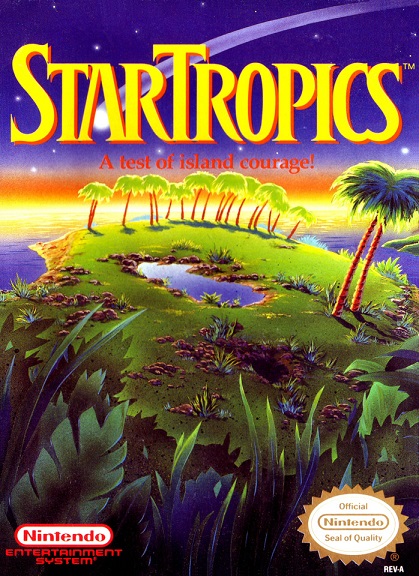
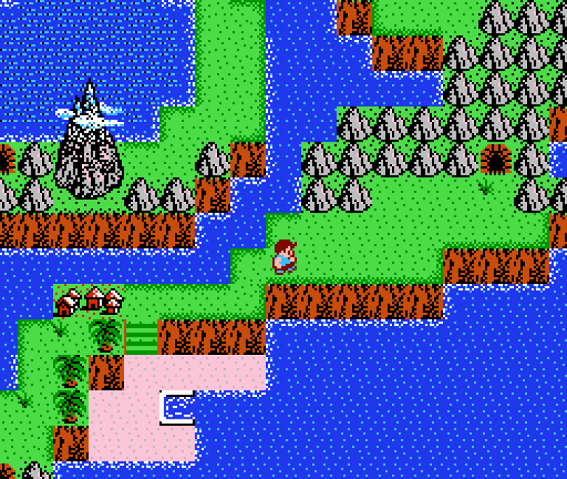
StarTropics was a video game released for the 8-bit Nintendo Entertainment System in 1990. It featured a protagonist named Mike, who was visiting his scientist uncle in the South Seas. Mike wielded a yo-yo and had to search for his missing uncle, eventually exploring the island, the ocean, and outerspace along the way.
The game became famous for a non-intuitive puzzle that baffled many players. At one point in the game, you needed to find a three-digit code to utilize a transceiver your uncle had in his shoe. The only clue was “dip my note in water.”
But there was no way to do this in-game.
The solution was simple, but eluded many players because it wasn’t in-game. It was something the players actually had to do.
You see, there was a physical letter from the uncle included with the instruction manual to the game. That was the note you had to dip in water to reveal the three-digit code.
So, yes, the game did tell you what to do, but it’s not intuitive because at no other point in the game do you have to do something outside the diegetic space of the game. It’s not like you need to jump up and down to make your character jump.
This sort of fourth wall breaking puzzling can certainly add to the gameplay, but it’s also very confusing for players not familiar with the concept.
For instance, more than one escape room game I’ve encountered outwitted and baffled some players by utilizing images on the game box itself (or even the bar code) as part of a puzzle. Since this is “outside” what the player has been told is part of the game — the components inside the box — this is clever, but also unexpected. (An entire video game, File://maniac, was built around this concept.)
In 2019, the game was ported over to the Nintendo Switch, the latest Nintendo console, allowing a new generation of gamers to rediscover this cult-classic 8-bit adventure.
Except they forgot about the puzzle and the letter and the dipping into water thing.
So there was literally no way for new players to solve the puzzle, because there was no letter included with the instructions.
This wasn’t the first time StarTropics had been ported over to a new console. But it was the first time they forgot to do something to help players with the letter puzzle. Often, it was a digital copy of the letter, complete with an animation of it being “dipped” into water and revealing the code.
But the Switch version didn’t have that.
So players were stuck.
There’s creating a really non-intuitive outside-the-box puzzle, and then there’s breaking the game entirely by removing the only clue to the solution.
So yeah, StarTropics. A charming game, but baffling in all the wrong ways… twice… thirty years apart.
Thanks for visiting PuzzleNation Blog today! Be sure to sign up for our newsletter to stay up-to-date on everything PuzzleNation!
Rubik’s Cube solving has come a long way since Erno Rubik built his prototype out of wood in 1974.
Top solvers are so fast that they need specially designed cubes that spin fast enough to match their fingers. We’ve seen them solved blindfolded, underwater, while being juggled, and during a skydive.
We’ve chronicled dozens of variations on the classic model, covering everything from larger cubes (4×4, 5×5, even 17×17!) to different shapes like spheres, pyramids, and dodecahedrons.
Heck, with the 3-D printing revolution, people are designing and making their own Rubik’s Cube-style twisty puzzles from the comfort of home!
Still, every once in a while, the thought crosses my mind that I’ve probably seen everything that people can do with Rubik’s Cubes, short of one being solved during a spacewalk or on the moon.
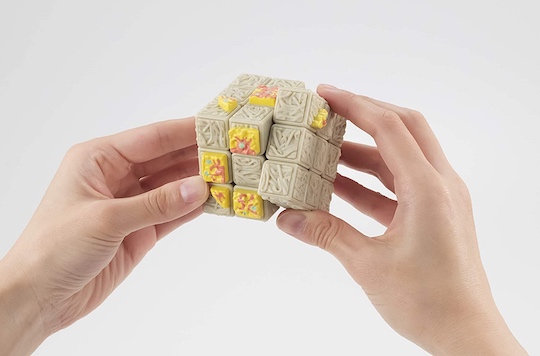
Yes, say hello to the Midori no Tanuki twisty puzzle.
What appears to be a traditional package of Maruchan Midori no Tanuki instant soba noodles is instead one of the fiendish Rubik’s-style puzzles ever devised.
It works like a standard Rubik’s Cube — a 3×3 twistable cube — but five of the six sides are based on a 3D scan of noodles. Only the top is distinguished by a tempura disk “atop” the noodles.
You would think this would make solving it easier. After all, who cares what the five virtually identical sides look like as long as you can arrange the pieces of the tempura disk on top?
But apparently, that’s not the case at all. There is only one arrangement of this six-sided cube that allows for the tempura disk to be properly formed. So you don’t have five sides you can disregard. Instead, you’re essentially solving five sides blindfolded while focusing on the top one.
That sounds like a challenge worthy of modern Rubik’s Cube solvers. Hopefully we start seeing reports of folks tackling this daunting brain teaser, and we can begin to get a sense of how long it takes to solve and how difficult the average puzzler would find it.
All we know for now is that we’re not supposed to pour water on it, no matter how delicious it looks.
What do you think, fellow puzzlers? Would you accept the challenge of the Midori no Tanuki puzzle? Is it really as difficult as reported, or do you think it’s just a lot of hype to sell a puzzle? Let us know your thoughts in the comments section below! We’d love to hear from you.
Thanks for visiting PuzzleNation Blog today! Be sure to sign up for our newsletter to stay up-to-date on everything PuzzleNation!
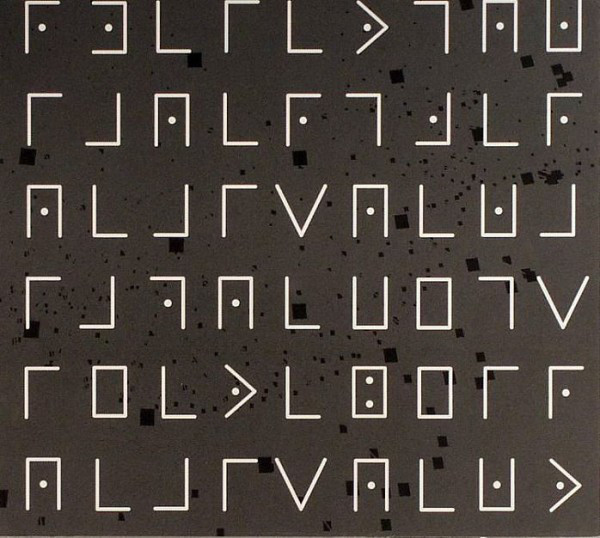
But did you know that composers can encode messages in their music, and have done so for centuries?
No, we’re not talking about subliminal messaging or tales of backwards messages hidden in metal songs. We’re talking about musical cryptography, and it turns out there’s not just music between the notes, but messages among them as well.
Now, to be fair, there is no evidence that musical encryption has ever been used for spycraft. (Sorry, Outlander fans.) Most of the time, composers simply entertained themselves by hiding the letters of their name or the names of others into compositions just because they could.
This sort of musical wordplay appears in compositions by Ravel, Debussy, and Shostakovich among others. Johann Sebastian Bach did this often enough that the succession of notes B-A-C-H is now called a Bach motif.
According to Western Michigan University Music Professor David Loberg Code:
Sometimes a musical version of a name is a subtle reference in the piece of music… Often it is very prominent; it is the main theme of the piece and is heard over and over. In that case, whether or not you know exactly how the composer translated the name into musical pitches, it is obvious that it is meant to be heard… They were not secretive about it.
It even proved therapeutic for some composers.
Johannes Brahms incorporated the notes A-G-A-H-E in bars 162 to 168 of the first movement in his 1868 piece “String Sextet No. 2 in G major.” By doing so, he included the name of Agathe von Siebold, a young woman he had fallen in love with. He and Agathe made plans to wed, but he later broke off the engagement to focus on his musical career.
But, by encoding her name into one of his works, he both honored her and gave himself closure on a relationship that would never be.
The musical nature of this encryption technique makes it effective — because casual listeners wouldn’t notice anything hidden — but it also means that longer messages are harder to include naturally.
You see, the “spelling” can affect the music. Obviously, the more complex the message, the more it interferes with the actual musical composition and flow of the piece. To the untrained ear, this wouldn’t necessarily jump out, but to a trained ear, or at least a person experienced in reading music, it would be fairly obvious that something was amiss.
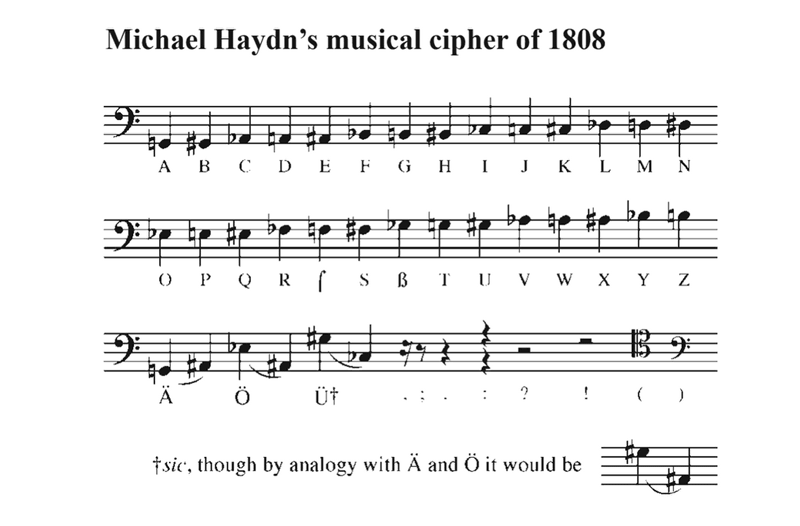
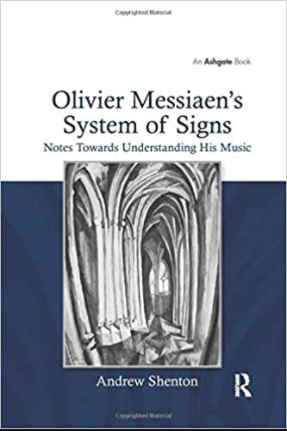
Musical ciphers are attributed to various composers (like Haydn) and even to writers like Francis Bacon, but arguably the greatest success story in musical cryptography goes to French composer Olivier Messiaen.
His cipher matched a different note to each of the 26 letters in the alphabet. Unlike many other composers, he managed to develop a cipher that closely mirrored his own compositional style. Because of the similarities between his cipher and his traditional musical works, there was less of a chance that listeners would detect anything was off.
He managed to translate the words of philosopher Thomas Aquinas into an organ piece called “Méditations sur le mystère de la Sainte Trinité,” and cryptographers and musical historians alike praise him for doing so with complex rhythms and rich tones without spoiling his own works.
It’s clear that it takes both an artistic flair and a puzzler’s mind to make the most of musical cryptography. But then again, those two pursuits have crossed paths many times before, as evidenced by musically minded solvers like Dan Feyer, Patrick Blindauer, Jon Delfin, and friend of the blog Keith Yarbrough.
Perhaps the best of musical cryptography is yet to come.













 PuzzCulture