Shell game

I’ve seen my share of con games — Three Card Monte and the like — but I’ve never before seen one in the form of a hand-cranked automaton. I can make some guesses as to how this works, but I’m not sure I want to know for sure. That would spoil it.

Puzzling with the Kids: Catch The Candy

The basic game mechanic couldn’t be simpler: In “Catch The Candy,” you play a fuzzy little critter with the ability extend a single tentacle, which can grab things or push things. Using this tentacle, you swing, drag, or otherwise navigate your critter across the terrain, in order to snag a piece of peppermint candy. (Computer game creatures really like peppermint candies these days — see also “Cut The Rope.”) Grab the candy, and you’re off to the next level.

The game’s 100 puzzles gradiate nicely, from super-easy to just a little tricky, with a few killers thrown in here and there. Even the littlest kids should be able to handle the first 40 levels, and maybe even more. Along the way, they’ll work on some basic problem-solving skills, with an emphasis on simple physics.

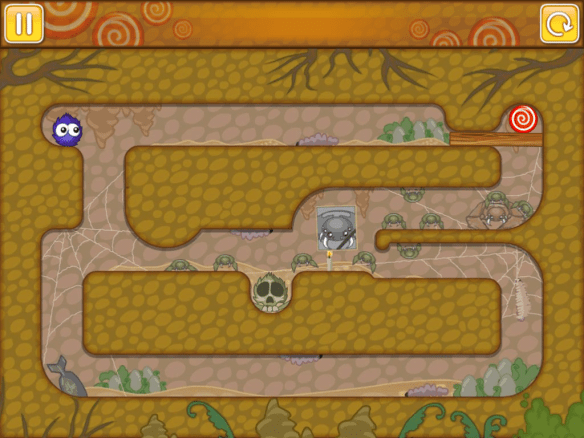
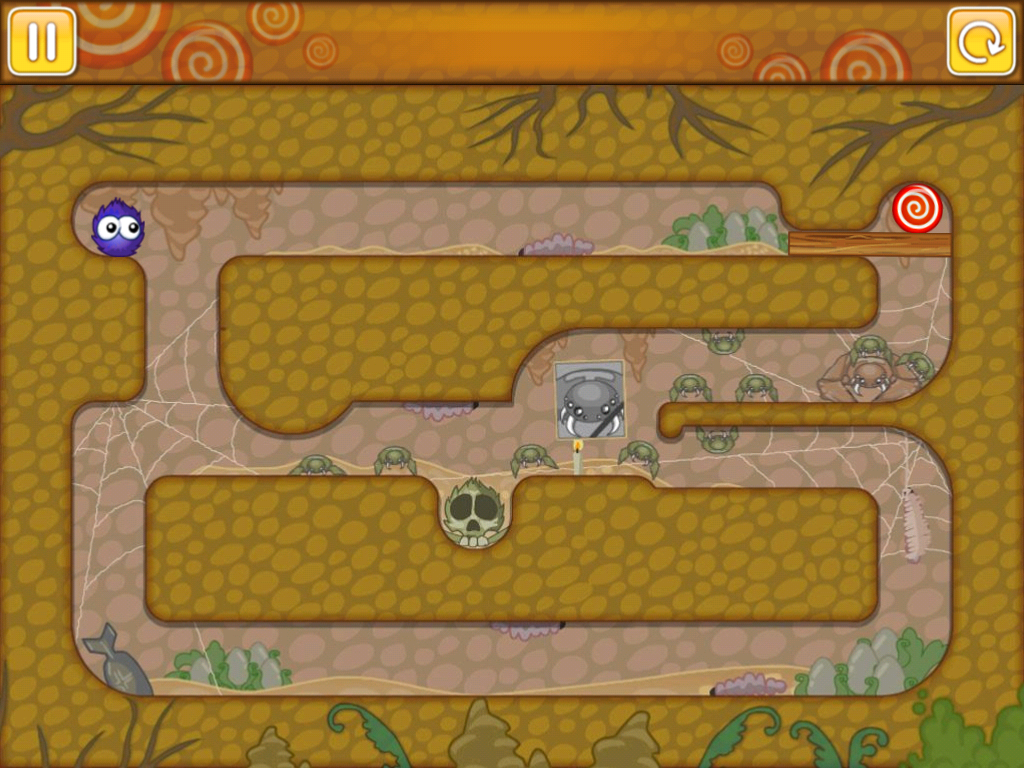
You can play some sample levels in the Flash version available here. If you should buy the full game from the iPad App Store, feel free to give me a hint about the level pictured above, which is one of only two levels I was unable to tackle this weekend. If you remove that wooden plank, the candy rolls down until it comes to a rest in the little niche with the illustration of the skull. Your tentacle can’t reach it there, nor can you fit through any of the level’s narrower tunnels. I imagine you need to drag that wooden plank around and use it in some way, but I’ve had no success at this. At the moment, I am simply waiting for my daughter to reach this level. Maybe she’ll give me a hint after she solves it before I do.

More from the Scrabble championship

Stefan Fatsis (author of Word Freak) reports on all the drama — and there was plenty of drama — from this year’s tournament.

For when you get bored playing the expert level of Sudoku.

Do you find your average Super-Challenging God-Level Expert Platinum Blond mode of Sudoku too easy?  Now you can prove it!

A pair of computer scientists from the  Babes-Bolyai University (Romania) and the University of Notre Dame (USA) have made some remarkable connections between Sudoku, the classic k-SAT problem, and the even more classic non-linear continuous dynamics.

Using these connections they’ve been able to come up with a “Richter Scale” to objectively determine the difficulty of a Sudoku puzzle.

So when you encounter a puzzle labelled hard and you find it easy all you need to do is to compute its η, a co-efficient that measures the hardness of the problem.

Simple as that! Now you can have both the challenge (or lack-thereof) of the Sudoku game plus figuring out just how badly the editors mischaracterized its difficulty level!

I’m off to try and figure out how well our Classic Sudoku difficulty ratings stack up….

Source: The Chaos Within Sudoku – A Richter Scale

WOW is worth 9 points

This past weekend was the National Scrabble Championship. I watched some of the games live on the Web — it’s hypnotically fascinating to watch these word geniuses play things like UNWISHED across two triple-word scores, netting 176 points in one go. (Not that I saw that one happen, but it’s a good example of how impressive these players are.)

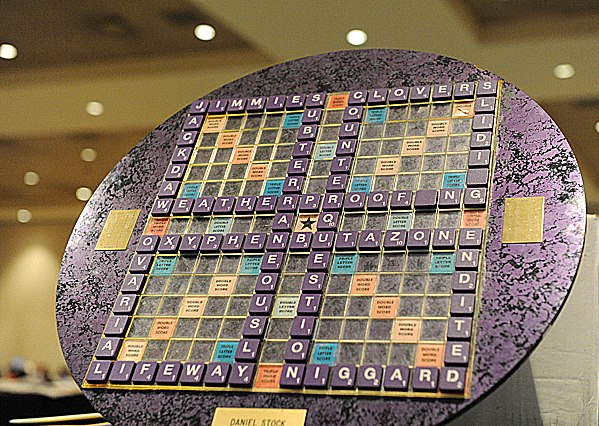
But the most mind-boggling thing to come out of the tournament may be this board created by Dan Stock. All the words are legit, and it uses all 100 Scrabble tiles.

Hat tip to Trip Payne. Photo credit: Patricia Hocker of the National Scrabble Association.

You know what a puzzle blog needs? Puzzles!

Back in February, puzzlemaker Jeffrey Harris and I presented a series of puzzles at the American Crossword Puzzle Tournament — all of them connected to PuzzleNation. Okay, it was something of an advertisement for the new site (hey, we were excited), but the puzzles themselves are varied and challenging, and were warmly received. And now we’re posting them here for your solving pleasure.

There are seven puzzles in the set. The first six will give you answers you’ll need to solve the seventh and final puzzle. Solve ’em with a friend and see if you can beat the time of Francis Heaney and Lorinne Lampert, who blazed through all the puzzles in about 25 minutes!

You can download the puzzles here. And the answers can be found here. Happy solving!