So, you like crosswords, do you?

There are many reasons to love the Internet, but a key reason for puzzle lovers is this: The many talented crossword constructors who put free puzzles on their Web sites. Once upon a time, there were one or two of them, but now there are enough to keep even the most die-hard puzzle lover busy. If you were not aware of this, then get ready to add a whole lot of Web sites to your bookmarks list…

A-Frame Games – the Web site of Patrick Berry. It doesn’t get updated nearly often enough (HINT, HINT, PATRICK), but when it does, the puzzles are amazing. A site for variety crossword lovers.

Patrick Blindauer – a new puzzle every month.

Peter Broda – Crossword “reviews, musings, and epiphanies,” and a free puzzle every Tuesday.

Neville Fogarty – a new puzzle each week.

Matt Gaffney – a weekly crossword contest: Solve the puzzle, and then try to find the hidden answer. Late-in-the-month puzzles are for experts only.

Matt Gaffney – what, again? Yes. Matt’s one of the busier constructors out there. He also presents a daily crossword at this other Web site.

Todd McClary – “The Autofill Project” is a a fun blog for word lovers, as Todd discusses interesting new words as he adds them to his crossword database. Page through the archives and you’ll come across his excellent “Unthemely” puzzles.

Pete Muller – a monthly contest crossword with a music theme.

Squaresville Puzzles – periodic puzzling from Jeffrey Harris.

Triple Play Puzzles – An emphasis on variety crosswords, from puzzlemaster Trip Payne. Updated periodically.

Brendan Emmett Quigley – boundary-pushing crosswords, twice a week.

The Wall Street Journal – The Friday crosswords and (even better) the Saturday variety puzzles are all available for free from this blog.

Whew. I think you’re gonna need a fresh pencil sharpener.
She must be no fun to play Hangman with.

We’ve all seen some lucky guesses and fortunate letters on Wheel of Fortune and other game shows in the past, but I don’t think I’ve ever seen something like this:

Time Out

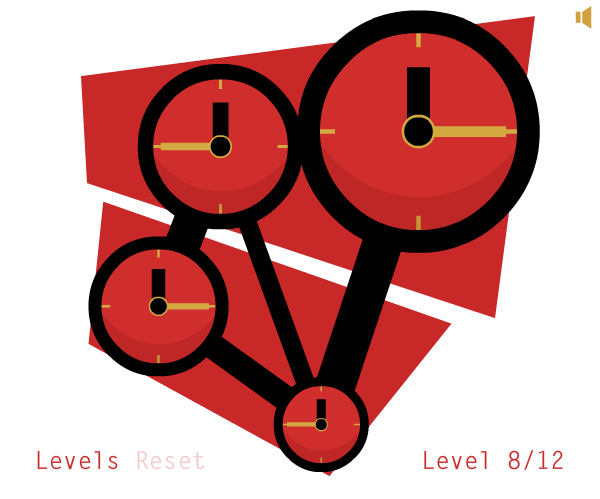
Are you reading this? Then clearly you have not had your brain crushed to powder by Twelve O, a sleek, original online puzzle game by Ozzie Mercado. Like the best games, Twelve O is simple to understand: All you have to do is get all the clocks to point to high noon. And like the best puzzle games, “simple to understand” does not necessarily mean “simple to do.”

You move a clock’s minute hand by clicking on it and twirling it around. Easy enough. The slight problem is, when you move the minute hand on one clock, you also move the minute hand of every clock connected to it. (The hour hands are locked on noon — you don’t have to deal with them at all, thank goodness.) Getting everything to sync up, therefore, becomes an exercise in switching back and forth between the clocks, making slight adjustments, until you finally see how to get them all to show the same time. Or, quite possibly, stumble blindly across the solution, as I did several times.

The twelve basic levels are reasonably solvable. The real brain crushing comes in later levels: In some, certain clocks run in the opposite direction, so you’ll have to think both backward and forward to get everything in sync. And in the final six levels, different size clocks run at different speeds — at that point, it becomes quite tricky to predict what will happen when you move a given clock hand. While you’re sweating through those final levels, keep telling yourself: At least I don’t have to sync up both hands. Maybe that’s coming in the next version.

It’s only logical

If you like tricky logic puzzles and also donating to worthy charities, check out Grant Fikes new puzzle contest.  (Thanks to Tyler Hinman for the pointer.)

Make room for The Room

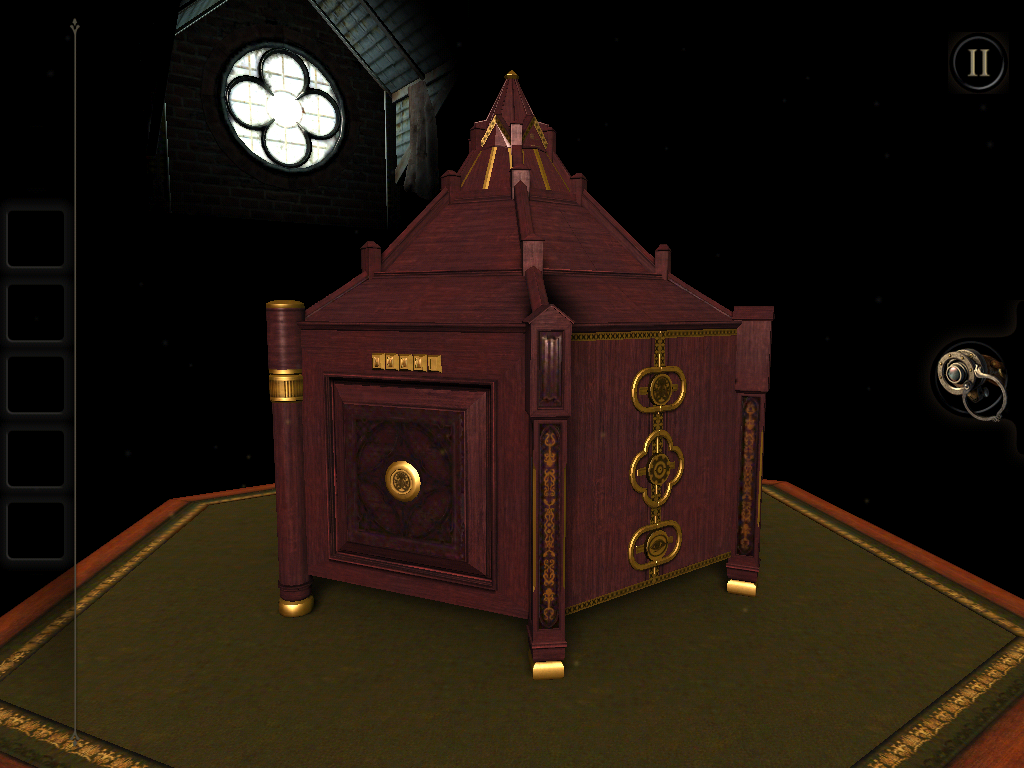
Does anybody not love puzzle boxes? Who can fail to be fascinated by a simple-looking box that reveals itself to have sliding panels and secret hinges? I own one, a cheap and mass-produced thing, that I nonetheless adore. It takes seven clever moves to open it, and I have yet to give it to anybody who simply tossed it aside with disinterest. Once a puzzle box is in your hands, you have to try to open it. It’s just human nature.

My cheapo puzzle box is nothing compared to what you’ll face in The Room, an iPad app from Fireproof Games. Puzzles boxes like those presented in the game would cost heaven-knows-what if they existed in real life. The Room gives them to you on the compact screen of your iPad, and lets you manipulate them to your heart’s content: You’ll spin the knobs, pull the levels, find the secret keys (and then figure out where they go), discover the secret panels, and, best of all, solve the puzzles. Oh, there’s a backstory — you’re following in the footsteps of a scientist who discovered some mysterious new element — but this is beside the point, as are the supposedly creepy atmospherics. Really, you’re trying to open the box because how can you not? The box has secrets; you want to discover them. It’s just that simple.

The controls are wonderfully intuitive — you can examine the boxes by spinning them around, zooming in when you find something worth exploring. It actually feels like these boxes exist in a room somewhere, and you are manipulating them remotely. The art is luxuriously beautiful. All of this combines to make a game worth savoring.

Savoring it is difficult, alas, because the one drawback to The Room is its rather short length: There are just four distinct levels, and that includes the opening tutorial. A few reviews in the App Store complain that they beat the whole game in an hour or so. I spread it out over a few days and feel more-or-less satisfied with my purchase, but if you feel that a $4.99 price should get you a game of epic length, you are bound to come away at least a little disappointed. Nonetheless, The Room is elegant, original, and gorgeous — I say those adjectives make the game worth the price.

Get a clue.

One of the most challenging parts of making a puzzle is coming up with new or clever clues. I daresay it’s the toughest part of creating a puzzle.

Of course, that same challenge also makes it one of the most enjoyable aspects of both puzzle-making and puzzle-solving. (After all, if every clue is simply a synonym or a fill-in-the-blank, it wouldn’t be much of a puzzle.)

Now, I love wordplay, I always have. Whenever I can work palindromes or anagrams or the like into a puzzle or its clues, I’m all over it. Getting to do a series of Tom Swifties as clues one time was a particular joy.

But this style of cluing is harder than you think, since sometimes you only have so much space allotted for cluing an entire puzzle. The difference between two lines and three can be crucial.

So your goal should be wordplay that’s funny AND space-efficient while still being appropriate for a wide audience. A personal favorite that I’ve seen in crosswords for a while now is the clue “It’s for posers.” (The answer is “yoga.”)

In my own cluing experience, my sense of humor occasionally causes me to stray toward impropriety when it comes to clues.

For instance, I had a puzzle where I needed to clue “bald,” so I used “unlocked” as the clue. Mildly clever, not too bad, and totally unoffensive. That’s the trinity I need to hit for new cluing.

But in the same puzzle, I had the word Lisp, and I was trying to conjure up a fun clue, instead of relying on something like “speech issue,” which is bland. The clue I eventually came up with — “Make sin thin, e.g.” — made me smile, but I scrapped it, because it might come off as insensitive.

That’s why a clue like “Grass guillotine” for “lawnmower” could cause some problems. You could offend people with that. (The French, or the recently decapitated, I suppose.)

But sometimes, you simply can’t help yourself. A fellow puzzler was trying to come up with an inoffensive way to clue “witch hunt,” a phrase that would’ve fit nicely into a particular crossword grid. (Referring to either the historical pursuit of witches OR the general connotation of persecution was out of the question.)

My thought was that wordplay could save the entry, by getting people to summon up the phrase itself without the negative connotations. You know, like “spellcaster’s search?” or something like that.

That clue came to mind later. After another clue. One that I loved so very, very much, but that I could never use for the above reasons.

My clue for “witch hunt”…

“Pressing engagement.”