History Mystery

Ken Jennings — yes, the well-known Jeopardy! champ — is collaborating with Smithsonian magazine on “The Great American History Puzzle.” This great big puzzle hunt will begin in the October issue of the magazine (you can download a free PDF here) and then leap out on to the Internet: Solving the codes and puzzles in the magazine will get you the password you’ll need to access this Web site. On October 1st, the first of ten challenging puzzles will appear on the site. Save your answers to the first nine puzzles — you’ll need them for the big finish. The first person to e-mail the correct answer to that final puzzle (it will be available on October 22nd) will win a trip for four people to Washington, D.C. plus a behind-the-scenes tour of the Smithsonian.

Serious solvers will want to keep an eye on the contest page — Ken will be blogging there, and might just offer a hint or two as the contest progresses. And just in general I highly recommend Ken’s own excellent blog.
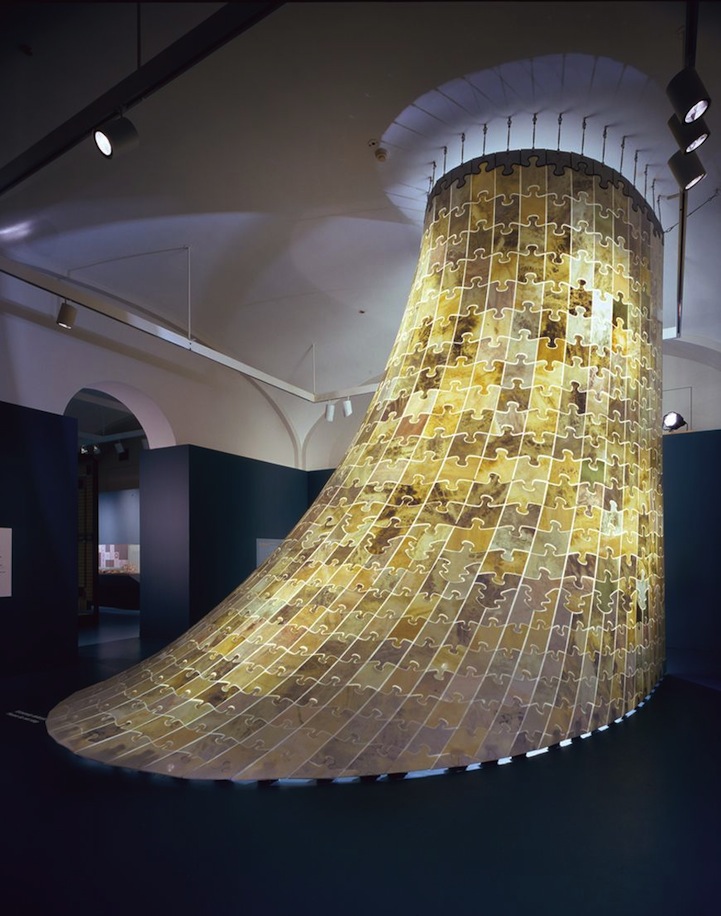
Gorgeous jigsaw puzzle curtain made of stone

Made of stone? Then I guess I’m not buying this for my front windows.

Marble Curtain is an installation at the Smithsonian’s National Building Museum. More pics at the link, including one that emphasizes how amazingly thin this marble curtain is.

(Hat tip: Neatorama.)

The National Brain Game Challenge

Crossword constructor Merl Reagle, working with the Alzheimer’s Foundation of America, is presenting the National Brain Game Challenge on September 30th at 3:00 p.m. Eastern time. Registration is $25 (benefiting the AFA, of course), and if you can complete the contest crossword super-fast, and then find the sure-to-be-devious hidden answer, you stand a chance to win up to $2,500.

This is the second year for this contest, and this time around they’re dividing up the contestants into two groups: “Professionals” (people who create puzzles or have won previous crossword tournaments) and “public” (everybody else). So there’s no reason to sit out because you fear getting trounced by crossword experts — those folks will be in their own division. Plus, the money is for a good cause. Plus Merl Reagle makes truly excellent and entertaining puzzles that are worth the price of admission even if you don’t win.

If you take part — good luck and speedy solving!

That’s how we roll

Puzzler and mathematician Eric Harshberger has created a fascinating set of dice.

When two or more people roll a die each in order to see who scores highest – what you do, for example, when deciding who goes first in a board game – there is always the chance of a tie.

In the event of a tie, of course, you roll again.

But then there is still the chance of a tie. And this can go on ad infinitum.

In other words, the process is not as efficient as it could be. Eric wondered if he could come up with a set of fair dice such that one roll of each die is enough to establish an absolute winner.

I’m not sure if the result of Eric’s thinking will save gamers “hours and hours” of time, as the article above claims, but his Go First dice are definitely cool, in the nerdiest possible way. You can roll two, three, or four of the dice, and there will never be a tie, and each player has an equal chance of rolling the highest number. You can see the Go First dice — and oodles of other specialty dice, all of which are for sale — at Eric’s Web site. (This one is my favorite.)

Not to be outdone…

Remember that room-sized gadget made from thousands of K’nex pieces? Took its creator the better part of a year to assemble it? That was mighty impressive, wasn’t it?

Well. As if in response, here is an even larger room-sized gadget, this time created out of a shmillion Lego pieces assembled into 17 separate robotic modules. Supposedly putting this thing together took almost two years. Fans of Rube Goldberg contraptions will agree it was worth every minute.

The Mazemaker’s Dilemma

Joe Wos has created what may be the world’s largest hand-drawn maze. But before it can be confirmed as such, someone needs to sit down and solve the thing. Anybody want to grab a pencil and make their way through a 140-square-foot labyrinth? The full story is at the Wall Street Journal.