
Wait — this is only a conceptual bridge? Well, phooey.

Wait — this is only a conceptual bridge? Well, phooey.
Part of being a fan of crosswords is enjoying the interaction of across and down entries as they construct an entire grid under the tip of your pencil (or pen, if you’re hardcore about it).
Part of constructing crosswords and similar puzzles is being able to build those grids, laying out words in an intricately woven lattice of linguistic delights (and occasional words-you-only-see-in-crosswords, like NENE or ELHI.)
But some puzzles rely more heavily on letter placement and interaction. (For one impressively visual example, there’s the Rows Garden puzzle Eric posted on Monday.)
I don’t know if there’s a more official version of this puzzle out there in the untamed wilds of the puzzle world, but I call it Word Chain (or Word Loops), and it takes letter placement and interaction to another level.
In Word Chain, the solver is given clues to a series of six-letter words. The “chain” (or “loop”, if you prefer) aspect comes from the answers themselves. The last three letters of one answer become the first three letters of the next answer, and so on down the line, until the final answer’s last three letters are the same as the first answer’s first three letters, completing the chain.
For instance, here’s a 9-entry Word Chain:
Toyota model _ _ _ _ _ _
Basement _ _ _ _ _ _
More massive _ _ _ _ _ _
Like some shepherds? _ _ _ _ _ _
Devoted insect? _ _ _ _ _ _
Cold-sufferer’s need _ _ _ _ _ _
Soft-surfaced leathers _ _ _ _ _ _
Tyrant _ _ _ _ _ _
Sherman or Harry _ _ _ _ _ _
The biggest advantage to the solver is that one answer provides valuable clues for the neighboring answers. Let’s say you can’t think of the first or second words, but LARGER immediately jumps to mind as the answer to the third.
You fill it in:
Toyota model _ _ _ _ _ _
Basement _ _ _ _ _ _
More massive L A R G E R
Like some shepherds? _ _ _ _ _ _
Devoted insect? _ _ _ _ _ _
Cold-sufferer’s need _ _ _ _ _ _
Soft-surfaced leathers _ _ _ _ _ _
Tyrant _ _ _ _ _ _
Sherman or Harry _ _ _ _ _ _
And then you place the connected parts of the Word Chain above and below:
Toyota model _ _ _ _ _ _
Basement _ _ _ L A R
More massive L A R G E R
Like some shepherds? G E R _ _ _
Devoted insect? _ _ _ _ _ _
Cold-sufferer’s need _ _ _ _ _ _
Soft-surfaced leathers _ _ _ _ _ _
Tyrant _ _ _ _ _ _
Sherman or Harry _ _ _ _ _ _
And suddenly, CELLAR and GERMAN spring to mind.
Now, while I haven’t completed this one, you can probably see where it’s going, with MANTIS as the next answer down the chain.
I think the inherent challenge of such an interconnected word list is what I enjoy most about constructing this puzzle.
Oddly enough, this puzzle actually becomes easier to construct the longer it is. Here’s a 13-entry version of Word Chain I whipped up just for the blog.
Jesus’s teachings _ _ _ _ _ _
Of the hip area _ _ _ _ _ _
Winner _ _ _ _ _ _
Rotation force _ _ _ _ _ _
Canadian province _ _ _ _ _ _
Transform into _ _ _ _ _ _
Breakfast dish _ _ _ _ _ _
Deadly _ _ _ _ _ _
Make holy _ _ _ _ _ _
Farthest down _ _ _ _ _ _
Writer Friesner _ _ _ _ _ _
“The Munsters” dad _ _ _ _ _ _
Tropical fruits _ _ _ _ _ _
With more time to build a chain back to the first entry, the puzzle’s loop is far easier to complete. But I set myself the challenge of creating the smallest Word Chain that still offered some challenge. (After all, while CANCAN would be a Word Chain in itself, it’s not the most taxing puzzle in the world, either to construct or solve.)
I settled on a four-line Word Chain, which was hands down the most difficult Word Chain I’ve yet constructed, because of the severe limitations the short word count imposed.
Nonetheless, here you go:
Hindu chant _ _ _ _ _ _
Qualities _ _ _ _ _ _
The very thing _ _ _ _ _ _
Danny or Jenna _ _ _ _ _ _
Well, I hope you’ve enjoyed today’s post, and that Word Chains provided you with a bit of brain-teasing fun for the day. Keep calm, puzzle on, and I’ll catch you next time.
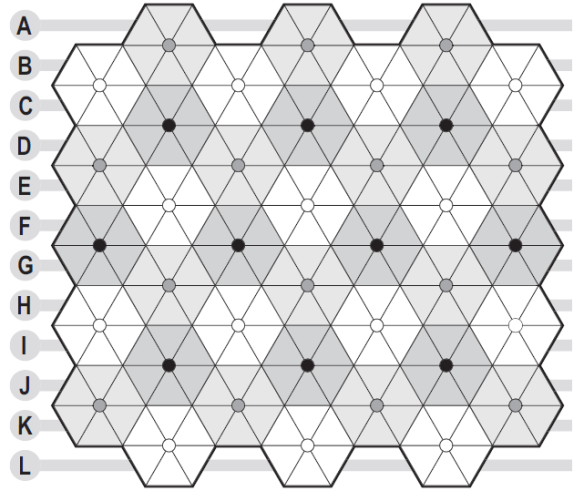
The Rows Garden is a doozy of a variety crossword invented by Patrick Berry. He puts a free one on his Web site every once in a while, and it is also frequently featured as the Wall Street Journal Saturday puzzle.
Like most variety crosswords, the Rows Garden can be intimidating if you’ve never tried one before. Just look at that grid. It’s beautiful, but kinda scary — where are the black sqares?! Or do words span those long rows from end to end? Why are the hexagons different colors? What is this?
The Rows Garden is actually a pretty easy puzzle to understand, if not to solve. Two answers will be written, one after the other, in each of the long rows. (The top and bottom rows, being shorter, get one answer each.) You’ll have to figure out where one answer ends and the next begins.
The big curveball comes with the three kinds of “blooms.” Each hexagonal shape represents a six-letter word. You don’t know which answer goes in which bloom — nor do you know in which “petal” a given answer begins. Just to add to the fun, answers can go either clockwise or counterclockwise. This flexibility allows the puzzle constructor to weave spectacularly long answers into the rows, but it makes solving a particular challenge.
Never fear! You do have one thing going for you: All of the clues for the White Bloom answers grouped together, and so are all of the Medium Bloom clues and the Dark Bloom clues.
The trick, as always with these variety puzzles, is to remember to keep your brain flexible. A row answer will provide letters for a particular bloom, and those letters might come anywhere in that bloom’s answer. For example, let’s say you determine that the first answer in row B is TRADE SECRET. That means the answer in that first white bloom contains the letters TRA. It does not mean, however, that the answer in that bloom begins with TRA. Those letters can come anywhere in the answer. Indeed, the answer here could well be RABBIT, with the RA at the start and the T at the end.
So you peruse the list of White Bloom clues, and eventually you see it: “Home decoration titan Stewart.” Aha! That would be MARTHA. When you fill the answer into the bloom, reading counter-clockwise, you then see that the first answer in row C must now begin with HAM…, and you are well on your way to solving the whole puzzle.
Somehow I feel like I haven’t made this sound less intimidating for the newbie.
Well, you’re in luck, because a fellow named Andrew Ries creates a new Rows Garden every week — and not only that, but he puts up two versions of each puzzle: Easier, and Harder. In the Easier version, you won’t have to figure out which clue matches to which bloom — that information is given to you. That’s a great way to get started on this puzzle type. And if you’ve never been to Andrew’s site before, there are 94 Rows Gardens there waiting for you. Start solving now, and in no time at all, you’ll have the puzzler’s equivalent of a green thumb.
David Kwong’s magic trick involving Scrabble is a little slow to get going — you get to watch him arrange tiles for three minutes — but puzzle lovers will be amazed at the ending.

Last week, Eric posted a link to an article chronicling the top ten works of fiction to prominently feature crossword puzzles.
While the Guardian’s countdown included some choice entries — mentioning not only The West Wing but another show near and dear to the heart of yours truly — there’s one glaring omission from their otherwise impressive listing.
M*A*S*H. More specifically, the season 5 episode entitled “38 Across,” which aired on January 11, 1977.
Now, for those of you who’ve never known a world without the Internet, I’ll explain.
(*gasp* I know! A world without the Internet! Think of it! Heaven is chock full of people who’ve never known Facebook!)
M*A*S*H centered around a mobile army surgical hospital (mad acronym skills at work here) and the trials and tribulations endured by those stationed in Korea during the war.
Some of M*A*S*H’s best episodes came from the medical staff’s desperate need to alleviate boredom at all costs during their downtime, and in “38 Across,” Hawkeye becomes fixated on completing the New York Times Crossword.
Stymied by a single clue — the Yiddish word for bedbug — he goes as far as to contact an old naval buddy, Lt. Tippy Brooks. In his fervor to solve the puzzle, he says it’s an emergency.
This comes back to bite Hawkeye and his chums when Tippy arrives, with his commanding officer Admiral Cox in tow, expecting a medical emergency, not a linguistic one.
(Click here for a terrific plot synopsis of the episode.)
It’s a very funny episode that plays nicely with a classic sitcom trope — the big misunderstanding. (The title is also a clever inside reference to the 38th Parallel, the line crossed by invading Communist forces, igniting the Korean War.)
Considering how beloved M*A*S*H was, and still is, I was surprised this episode didn’t make The Guardian’s cut.
Alas, no top ten list is perfect. (Just ask David Letterman.)
Oh! For the curious readers, the answer was “vantz.” (The fact that Hawkeye never once mentions the Down words crossing the entry makes me think puzzles aren’t exactly his forte. *laughs*)
And there you have it! All is well with the puzzle world once more. Hope you enjoyed this post, and as always, keep calm, puzzle on, and I’ll catch you next time.
I’ve seen this linked on every other blog I read, quite possibly because it is the most awesome halftime-salute-to-videogames-performed-by-a-marching-band ever.
 PuzzCulture