How did you get into puzzling?

More than a few people have asked me how I became a puzzler. What strange, meandering road led me to the hallowed halls of puzzlesmithery? Could aspiring puzzlers follow the same path to puzzlewonderful adventures?

There’s no single path to puzzlerhood. Sure, there are some fairly universal commonalities. Do you have a great vocabulary? Mad trivia skills? Are you a whiz with palindromes, anagrams, or other forms of wordplay? These can all help. Also, a background or degree in English doesn’t hurt.

But every puzzler I know took a different route. It’s not as if we all one day awoke to a knock at the door, only to discover a small basket left on the doorstep, and tiny elfin footprints leading back toward the enchanted forest down the street.

Though, admittedly, that would have been awesome.

Here, let me take you through some of the highlights in my puzzle resume, and we’ll see if my experiences offer some guidance or inspiration for those with puzzletastic aspirations.

Unrecognized Wheel of Fortune Grand Champion, USA, 1988-present

Since I was about seven years old, family members have called me into the family room to see who can puzzle out the quotes, phrases, and punny answers behind the lovely Vanna White, and I regularly school both contestants and kin with ease. While Mr. Sajak refuses to recognize my two decade reign as Wheel of Fortune Grand Champion (Stay-at-Home Division), that doesn’t make it any less noteworthy.

Internship with the Riddler, Gotham City, 2000-2001

There are few puzzle personalities in the world with the flair, cachet, and renown of Edward Nigma, otherwise known as freelance detective and occasional criminal mastermind The Riddler. So when I had the opportunity to sit in with him and learn from his decades of riddle-centric shenaniganry, I leapt at the chance.

I studied the intricacies of mechanical puzzles, wordplay, and punsmithery while under Nigma’s wing, and although I frequently found myself in legal and moral gray areas — and on the receiving end of more than a few POW!s and BIFF!s — the experience was well worth it.

Tetris Foreign Exchange Program, St. Petersberg, 2002

There’s no better spacial awareness training than Tetris — I can feng shui the packages in the back of a UPS truck like nobody’s business, and don’t get me started on my legendary vacation-packing skills — and with the addition of that horrendous tension-inducing “you’re near the top!” music, I’m cool as Siberia under pressure.

Puzzle Summit with Will Shortz, New York City, 2007

Okay, it wasn’t so much a historic meeting-of-the-minds as it was me yelling puzzle ideas at him with a megaphone as I chased him down the street. But that totally counts.

Freelance Puzzle Historian, Self-Appointed, USA, 2009-present

Oh yes, puzzle history is a rich and varied field of study, one to which I have devoted a great deal of time and effort, unearthing some fascinating and surprising discoveries. For instance, did you know that Nero did not, in fact, fiddle while Rome burned? He was far too busy being frustrated by the extreme Sudoku puzzle he’d picked up in the marketplace.

PuzzleNation Citizen, PuzzleNation, 2011-present

Yes, I was granted full citizenship in PuzzleNation, with all rights and responsibilities that entails. (Like walking the Diggin’ Words dogs and such.)

Well, there you have it. A brief glimpse in my particular puzzle experiences and how they’ve shaped me. Here’s hoping you can blaze your own puzzlerific trail, be it through decoding Linear B with Cryptogram-ingrained proficiency or anagramming your friends’ names to your heart’s content.

Good luck, and in the meantime, keep calm, puzzle on, and I’ll catch you next time.
For puzzle people, this is huge news

ETAOIN SHRDLU!

If that looks like something other than gibberish to you, then you might be a puzzle person — specifically, a puzzler who has solved your share of cryptograms. (Or played PuzzleNation’s Guessworks.) Those twelve letters are the most commonly used in the English language… or so it was widely thought for a very long time.

The original frequency list was put together by a researcher named Mark Mayzner back in 1965. The English language has surely drifted around a bit in the last fifty years — perhaps it was time to revise the list. Furthermore, computing power has improved somewhat since the mid-sixties. Mayzner’s famous list was based on just 20,000 words; a new look would obviously cast a much wider net.

And that is why Mayzner, now 85 years old, contacted Peter Norvig of Google. Using Google Books and the research tool Ngrams, Norvig redid Mayner’s work, but on a grand scale, analyzing 97,565 distinct words, which were collectively used in books over 743 billion times. That breaks down to over 3.5 trillion letters. Norvig sorted them for frequency and — whoa! We have a new list!

ETAOIN SRHLDCU!

Mayzner’s low-tech effort holds up pretty well — we don’t see any variation for the first seven letters. After that, things change a little: I always suspected R was getting short shrift compared to H. I’m not too surprised to see L edge out D, either. And U must be bummed to have slipped a place. “I’m a vowel!” you hear him cry. “I’m just as important as E or A! Do you hear me?!”

Peter Norvig’s full report, with lots more fascinating trivia about letter and word usage, can be read here.

Update: The original frequency list apparently pre-dates Mayzner.

Easy and not so easy

Pudding Monsters

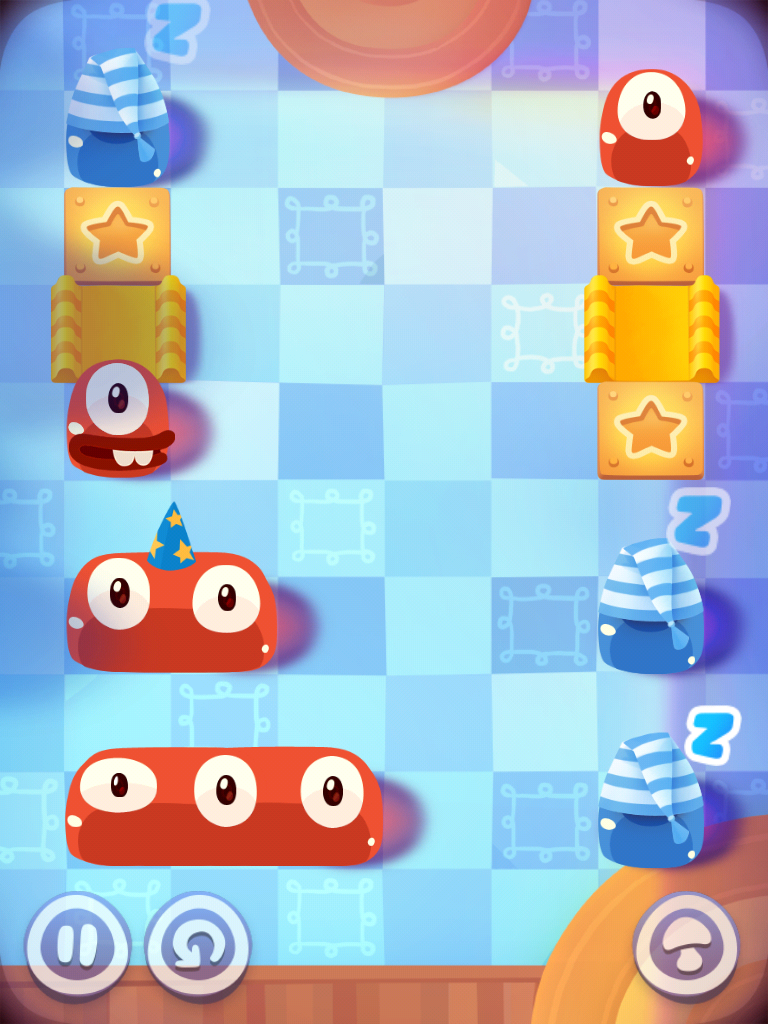
As in so many things, you can’t judge a game at a glance. Pudding Monsters, for iOS, is cartoonish but feels like it might prove to be a complex puzzle game. It’s a variant on the “tilt maze,” in which objects, once they start moving in a particular direction, cannot stop until they hit something. Here the objects in question are globs of pudding with googly eyes. On each level, the various globs wish to be united into one big glob, and they’re relying on you to help them. The game’s sole mechanic is a simple flick of the finger, which sends the pudding monsters sliding this way and that. The mazes are not terribly challenging, however, even given the little curveballs the game designers throw your way, like pudding monsters that cannot be moved until they are woken up, or gooey monsters that leave behind a trail of sticky slime. A determined solver can easily burn through the game’s 75 levels in a day — the three challenge levels you then unlock may take a little longer. Still, for .99, this is a fun diversion, especially for puzzle-loving kids, and like many iOS games, we can assume that additional levels will soon be available.

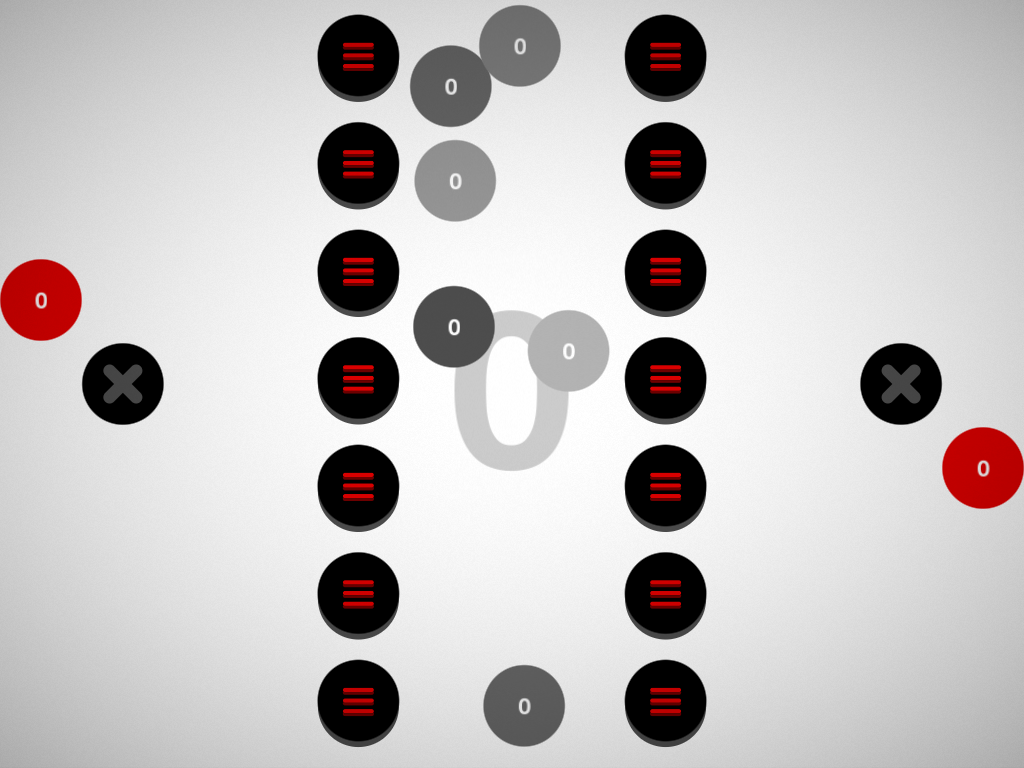
HundredsHundreds, on the other hand, looks at first like it’s going to be dead simple. The first level is little more than a joke: You touch a circle with a zero in it. It turns red and grows until the number within it hits 100. Ta da! You win!

Savor that victory. On that first level, there’s only the one circle, so there’s no way to go wrong. On subsequent levels, if the circle touches anything when it’s red and growing, that’s it: Instant death. With that intriguing, original idea established, the game designers ramp up the difficulty, crowding the screen with bubbles, spinning blades, immovable blocks, and who knows what else — I’m only about halfway through the game. Getting the circles to add up to 100 soon becomes a serious challenge, and also a thoroughly addictive one.

Up and coming

Crossword champ and bigtime Scrabble player Trip Payne writes:

This weekend, Mack Meller (who has only been playing Scrabble for about two years) destroyed a strong expert field in Albany, winning 21 out of 26 games and raising his rating to #15 in North America.

Mack Meller is 13 years old.

Resolve to solve more puzzles

Happy new year! If you’re looking for a whole bunch of great puzzles to kick 2013 off right, you have come to the right place. A bunch of talented puzzlemakers have big, wonderful projects in the works, and there’s still plenty of time for you to jump on board.

Trip Payne is just a couple of steps away from funding his new Kickstarter project, which means we’ll be seeing a crossword extravaganza from him later this year. What’s a “crossword extravaganza,” you ask? It’s crosswords and then some. Each puzzle in the set will give the solver a particular answer. All of these answers will then be combined to reveal the “meta” answer — the solution to the entire extravaganza. Depending on how many backers Trip gets, one or more people who submit the meta answer will be in the running for a $100 prize. Of course, for most of us puzzle-lovers, a brand-new challenging puzzle set is prize enough. Do yourself a favor and pledge $20 so that you can get the three bonus puzzles — a themeless crossword, a great cryptic, and a one-of-a-kind “Something Different” crossword.

Roy Leban of Puzzazz also has a Kickstarter project going: Unique Puzzles for a Yankee Echo Alfa Romeo. This will be another puzzle extravaganza, stretching across the whole year. He’s promising a wide variety of puzzles, and again, if you pledge beyond the basic level, you’ll get bonus puzzles as well. Furthermore, the project itself is a mini-puzzle-hunt! There are three puzzles on the Kickstarter page itself (one of them cleverly hidden); two more puzzles were recently revealed in the updates. Solve ’em all and keep the answers handy.

Not every puzzlemaker is going through Kickstarter. Andrew Ries has been putting out a Rows Garden puzzle every week for some time. Now he’s just a few days away from launching a twelve-puzzle contest. Jump in before the puzzles are released on January 13th.

Finally, Thomas Snyder, a world-champion logic puzzle solver, launched his own new project as the New Year’s Ball dropped: He’ll be providing an original, handmade logic puzzle every day, Monday through Saturday, at his new blog, Grandmaster Puzzles. Sign up for an account so you can enter your solutions and make a run for the leaderboard.

I think one of my new year’s resolutions should be stocking up on pencils…

PuzzleNation Book Review: The Puzzling World of Winston Breen

Welcome to the second installment of PuzzleNation Book Reviews!

All of the books discussed and/or reviewed in PNBR articles are either directly or indirectly related to the world of puzzling, and hopefully you’ll find something to tickle your literary fancy in this entry or the entries to come.

Let’s get started!

Our book review post this time around features Eric Berlin’s novel The Puzzling World of Winston Breen.

That name might look familiar. Yes, Eric and I are both contributors to the PuzzleNation blog. You may think that biases my review in some way, but I assure you it doesn’t. Yes, we both work on the same blog, but Eric stole my lunch money once, and I think that evens things out nicely. Remember: coworker + stolen lunch money = objectivity.

Anyway.

Young Winston Breen is a puzzling fiend, and most everyone in his town knows his penchant for puzzles is unmatched. So when the box he buys his little sister for her birthday turns out to have a secret compartment with a puzzle inside, everyone assumes Winston is behind it. But he’s not, and worse yet, he can’t solve the puzzle at all.

Winston and his chums start investigating where the puzzle came from, but after a curious encounter with the town librarian and crossing paths with a few shady characters, he soon discovers his puzzle is part of a much larger mystery: an actual treasure hunt. Can Winston, his pals, and these strange treasure hunters unravel a 25-year-old puzzle? More importantly, who can Winston trust?

I’ve seen this book described elsewhere as The Da Vinci Code for younger readers, but honestly, I enjoyed this book a lot more than Dan Brown’s efforts. The Puzzling World of Winston Breen is not only a fun read and chock full of all sorts of puzzles — some central to the mystery, others as stand-alone little challenges — but it’s a delightful romp of a story.

The voices of the younger characters all ring true, avoiding the common YA pitfall of having preternaturally sharp protagonists and supporting characters. Winston is often flummoxed by the challenges and obstacles he encounters, but he never gives up, always looking for another solution or pathway to solving whatever problem he faces.

But I also appreciate the lingering sense of menace to the book’s central mystery. You never lose that feeling that there’s some potential danger involved. With break-ins, vague threats, and shady characters with their own agenda, that shadowy feeling doesn’t overwhelm the more carefree puzzle-solving fun of the book, but it does add some stakes to the treasure hunt itself, which I quite enjoyed.

A quick and immensely charming read — the first in a series — The Puzzling World of Winston Breen is perfect for younger readers and puzzlers alike. (Check out the website by clicking here!)

Well, I hope you enjoyed the latest installment of PuzzleNation Book Reviews, and I look forward to more book discussions in the future. In the meantime, keep calm, puzzle on, and I’ll catch you later.