
Symmetry is nothing new to puzzle enthusiasts.
After all, diagonal symmetry is one of the fundamental rules of crossword grid design. (Along with the occasional example of vertical symmetry.)
Puzzlers are used to linguistic symmetry as well. A well-constructed palindrome, the same message reading forward and backward, has delighted and challenged many a puzzly mind. Go hang a salami, I’m a lasagna hog.

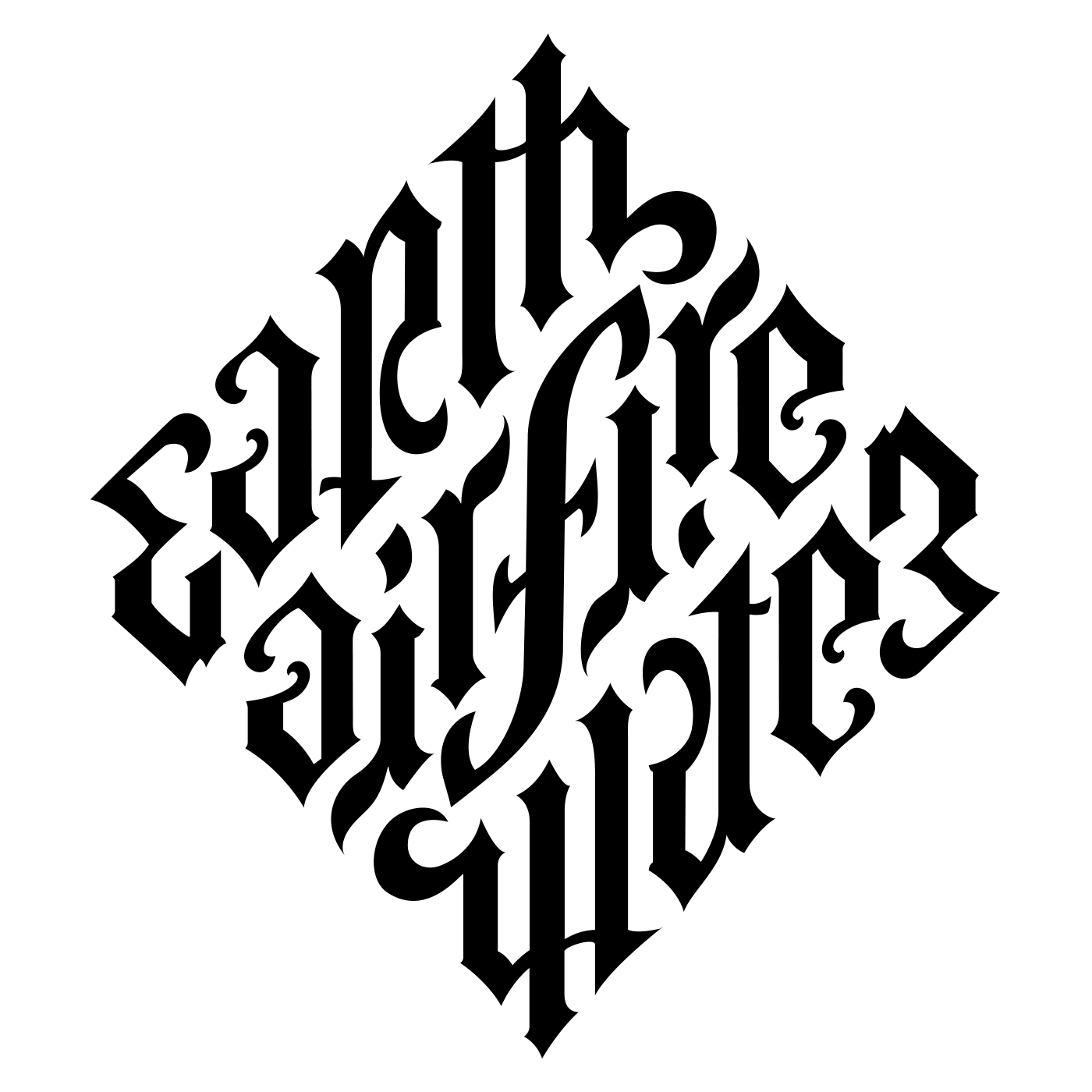
Ambigrams scratch the same itch, combining artistic flourish with clever letter placement to create a message with rotational symmetry, allowing you to rotate the image 180 degrees and see the same message.
The curious thing about ambigrams that they feel ancient, like an artistic work steeped in history from centuries past, but in reality, they’ve only been around since the 1970s! (The term itself was coined by Douglas Hofstadter in 1984.)
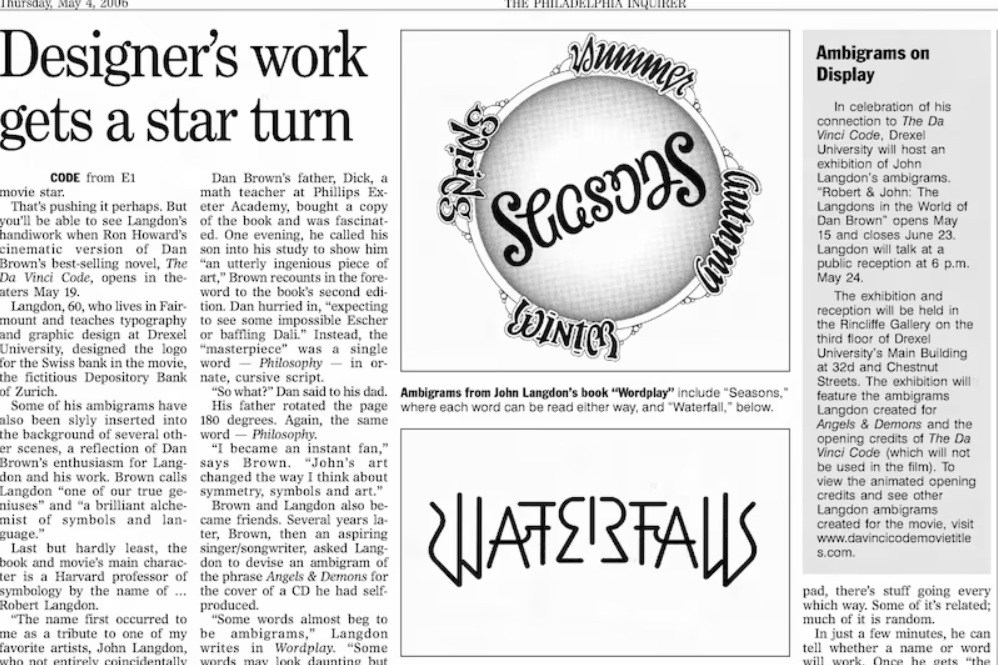
The creation of Philadelphia painter, writer, professor, and graphic designer John Langdon, he always envisioned his ambigrams as a visual presentation of words intended to present a familiar concept in an unfamiliar way.
In an interview in 2006 with Newswise.com, he said, “In the early ’70s, I tried to do with words what Dali and Escher did with images.”
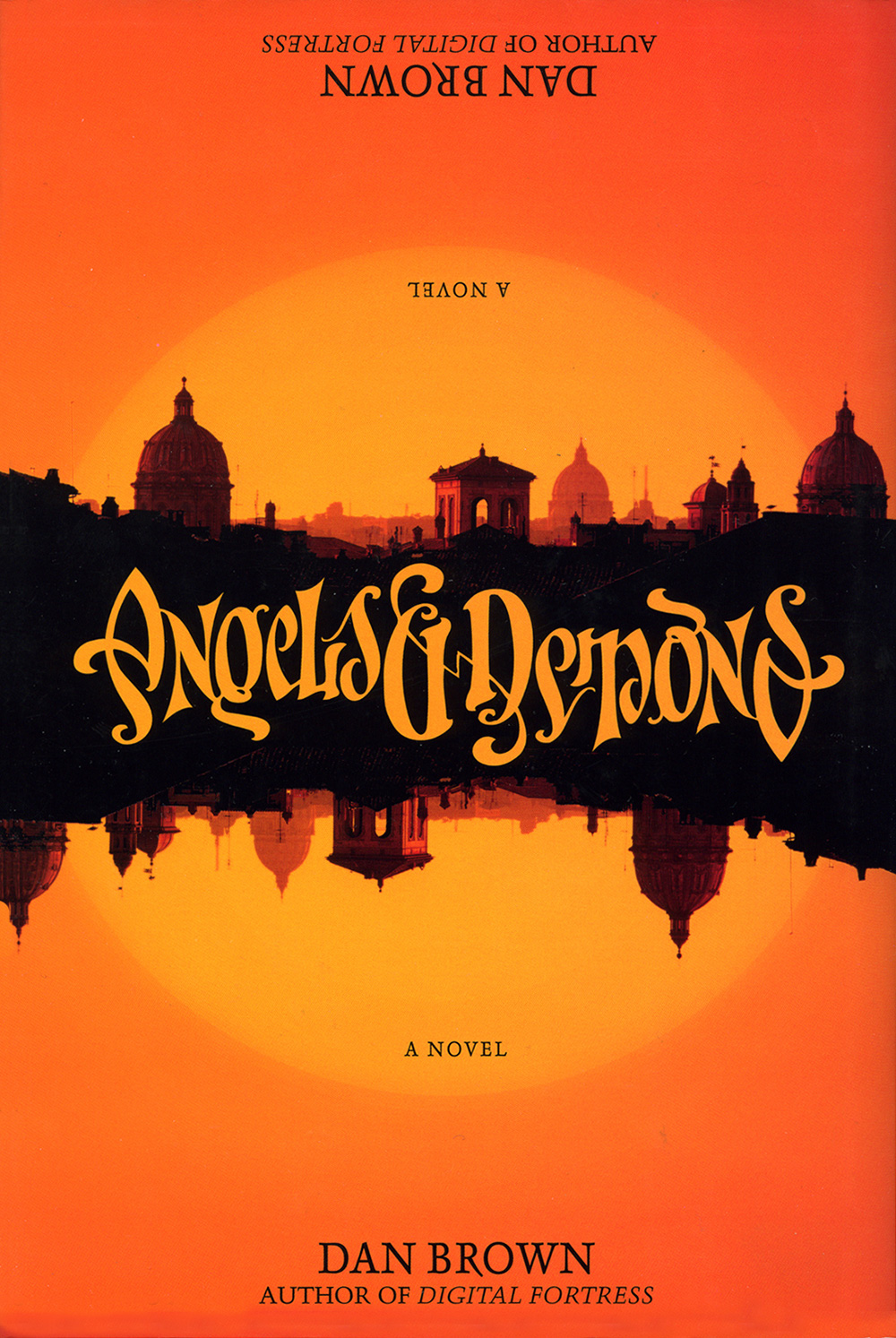
Most famously, he created several ambigrams for Dan Brown’s book Angels & Demons, adding a mystical aura to Robert Langdon’s adventures involving the church and the Illuminati.
Oh, yeah, you noticed that, did you? Yes, the protagonist of The Da Vinci Code and several other bestselling works is named after John Langdon.
In an interview, Brown shared the story of his father, a math teacher, showing him Langdon’s book Wordplay, and he was instantly hooked. “John’s art changed the way I think about symmetry, symbols, and art.”
We sadly lost John earlier this year at the age of 79, but his lasting influence in the world of wordplay is alive and well, not only with his literary legacy and namesake, but in the work of other ambigram artists.
The YouTube channel Write Words – Make Magic has gone viral over the last few years by creating ambigrams for viewers’ names, as well as other cultural touchstones, and it’s absolutely worth a watch. They happily show off their techniques for creating ambigrams, and it’s a true delight.
Ambigrams, and Langdon’s art in general, are all about revisiting one’s perspective. “Ambiguity makes people uncomfortable. But the lesson of Taoism is that if you have only one vantage point, you’re not seeing the truth.”
Puzzles are often about viewing things from another angle. Wordplay, punnery, manipulating language to surprise and playfully mislead… these are hallmarks of crosswords and crossword cluing.
A “very strong sense of legibility but also a marvelous sense of esthetics, flow, and elegance.” This could easily describe a great crossword puzzle, but it’s actually Douglas Hofstadter’s description of John Langdon and his work.
I guess it’s all a matter of perspective. Insight and wordplay, lurking within the symmetry.
If you just know how to look for it.
Do you have any favorite palindromes, ambigrams, or examples of symmetrical puzzling, fellow reader? Let us know in the comments section below! We’d love to hear from you.
Happy puzzling!
 PuzzCulture