Welcome to 5 Questions, our recurring interview series where we reach out to puzzle constructors, game designers, writers, filmmakers, musicians, artists, and puzzle enthusiasts from all walks of life!
It’s all about exploring the vast and intriguing puzzle community by talking to those who make puzzles and those who enjoy them! (Click here to check out previous editions of 5 Questions!)
And I’m excited to welcome Mike Doyle as our latest 5 Questions interviewee!

Mike Doyle is a fantastic representative of the constantly expanding independent LEGO builder community on the Internet. Pushing the limits of what people can create with LEGO bricks, Mike has created some iconic pieces, and exhibitions of his work have even appeared at the Columbus Museum of Art!
He’s also one of the driving forces behind the Beautiful LEGO series of photography books, chronicling the amazing non-official designs — I hesitate to call them “amateur” when you see the level of style, dedication, and sophistication involved — being brought to life by LEGO enthusiasts around the world.
Here’s a little lingo for you. These works are often marked MOC — My Own Creation — and creators like Mike are often called an ALE (Adult LEGO Enthusiast), AFOL (Adult Fan of LEGO), or ALH (Adult LEGO Hobbyist).
Mike was gracious enough to take some time out to talk to us, so without further ado, let’s get to the interview!
5 Questions for Mike Doyle
1. What is your process when creating one of these ambitious sculptures? How much planning goes into them before the first brick is laid? How do you know if you’re heading in the right direction or if you need to stop, reassess, and try something else?
I always have an idea before I begin. For the Abandoned Houses series, it was to emphasize the textural aspect of houses falling apart. Also I wanted to comment on the mortgage crisis at the time. The burning newspaper building was a comment on the sensationalist, fearful reporting of the media. All the pieces have a social/political or spiritual aspect to them.

[This stunning piece is “Sign of the Times: Failure of the Fourth Estate.”
Click here for a larger image and a closer look at the rich detail.]
Next, I research for interesting, inspirational images. I begin to assemble a basic idea of what I’m looking for in my head and start building from there. In this way, it is an organic process where I go with the flow until a strong look begins to emerge.
The wonderful thing about working with LEGO, is it is a one-step process in terms of visualization. No cutting, sanding, gluing or painting needed. After a small section of the model is looking good, I can stand back and take a look at that section of the finished product. From there, I can assess if the textures are working hard enough or conveying the message I want.
2. What are some of your favorite Mike Doyle originals? And what creations of others have most impressed or inspired you? Did putting together the Beautiful LEGO books introduce you to new builders and designers, or was it more of a chance to highlight the work of others you admired?
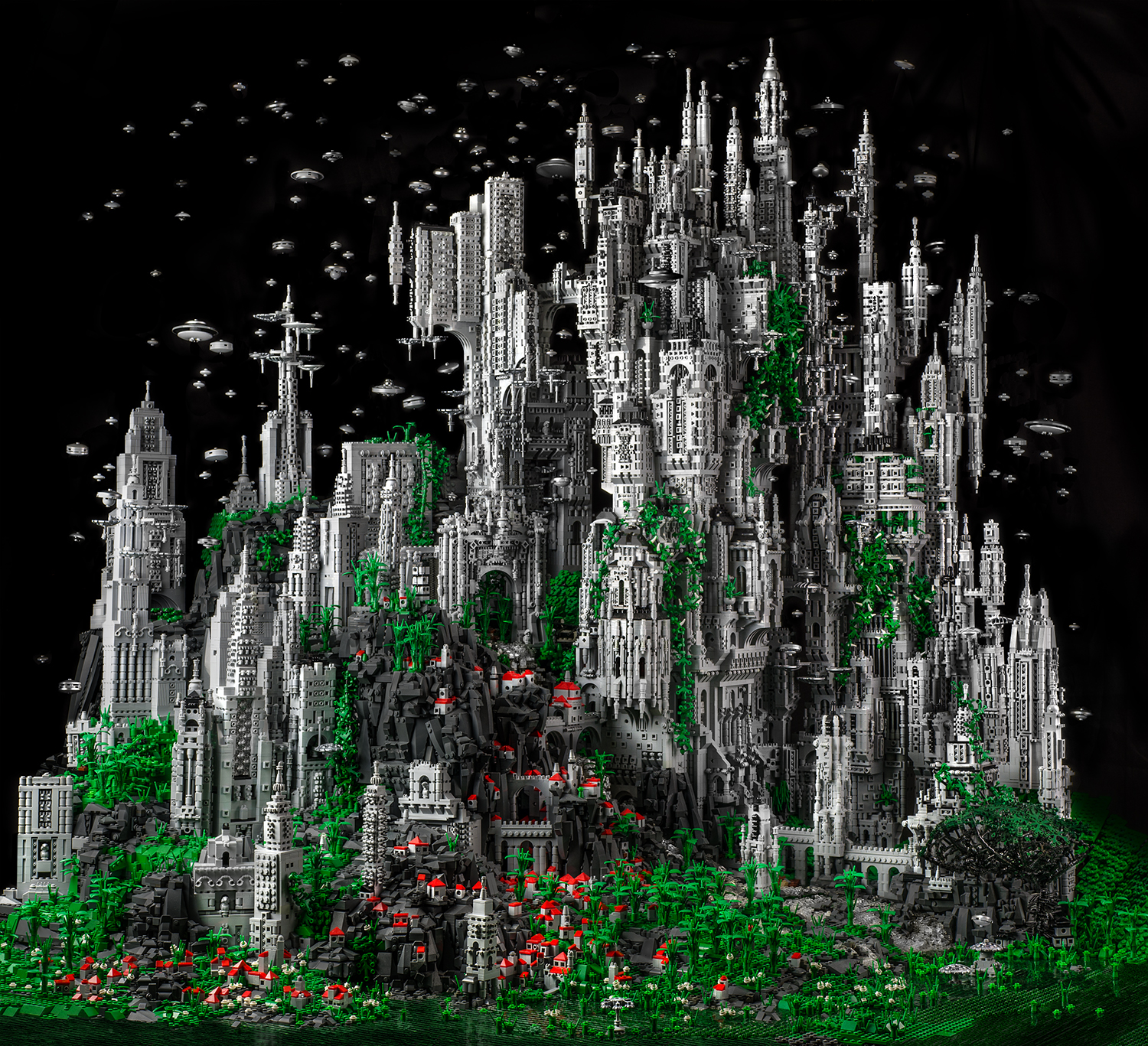
I love all of my pieces like children, so it is hard to pick a favorite. But the ones I find that have drawn my eye the most over time are “Sign of the Times: Failure of the Fourth Estate” and the large sci-fi cityscape called “Odan.”
The power of the smoke and explosion rising over the building is arresting and is not what one would expect for a LEGO model. For Odan, the sheer scale of it all and detailing is still mesmerizing for me. Also, the story behind it is filled with metaphysical principles that are of interest to me.

[Odan, in all its glory. Click here for a bigger picture to get a true sense of scale.]
When I began taking up LEGO, I looked online to see if there were others working creatively in this medium. A quick search uncovered a large group of individuals passionate about their unique LEGO creations.
As I began putting together the Beautiful LEGO books, I found more and more works and designers that were of interest to me. An example of a few of them are Moko’s shiny, sparkling “Fenix”, all of MisaQa’s little 15-30 piece micro works, Mike Nieves‘ organic sculptural representations of animals and the bizarre world of Mihai Marius Mihu.
3. Was it always LEGO for you, or did other puzzles and games play a role in forging the creator you are today?
LEGO is a relatively new interest for me. I picked it up 5 1/2 years ago after visiting Legoland, CA. While there, it suddenly hit me that this little plastic ‘toy’ could be used to create serious art. I have to say though that board games have been my lifelong passion. Every month I look forward to my game group meetings where we play the latest hot Euro games.

[One of Mike’s Abandoned Houses designs.]
4. What’s next for Mike Doyle?
I continue to work with LEGO — though at a slower pace than previous years. Right now I’m exploring a series of abstract works based on metaphysical/spiritual principles. I also look forward to building some more epic cityscapes in the Odan theme.
5. If you could give the readers, puzzle fans, and LEGO building enthusiasts in the audience one piece of advice, what would it be?
The only advice I ever give is to go with the heart. An abundance of creative energy can always be found within one’s passion. Whether it be artistic, work, play, or societal, we all have potential to thrive in our own ways.
A huge thank you to Mike for his time. You can follow his work on his blogspot page, and be sure to check out Beautiful LEGO, Beautiful LEGO: Dark, and Beautiful LEGO: Wild! for some absolutely stunning creations. I can’t wait to see what he has in store for us next.
Thanks for visiting PuzzleNation Blog today! Be sure to sign up for our newsletter to stay up-to-date on everything PuzzleNation!
You can also share your pictures with us on Instagram, friend us on Facebook, check us out on Twitter, Pinterest, and Tumblr, and explore the always-expanding library of PuzzleNation apps and games on our website!





 PuzzCulture