
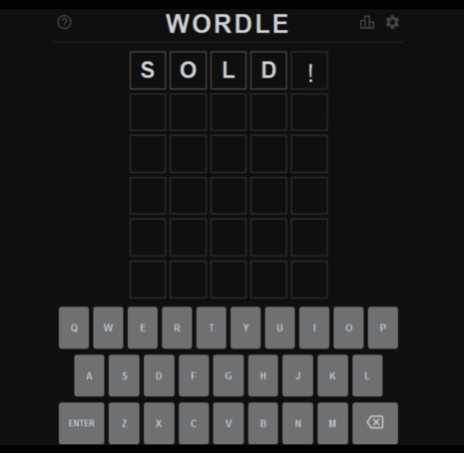
Each day brings a new five-letter word for Wordle’s devotees to deduce. If I had to pick one five-letter word to describe Wordle’s current moment, it would be SHIFT, as in seismic movement and mutation. This is for a couple of reasons. The first is a piece of news that rippled through the puzzle-loving internet at the end of January: Wordle has been purchased by the New York Times, and will be packaged with games like Spelling Bee and Letter Boxed going forward. Creator Josh Wardle’s Twitter announcement pointed out, “If you’ve followed along with the story of Wordle, you’ll know that NYT games play a big part in its origins and so this step feels very natural to me.” For anyone who hasn’t done a deep dive into Wordle’s genesis: Wardle is referring, here, to the fact that he created the game as a gift for his partner after she got hooked on Spelling Bee and the Times crossword.
Despite how it started, Wordle is no longer just “a love story” (as a January 3rd Times headline said). It’s also a story of hitting the jackpot—reportedly, Wardle sold the game for a number in the low seven figures—and it could become, as well, a story of the internet’s ongoing privatization. Wardle’s tweet stated that the game will be “free to play for everyone” even after its migration to the Times website, but fears to the contrary abound. A Mashable article about the news features the sub-headline, “’Paywall’ has too many letters,” and ends by gloomily describing Wordle as “beautiful while it lasted.” Twitter user @mcmansionhell summed up the ordeal: “the NYT took one nice and simple thing that a lot of people really liked, a dumb bit of fun in our exhaustingly dark times, and implied that they’ll stick it behind a paywall. exhausting.” Overall, ominous social media speculation has little to do with resenting Josh Wardle’s laudable success, and everything to do with anxiety about the once-free commons of the internet becoming less and less free by the day.
In response to this anxiety, solvers are already finding workarounds for the possible future paywall. One solution is downloading the Wordle site to your device, a process with instructions located here. Another alternative is playing on the Wordle Archive, which recycles previous days’ words.
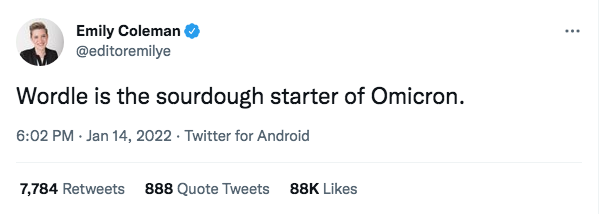
Even if the Times does decide to throw Wordle behind a paywall, its story will remain a love story. I’m not just talking about Wardle’s love for his partner; I’m referring to the public’s intense love for the game. Regardless of who officially owns Wordle, it has taken on a life of its own, and that’s the second reason why SHIFT is the word of the moment. Minimalist though it may appear, Wordle has sparked widespread creativity, inspiring memes and jokes, craft projects, and spin-off puzzles that take the game’s basic premise and alter the specifics just enough to be novel. In a short span of time, Wordle has mutated, in many incarnations, away from where it began in Wardle’s Brooklyn home.
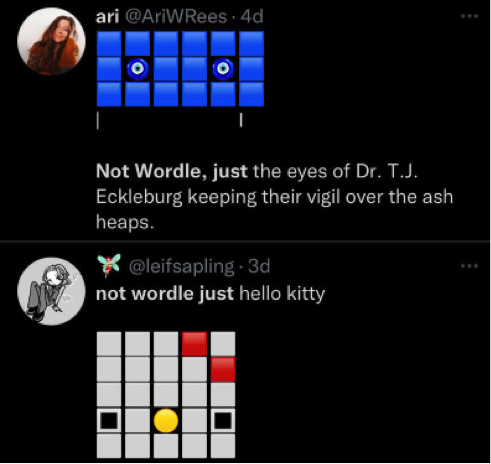
Absurdle, for instance, is a version of Wordle that does not start out with one secret word in mind. Instead, behind the scenes, the site responds to the player’s guesses by—as slowly as possible—whittling down a mammoth list of possible words until the player essentially traps the computer into only having one word left. If you identified with my earlier post speculating that Wordle’s appeal lies in its un-bingeable nature and the way it provides all players with a short, sweet shared experience, then maybe the infinitely replayable Absurdle is not for you. On the other hand, if you prefer your puzzles to have concepts that can be difficult to wrap your brain around, then dive on in. You might also love to read a further explanation from the creator of the exact mechanics of the computer’s adversarial actions.
Then there’s Queerdle, a Wordle lookalike in which the word is a different length each day, but all are themed around LGBTQ culture and history. Answers have included COMPTON—in reference to the 1966 Compton Cafeteria Riot, a San Francisco-based Stonewall Riot predecessor—and DIVINE, as in the name of the drag queen best known for appearances in Hairspray and other John Waters films. When players guess correctly, a pop-up appears with a GIF or different snappy indicator of the word’s queer significance, and a grid of snake, coconut, and banana emojis meant to emulate Wordle’s shareable squares.
Byrdle is a version of Wordle where all answers are related to choral music. Gordle is Wordle for hockey fanatics. Squirdle invites players to guess names of Pokemon, Weredle howls words at the full moon, and you can probably guess the theme organizing Lordle of the Rings. Call them knock-offs, parodies, or homages, these variations most importantly are multiplying explosively. The New York Times may own the original game, but they cannot commandeer the inventive passion that Wordle has stoked in puzzlers everywhere.
____
Not Wordle, just a different exciting opportunity to solve new word puzzles each day:

You can find delightful deals on puzzles on the Home Screen for Daily POP Crosswords and Daily POP Word Search! Check them out!
Thanks for visiting PuzzleNation Blog today! Be sure to sign up for our newsletter to stay up-to-date on everything PuzzleNation!

 PuzzCulture