

In September, there was a terrific piece in The Wall Street Journal about a trivia fan’s dream job: writing clues for “Jeopardy!” for the contestants to answer.
The application process involved writing a full show’s worth of clues and categories, and more than 1,300 applicants vied for the position. (It was the first time in the show’s history that a clue-writer position for the show was made open to the public.)
And it got me thinking about writing trivia.
Now, I’m no stranger to crafting trivia questions. I’ve assembled trivia for puzzle magazines and hosted pub trivia on a number of occasions.
So I know firsthand that writing a solid, engaging trivia question is both a skill and an art.
Years ago, I asked Stella Zawistowski about it. The crossword constructor, powerlifter, and Geeks Who Drink trivia contributor said, “Good trivia accomplishes one of two things: teaches people something they don’t know and will find interesting, or nudges them to realize they know more than they think.”
That’s something Thorsten A. Integrity has a lot of experience with. As commissioner of the invite-only Learned League trivia website, Thorsten is responsible for the six questions each day that comprise the quarterly 25-day seasons of Learned League.
In an interview with Milwaukee Mag.com, he shared his thoughts on crafting “a really primo trivia question” for solvers:
But the best kind of question, first of all, it can’t be too long. And it is something that is knowable and worth knowing – you know, interesting to know. And the question itself is written in a way that allows you different ways to come at the answer.
So if you think of it as a big boulder that you’re trying to crack open, and there are lots of soft spots around it. And you can use your tool to kind of chip away at one part or chip away at another, or chip away at the ground underneath it – ruling things out. Having these different kinds of angles of attack, and not necessarily all of those angles of attack are the words of the question itself.
In “Jeopardy!” clue-writing parlance, that’s “pinning the clue.”
According to “Jeopardy!” co-head writers Billy Wisse and Michele Loud:
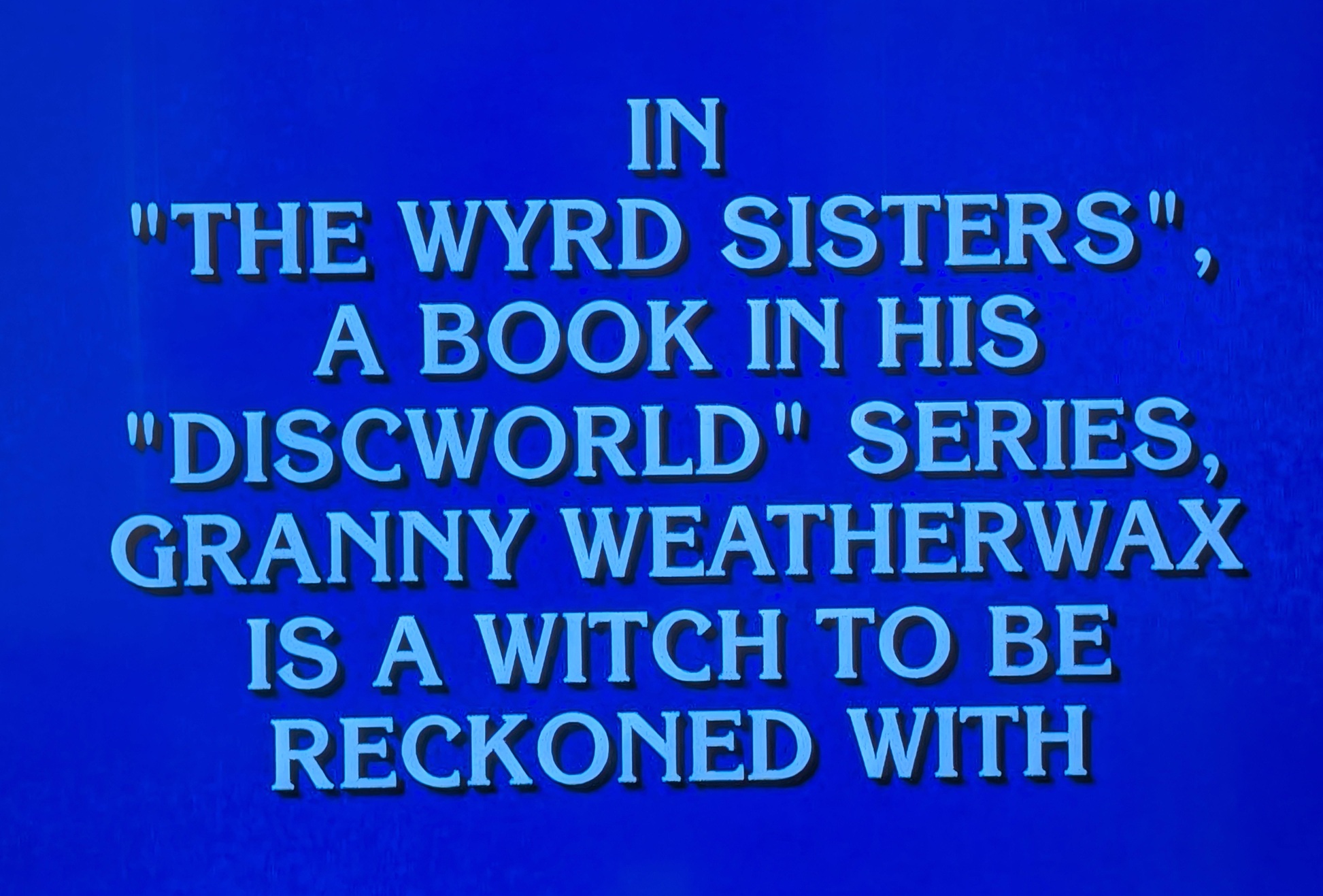
To avoid unfairness or confusion in gameplay, a writer’s most important task is to “pin” their clue to a single correct response. That means avoiding “pointers,” wordings that could lead to multiple correct responses, and “traps,” such as referring to a creepy scientist from Gothic literature other than Victor Frankenstein.
The difference between writing a softball clue versus a stumper often comes down to the “prompt,” signaled by the words “this” or “these” and the nouns that follow (such as “this horror franchise” or “these Chinese mountains”). “Those extra words, or the lack thereof, slide the difficulty level of the clue,” Loud said.
But I wanted to know more, specifically about writing clues for both live contestants and a viewing audience at home.
So I reached out to “Jeopardy!” and two of my favorite online trivia shows — Um, Actually (Dropout TV) and WrestleTrivia (YouTube) — in the hopes of learning about how they approach the clue-writing process.
Thankfully, one of them replied!
Kevin J. Kalis is the one-man creative team behind WrestleTrivia, serving as both host and triviamaster for every show, crafting everything from the 200 Point Jobber Round to the Final Question.
And Mr. WrestleTrivia was kind enough to take me behind the scenes of the show. (Which is closing in on episode 100 soon!)
How much time does it take to prepare an episode?
The pre-production of each episode begins with the formation of the five primary categories. I try to choose topics that will let me cover multiple decades of pro wrestling history. It’s important to me to highlight a variety of promotions & different eras because I feel that makes the game more complete & earns the distinction of being called “Wrestling Jeopardy” as opposed to “WWE Jeopardy.”
Once the questions are complete & written to my liking, I record in front of a green screen (not quite at the level where I can use a studio), then I edit & produce the entire video, which usually takes two days.
When you’re putting together questions, you have a terrific knack for appropriately scaling your difficulty. How do you judge where to place each question or if a category is too difficult or too obscure?
Two-thirds of my audience are between the ages of 35-54 years old, so the questions skew more to the ‘80s, ‘90s, & early 2000s. Plus, the more obscure the clues are, the more likely they will be worth 800 or 1000 points. Being a one-man operation & not having a research team to bounce ideas off of is a challenge that probably takes more time than it should. The phrase “perfect is the enemy of good” affects my workflow at times, but I enjoy the process of trying to figure out the degree of difficulty on my own.
Are there categories or questions you’ve ditched for being too difficult or obscure?
The one category that sticks out to me was in Episode 21 called “Extreme Anagrams.” I scrambled the first & last names of ECW wrestlers & those watching had the tough task of figuring them out. For example, Kent Furry is an anagram for Terry Funk. I got a lot of complaints in the comments, so that category has been tucked away for some time.
It was also around this time early on that I realized I was making the questions way too difficult for the average wrestling fan. There are some hardcore ‘rasslin trivia buffs out there, but I needed to cast a wider net in an effort to build an audience, & that’s where the 200 Point Jobber Round came from!
Much like crossword cluing, trivia writing demands that the solver meet the constructor/writer halfway. You must bring your own knowledge to the table in order to participate.
But there are degrees of this when it comes to trivia. Some falls into the YEKIOYD valley: You Either Know It Or You Don’t. Other questions have small hints or ways of leading you toward the answer without giving it away.
Your mileage may vary on which type of trivia writing you prefer.
But as you can see, writing great trivia is a careful balancing act of accessibility, surprise, and phrasing.
When I write trivia, I always want it to feel fair, regardless of whether the players get the answer or not. It should be fun whether you know every answer or only a few.
This is absolutely a topic I’d love to return to in the future, so please let me know if you have any favorite trivia shows, big or small, and maybe they’ll let us behind the clue-writing curtain.
Many thanks to Kevin J. Kalis for his time and insight into the creative process. If you’re a wrestling fan, you should absolutely check out WrestleTrivia on YouTube.

