Puzzling with the Kids: Catch The Candy

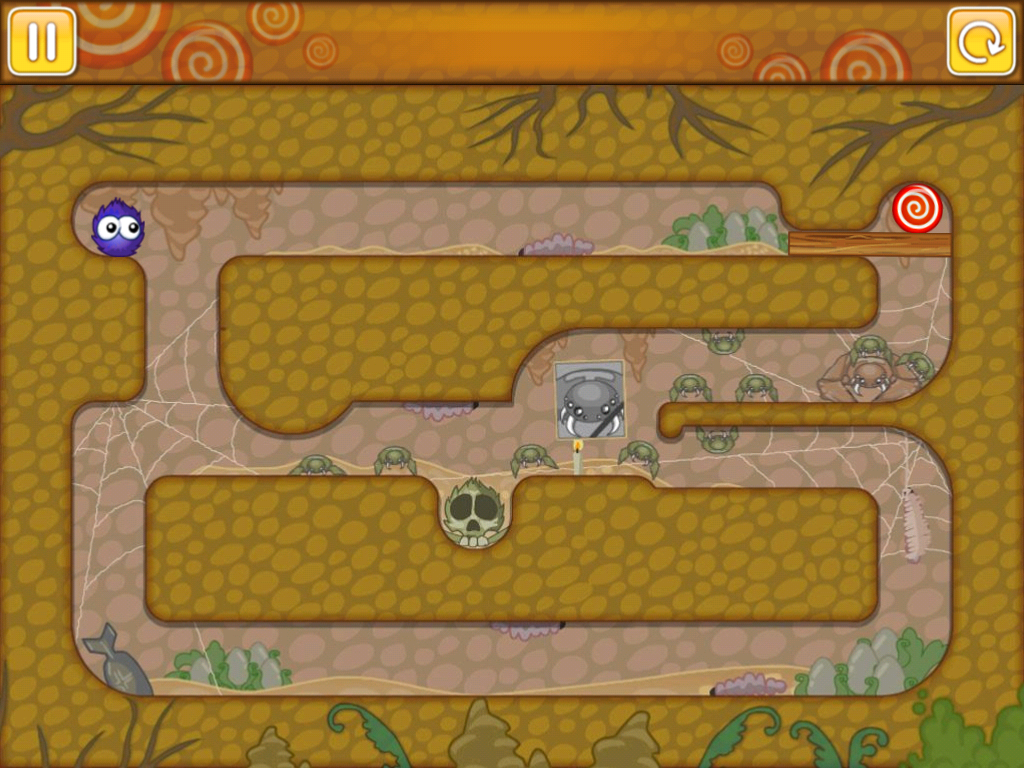
The basic game mechanic couldn’t be simpler: In “Catch The Candy,” you play a fuzzy little critter with the ability extend a single tentacle, which can grab things or push things. Using this tentacle, you swing, drag, or otherwise navigate your critter across the terrain, in order to snag a piece of peppermint candy. (Computer game creatures really like peppermint candies these days — see also “Cut The Rope.”) Grab the candy, and you’re off to the next level.

The game’s 100 puzzles gradiate nicely, from super-easy to just a little tricky, with a few killers thrown in here and there. Even the littlest kids should be able to handle the first 40 levels, and maybe even more. Along the way, they’ll work on some basic problem-solving skills, with an emphasis on simple physics.

You can play some sample levels in the Flash version available here. If you should buy the full game from the iPad App Store, feel free to give me a hint about the level pictured above, which is one of only two levels I was unable to tackle this weekend. If you remove that wooden plank, the candy rolls down until it comes to a rest in the little niche with the illustration of the skull. Your tentacle can’t reach it there, nor can you fit through any of the level’s narrower tunnels. I imagine you need to drag that wooden plank around and use it in some way, but I’ve had no success at this. At the moment, I am simply waiting for my daughter to reach this level. Maybe she’ll give me a hint after she solves it before I do.
For when you get bored playing the expert level of Sudoku.

Do you find your average Super-Challenging God-Level Expert Platinum Blond mode of Sudoku too easy?  Now you can prove it!

A pair of computer scientists from the  Babes-Bolyai University (Romania) and the University of Notre Dame (USA) have made some remarkable connections between Sudoku, the classic k-SAT problem, and the even more classic non-linear continuous dynamics.

Using these connections they’ve been able to come up with a “Richter Scale” to objectively determine the difficulty of a Sudoku puzzle.

So when you encounter a puzzle labelled hard and you find it easy all you need to do is to compute its η, a co-efficient that measures the hardness of the problem.

Simple as that! Now you can have both the challenge (or lack-thereof) of the Sudoku game plus figuring out just how badly the editors mischaracterized its difficulty level!

I’m off to try and figure out how well our Classic Sudoku difficulty ratings stack up….

Source: The Chaos Within Sudoku – A Richter Scale

Puzzling with the Kids: Fireboy and Watergirl

Kids just want to help. They want to help make dinner; they want to push the grocery cart all by themselves. And heaven knows they want to help solve that puzzle you’re working on. My daughter used to help me with the New York Times crossword by pointing to the few random words she was able to read and shrieking them with joy. Very helpful.

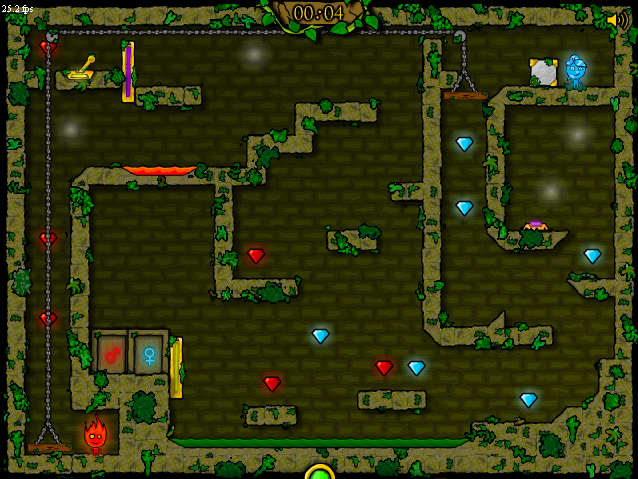
The Fireboy and Watergirl series of online video games really lets your kid help. Each level is a maze, which must be solved by two people working together. One player controls Fireboy, a smiling red flame, who will of course go up in smoke if he so much as touches water. The other player controls Watergirl, a sprightly blue splash, who naturally cannot enter the pools of lava that seem to be everywhere these days. Only through cooperation can the two friends make their way to the exit and the next, more challenging level.

The games — I believe there are four of them now — are perfectly accessible for even little kids: The only controls are right, left, and jump. (I started playing these games with my daughter when she was six.) But the puzzles themselves are no joke. After a few whet-your-appetite easyish mazes, things start getting challenging indeed. You’ll probably want to discuss strategy with your child — and you may be surprised how quickly your child sees the correct way forward. (“Okay, you stand on the blue button to lower the door and then I’ll go through and pull the lever so that the elevator descends, and you take the elevator to get the gem!”) Even so, certain levels will have to be attempted more than once — if either character touches something he or she should not, it’s curtains and back to the start.

We solve puzzles because it is satisfying to do so. Well, it is even more satisfying to solve a puzzle when your child is sitting on your lap, genuinely lending assistance every step of the way. Actually, wait — your child doesn’t merely “help” solve the Fireboy and Watergirl mazes. You and your child are, in fact, equals. You are helping each other.