The Fool, The Magician, The High Priestess, and The Gamer

Jane Seymour reading tarot as the James Bond character Solitaire in Live and Let Die

What do you think of when you think of tarot cards? Puzzles, games, logic, and creative problem-solving? Or crystal balls, tea leaves, palmistry, and vibes?

Popular imagination seems to be split on this. Googling “tarot” brings me recommendations for psychics I might want to visit; a significant chunk of the other search results occupy astrology and “lifestyle” websites. A Teen Vogue introduction to tarot states, “To those who think the practice of reading tarot is an occult art reserved for spook sessions, let me say: You’re wrong,” but goes on to explain that a tarot reading is an intimate conversation.

However, according to A History of Games Played with the Tarot Pack, Volume 1,tarot cards were invented for gaming, not for fortune-telling, when they originated in 15th century Italy. And while their modern role in the world of games and puzzles is fairly divorced from their roots, many still see them as having puzzly potential.

The final puzzle in horror video game Silent Hill 3, for example,requires players to arrange tarot cards in a specific order. New tabletop narrative puzzle game The Light in the Mist involves unraveling a mystery with a deck of tarot cards as your greatest resource. A 2018 Nerdist article gives advice on how to incorporate tarot into tabletop role-playing regardless of the original game’s design. There are also many jigsaw puzzles drawing on the designs of various tarot decks, including the classic 1909 Rider-Waite deck, and the “Life is Like a Board Game Tarot” is a fully functional deck modeling itself after Monopoly.
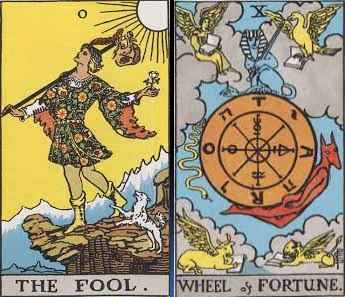
A couple of Rider-Waite major arcana cards. The Fool is commonly the trump card in tarot games. The Wheel of Fortune is unfortunately unrelated to the game show.

The Nerdist article does suggest that using tarot for role-playing is “poor form and bad luck,” and that it would be safest to use a special, dedicated deck for any gameplay rather than mixing and matching your fictional fortunes with your more “factual” future. But just as it’s a personal choice whether to treat a Ouija board as a spiritual artifact and potential gateway to demonic possession or to take it very literally as a toy by Hasbro, only you can decide how much weight to give this word of caution.  

Yes, some people fear that they are tempting fate by using a tarot deck for both serious and recreational purposes—but maybe you’re perfectly comfortable tempting fate! Or maybe you’ll choose to acquire a deck that will only ever be used recreationally. Either way, you can have a lot of fun with tarot, even beyond the possibilities of incorporating it into your usual tabletop role-playing hijinks.

The original Italian trick-taking tarot card games introduced the concept of cards trumping other cards to the realm of gameplay, a concept we can trace all the way to modern fantastical, battle-style competitive card games like Pokemon and Yu Gi Oh. After occupying Milan, the French adopted the idea of playing with the tarot deck, and the game of French tarot quickly became favored more highly than chess. The full rules to playing French tarot can be found here, though you might decide that you’re more interested in playing Grosstarock, which Stewart Dunlop describes as “really cool, if you want to play for real stakes, but are tired of poker.” Or perhaps your fancy will be struck by Hungarian Tarokk or Königrufen, the latter of which is wildly popular in Austria. These games differ in exact rules, number of players, and even number of cards used from the tarot deck, but are united by gameplay featuring bidding and the assignment of point values to the cards.
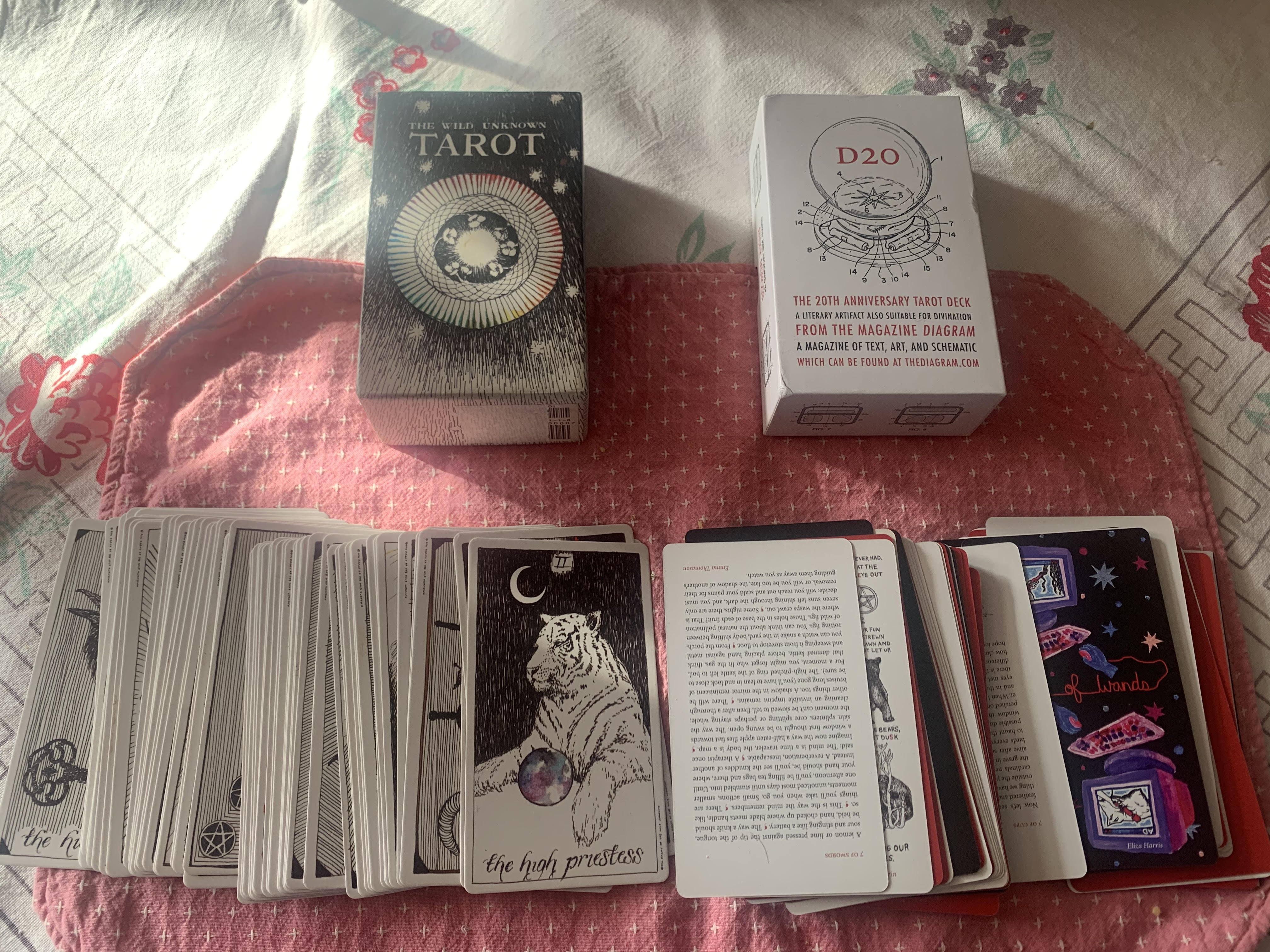
Your blogger’s preferred tarot decks

Between trick-taking, tabletop gaming, and forecasting the future, tarot is replete with many marvelous uses. While its forecasting function appears to tie into the mystical side of the cards more than the puzzly side, I’d argue that it sits comfortably in both realms. Michelle Tea, who wrote The Modern Tarot: Connecting With Your Higher Self Through the Wisdom of the Cards (my personal go-to volume for discerning meaning in my own readings), describes her early experience with tarot thusly:

I was in a growing state of awe at their intuitive accuracy, the way the small stories encapsulated in each illustration knit together into a wider narrative that made sense, sometimes poetic, sometimes chillingly pointed.

What I see in this take, above all, is the word narrative, drawing me back to the allure of tying tarot and tabletop gaming together. There may be no dice or character stats involved, but tarot still enables us to tell compelling stories. Considering that we are living in a world in which forces such as Lifehacker urge us to gamify our lives via apps, I think now is tarot’s time to shine. Maybe pointedly using the same deck for both role-playing games and connecting with your inner truth is actually the perfect way to go, a strategy for injecting your day-to-day life with the magic of games.

Move over habit trackers and apps that turn jogging into an escape from zombies! Here comes something more poetic and more pointed: in Michelle Tea’s words, “an ancient story system” that will fill your life with wonder.


I see in your future . . . a tall, dark stranger, a voyage across the sea, and some delightful deals on puzzles. You can find those deals on the Home Screen for Daily POP Crosswords and Daily POP Word Search! Check them out!

Thanks for visiting PuzzleNation Blog today! Be sure to sign up for our newsletter to stay up-to-date on everything PuzzleNation!

The PuzzleNationer’s Guide to The Adventurer’s Guide to the Bible

“Cleopatra is dead,” begins the voiceover narration of the trailer for The Adventurer’s Guide to the Bible. “Distant empires struggle for world domination, while the people in the middle kingdoms wait for the coming of a so-called Messiah.” So go the events of the first century A.D. Fast-forward to the twenty-first century A.D., and Cleopatra is still dead, but we also have the internet, and with it, Kickstarter crowdfunding.

As of this writing, the Kickstarter for The Adventurer’s Guide to the Bible has raised over $47,000 from more than 880 backers, massively exceeding its original $5,500 goal. And that’s with a February 5th deadline—there’s plenty of time left for that pot of gold to overflow even more. An ambitious project of Red Panda Publishing, the Guide sets the events of the Bible alongside non-biblically documented events, and in the midst of all of this, invites players to create their own characters and stories as they would in any other Dungeons & Dragons campaign. The project creators note that this sort of collaborative, choose-your-own adventure storytelling is itself biblical, explaining:

“Each time Jesus tells his gathered listeners about the prodigal son or the good Samaritan, he is creating a scenario that challenges the listener not only to reflect, but to respond. Just look at how many of these parables end with a question like ‘what would you do next?’”

You might have a question of your own: What exactly is all that money for? The funds are intended to go toward the production and publication of a hardcover, vividly illustrated campaign guide compatible with “5E,” shorthand for the 5th edition of the Dungeons & Dragons rulebook. The differences between the various editions of the game might seem opaque if you’re not well-versed in tabletop gaming, but as one blog post puts it, “5E is not just the most approachable edition of D&D ever, it’s also one of the most approachable RPGs ever made,” meaning that it’s simple for new players to grasp the game’s mechanics and dive right in.

While others have imagined biblical D&D, the Guide goes far far beyond imagination.

The same post argues, however, that 5E is not so appealing for GMs, or Game Masters—typically known as Dungeon Masters in the context of Dungeons & Dragons. This is because rather than being granted a ton of artistic license as they run the show, “The GMs are just there to execute the game. Particularly, to execute published, prewritten games. And to allow the players to show off their creative visions during those published, prewritten games.” The Adventurer’s Guide to the Bible is one such game. At 350 pages, the Guide will be replete with relevant maps, NPCs, monsters, and all other information necessary to produce a fully fleshed-out story, as long as your character doesn’t exceed level 10. For the uninitiated: characters level up as they go on adventures, eventually maxing out at level 20; a thorough explanation of character levels can be found here.

The Kickstarter FAQ page promises simultaneous fealty to the Bible’s text and incorporation of the game aspects players love—“dungeon crawls, mysteries, romance, monsters, etc.” High-level supporters of the book have also been promised a related Spell Cards deck and world map poster.

Now here’s the part that makes this truly a new source of adventure rather than a rehash of a narrative with which many are intimately familiar: the majority of the campaign takes place in 26 A.D., a period in Jesus’ life that the Bible does not cover. The Guide’s creators explain that this choice is meant to give players freedom and flexibility to build their own narratives within the campaign without conflicting with the Bible’s own narrative arc.

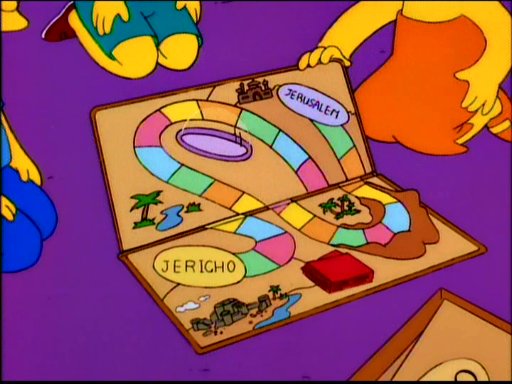
The Simpsons and Flanders children sit down to a game of Good Samaritan.

According to a Reddit comment by the creators, the Guide was first born out of a personal desire to play in a biblical setting, with no plans for a wider release. However, the Christian response, particularly from youth groups and Bible study groups that play 5E, pushed Red Panda Publishing to expand their vision. This is the publishing group’s first major project, though the game designers have independently published a few board games.

The year is 2022. We have the internet, we have Kickstarter, we have Dungeons & Dragons, Cleopatra is dead, and The Adventurer’s Guide to the Bible is scheduled to ship out to Kickstarter supporters this coming August.


In the meantime, treat yourself to some delightful deals on puzzles. You can find them on the Home Screen for Daily POP Crosswords and Daily POP Word Search! Check them out!

Thanks for visiting PuzzleNation Blog today! Be sure to sign up for our newsletter to stay up-to-date on everything PuzzleNation!
A Wordle a Day Keeps the Burnout Away

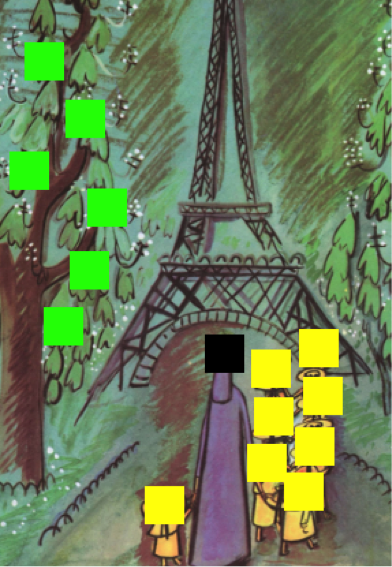
If you’re like me, in the past few weeks your Twitter timeline has become a parade of yellow, green, and black-or-white squares all lined up in rows like Madeline and her schoolmates walking through the streets of Paris. Early on, I discovered that the squares were part of a game called “Wordle,” but I initially assumed that arranging the squares was itself the game, that there was some kind of subtle pattern creation at work. Plugging “Wordle” into a search engine led to trying to solve one Wordle puzzle, just to see what all the fuss was about, and that immediately led to making Wordle an essential part of my daily routine (just like Madeline’s daily walks).  

As demonstrated by those squares on Twitter—and by a recent flurry of news coverage— I’m not alone. Maybe you too are riding the Wordle wave, eagerly waiting for midnight, when you’ll be granted a new chance to deduce a secret five-letter-word. On the surface, the fact that we only get one Wordle challenge each day seems like it could be a point of frustration. In a pop culture landscape dominated by the model of “binging” media, we tend to always want more, more, more of what we enjoy. So why have so many people become riveted by a website that not only doesn’t ask for more than a little slice of your day but actively doesn’t allow you to participate for more than a single six-guess puzzle at a time? 

Sarah Demarest, a library youth services provider in western Massachusetts, theorized to me that our overfamiliarity with binging the latest trends is exactly why something like Wordle can catch on; a large part of its charm is its model’s rarity. She explained, “For me a lot of the appeal is in the fact that you can’t just play nonstop. You get a new episode every day.” Picking up on her television analogy, I pointed out that this meant Wordle was like a return to classic patterns of TV consumption, and she agreed, adding, “I have always been a strong believer that we need an equal mix of serialized and bingeable TV. But I have never thought about how that applies to other trends too.”

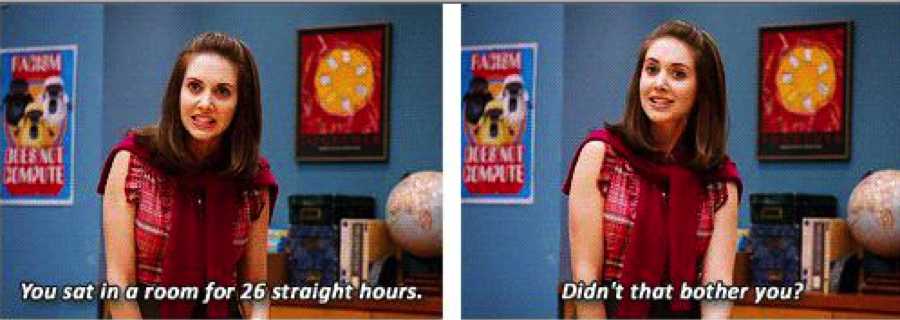
You watched Tiger King for five straight hours. Didn’t that bother you? Maybe!

A tweet by screenwriter Eden Dranger @Eden_Eats with more than 4,000 retweets and 44,000 likes places Wordle in a list of “Covid Eras” beginning with the Netflix documentary series Tiger King. Both have been pandemic sensations, topics of memes and group-chat conversations alike, but this shift from Tiger King to Wordle, taking Sarah’s theory into account, indicates that maybe we are seeing an overall shift from a passion for the bingeable to a passion for the serialized. At a time when so many of us are burned out for larger, heavier reasons than a pop culture trend, do we really need to be inviting more of that exhaustion into our brains?

The game’s creator, Josh Wardle, is conscious of how his site fits into our greater historical context, explaining on an episode of Spectacular Vernacular that the choice to remove attention-manipulating features like push notifications and endless play “had this effect where the game feels really human . . . And that really resonates, you know, [with] where we’re at right now in the world in light of Covid.” When we ourselves are so often, on Zoom, reduced to little squares on a screen, a different set of little squares on a screen has the ironic power to remind us of our humanity. After all, not being able to binge means having to move at the same speed as everyone else. We are all walking next to each other. 

A New York Times article about Wardle and his game states that the limit on one game per day “enforced a sense of scarcity . . . which leaves people wanting more.” There’s probably some truth to that, but in spite of what the creator of the copycat website Wordle Unlimited might think, maybe we’re just ready to pace ourselves instead of being deluged with constant streams of entertainment.

Pacing ourselves instead of binging is our philosophy when it comes to our Daily POP crosswords and word search puzzles. You know that we love pop culture enough to consume our favorite pieces of media for five—or twenty-six—straight hours ourselves. However, in this binging-saturated world, we’re happy to provide something steady and serialized for contrast. So, after you finish tweeting your Wordle squares for the day, why not hop on over to Daily POP and continue your slow-burn love affair with word puzzles?


Treat yourself to some delightful deals on puzzles. You can find them on the Home Screen for Daily POP Crosswords and Daily POP Word Search! Check them out!

Thanks for visiting PuzzleNation Blog today! Be sure to sign up for our newsletter to stay up-to-date on everything PuzzleNation!