Crosswords are perfectly good puzzles. I love ’em. I construct ’em. The cleverest crosswords make you want to sit back in your seat and stare with the deepest admiration for the person who made them. Crosswords are a mainstay of the puzzle world, and that is absolutely fine with me.
But puzzlemakers, being a creative lot, have never been content with words that only go across and down. They want to send words in crazy new directions: Diagonals! Around in circles! Out of the grid entirely!
These are variety crosswords, and the best of them are among the most dazzling word puzzles ever created. But, alas, many people — even people who solve a crossword every single day — look at variety crosswords and immediately decide, “That’s too complicated. That’s too crazy. That’s too hard.”
Variety crosswords may be a little harder, in general, than standard crosswords, but they are still perfectly solvable puzzles. If you can solve a mid-week New York Times crossword, then you can handle just about any variety crossword in existence.
Here’s the key thing you need to know about variety crosswords: Many of them still have words going in two different directions. It just so happens that those two directions are not merely “across” and down.” But that’s okay: You solve them the pretty much same way, by working back and forth between two sets of clues. You might need to bend your brain in interesting new ways, but you can do that, right?
Let’s take a look at a particularly complicated variety crossword, and hopefully I can show you that it’s not complicated at all.
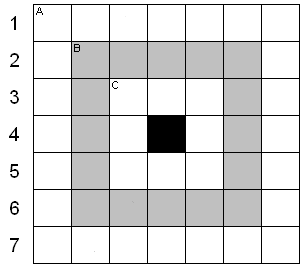 Marching Bands is a puzzle type invented by Mike Shenk. The first several times I looked at a Marching Bands, I could not comprehend what was going on. (Granted, I was a kid at the time.) Some of the answers read across the numbered rows — I could grasp that much. But the other words were doing what? I felt instantly out of my depth.
Here’s how it works: Just like I said, the words will be entered in two different ways:
- Two words will be entered in each numbered row.
- A set of words will be entered clockwise around each “band,” starting in its upper-left corner.
That second point is where a lot of people trip and fall, so let’s take a closer look at a completed grid.
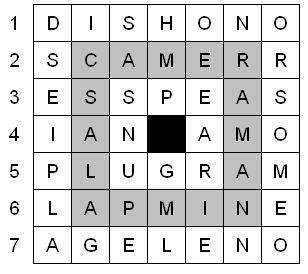 Marching Bands are not usually this small, but it will do for an example. Now, if you’re not used to solving variety crosswords, then what you may see here is a wall of letters. Let’s impose a little order on it.
Two words will be entered in each numbered row.
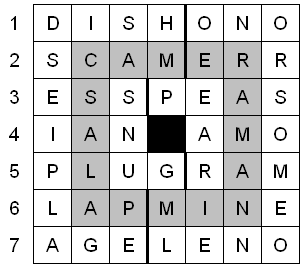 So in the first row we have DISH and (Yoko) ONO. In row two, SCAM and ERR. In row three, ESS (the letter) and PEAS. In row four, IAN and the Latin word AMO. And so on.
You’ll note that in the center row, you don’t have to figure out the dividing point between the words — it’s always the black space.
Now let’s look at the bands. This is where this puzzle type turns into a wow, for those of us who like this kind of thing.
Each band contains a set of words, entered clockwise starting from its upper-left corner.
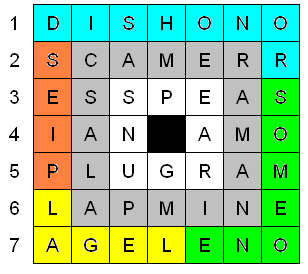 The first band contains four words: DISHONOR, SOMEONE, LEGAL, and PIES.
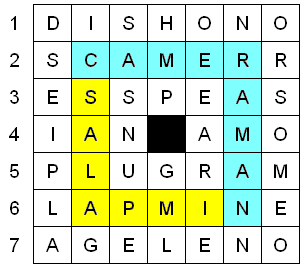 The second band contains two words: CAMERAMAN and IMPALAS.
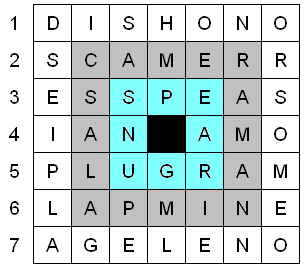 And the third band contains just one word, SPEAR GUN. Okay, a two-word phrase.
And that’s it. Words reading in two directions, with every letter used exactly twice — just like in a regular crossword. Sure, the going-around-in-circles thing takes some getting used to, and there is certainly a challenge in that you don’t always know where one word ends and the next begins. But that’s the point of variety crosswords: To provide an extra challenge for people who have grown used to the standard across-and-down grid.
Now that you know the score, try your hand at this easy 9×9 Marching Bands I’ve constructed. (The answers, should you need them — and, seriously, you shouldn’t need them — are here.) If that whets your appetite for this puzzle type, then try your hand at three different full-size puzzles by Trip Payne: One, two, and three.




 PuzzCulture