And in other news, puzzle people are sometimes known to be eccentric

This Machine Kills Secrets, by Andy Greenberg, is a look at the history of information leaks, and as such spends a fair amount of time on Julian Assange. Forbes has an excerpt with these surprising paragraphs.

…Perhaps chiefly to entertain himself during his time in college, Assange invented a game: The Puzzle Hunt. Following a model invented by MIT for its venerable Mystery Hunt, the Puzzle Hunt was an elaborate campus-wide scavenger hunt punctuated with dozens of math and logic problems that drew in hundreds of students and still takes place annually on the University of Melbourne’s campus.

One of the puzzles Assange generated for that competition—and he created more of them in his first year than any other student—involved a long quote from Shakespeare’s Julius Caesar, with each letter written backward. Seemingly random gaps appeared throughout the chunk of text, and collecting the letters following those anomalies revealed a clue for the next puzzle. Another conundrum involved factoring large numbers into primes—a procedure that would have seemed natural for anyone familiar with RSA’s public key encryption tricks.

A year after Assange left the university—he’s described quitting as a “forced move,” as in chess, “when you have to do something or you’ll lose the game”—he sent an e-mail to many of his former colleagues in the Melbourne University Math and Statistics Society asking for their participation in a new project as exciting and intellectually challenging as the Puzzle Hunt.

It was called WikiLeaks.

Tennis, anyone?

How about Pong? While waiting to cross a street in Germany?

Someone has to import this to America ASAP.

The Edited Version

Some clever but anonymous soul has been deleting letters from various movie titles, and creating a poster for each new name. Before you click through to see all of them, can you figure out the title we’ve removed from the poster below?

Hat tip: Neatorama.

A Puzzle A Day

Here’s a clever idea: A calendar you have to solve each and every day. The puzzle consists of ten tiles, which can be flipped, rotated, and overlapped to reveal the current date. Granted, you have to know the correct date in order to solve the puzzle, which somewhat goes against the very idea of a calendar, but hey: It’s a fun puzzle you can solve again and again, and that’s better than a normal calendar any day, right?

Gene-ius

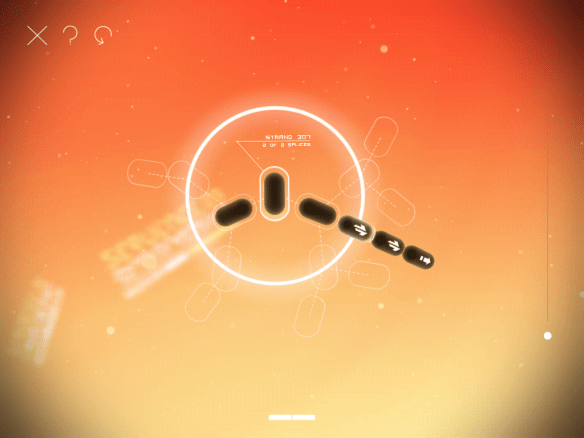
Splice is an elegant, minimalist new puzzle game, created by Cipher Prime and available for the iPad and on Steam. Each level presents you with a small number of genes, which you must organize into a precise shape. (Actually, I am not sure if these are “genes” or “microbes” or what, but only “genes” lets me use the headline pun. So it shall be.) Genes can be moved around — spliced — as long as you follow a couple of very simple rules: You only get a certain number of splices on each level, and each gene can have no more than two other genes connected to it. That’s pretty much it.

Sounds straightforward enough, but it is not always easy to predict what will happen as a result of a given splice, and making those predictions is the key to solving advanced levels. Be prepared to restart certain puzzles a few times, especially as special genes are introduced, making things even more complicated: There are genes that will mutate into two new ones, other genes that will destroy themselves and anything connected to them, and so on.

The puzzles, of course, grow increasingly devious, but it’s hard to feel tense about it when the game is this beautiful. Each level is simply presented, on a spacy mono-color background and with a calming piano soundtrack. iPad games have of late been following several tired trends — I downloaded one recently that was an exact duplicate of something I played months ago, but with different art — so it is always nice when something truly original comes along. Splice is not only original; it’s delightful, brain-crunching fun as well.