Yeah, just you wait. By the time this guy gets around to picking up a second ball, your jaw will already be on the floor.
Juggling only one ball? How is that impressive?
Reply

Yeah, just you wait. By the time this guy gets around to picking up a second ball, your jaw will already be on the floor.
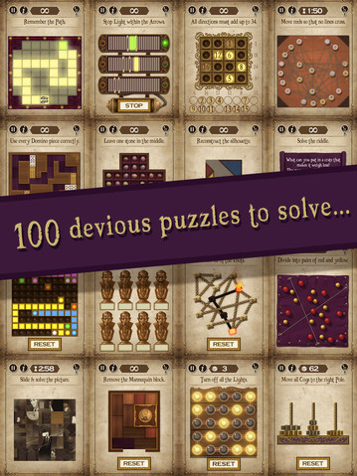 I haven’t actually played The Curse yet — I’ll be correcting that shortly — but I’m rushing to tell you about it because it’s currently (and briefly) on sale for .99, down from the original price of $4.99. A hundred puzzle chestnuts for a buck? I’m in.
The “puzzle question” has become a mainstay of job interviews. Good thing you already like puzzles, isn’t it?

Wait — this is only a conceptual bridge? Well, phooey.
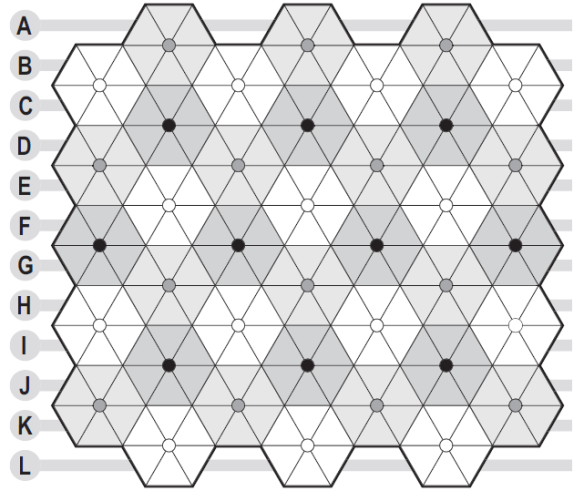
The Rows Garden is a doozy of a variety crossword invented by Patrick Berry. He puts a free one on his Web site every once in a while, and it is also frequently featured as the Wall Street Journal Saturday puzzle.
Like most variety crosswords, the Rows Garden can be intimidating if you’ve never tried one before. Just look at that grid. It’s beautiful, but kinda scary — where are the black sqares?! Or do words span those long rows from end to end? Why are the hexagons different colors? What is this?
The Rows Garden is actually a pretty easy puzzle to understand, if not to solve. Two answers will be written, one after the other, in each of the long rows. (The top and bottom rows, being shorter, get one answer each.) You’ll have to figure out where one answer ends and the next begins.
The big curveball comes with the three kinds of “blooms.” Each hexagonal shape represents a six-letter word. You don’t know which answer goes in which bloom — nor do you know in which “petal” a given answer begins. Just to add to the fun, answers can go either clockwise or counterclockwise. This flexibility allows the puzzle constructor to weave spectacularly long answers into the rows, but it makes solving a particular challenge.
Never fear! You do have one thing going for you: All of the clues for the White Bloom answers grouped together, and so are all of the Medium Bloom clues and the Dark Bloom clues.
The trick, as always with these variety puzzles, is to remember to keep your brain flexible. A row answer will provide letters for a particular bloom, and those letters might come anywhere in that bloom’s answer. For example, let’s say you determine that the first answer in row B is TRADE SECRET. That means the answer in that first white bloom contains the letters TRA. It does not mean, however, that the answer in that bloom begins with TRA. Those letters can come anywhere in the answer. Indeed, the answer here could well be RABBIT, with the RA at the start and the T at the end.
So you peruse the list of White Bloom clues, and eventually you see it: “Home decoration titan Stewart.” Aha! That would be MARTHA. When you fill the answer into the bloom, reading counter-clockwise, you then see that the first answer in row C must now begin with HAM…, and you are well on your way to solving the whole puzzle.
Somehow I feel like I haven’t made this sound less intimidating for the newbie.
Well, you’re in luck, because a fellow named Andrew Ries creates a new Rows Garden every week — and not only that, but he puts up two versions of each puzzle: Easier, and Harder. In the Easier version, you won’t have to figure out which clue matches to which bloom — that information is given to you. That’s a great way to get started on this puzzle type. And if you’ve never been to Andrew’s site before, there are 94 Rows Gardens there waiting for you. Start solving now, and in no time at all, you’ll have the puzzler’s equivalent of a green thumb.
David Kwong’s magic trick involving Scrabble is a little slow to get going — you get to watch him arrange tiles for three minutes — but puzzle lovers will be amazed at the ending.
 PuzzCulture