The above video contains a couple of naughty words, and you may be tempted to utter a few yourself as you watch in disbelief.
Juggling skills, cubed
Reply

The above video contains a couple of naughty words, and you may be tempted to utter a few yourself as you watch in disbelief.
Two interesting bits of news from the world of Across and Down:
1) Constructor Erik Agard put together a small crossword where every clue is represented by a short YouTube video, featuring a great many well-known puzzle constructors and solvers. Go solve!
2) Michael Sharp, aka crossword blogger Rex Parker, has assembled a set of brand new crosswords from folks like Merl Reagle, Liz Gorski, and Brendan Emmett Quigley. Twenty-four crosswords in all! The puzzles are free, but since this is a fundraiser for the American Red Cross, specifically to benefit victims of Hurricane Sandy, I imagine you’ll throw in a few bucks, right? Right. Suggested donation is $20. Go solve!
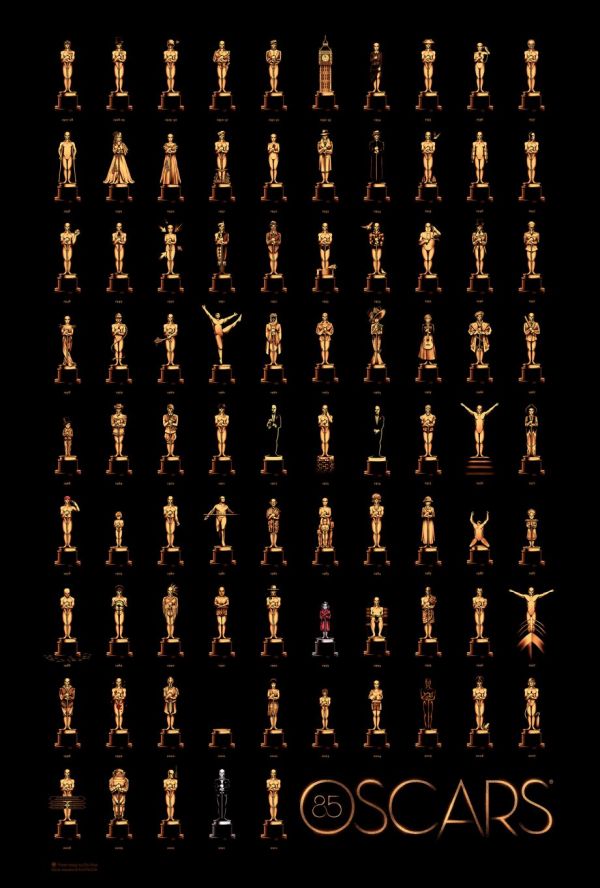 Artist Olly Moss was commissioned to produce this poster, featuring 85 Oscars, each customized to the Best Picture winner for that year. How many of the movies can you name? (Click here to enlarge the poster.)
Really. I have to imagine there are a dozen Hollywood producers all trying to make this into a project for Vince Vaughn and Ben Stiller.
If you want to work at the San Francisco-based start-up Wibidata, you’ll first have to conquer the puzzles in a series of custom-made Portal 2 levels, designed to look like Wibidata’s own offices.
Bonus link, from 2011: The Portal 2 wedding proposal.
ETAOIN SHRDLU!
If that looks like something other than gibberish to you, then you might be a puzzle person — specifically, a puzzler who has solved your share of cryptograms. (Or played PuzzleNation’s Guessworks.) Those twelve letters are the most commonly used in the English language… or so it was widely thought for a very long time.
The original frequency list was put together by a researcher named Mark Mayzner back in 1965. The English language has surely drifted around a bit in the last fifty years — perhaps it was time to revise the list. Furthermore, computing power has improved somewhat since the mid-sixties. Mayzner’s famous list was based on just 20,000 words; a new look would obviously cast a much wider net.
And that is why Mayzner, now 85 years old, contacted Peter Norvig of Google. Using Google Books and the research tool Ngrams, Norvig redid Mayner’s work, but on a grand scale, analyzing 97,565 distinct words, which were collectively used in books over 743 billion times. That breaks down to over 3.5 trillion letters. Norvig sorted them for frequency and — whoa! We have a new list!
ETAOIN SRHLDCU!
Mayzner’s low-tech effort holds up pretty well — we don’t see any variation for the first seven letters. After that, things change a little: I always suspected R was getting short shrift compared to H. I’m not too surprised to see L edge out D, either. And U must be bummed to have slipped a place. “I’m a vowel!” you hear him cry. “I’m just as important as E or A! Do you hear me?!”
Peter Norvig’s full report, with lots more fascinating trivia about letter and word usage, can be read here.
Update: The original frequency list apparently pre-dates Mayzner.
 PuzzCulture