If you like tricky logic puzzles and also donating to worthy charities, check out Grant Fikes new puzzle contest. (Thanks to Tyler Hinman for the pointer.)
It’s only logical
Reply

If you like tricky logic puzzles and also donating to worthy charities, check out Grant Fikes new puzzle contest. (Thanks to Tyler Hinman for the pointer.)
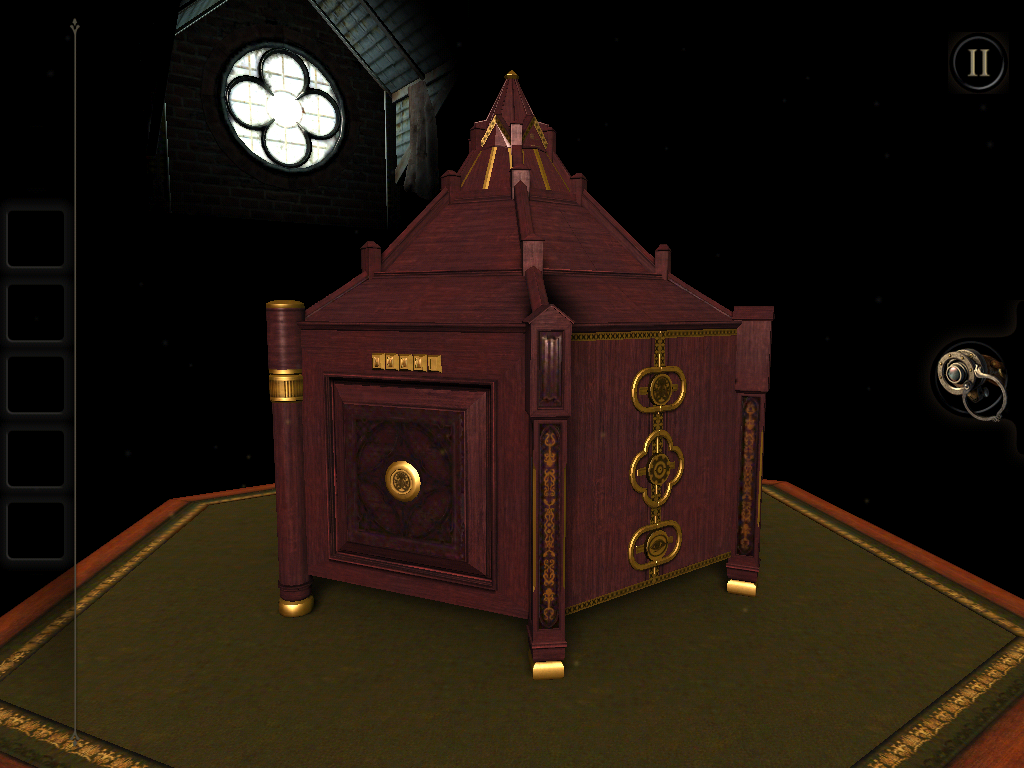
Does anybody not love puzzle boxes? Who can fail to be fascinated by a simple-looking box that reveals itself to have sliding panels and secret hinges? I own one, a cheap and mass-produced thing, that I nonetheless adore. It takes seven clever moves to open it, and I have yet to give it to anybody who simply tossed it aside with disinterest. Once a puzzle box is in your hands, you have to try to open it. It’s just human nature.
My cheapo puzzle box is nothing compared to what you’ll face in The Room, an iPad app from Fireproof Games. Puzzles boxes like those presented in the game would cost heaven-knows-what if they existed in real life. The Room gives them to you on the compact screen of your iPad, and lets you manipulate them to your heart’s content: You’ll spin the knobs, pull the levels, find the secret keys (and then figure out where they go), discover the secret panels, and, best of all, solve the puzzles. Oh, there’s a backstory — you’re following in the footsteps of a scientist who discovered some mysterious new element — but this is beside the point, as are the supposedly creepy atmospherics. Really, you’re trying to open the box because how can you not? The box has secrets; you want to discover them. It’s just that simple.
The controls are wonderfully intuitive — you can examine the boxes by spinning them around, zooming in when you find something worth exploring. It actually feels like these boxes exist in a room somewhere, and you are manipulating them remotely. The art is luxuriously beautiful. All of this combines to make a game worth savoring.
Savoring it is difficult, alas, because the one drawback to The Room is its rather short length: There are just four distinct levels, and that includes the opening tutorial. A few reviews in the App Store complain that they beat the whole game in an hour or so. I spread it out over a few days and feel more-or-less satisfied with my purchase, but if you feel that a $4.99 price should get you a game of epic length, you are bound to come away at least a little disappointed. Nonetheless, The Room is elegant, original, and gorgeous — I say those adjectives make the game worth the price.
Ken Jennings — yes, the well-known Jeopardy! champ — is collaborating with Smithsonian magazine on “The Great American History Puzzle.” This great big puzzle hunt will begin in the October issue of the magazine (you can download a free PDF here) and then leap out on to the Internet: Solving the codes and puzzles in the magazine will get you the password you’ll need to access this Web site. On October 1st, the first of ten challenging puzzles will appear on the site. Save your answers to the first nine puzzles — you’ll need them for the big finish. The first person to e-mail the correct answer to that final puzzle (it will be available on October 22nd) will win a trip for four people to Washington, D.C. plus a behind-the-scenes tour of the Smithsonian.
Serious solvers will want to keep an eye on the contest page — Ken will be blogging there, and might just offer a hint or two as the contest progresses. And just in general I highly recommend Ken’s own excellent blog.
Made of stone? Then I guess I’m not buying this for my front windows.
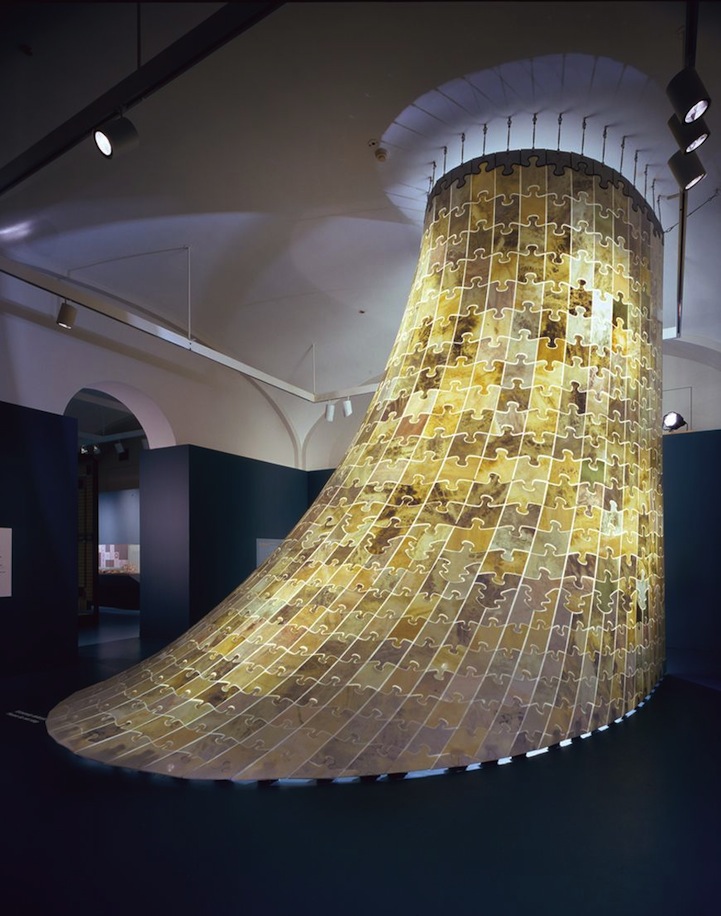
Marble Curtain is an installation at the Smithsonian’s National Building Museum. More pics at the link, including one that emphasizes how amazingly thin this marble curtain is.
(Hat tip: Neatorama.)
Crossword constructor Merl Reagle, working with the Alzheimer’s Foundation of America, is presenting the National Brain Game Challenge on September 30th at 3:00 p.m. Eastern time. Registration is $25 (benefiting the AFA, of course), and if you can complete the contest crossword super-fast, and then find the sure-to-be-devious hidden answer, you stand a chance to win up to $2,500.
This is the second year for this contest, and this time around they’re dividing up the contestants into two groups: “Professionals” (people who create puzzles or have won previous crossword tournaments) and “public” (everybody else). So there’s no reason to sit out because you fear getting trounced by crossword experts — those folks will be in their own division. Plus, the money is for a good cause. Plus Merl Reagle makes truly excellent and entertaining puzzles that are worth the price of admission even if you don’t win.
If you take part — good luck and speedy solving!
Puzzler and mathematician Eric Harshberger has created a fascinating set of dice.
When two or more people roll a die each in order to see who scores highest – what you do, for example, when deciding who goes first in a board game – there is always the chance of a tie.
In the event of a tie, of course, you roll again.
But then there is still the chance of a tie. And this can go on ad infinitum.
In other words, the process is not as efficient as it could be. Eric wondered if he could come up with a set of fair dice such that one roll of each die is enough to establish an absolute winner.
I’m not sure if the result of Eric’s thinking will save gamers “hours and hours” of time, as the article above claims, but his Go First dice are definitely cool, in the nerdiest possible way. You can roll two, three, or four of the dice, and there will never be a tie, and each player has an equal chance of rolling the highest number. You can see the Go First dice — and oodles of other specialty dice, all of which are for sale — at Eric’s Web site. (This one is my favorite.)
 PuzzCulture