Last Call For Boswords

Boswords, the crossword competition that started in Boston but is now held online four times a year, is back with its Fall Themeless League! If you want a great themeless crossword every week, and furthermore want to see how you stack up against other crossword lovers, jump over to the Boswords site and sign up quick — the first puzzle of the weekly tournament will be released this coming Monday, October 3. (You don’t have to solve the puzzle that very day; just find time to sit with at some point during the week.)

As with previous iterations of the league, when you register, you choose which of three difficulty levels is best for you — Smooth, Choppy, or Stormy. (Boston is a port town.) The answers in the grids are the same for each puzzle, but the clues are not: Smooth means you’ll face a Tuesday level of difficulty, according to the New York Times difficulty scale. Choppy means Friday-level clues. And Stormy is “harder than a Saturday,” so yikes. (If you discover partway through the tournament that you have mis-ranked yourself, you can switch difficulty levels; just ask.)

Furthermore, you don’t have to go it alone: Boswords embraces a trend seen at other independent tournaments — Pairs solving! If you think you’ll need help with those Stormy-level clues, grab your friend, spouse, or significant other and discover the joys of co-solving.

All the puzzles are solved via your computer and timed automatically, and the ongoing scores are updated weekly. In the final week, there is a Championship puzzle, and the winner is thereby crowned. But even if you have no hope of coming out on top, it’s fun to see how far up the ladder you can climb — and then see if you can top that next time.

To emphasize: If this all sounds like fun, there are only a few days left to register before the first puzzle is released, so get moving!

The Hardest Puzzle Ever (by far)

As part of his exploration of the world of puzzles for his excellent book The Puzzler, author A.J. Jacobs set out on a rather quirky mission: He wanted to commission the world’s most challenging puzzle. The job ultimately went to puzzle constructing legend Oskar van Deventer, and the result is a device called the Jacobs’ Ladder.

How difficult is this puzzle? Let’s back up a moment.

Did you ever download a puzzle app for your phone or tablet, and find that you are encouraged not only to solve each level but to do so in a minimum number of moves? Yes, you can slide the doohickey into the whatever, avoiding all the traps along the way, but can you do it in six moves or less? The 6 sits in the upper corner of the screen, mocking you. You solved the level in eight moves. Do you move on? If you are me: Heck, no. You reset the level and try to find an improved solution.

Similarly, there are classic puzzle games like the Tower of Hanoi, where you have to move all of the discs from one peg to another, always keeping smaller discs on top of larger ones. These games have been the subject of much mathematical analysis — it is reasonably well-known that a three-disc version of Tower of Hanoi can be solved in seven moves. A four-disc game can be solved in fifteen moves. If you have five discs, you’ll need 31 moves. That’s if you take the most direct route, of course. Make a wrong turn and the puzzle might take you far longer.

You might suppose that a Rubik’s Cube would take longer to solve than a five-disc Tower of Hanoi, but you would be wrong. Back in 2010, computer scientists figured out that no matter how scrambled your cube is to start, you can get it to a solved position in a minimum of 20 moves.

The very hardest puzzles, of course, have a much higher number of minimum moves. Before the Jacobs’ Ladder was created, the acknowledged contender for the record was a Chinese ring puzzle with 65 rings, owned by collector Jerry Slocum: Solving it perfectly will take you a full 18,446,744,073,709,551,616 moves. As Slocum notes in this New York Times article, at one move per second, that would take about 56 billion years. But, you know. By moving faster maybe you could cut that time in half.

So Slocum’s puzzle takes longer to solve than the age of the universe, but Jacobs’ Ladder beats it somehow? Indeed it does. The goal of Jacobs’ Ladder is to get a corkscrew-type thingie from the bottom of the device all the way to the top, traversing a number of pegs along the way. This will require you (if you take the shortest possible route) to make 1,298,074,214,633,706,907,132,624,082,305,023 moves. That’s over a decillion moves, and needless to say it leaves Slocum’s 18 quintillion moves in the dust. I can’t improve on Oskar van Deventer’s own description of just how long this is, so let’s break out the quote box, from this article by A.J. Jacobs in the Atlantic:

Oskar did some delightfully nerdy calculations on just how long it would take to solve this puzzle. If you were to twist one peg per second, he explained, the puzzle would take about 40 septillion years. By the time you solved it, the sun would have long ago destroyed the Earth and burned out. In fact, all light in the universe would have been extinguished. Only black holes would remain. Moreover, Oskar said, if only one atom were to rub off due to friction for each move, it would erode before you could solve it.

You might wonder what the point is of a puzzle that, at the end of the day, can’t really be solved. Well, in the above-linked article, Jacobs points to the enjoyable meditative aspect of sitting and turning the pegs, embarking on a slow, slow journey down the solving path. Fair enough. The puzzle is also a physical encapsulation of how hard it is for humans to envision enormous numbers. You can hold it in your hands and try to get your brain around the concept of 40 septillion years.

But for sheer solving pleasure, I think I’m going to stick to this app on my phone. Surely this time I’ll figure out how to beat this level in a mere six moves.

Ever So Logical

Sudoku has become such a mainstay puzzle, a common find in newspapers and magazines, that it’s easy to forget that it wasn’t always this way. While Sudoku got its start as Number Place in the pages of Dell Magazines back in the late 1970s, it wasn’t until mid-2006 that the logic puzzle became an all-consuming worldwide fad, blowing up in a way no puzzle had since the crossword in the 1920s.

The fad has subsided a bit, but Sudoku is still with us, exercising the minds of millions of solvers. But for lovers of logic puzzles, Sudoku’s greatest impact is in how it inspired dozens if not hundreds of related puzzles, all with their own devious rules. If you love Sudoku but have wondered now and again what else there might be for you out there, read on.

A great place to start is at the blog of Grandmaster Puzzles, where Thomas Snyder and his crew of constructors post a new logic puzzle six days a week. It’s a great place to start, that is, if you can overcome the intimidation factor, which is significant. Take a look at that menu of puzzle types on the left! What are all those? Statue Park? Cross the Streams? Kakuro, Kurotto, Kuromasu?

Deep breaths. We’re going to give you a few good places to start, and then if you like what you see, you can branch out from there.

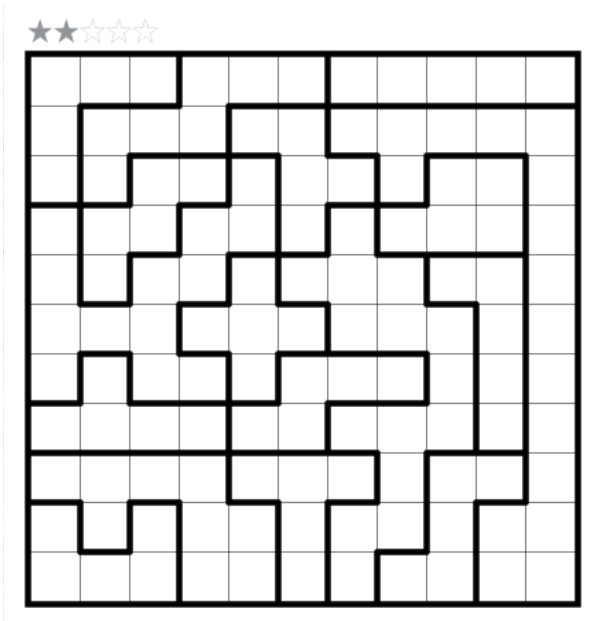
Star Battle: As simple to grasp as a logic puzzle gets, which is why you’ll sometimes see this type in other venues, notably in the New York Times under the (bizarre) name of “Two Not Touch.” All you need to do is place some number of stars (usually two) in every row, every column, and each bordered region so that stars are never right next to each other, even diagonally. Here are Grandmaster Puzzles’s easiest Star Battle puzzles, an excellent place to get started.

Fillomino: A step up in trickiness, but still a good type for newbies. You’ll need to divide up a Fillomino grid into irregularly shaped regions according to the following few rules: First, the area of each region must be equal to the numbers within it — so, for example, a region of three cells has to contain three 3s. (You’ll never have a region with different digits within it.) Second, no two regions of the same size may share an edge. Third… there is no third. That’s it, those are the two rules. See?

One thing newcomers to this puzzle type need to watch out for: Not every region in a completed puzzle will encompass one of the numbers given to you at the start. You might have a “hidden” region that is only logically revealed as you figure out the regions around it. Once you’re prepared for that possibility, though, this puzzle is reasonably straightforward. Here are the easiest Grandmaster Filliominos.

LITS: Looks a lot like Star Battle, right? Sure. But this time around you’re not placing stars. Instead, you will shade in exactly four spaces in each region, so that when you’re done, all of the shaded cells make a connected path through the grid. (That is, you can reach any shaded cell from any other shaded cell.)

There are only four shapes you can make with shaded cells: L, I, T, and S. (Hey, I think I figured out where this puzzle’s name comes from!) In the completed grid, no two shapes of the same type can share an edge. Also, no four shaded cells can form a 2×2 square. Those extra rules will definitely give you pause as you go about filling a grid. Try some easy LITS puzzles here.

Masyu: We’ll conclude with a slightly trickier puzzle to grasp — but only slightly. In Masyu, you’ll draw a loop that goes through some number of cells in the grid (not necessarily every cell). The white circles and the black circles obey different rules:

Black Circles: The path must turn here, and then the path must not turn in either adjacent cell.

White Circles: The path must go straight through these circles without turning. Also the path must turn in the cell just before and/or just after a white circle.

Not a ton of rules, but they can be a little confusing for the newbie. Still, this is a satisfying type. Try some easy examples here.

————————————————————-

Nobody is going to enjoy every logic puzzle type. I personally will wave away all attempts to get me to solve the math-oriented Kakuro — even though I enjoy both TomTom (an improvement on KenKen) and Japanese Sums, both of which are also math-based. Why? Who knows? We are what we are. So go explore the puzzle types above and then dive into Grandmaster’s full list of logic types. Your next favorite puzzle is in there somewhere.

It’s Puzzletember!

The Curious Correspondence Club creates all manner of unusual, immersive puzzle experiences — a bit like if escape rooms could fit in your mailbox. These folks love puzzles, and as such, for the past few years they have decided that the month we are now in should be called Puzzletember. And what better way to celebrate Puzzletember than by turning the spotlight on a different online puzzle company for each day of the month? They’ve gotten thirty different puzzlemakers (full disclosure: your friendly PuzzleNation correspondent is one of them) to create an Instagram-friendly puzzle. Already we have seen offerings from Puzzling Pursuits, Gruzzle, the German company EscapeWelt, and Edaqa’s Room.

If you solve the daily puzzle and submit your answer, you might win a prize. But even if you don’t win, you’ll discover thirty different new places to add to your puzzle checklist, and that’s pretty good all by itself. Follow along with Puzzletember here!